
Courts, Drostdys & Magisterial Residencies
Quote from Steve on September 26, 2026, 10:14 amClerke Burton, Master of the Supreme Court
Collectors of early British Cape colonial mail will be familiar with some of the many letters addressed to Clerke Burton of the Supreme Court, Cape Town. These very largely came out of the Cape Archives under the questionable advice of A. A. Jurgens RDPSA. It was not until I read Adele Keen's 'Under Devil's Peak' (1990 revised 2023) about some of the old houses and the people who lived in them in the Mowbray, Rosebank and Rondebosch area that I realised that 'Clerke' was a first name, not an olde worlde job title.
Circa 1830. Wrapper. CALEDON POST PAID 5d to CAPE TOWN.
Marked by the dispatching postmaster 'paid 5'. Dispatched with CALEDON CiC Town Handstamp.
Received and stamped in Cape Town 'POST PAID'.
The POST PAID handstamp was introduced in 1827 and was 'exclusive (Goldblatt) to Cape Town's GPO.
Circa 1830. Wrapper. POST PAID 1/- to CAPE TOWN.
Marked by the dispatching postmaster 'Pd 1/-'. Received and stamped in Cape Town 'POST PAID'.Francis Clerke Burton was a prominent colonial judicial official who served as the Master of the Supreme Court of the Cape of Good Hope (Cape Colony), then based in the Old Slave Lodge which was also the headquarteres of the Cape Post Office. Clerke was appointed Master of the Supreme Court in 1828 following its establishment under the first Charter of Justice. His primary responsibilities as Master involved overseeing the administration of deceased estates, safeguarding the affairs of minors and insolvent estates within the colony. He was active in this role during the 1830s and 1840s until his death in 1848.
1845. WRAPPER. UNKNOWN PO to CAPE TOWN. POST PAID 1/-10d to CAPE TOWN.
A pencilled inner manuscript annotation typical of A. A. Jurgens states '1845'.Burton married Catherine Becker who had inherited the house Wolmunster from her father. However, they could not possess it because of threatened insolvency. Burton had to buy his wife's inheritance for ₤2 000 to save the estate from going bankrupt. He took possesion of Wolmunster House in 1844. Burton was the brother of William Westbrooke Burton, Judge of the Supreme Court of the Cape Colony, who owned the house “Westbrooke” (now the State President’s country residence). Clerke Burton was the grandfather of Henry Burton, who became Minister of Finance in the first Union Cabinet. He was responsible for 'austerity bread' which was produced during the First World War, known as “Burton’s Loaf” (Dictionary of South African Biography.)
Clerke Burton did not live for very many years at Wolmunster. Probably for financial reasons the house was let and the Burtons moved to Rose Street, Mowbray. They had a second house, Lochlands at Zeekoe Vlei, where they kept a sailing boat and a couple of dinghies. In 1848 Clerke Burton died and in 1849 his estate was found to be insolvent. The house and its grounds had to be sold. The new purchaser, Alexander McDonald, divided and sold the property in lots in 1852. The Wolmunster House lot was bought by William Porter, “Attorney-General of this Colony” (with buildings thereon), for ₤1,750.
Clerke Burton, Master of the Supreme Court
Collectors of early British Cape colonial mail will be familiar with some of the many letters addressed to Clerke Burton of the Supreme Court, Cape Town. These very largely came out of the Cape Archives under the questionable advice of A. A. Jurgens RDPSA. It was not until I read Adele Keen's 'Under Devil's Peak' (1990 revised 2023) about some of the old houses and the people who lived in them in the Mowbray, Rosebank and Rondebosch area that I realised that 'Clerke' was a first name, not an olde worlde job title.
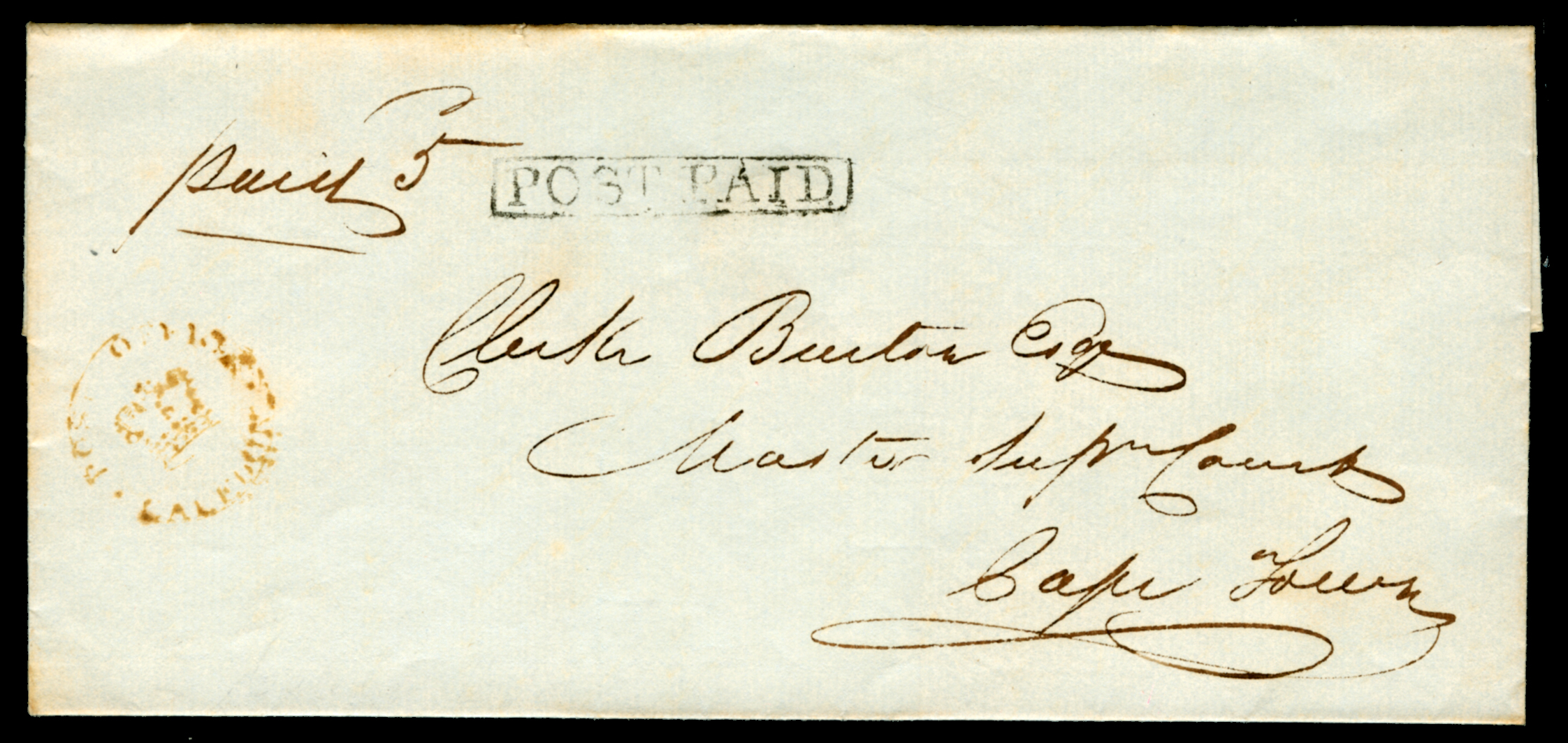
Circa 1830. Wrapper. CALEDON POST PAID 5d to CAPE TOWN.
Marked by the dispatching postmaster 'paid 5'. Dispatched with CALEDON CiC Town Handstamp.
Received and stamped in Cape Town 'POST PAID'.
The POST PAID handstamp was introduced in 1827 and was 'exclusive (Goldblatt) to Cape Town's GPO.
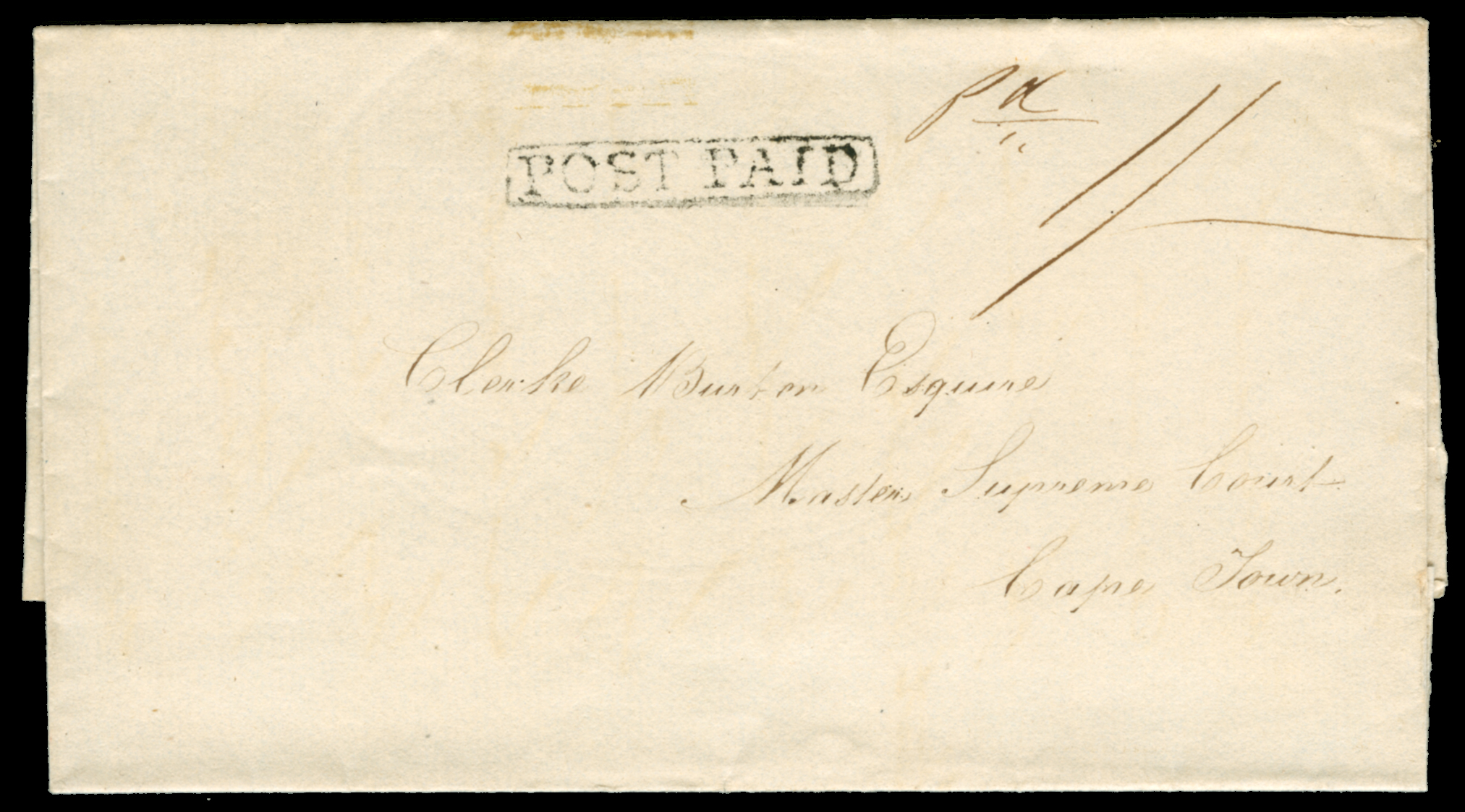
Circa 1830. Wrapper. POST PAID 1/- to CAPE TOWN.
Marked by the dispatching postmaster 'Pd 1/-'. Received and stamped in Cape Town 'POST PAID'.
Francis Clerke Burton was a prominent colonial judicial official who served as the Master of the Supreme Court of the Cape of Good Hope (Cape Colony), then based in the Old Slave Lodge which was also the headquarteres of the Cape Post Office. Clerke was appointed Master of the Supreme Court in 1828 following its establishment under the first Charter of Justice. His primary responsibilities as Master involved overseeing the administration of deceased estates, safeguarding the affairs of minors and insolvent estates within the colony. He was active in this role during the 1830s and 1840s until his death in 1848.
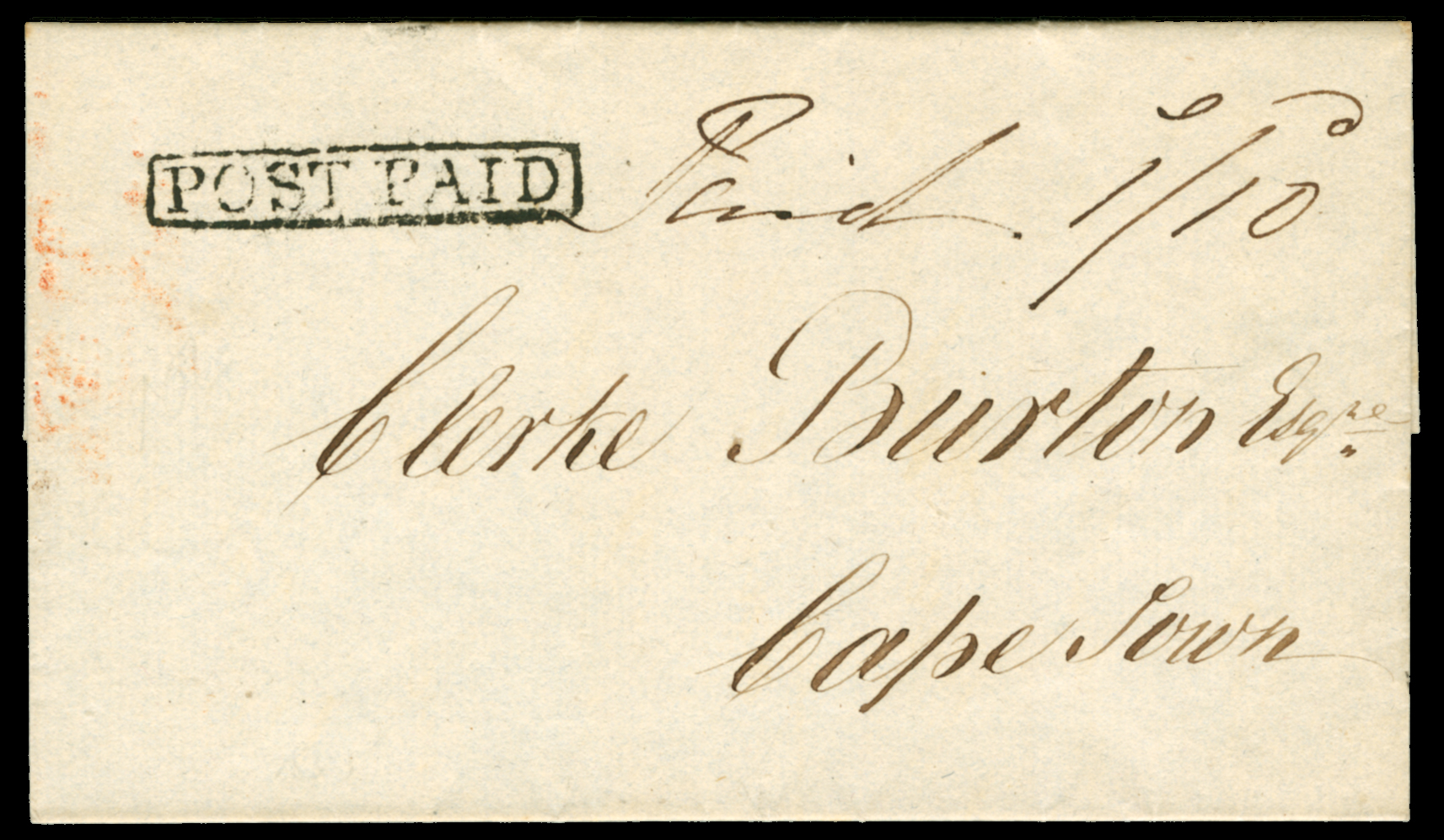
1845. WRAPPER. UNKNOWN PO to CAPE TOWN. POST PAID 1/-10d to CAPE TOWN.
A pencilled inner manuscript annotation typical of A. A. Jurgens states '1845'.
Burton married Catherine Becker who had inherited the house Wolmunster from her father. However, they could not possess it because of threatened insolvency. Burton had to buy his wife's inheritance for ₤2 000 to save the estate from going bankrupt. He took possesion of Wolmunster House in 1844. Burton was the brother of William Westbrooke Burton, Judge of the Supreme Court of the Cape Colony, who owned the house “Westbrooke” (now the State President’s country residence). Clerke Burton was the grandfather of Henry Burton, who became Minister of Finance in the first Union Cabinet. He was responsible for 'austerity bread' which was produced during the First World War, known as “Burton’s Loaf” (Dictionary of South African Biography.)
Clerke Burton did not live for very many years at Wolmunster. Probably for financial reasons the house was let and the Burtons moved to Rose Street, Mowbray. They had a second house, Lochlands at Zeekoe Vlei, where they kept a sailing boat and a couple of dinghies. In 1848 Clerke Burton died and in 1849 his estate was found to be insolvent. The house and its grounds had to be sold. The new purchaser, Alexander McDonald, divided and sold the property in lots in 1852. The Wolmunster House lot was bought by William Porter, “Attorney-General of this Colony” (with buildings thereon), for ₤1,750.