
Fakes, Forgeries & Jurgensiana
Quote from Steve on January 16, 2026, 10:46 amJurgens at Work in the Archives
While browsing through old back issues of the SAP (SA Philatelist) I discovered an interesting article in Afrikaans, published in the days when there were almost as many Afrikaans articles as there were English ones. This annoyed English subscribers, especially those in England and elsewhere who did not enjoy the one great benefit of a South African Christian National education - the ability to read and speak Afrikaans. As a result there were many complaints in Letters to the Editor. The SAP has almost no articles in Afrikaans today.
To help English-speakers who are unable to read Afrikaans I have translated the article that I found, 'Archival light on Jurgens', (D. W. KRYNAUW, SAP, issue and date misplaced), for your edification and delight. It throws a little more light on the activities and or the 'modus operandi' of A A Jurgens in the Cape Archives. It describes his relationship with often awed staff members and describes how Jurgens worked through the Cape archival records with official permission and without any supervision.
D. W. (David Wilhelm) Krynauw, 1916-2001, was an archivist and author who specialized in South African history and heritage. He was a prolific writer and a respected archivist who worked in several locations across South Africa and South West Africa (Namibia). His work focused on uncovering historical details from archival records. This article result ftom a radio talk by the SAP editor. Krynauw contacted the editor and shared some of his recollections of Jurgens, part of which is of particular interest for the philatelic record
The article begins by describing Krynauw asw "a retired archivist (years of service 1937–1970). His acquaintance with A. A. Jurgens, RDPSA, dates back to the time when, as an MA student, he performed auxiliary duties at the Cape Archives Repository, before being appointed there in 1937. In 1948 he returned to work at the Cape Archives. In 1953, following Jurgens’s death, the Archive was invited to inspect Jurgens’s possessions prior to an auction. Krynauw was delegated to go and have a look. The author’s recollections in this regard have been edited with his permission for The SA Philatelist. They should be read together with the articles that appeared in The SA Philatelist in 1976, pp. 33, 182 and 253; and 1979, p. 299." I find it worrying that the SAP needed to edit any of this.
I translated this article into English using AI (ChatGPT). It was quickly and simply done with, I believe, accuracy.
****
"When I began working at the Archives in 1937, I sometimes went into the semi-underground document room where documents dating from the earliest years of the old Company days were stored. On those occasions I noticed an elderly gentleman in a white coat standing among the shelves—usually with one of the document bundles in his hands.
Because the rest of us also wore white coats to protect our clothing, I assumed that the gentleman was simply another member of staff whom I had not yet met, and therefore paid him no further attention. Even later, when I did find out who he was and what he was busy with there, it still did not trouble me. In my ignorance I assumed that he must surely have had permission to leaf through the documents in order to look at the old seals. In this way it would have been unnecessary for almost the entire contents of the archives to be carried to the reading room for him.
Thus I made the acquaintance of the well-known Cape Town philatelist A. A. Jurgens, and saw how he systematically worked through the Cape archival records - with official permission and without any supervision.
Over the years I built up a layman’s knowledge of postage stamps, and eventually also knew that the elderly gentleman in the white coat’s large stamp collection had been purchased by the state for a considerable sum, and was on display in the South African Cultural History Museum in Cape Town - not far from the Archives. I also went to acquaint myself with it there during a visit from Pretoria, and again later when I was back at the Cape Archives in 1948.
It was an impressive collection, that of old Jurgens, and more and more I realised that my own knowledge of stamps was rather limited.
However, I did have more knowledge of another part of the collection, namely that section containing the original signatures of the old Cape governors, beginning with that of Van Riebeeck (who did not yet have that title), and all his successors, because these I could easily recognise.
It was this aspect of the entire collection that began to trouble me. How had that collection come into being? Where could old Jurgens have obtained those original signatures? These had originally appeared only on the official documents of the time, and those were not scattered all over the world - although supervision over them was initially probably not as strict as it should have been.
As I already half-knew the story of the old Cape documents at that time, they were first kept in the old Castle, then later in the basement rooms of Parliament, and only later transferred to the Archive building, I began to have uneasy thoughts. If old Jurgens had access to the material in 1937 - as I myself had witnessed - had he perhaps also had access to it earlier, there in the Castle and in Parliament?
And then it became 1953. On 11th July of that year old Jurgens passed away, and a few days later a certain J. C. Silvie, apparently a friend of the Jurgens family and now also apparently the executor of his late friend’s estate, phoned the Cape Archives:
“On that very same day an auction will take place of the deceased’s possessions, and there are some items that should certainly find a home in the Archives. Could the Archives not send someone to come and look at the items and select them before the auction begins?"
I no longer remember who received the call, but I was given the instruction to go and look at the items and select what was needed. Silvie (a well-known philatelic dealer at the time) and I had to work quickly because the auction could begin at any moment.
It very quickly became clear to me that the items I now had to inspect which might be of use to the Archives were photographic material - enlarged photographs, some of which I immediately recognised as the work of Arthur Elliott, as well as negatives (also glass, like Elliott’s) and lantern slides used to project an image onto a screen.
In March 1958, when I had already been transferred to Windhoek, I received an enquiry from the head office. According to Silvie, in 1953, when I was serving at the Cape Archives, certain items of historical importance were handed to me at an auction of the estate of a well-known Cape personality, Mr Jurgens, as a donation to the Archives. Some of these articles belonged to Mr Silvie himself and were to be returned to him after the Archives had made use of them, but this had never been done. Could I perhaps shed any light on the matter?
I was fortunate to come across a copy of my reply to Pretoria regarding Silvie’s claims, and would like to add it here. Because it was written only five years after the events, it will probably be a more accurate account than I could give today. It read, among other things, as follows:
“… I must inform you that I cannot recall Mr Silvie having any claim to any of the items in the collection. In my negotiations with him I would at most have promised him a copy of any list that we might later compile of the collection. I would not wish to cast doubt on Mr Silvie’s claim, whatever it may be. It was only through his actions that we became aware of the items. If he can, however, be more specific, it will hopefully help to refresh my memory.” And with this reply to Pretoria the entire matter, as far as I was concerned, was concluded, and I did not trouble myself much further about it.
Whether Silvie is still alive I do not know (no, deceased, Ed.), but that day the two of us found something among the estate of old Jurgens. Silvie did not recognise it immediately, but I did - and only because I had already dealt with a similar item in our own display cases at the Archives. It was a metal stamp (in English, a “die”), like those used for a coat of arms or a family crest. But what we were looking at was a cutting block of an old Cape triangular stamp. In our ignorance we simultaneously had uneasy thoughts:What was such a block used for? No, we did not know, and both of us were too afraid to voice an opinion.
My thoughts, however, were more or less as follows: Was that block used to show potential buyers of such triangular stamps elsewhere what such a stamp looked like - or was it used to produce the genuine article itself? But my knowledge of philatelic practices was limited, as was my technical knowledge of a possible forger’s skills. And we looked at one another in silence—each too afraid to be the first to venture something. Then I ventured it: “It might be so, but I really don’t know.” And he said the same, and I added: “If that is the case, I will keep quiet. And I do not want to, and will not, accept it into the collection.”
Silvie said thank you, and promised to keep quiet as well—and to take care of what was necessary regarding the stamp. And then it was time for the auction to begin."
END OF SAP ARTICLE
This is most unsatisfactory. It raises more questions than it provides answers. The SAP is certainly not going to win an award for philatelic investigative reporting. Sadly, South African philately's Jurgens imbroglio remains a mess wrapped within a muddle.
Jurgens at Work in the Archives
While browsing through old back issues of the SAP (SA Philatelist) I discovered an interesting article in Afrikaans, published in the days when there were almost as many Afrikaans articles as there were English ones. This annoyed English subscribers, especially those in England and elsewhere who did not enjoy the one great benefit of a South African Christian National education - the ability to read and speak Afrikaans. As a result there were many complaints in Letters to the Editor. The SAP has almost no articles in Afrikaans today.
To help English-speakers who are unable to read Afrikaans I have translated the article that I found, 'Archival light on Jurgens', (D. W. KRYNAUW, SAP, issue and date misplaced), for your edification and delight. It throws a little more light on the activities and or the 'modus operandi' of A A Jurgens in the Cape Archives. It describes his relationship with often awed staff members and describes how Jurgens worked through the Cape archival records with official permission and without any supervision.
D. W. (David Wilhelm) Krynauw, 1916-2001, was an archivist and author who specialized in South African history and heritage. He was a prolific writer and a respected archivist who worked in several locations across South Africa and South West Africa (Namibia). His work focused on uncovering historical details from archival records. This article result ftom a radio talk by the SAP editor. Krynauw contacted the editor and shared some of his recollections of Jurgens, part of which is of particular interest for the philatelic record
The article begins by describing Krynauw asw "a retired archivist (years of service 1937–1970). His acquaintance with A. A. Jurgens, RDPSA, dates back to the time when, as an MA student, he performed auxiliary duties at the Cape Archives Repository, before being appointed there in 1937. In 1948 he returned to work at the Cape Archives. In 1953, following Jurgens’s death, the Archive was invited to inspect Jurgens’s possessions prior to an auction. Krynauw was delegated to go and have a look. The author’s recollections in this regard have been edited with his permission for The SA Philatelist. They should be read together with the articles that appeared in The SA Philatelist in 1976, pp. 33, 182 and 253; and 1979, p. 299." I find it worrying that the SAP needed to edit any of this.
I translated this article into English using AI (ChatGPT). It was quickly and simply done with, I believe, accuracy.
****
"When I began working at the Archives in 1937, I sometimes went into the semi-underground document room where documents dating from the earliest years of the old Company days were stored. On those occasions I noticed an elderly gentleman in a white coat standing among the shelves—usually with one of the document bundles in his hands.
Because the rest of us also wore white coats to protect our clothing, I assumed that the gentleman was simply another member of staff whom I had not yet met, and therefore paid him no further attention. Even later, when I did find out who he was and what he was busy with there, it still did not trouble me. In my ignorance I assumed that he must surely have had permission to leaf through the documents in order to look at the old seals. In this way it would have been unnecessary for almost the entire contents of the archives to be carried to the reading room for him.
Thus I made the acquaintance of the well-known Cape Town philatelist A. A. Jurgens, and saw how he systematically worked through the Cape archival records - with official permission and without any supervision.
Over the years I built up a layman’s knowledge of postage stamps, and eventually also knew that the elderly gentleman in the white coat’s large stamp collection had been purchased by the state for a considerable sum, and was on display in the South African Cultural History Museum in Cape Town - not far from the Archives. I also went to acquaint myself with it there during a visit from Pretoria, and again later when I was back at the Cape Archives in 1948.
It was an impressive collection, that of old Jurgens, and more and more I realised that my own knowledge of stamps was rather limited.
However, I did have more knowledge of another part of the collection, namely that section containing the original signatures of the old Cape governors, beginning with that of Van Riebeeck (who did not yet have that title), and all his successors, because these I could easily recognise.
It was this aspect of the entire collection that began to trouble me. How had that collection come into being? Where could old Jurgens have obtained those original signatures? These had originally appeared only on the official documents of the time, and those were not scattered all over the world - although supervision over them was initially probably not as strict as it should have been.
As I already half-knew the story of the old Cape documents at that time, they were first kept in the old Castle, then later in the basement rooms of Parliament, and only later transferred to the Archive building, I began to have uneasy thoughts. If old Jurgens had access to the material in 1937 - as I myself had witnessed - had he perhaps also had access to it earlier, there in the Castle and in Parliament?
And then it became 1953. On 11th July of that year old Jurgens passed away, and a few days later a certain J. C. Silvie, apparently a friend of the Jurgens family and now also apparently the executor of his late friend’s estate, phoned the Cape Archives:
“On that very same day an auction will take place of the deceased’s possessions, and there are some items that should certainly find a home in the Archives. Could the Archives not send someone to come and look at the items and select them before the auction begins?"
I no longer remember who received the call, but I was given the instruction to go and look at the items and select what was needed. Silvie (a well-known philatelic dealer at the time) and I had to work quickly because the auction could begin at any moment.
It very quickly became clear to me that the items I now had to inspect which might be of use to the Archives were photographic material - enlarged photographs, some of which I immediately recognised as the work of Arthur Elliott, as well as negatives (also glass, like Elliott’s) and lantern slides used to project an image onto a screen.
In March 1958, when I had already been transferred to Windhoek, I received an enquiry from the head office. According to Silvie, in 1953, when I was serving at the Cape Archives, certain items of historical importance were handed to me at an auction of the estate of a well-known Cape personality, Mr Jurgens, as a donation to the Archives. Some of these articles belonged to Mr Silvie himself and were to be returned to him after the Archives had made use of them, but this had never been done. Could I perhaps shed any light on the matter?
I was fortunate to come across a copy of my reply to Pretoria regarding Silvie’s claims, and would like to add it here. Because it was written only five years after the events, it will probably be a more accurate account than I could give today. It read, among other things, as follows:
“… I must inform you that I cannot recall Mr Silvie having any claim to any of the items in the collection. In my negotiations with him I would at most have promised him a copy of any list that we might later compile of the collection. I would not wish to cast doubt on Mr Silvie’s claim, whatever it may be. It was only through his actions that we became aware of the items. If he can, however, be more specific, it will hopefully help to refresh my memory.” And with this reply to Pretoria the entire matter, as far as I was concerned, was concluded, and I did not trouble myself much further about it.
Whether Silvie is still alive I do not know (no, deceased, Ed.), but that day the two of us found something among the estate of old Jurgens. Silvie did not recognise it immediately, but I did - and only because I had already dealt with a similar item in our own display cases at the Archives. It was a metal stamp (in English, a “die”), like those used for a coat of arms or a family crest. But what we were looking at was a cutting block of an old Cape triangular stamp. In our ignorance we simultaneously had uneasy thoughts:What was such a block used for? No, we did not know, and both of us were too afraid to voice an opinion.
My thoughts, however, were more or less as follows: Was that block used to show potential buyers of such triangular stamps elsewhere what such a stamp looked like - or was it used to produce the genuine article itself? But my knowledge of philatelic practices was limited, as was my technical knowledge of a possible forger’s skills. And we looked at one another in silence—each too afraid to be the first to venture something. Then I ventured it: “It might be so, but I really don’t know.” And he said the same, and I added: “If that is the case, I will keep quiet. And I do not want to, and will not, accept it into the collection.”
Silvie said thank you, and promised to keep quiet as well—and to take care of what was necessary regarding the stamp. And then it was time for the auction to begin."
END OF SAP ARTICLE
This is most unsatisfactory. It raises more questions than it provides answers. The SAP is certainly not going to win an award for philatelic investigative reporting. Sadly, South African philately's Jurgens imbroglio remains a mess wrapped within a muddle.
Quote from Jamie Smith on January 16, 2026, 2:53 pmI found this very interesting. I remember talk among the dealers in the 70's & 80's of expensive covers being produced from cheap covers with cachets that were produced by Jurgens. Also there was material stolen from archiives and sold on the market. Lastly, VanRiebeck covers being found in rubbish thrown out from the castle. Well done for bringing this one up and glad to see you are using AI, but be careful, it can produce a lot of rubbish when people have posted rubbish on the internet!
I found this very interesting. I remember talk among the dealers in the 70's & 80's of expensive covers being produced from cheap covers with cachets that were produced by Jurgens. Also there was material stolen from archiives and sold on the market. Lastly, VanRiebeck covers being found in rubbish thrown out from the castle. Well done for bringing this one up and glad to see you are using AI, but be careful, it can produce a lot of rubbish when people have posted rubbish on the internet!
Quote from Steve on January 17, 2026, 11:03 amI'm glad you found this "interesting". That word always reminds me of the old Chinese curse - "May you live in interesting times".
I am interested in this subject because there is no definitive account of what Jurgens did. As a specimen of philatelic integrity his reputation remains comfortably wrapped in cotton wool. It would be good to get to the bottom of all his activities by documenting each and every one. That would be a worthy project for an iconoclast. I am trying to dig up some new facts here by analysing old ones. It is difficult as all who knew Jurgens are no longer with us. Soon much of this will have happened 100 years ago and we will still not be any closer to the truth of it. Jurgens continues to get away with it because no-one has written his history. No-one has yet succeeded in drawing a line under his tale of fakery, forgery and theft, thereby ending it. The story of A A Jurgens and his activities has a known starting point, one bare in detail.
The controversial part of Jurgens's life that comes after the publication of his book in 1943 has been obscured by his incredulous friends, admirers, supporters and collaborators. It seems to me that many people acted to protect him despite realising what he had done. This lingering defence is based on indifference. It says much about the charm of Jurgens and his philatelic pact with Faust! It also has to do with senior SA philatelists wanting to cover up Jurgens' activities for fear of upsetting the market. It is my belief that there are Jurgen's fakes that have solds for over £100,000+. Who would buy a bisected Cape triangle on cover at that price if there was the merest hint of forgery?
I'm glad you found this "interesting". That word always reminds me of the old Chinese curse - "May you live in interesting times".
I am interested in this subject because there is no definitive account of what Jurgens did. As a specimen of philatelic integrity his reputation remains comfortably wrapped in cotton wool. It would be good to get to the bottom of all his activities by documenting each and every one. That would be a worthy project for an iconoclast. I am trying to dig up some new facts here by analysing old ones. It is difficult as all who knew Jurgens are no longer with us. Soon much of this will have happened 100 years ago and we will still not be any closer to the truth of it. Jurgens continues to get away with it because no-one has written his history. No-one has yet succeeded in drawing a line under his tale of fakery, forgery and theft, thereby ending it. The story of A A Jurgens and his activities has a known starting point, one bare in detail.
The controversial part of Jurgens's life that comes after the publication of his book in 1943 has been obscured by his incredulous friends, admirers, supporters and collaborators. It seems to me that many people acted to protect him despite realising what he had done. This lingering defence is based on indifference. It says much about the charm of Jurgens and his philatelic pact with Faust! It also has to do with senior SA philatelists wanting to cover up Jurgens' activities for fear of upsetting the market. It is my belief that there are Jurgen's fakes that have solds for over £100,000+. Who would buy a bisected Cape triangle on cover at that price if there was the merest hint of forgery?
Quote from Steve on January 17, 2026, 1:26 pmSo, just who was James 'Jimmy' Silvie?
Birth: Unavailable. Died: 22nd March 1968. Cape Town*
D. W. Krynauw, 'Archival light on Jurgens', (SAP), tell us that in 1953 after "old Jurgens passed away .... a few days later a certain J. C. Silvie, apparently a friend of the Jurgens family and now also apparently the executor of his late friend’s estate, phoned the Cape Archives." Silvie was, according to Krynauw, "a well-known philatelic dealer at the time". The Royal Philatelic Society of Cape Town records "May 8th. Cape of Good Hope Revenues were displayed by Mr. Silvie" (SAP July 1958) and that he won the Jacob Cup for 'Cape Postal History' (SAP March 1960).
This suggest that Silvie was a dealer and a philatelist with interests in much the same areas that his good friend Jurgens is known to have faked. It also shows that the Royal Philatelic Society of Cape Town believed Silvie was relatively expert in these areas. As a consequence, it is hard to imagine that Silvie could have been fooled by Jurgens' fakery unless he was utterly unwitting. But maybe that was Jurgens' skill, to fake, flatter and manipulate the useful idiots who dared to bathe within the light of his orbit. Who knows?
In 'REMINISCENCES OF A STAMP DEALER' by Eliezer Blum, (SAP May 1971).,"The late James (Jimmy) Silvie," is described as "a great friend and admirer of A.A.J.", (Jurgens). Blum says that Silvie "should equally be credited for the help and co-operation he gave so unstintingly. I do not think that A.A.J could have completed the immense tasks he undertook without the help of Jimmy, and while Jurgens was a controversial character and open to some criticism, in contrast, J.Silvie was entirely devoted to the subject, and so much ignored the material aspects, that he was, no doubt, the student and collector par excellence. He avoided publicity, and this is why he is not better known. I would often arrive at 26, Woodside Road" (the home of Jurgens), "to see A.A.J. and J.S. have an argument about a date, or postmark, or such conundrum in which postal history abounds. Both were "burning the midnight oil", and it was impossible to leave before 1 a.m. Adriaan Jurgens had many friends among prominent philatelists, and while relaxing at his place I often met such notabilities as Dr. J. Harvey Pirie," (editor of the SAP), Dr. Goldschmidt (A.A.J.'s friend and sponsor), and Messrs. Courlander, Thornton, Simenhoff, Gregory, Kaganson, and others. He was known far and wide, and visitors arrived from all parts of South Africa."
It is interesting that Blum describes Jurgens so mildly as "a controversial character .... open to some criticism,himself".
In 'Felons, Forgers and Fences: South Africa’s Undeclared War on its Archives' by Franco Frescura, ( Forerunners # 90. Vol. XXXI, No. 2, November 2017-February 2018), THE STORY OF ADRIAAN ALBERTUS JURGENS ....DESTROYING THE EVIDENCE, Frescura writes that "Jurgens’ wake of destruction did not come to an end with his death in 1953. In 1941 the South African Museum in Cape Town allowed him to take impressions of the plates used in 1861 to print the “woodblock” triangular stamps. Sheets of these were included in his book in 1943 (Jurgens, 1943: 123-4). Then in 1952, these plates were displayed at the SATISE International Philatelic Exhibition held in Cape Town, at the end of which the organising committee should have returned them to the Museum. Quite clearly they did not, and the two plates somehow found their way into the hands of Jurgens."
"When the police CID raided Jurgens’ home later in 1952,he managed to smuggle out a batch of his forged material as well as the two printing plates and delivered them to the home of a friend, JC Silvie, for safekeeping. After Jurgens’ death in 1953, Silvie kept the material hidden in a chest until his own death in the mid-1970s,* (wrong) when it was discovered by his family, (Rosenthal, 2009).".
"What then followed was even more inexplicable. When the location of the plates became known, four of Cape Town’s leading philatelists, including Eliezer Blum," (the writer of the SAP May 1971 article suggesting Silvie's loyal friendship with Jurgens), "descended upon the widow Silvie and purchased this material from her for R400. They then reduced it to ashes in her fireplace (Rosenthal, 2009 50-51). While it is understandable that they might want to destroy Jurgens’ forgeries and had the legal right to do so, what gave these men the self-appointed obligation to destroy these stolen plates instead of returning them to the South African Museum is not known. The suspicion that Jurgens had not acted alone, and that these four men were destroying incriminating evidence must therefore linger in the mind of any critical thinker (Rowe, pers comm, September 2015)."
"In the final analysis therefore, Adriaan Albertus was not only a forger and a fraud, he was also a thief, and may well have been the guiding hand behind a circle of similarly-minded people."
Let us return to Krunauw's recollections of Silvie and the auction after Jurgens' death
It is reasonable for Silvie to have contacted the Archive to give them first choice of 'the deceased’s possessions'. This was both salesmanship as befits a dealer and the executor of Jurgens' estate, as well as responsible thinking in the national interest. We cannot fault him for this. It is interesting that what attracted Krynauw were photos by Arthur Elliot, an American photographer who documented old Cape Town, not philatelic or postal history items. What is most curious is the misunderstanding between Silvie nd Krynauw about items which Krynauw thought were a donation but which Silvie later claimed were his. As Silvie appears not to have persisted with his claim for their return, did it ever have any merit at all?
Finally, there is the awkward moment when Krynauw spots "a metal stamp (in English, a “die”)". He does not mince his words. "What we were looking at was a cutting block of an old Cape triangular stamp." My question is: "Was this an original or a fake?" Krynauw can be forgiven for his surprise and reaction, perhaps. But Silvie? We now know from Frescura / Rosenthal that in 1952 when Jurgens was being raided by the CID, Silvie hid in his home "two printing plates .... in a chest until his own death in the mid-1970s" As hiding this material on Jurgens' behalf was a crime, it was an act of great loyalty by a friend or one of desparation by a fellow conspirator.
The auction that Krynauw refers to took place was in 1953 after Jurgens had given Silvie the material to hide in his house. As a consequence it is likely that Silvie knew something about the 'die' that he an Krynauw were looking at in awkward embarrassment. Krynauw missed a trick by not buying it. It would be a remarkable item for the the SA Museum to keep in perpetuity, both as evidence for the prosecution in the case against Jurgens, as well as an iconic historic item from a time of great fakery and corruption within South African philately. Krynauw walked away from, leaving Silvie to "take care of what was necessary regarding the stamp."
All this circumstantial evidence suggests that Silvie knew more than he was letting on. It also reveals that he had acted criminally by concealing items from the CID who werte investigating allegations of Jurgens' fakery. It's not a good look. Assuming there was a clique of conspiritors knowingly working with Jurgens to disseminate fakes, then based on what little we know Silvie is the prime candidate.
For the record the original woodblock dies remain in the possession of the SA Museum. I do not know what was destroyed in the fireplace of widow Silvie's house. A woodblock die was recently on sale on eBay. A similar one is coming up this month at auction.
So, just who was James 'Jimmy' Silvie?
Birth: Unavailable. Died: 22nd March 1968. Cape Town*
D. W. Krynauw, 'Archival light on Jurgens', (SAP), tell us that in 1953 after "old Jurgens passed away .... a few days later a certain J. C. Silvie, apparently a friend of the Jurgens family and now also apparently the executor of his late friend’s estate, phoned the Cape Archives." Silvie was, according to Krynauw, "a well-known philatelic dealer at the time". The Royal Philatelic Society of Cape Town records "May 8th. Cape of Good Hope Revenues were displayed by Mr. Silvie" (SAP July 1958) and that he won the Jacob Cup for 'Cape Postal History' (SAP March 1960).
This suggest that Silvie was a dealer and a philatelist with interests in much the same areas that his good friend Jurgens is known to have faked. It also shows that the Royal Philatelic Society of Cape Town believed Silvie was relatively expert in these areas. As a consequence, it is hard to imagine that Silvie could have been fooled by Jurgens' fakery unless he was utterly unwitting. But maybe that was Jurgens' skill, to fake, flatter and manipulate the useful idiots who dared to bathe within the light of his orbit. Who knows?
In 'REMINISCENCES OF A STAMP DEALER' by Eliezer Blum, (SAP May 1971).,"The late James (Jimmy) Silvie," is described as "a great friend and admirer of A.A.J.", (Jurgens). Blum says that Silvie "should equally be credited for the help and co-operation he gave so unstintingly. I do not think that A.A.J could have completed the immense tasks he undertook without the help of Jimmy, and while Jurgens was a controversial character and open to some criticism, in contrast, J.Silvie was entirely devoted to the subject, and so much ignored the material aspects, that he was, no doubt, the student and collector par excellence. He avoided publicity, and this is why he is not better known. I would often arrive at 26, Woodside Road" (the home of Jurgens), "to see A.A.J. and J.S. have an argument about a date, or postmark, or such conundrum in which postal history abounds. Both were "burning the midnight oil", and it was impossible to leave before 1 a.m. Adriaan Jurgens had many friends among prominent philatelists, and while relaxing at his place I often met such notabilities as Dr. J. Harvey Pirie," (editor of the SAP), Dr. Goldschmidt (A.A.J.'s friend and sponsor), and Messrs. Courlander, Thornton, Simenhoff, Gregory, Kaganson, and others. He was known far and wide, and visitors arrived from all parts of South Africa."
It is interesting that Blum describes Jurgens so mildly as "a controversial character .... open to some criticism,himself".
In 'Felons, Forgers and Fences: South Africa’s Undeclared War on its Archives' by Franco Frescura, ( Forerunners # 90. Vol. XXXI, No. 2, November 2017-February 2018), THE STORY OF ADRIAAN ALBERTUS JURGENS ....DESTROYING THE EVIDENCE, Frescura writes that "Jurgens’ wake of destruction did not come to an end with his death in 1953. In 1941 the South African Museum in Cape Town allowed him to take impressions of the plates used in 1861 to print the “woodblock” triangular stamps. Sheets of these were included in his book in 1943 (Jurgens, 1943: 123-4). Then in 1952, these plates were displayed at the SATISE International Philatelic Exhibition held in Cape Town, at the end of which the organising committee should have returned them to the Museum. Quite clearly they did not, and the two plates somehow found their way into the hands of Jurgens."
"When the police CID raided Jurgens’ home later in 1952,he managed to smuggle out a batch of his forged material as well as the two printing plates and delivered them to the home of a friend, JC Silvie, for safekeeping. After Jurgens’ death in 1953, Silvie kept the material hidden in a chest until his own death in the mid-1970s,* (wrong) when it was discovered by his family, (Rosenthal, 2009).".
"What then followed was even more inexplicable. When the location of the plates became known, four of Cape Town’s leading philatelists, including Eliezer Blum," (the writer of the SAP May 1971 article suggesting Silvie's loyal friendship with Jurgens), "descended upon the widow Silvie and purchased this material from her for R400. They then reduced it to ashes in her fireplace (Rosenthal, 2009 50-51). While it is understandable that they might want to destroy Jurgens’ forgeries and had the legal right to do so, what gave these men the self-appointed obligation to destroy these stolen plates instead of returning them to the South African Museum is not known. The suspicion that Jurgens had not acted alone, and that these four men were destroying incriminating evidence must therefore linger in the mind of any critical thinker (Rowe, pers comm, September 2015)."
"In the final analysis therefore, Adriaan Albertus was not only a forger and a fraud, he was also a thief, and may well have been the guiding hand behind a circle of similarly-minded people."
Let us return to Krunauw's recollections of Silvie and the auction after Jurgens' death
It is reasonable for Silvie to have contacted the Archive to give them first choice of 'the deceased’s possessions'. This was both salesmanship as befits a dealer and the executor of Jurgens' estate, as well as responsible thinking in the national interest. We cannot fault him for this. It is interesting that what attracted Krynauw were photos by Arthur Elliot, an American photographer who documented old Cape Town, not philatelic or postal history items. What is most curious is the misunderstanding between Silvie nd Krynauw about items which Krynauw thought were a donation but which Silvie later claimed were his. As Silvie appears not to have persisted with his claim for their return, did it ever have any merit at all?
Finally, there is the awkward moment when Krynauw spots "a metal stamp (in English, a “die”)". He does not mince his words. "What we were looking at was a cutting block of an old Cape triangular stamp." My question is: "Was this an original or a fake?" Krynauw can be forgiven for his surprise and reaction, perhaps. But Silvie? We now know from Frescura / Rosenthal that in 1952 when Jurgens was being raided by the CID, Silvie hid in his home "two printing plates .... in a chest until his own death in the mid-1970s" As hiding this material on Jurgens' behalf was a crime, it was an act of great loyalty by a friend or one of desparation by a fellow conspirator.
The auction that Krynauw refers to took place was in 1953 after Jurgens had given Silvie the material to hide in his house. As a consequence it is likely that Silvie knew something about the 'die' that he an Krynauw were looking at in awkward embarrassment. Krynauw missed a trick by not buying it. It would be a remarkable item for the the SA Museum to keep in perpetuity, both as evidence for the prosecution in the case against Jurgens, as well as an iconic historic item from a time of great fakery and corruption within South African philately. Krynauw walked away from, leaving Silvie to "take care of what was necessary regarding the stamp."
All this circumstantial evidence suggests that Silvie knew more than he was letting on. It also reveals that he had acted criminally by concealing items from the CID who werte investigating allegations of Jurgens' fakery. It's not a good look. Assuming there was a clique of conspiritors knowingly working with Jurgens to disseminate fakes, then based on what little we know Silvie is the prime candidate.
For the record the original woodblock dies remain in the possession of the SA Museum. I do not know what was destroyed in the fireplace of widow Silvie's house. A woodblock die was recently on sale on eBay. A similar one is coming up this month at auction.
Quote from Steve on January 19, 2026, 1:22 pmDouglas Roth: A Philatelic Rottweiler who Smelt a Rat!
I previously knew nothing about Douglas Roth, photo right, the man who exposed Jurgens as a cheat, a faker and a forger, now believed to be a thief also. In my ignorance I imagined Douglas Roth from Rondebosch was a Nobody armed with a little knowledge who had the temerity to denounce A. A. Jurgens, South Africa's favourite philatelic son, the man who put SA postal history on the world map.
Douglas Roth was not a Nobody. He was a substantial philatelist, a Big Beast, a man with an philatelic provenance that surpassed most of his peers in South Africa. Given the sycophantic SA philatelic community's unquestioning adulation for the bubbles Jurgens had blown, Roth bought fresh, qualified and unwavering heavyweight objectivity down on Jurgens. He drew his conclusions and could not be swayed. He was 'The Man' who burst Jurgens' bubble. Many disliked him for it!
Roth first came to my attention in "Felons, Forgers and Fences: South Africa’s Undeclared War on its Archives" by Franco Frescura. (Forerunners # 90 ( Vol. XXXI, No. 2, November 2017-February 2018. Page 44).
According to Frescura, "In July 1949, the British Philatelic Association Journal published an article by Douglas Roth pointing out that many of the illustrations used by Jurgens in his Cape book (“The Handstruck Letter Stamps of the Cape of Good Hope”, 1943.) were forgeries. Jurgens replied through the same publication that ”he knew all about the faked bisects but that they were the product of an earlier generation and that it was a pity to resuscitate the matter”.
It is worth pointing out that Roth chose to publish his article in Britain, not in SA, as if he could not trust South Africans with this information. Perhaps he wanted the greatest publicity possible without having to deal with Jurgens' legion of quibling local supporters.
Frescura continues. "At no stage did he (Jurgens) explain how they had found their way into his research (Roth, 1976: 33). Then, at the National Philatelic Exhibition held in Cape Town in 1952 a display of Cape postal history by Jurgens was brought into question when Roth, who also sat on the Exhibition Jury, pointed out that the exhibit contained a large number of forged pre-adhesive postmarks applied to genuine old covers. Roth also provided the Exhibition Organisers with documentary proof to substantiate his opinion."
Frescura descibes how "events took a serious turn, and the police began to take an interest in the matter. The Commercial Investigation
Department (CID) raided Jurgens’ home at 26 Woodside Road, Cape Town and took possession of a printing press, line blocks and a variety of printing inks. Following an investigation which lasted over six months, the docket was forwarded to the Public Prosecutor who expressed his intention to proceed with the case. However, nothing further took place, and upon enquiry, Douglas Roth, who had been assisting the police as an expert witness, was informed that the Attorney-General had declined to take the case further (Roth, 1976: 33).""Once his (Jurgens') Cape forgeries were exposed, his second book, on “The Bechuanalands”, was also subjected to critical examination, and it too was found to contain photographs of forged material. It has been estimated since then that approximately 70% of its contents are fraudulent (Buhrmann, pers comm. 2017)". (Forerunners #90 (Vol. XXXI, No. 2, November 2017-February 20. Page 46).
Douglas Roth's greatest contibution to SA philately was his attempt to keep it honest. The cover up suggests he failed.
So, Who was Douglas Roth?
1868. 1/- Orange Fre State, orange horizontal bisect used as 6p. Tied to cover by Barred Oval Numeral Canceller (BONC unclear). Cape of Good Hope 4p blue also tied at right. Colesberg backstamp, Somerset arrival on front. Addressee's name excised. As per regulations, covers to the Cape had to bear 6p in OFS and 4p in Cape postage. To accomplish this, the sender pinned a 1/- stamp at the top left corner of the envelope and had the cover carried to the postmaster at Phillipolis, who bisected the stamp and replaced the top half in the corner with the pin and canceled it after noting "1/2 Shilling/APJvdP" below. The Cape stamp was then affixed and canceled by a different barred oval, the cover arriving at Somerset East on June 3, 1868. A truly remarkable and unique cover, probably the greatest rarity of the Orange River Colony. (Originally described in 1956 by Douglas Roth in "The South African Philatelist)".
I found the following in "THE SOUTH AFRICAN PHILATELIST December, 1965. Page 272".
MEET OUR ADVERTISERS - MR. DOUGLAS ROTH
Douglas Roth was born in England in 1906 and became seriously interested in stamps at the age of 17. He collected generally at first but soon saw that this lead nowhere so confined himself to the stamps of early Roumania and, because some reasonable completion seemed possible, to those of Antigua.
About this time he had the good fortune to come in contact with that famous philatelist Benjamin Goodfellow, a leading member of the "Royal" and one of the so-called Manchester school who first realised the importance of multiple pieces and made a study of "plating'' and stamp production generally. Under Benjamin Goodfellow's guidance Douglas Roth soon saw that philately held great possibilities and interest far beyond filling up the missing spaces. He started to acquire philatelic literature and his greatest moment was when he was able to get a copy of Fred Melville's "Postage Stamps in the Making." This book has now been brought up to date by John Easton,
himself a printer, and a copy should be on every collector's shelf.Time passed by and in 1936 D.R., who had spent the last two years attending to family interests in the Balkans, found himself without a job. About this time he was pressed by a dealer there to part with a certain item from his collection and, although loath to do so, the price offered was so much above what he had paid that he agreed to let it go. This fortuitous deal gave him the idea that it would be nice to turn a hobby into a business and thus avoid work for the rest of his life! Accordingly he returned to England and consulted an old friend, P. L. Pemberton, then the doyen of the London stamp trade. P.L.P. was most helpful and kind and gave him much good advice which, strange to say, D.R. took and he also sponsored him into the trade and this alone was of enormous assistance.
Douglas Roth moved at once to London, the centre of the world's stamp trade, and started up business dealing from his flat postally. His interest being confined to early issues he decided to specialise in them but to deal both in foreign and colonial stamps. By moving around stamp circles in London and learning at all the society meetings he soon acquired a fair working knowledge of the trade and gradually started to accumulate a small stock, always being careful to buy items in really fine condition. This policy turned out a wise one as fine quality stamps give much more pleasure and are an immeasurably better investment. As he points out, •"If you buy a stamp that irritates you, you must be crazy."
The first year naturally showed a loss owing to the overhead expenses, but in the second year he, broke even which was in fact better than he expected. Then came a great piece of luck. Through the mutual interest in early Roumanian stamps D.R. had come to know Sir John Wilson, who was an avid student of these issues, and in early 1939 Sir John was appointed "Keeper of the King's Stamps" following the death of Sir Edward Bacon. Under these circumstances Sir John sold his many collections to Douglas Roth'who borrowed heavily to buy them.He bought everything Sir John had except Russia and Roumania. Apart from many specialised collections there was a general collection originally formed by Sir John's father and this contained, with the excepttion of a few great rarities such as the Hawaiian Missionaries and the Post Office Mauritius stamps, practically every stamp issued in the world up to 1900. At one lucky stroke therefore D.R. acquired a wonderful stock and was in a position to supply almost any stamp he might be asked for. In view of the Royal appointment and the fact that Sir John Wilson was President of the Royal Philatelic Society and also of their ExpertCommittee this deal was given considerable prominence in the philatelic press and D.R.found himself inundated with enquiries for items known to be in the various collections. In fact Douglas Roth was on the map.
However in September, 1939, the war broke out and D.R., who had been commissioned into the Territorial Army in 1926, was recalled to his regiment, the Manchesters. The business closed down with a bang - literally! After service in France as a Company Commander and evacuation at Dunkirk, D.R. eventually found himself chosen for Staff training and later, after serving as Deputy Assistant Adjutant General of 54 Division, was selected for service in India and attachment to the Indian Army. Proceeding thence in 1941 the troopship called at Cape Town and this visit so impressed him that in 1948 he returned and settled there
After four years in India and Ceylon on various staff appointments, D.R. returned to England in 1945 and in September was re-leased from the Army. Restarting his business he found life in England very restrict-ing. Trade however was excellent; prices had risen (much to the annoyance of the older collectors who swore that they must come down) and best of all the Sir JohnWilson collections were unbombed and still virtually intact. He was invited to join the Expert Committee of the British Philatelic Association and served on it until his departure for South Africa in 1948 when he settled down in Cape Town content to do less business in a more congenial climate.
D.R. collects personally Reprints of Classic Stamps and has five volumes of them which serve as a valuable reference collection. He also has a small collection of Capes. Earlier this year he acted as Commissioner for South Africa for the WIPA '65 Exhibition in Vienna and while over there was invited to j oin the Association of International Philatelic Experts which has its headquarters in Paris. He is also the happy owner of what is certainly the finest philatelic library in private hands in this country and he is al-ways more than willing to make it available to his clients and friends, the terms being generally synonymous.
Regular visits overseas enable him to keep in touch with world markets and replenish stocks. Maintaining an excellent and varied stock of the early issues of all countries, both foreign and colonial, Douglas Roth divides his time between philately, fishing and a little photography."
Turning a Blind Eye to the Facts
Eagle-eyed readers who are following this subject - the criminal activities of A. A. Jurgens and others, as well as the subsequent cover-up - will note that this article printed in December 1965 when Jurgens' activities were already known does not mention Roth's accusations against Jurgens. It is as if they never took place. One must imagine that whoever wrote this piece for the South African Philatelist had reason not to highlight Roth's most important contribution to South African philately and postal history. The SAP's Honorary Editor at this time was Dr. H. J. Raubenheimer with Dr T. B. 'Tom' Berry sitting on the Editorial Board. Both are respected men. It is not known who wrote the article but its failure to mention Roth vs Jurgens is an omission that can be laid squarely at the feet of the Editorial Board. I imagine that like most senior philatelists in SA they believed that by not talking about this matter it might be forgotten.
Ignoring Roth's contibution to SA philately is not uncommon. Here is Cape Town dealer, Eliezer Blum, writing about Roth in THE SOUTH AFRICAN PHILATELIST (REMINISCENCES OF A STAMP DEALER, May 1971. Page 114). "It was at about this time, when I first met Douglas Roth, who had just arrived from Britain to settle in Cape Town. For close on 23 years, our weekly meetings have become traditional, and are the evidence of a lasting friendship. As an expert of the classic issues of the worrld, he filled a great need in this country". Remember, it was Blum et al who on Silvie's death went to his house and criminally destroyed evidence. I am not suggesting that Blum was involved in Jurgens' activities, rather that he wanted to keep a lid on them to protect the market - he was a dealer - for top-end postal history and was prepared to break the law to do so.
Awards
The PFSA awards the title 'RDPSA' (Roll of the Distinguished Philatelists of South Africa) to deserving philatelists and postal historians. To qualify for election to the Roll a person shall have:
- Achieved distinction through philatelic research or philatelic writings and publications
- Service to the PFSA
- Have made an outstanding contribution to philately and/or philatelic societies
Douglas Roth was never accorded this honour. A. A. Jurgens was. His award has never been rescinded despite his misdeeds.
Douglas Roth: A Philatelic Rottweiler who Smelt a Rat!
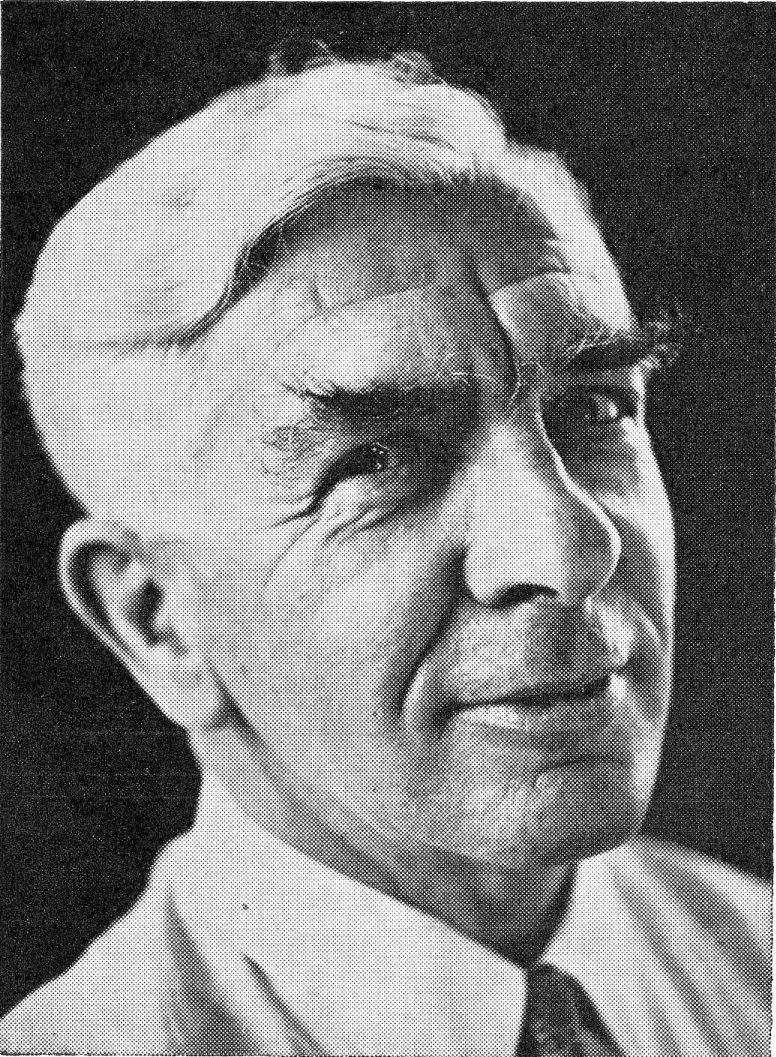 I previously knew nothing about Douglas Roth, photo right, the man who exposed Jurgens as a cheat, a faker and a forger, now believed to be a thief also. In my ignorance I imagined Douglas Roth from Rondebosch was a Nobody armed with a little knowledge who had the temerity to denounce A. A. Jurgens, South Africa's favourite philatelic son, the man who put SA postal history on the world map.
Douglas Roth was not a Nobody. He was a substantial philatelist, a Big Beast, a man with an philatelic provenance that surpassed most of his peers in South Africa. Given the sycophantic SA philatelic community's unquestioning adulation for the bubbles Jurgens had blown, Roth bought fresh, qualified and unwavering heavyweight objectivity down on Jurgens. He drew his conclusions and could not be swayed. He was 'The Man' who burst Jurgens' bubble. Many disliked him for it!
Roth first came to my attention in "Felons, Forgers and Fences: South Africa’s Undeclared War on its Archives" by Franco Frescura. (Forerunners # 90 ( Vol. XXXI, No. 2, November 2017-February 2018. Page 44).
According to Frescura, "In July 1949, the British Philatelic Association Journal published an article by Douglas Roth pointing out that many of the illustrations used by Jurgens in his Cape book (“The Handstruck Letter Stamps of the Cape of Good Hope”, 1943.) were forgeries. Jurgens replied through the same publication that ”he knew all about the faked bisects but that they were the product of an earlier generation and that it was a pity to resuscitate the matter”.
It is worth pointing out that Roth chose to publish his article in Britain, not in SA, as if he could not trust South Africans with this information. Perhaps he wanted the greatest publicity possible without having to deal with Jurgens' legion of quibling local supporters.
Frescura continues. "At no stage did he (Jurgens) explain how they had found their way into his research (Roth, 1976: 33). Then, at the National Philatelic Exhibition held in Cape Town in 1952 a display of Cape postal history by Jurgens was brought into question when Roth, who also sat on the Exhibition Jury, pointed out that the exhibit contained a large number of forged pre-adhesive postmarks applied to genuine old covers. Roth also provided the Exhibition Organisers with documentary proof to substantiate his opinion."
Frescura descibes how "events took a serious turn, and the police began to take an interest in the matter. The Commercial Investigation
Department (CID) raided Jurgens’ home at 26 Woodside Road, Cape Town and took possession of a printing press, line blocks and a variety of printing inks. Following an investigation which lasted over six months, the docket was forwarded to the Public Prosecutor who expressed his intention to proceed with the case. However, nothing further took place, and upon enquiry, Douglas Roth, who had been assisting the police as an expert witness, was informed that the Attorney-General had declined to take the case further (Roth, 1976: 33)."
"Once his (Jurgens') Cape forgeries were exposed, his second book, on “The Bechuanalands”, was also subjected to critical examination, and it too was found to contain photographs of forged material. It has been estimated since then that approximately 70% of its contents are fraudulent (Buhrmann, pers comm. 2017)". (Forerunners #90 (Vol. XXXI, No. 2, November 2017-February 20. Page 46).
Douglas Roth's greatest contibution to SA philately was his attempt to keep it honest. The cover up suggests he failed.
So, Who was Douglas Roth?
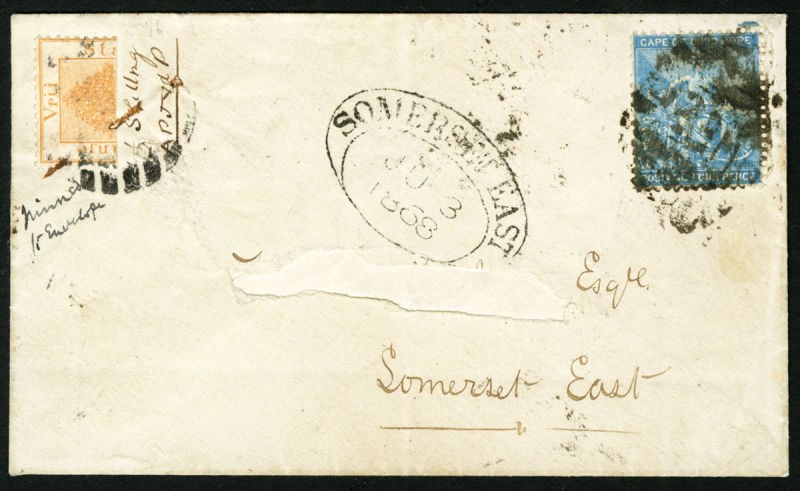
1868. 1/- Orange Fre State, orange horizontal bisect used as 6p. Tied to cover by Barred Oval Numeral Canceller (BONC unclear). Cape of Good Hope 4p blue also tied at right. Colesberg backstamp, Somerset arrival on front. Addressee's name excised. As per regulations, covers to the Cape had to bear 6p in OFS and 4p in Cape postage. To accomplish this, the sender pinned a 1/- stamp at the top left corner of the envelope and had the cover carried to the postmaster at Phillipolis, who bisected the stamp and replaced the top half in the corner with the pin and canceled it after noting "1/2 Shilling/APJvdP" below. The Cape stamp was then affixed and canceled by a different barred oval, the cover arriving at Somerset East on June 3, 1868. A truly remarkable and unique cover, probably the greatest rarity of the Orange River Colony. (Originally described in 1956 by Douglas Roth in "The South African Philatelist)".
I found the following in "THE SOUTH AFRICAN PHILATELIST December, 1965. Page 272".
MEET OUR ADVERTISERS - MR. DOUGLAS ROTH
Douglas Roth was born in England in 1906 and became seriously interested in stamps at the age of 17. He collected generally at first but soon saw that this lead nowhere so confined himself to the stamps of early Roumania and, because some reasonable completion seemed possible, to those of Antigua.
About this time he had the good fortune to come in contact with that famous philatelist Benjamin Goodfellow, a leading member of the "Royal" and one of the so-called Manchester school who first realised the importance of multiple pieces and made a study of "plating'' and stamp production generally. Under Benjamin Goodfellow's guidance Douglas Roth soon saw that philately held great possibilities and interest far beyond filling up the missing spaces. He started to acquire philatelic literature and his greatest moment was when he was able to get a copy of Fred Melville's "Postage Stamps in the Making." This book has now been brought up to date by John Easton,
himself a printer, and a copy should be on every collector's shelf.
Time passed by and in 1936 D.R., who had spent the last two years attending to family interests in the Balkans, found himself without a job. About this time he was pressed by a dealer there to part with a certain item from his collection and, although loath to do so, the price offered was so much above what he had paid that he agreed to let it go. This fortuitous deal gave him the idea that it would be nice to turn a hobby into a business and thus avoid work for the rest of his life! Accordingly he returned to England and consulted an old friend, P. L. Pemberton, then the doyen of the London stamp trade. P.L.P. was most helpful and kind and gave him much good advice which, strange to say, D.R. took and he also sponsored him into the trade and this alone was of enormous assistance.
Douglas Roth moved at once to London, the centre of the world's stamp trade, and started up business dealing from his flat postally. His interest being confined to early issues he decided to specialise in them but to deal both in foreign and colonial stamps. By moving around stamp circles in London and learning at all the society meetings he soon acquired a fair working knowledge of the trade and gradually started to accumulate a small stock, always being careful to buy items in really fine condition. This policy turned out a wise one as fine quality stamps give much more pleasure and are an immeasurably better investment. As he points out, •"If you buy a stamp that irritates you, you must be crazy."
The first year naturally showed a loss owing to the overhead expenses, but in the second year he, broke even which was in fact better than he expected. Then came a great piece of luck. Through the mutual interest in early Roumanian stamps D.R. had come to know Sir John Wilson, who was an avid student of these issues, and in early 1939 Sir John was appointed "Keeper of the King's Stamps" following the death of Sir Edward Bacon. Under these circumstances Sir John sold his many collections to Douglas Roth'who borrowed heavily to buy them.He bought everything Sir John had except Russia and Roumania. Apart from many specialised collections there was a general collection originally formed by Sir John's father and this contained, with the excepttion of a few great rarities such as the Hawaiian Missionaries and the Post Office Mauritius stamps, practically every stamp issued in the world up to 1900. At one lucky stroke therefore D.R. acquired a wonderful stock and was in a position to supply almost any stamp he might be asked for. In view of the Royal appointment and the fact that Sir John Wilson was President of the Royal Philatelic Society and also of their ExpertCommittee this deal was given considerable prominence in the philatelic press and D.R.found himself inundated with enquiries for items known to be in the various collections. In fact Douglas Roth was on the map.
However in September, 1939, the war broke out and D.R., who had been commissioned into the Territorial Army in 1926, was recalled to his regiment, the Manchesters. The business closed down with a bang - literally! After service in France as a Company Commander and evacuation at Dunkirk, D.R. eventually found himself chosen for Staff training and later, after serving as Deputy Assistant Adjutant General of 54 Division, was selected for service in India and attachment to the Indian Army. Proceeding thence in 1941 the troopship called at Cape Town and this visit so impressed him that in 1948 he returned and settled there
After four years in India and Ceylon on various staff appointments, D.R. returned to England in 1945 and in September was re-leased from the Army. Restarting his business he found life in England very restrict-ing. Trade however was excellent; prices had risen (much to the annoyance of the older collectors who swore that they must come down) and best of all the Sir JohnWilson collections were unbombed and still virtually intact. He was invited to join the Expert Committee of the British Philatelic Association and served on it until his departure for South Africa in 1948 when he settled down in Cape Town content to do less business in a more congenial climate.
D.R. collects personally Reprints of Classic Stamps and has five volumes of them which serve as a valuable reference collection. He also has a small collection of Capes. Earlier this year he acted as Commissioner for South Africa for the WIPA '65 Exhibition in Vienna and while over there was invited to j oin the Association of International Philatelic Experts which has its headquarters in Paris. He is also the happy owner of what is certainly the finest philatelic library in private hands in this country and he is al-ways more than willing to make it available to his clients and friends, the terms being generally synonymous.
Regular visits overseas enable him to keep in touch with world markets and replenish stocks. Maintaining an excellent and varied stock of the early issues of all countries, both foreign and colonial, Douglas Roth divides his time between philately, fishing and a little photography."
Turning a Blind Eye to the Facts
Eagle-eyed readers who are following this subject - the criminal activities of A. A. Jurgens and others, as well as the subsequent cover-up - will note that this article printed in December 1965 when Jurgens' activities were already known does not mention Roth's accusations against Jurgens. It is as if they never took place. One must imagine that whoever wrote this piece for the South African Philatelist had reason not to highlight Roth's most important contribution to South African philately and postal history. The SAP's Honorary Editor at this time was Dr. H. J. Raubenheimer with Dr T. B. 'Tom' Berry sitting on the Editorial Board. Both are respected men. It is not known who wrote the article but its failure to mention Roth vs Jurgens is an omission that can be laid squarely at the feet of the Editorial Board. I imagine that like most senior philatelists in SA they believed that by not talking about this matter it might be forgotten.
Ignoring Roth's contibution to SA philately is not uncommon. Here is Cape Town dealer, Eliezer Blum, writing about Roth in THE SOUTH AFRICAN PHILATELIST (REMINISCENCES OF A STAMP DEALER, May 1971. Page 114). "It was at about this time, when I first met Douglas Roth, who had just arrived from Britain to settle in Cape Town. For close on 23 years, our weekly meetings have become traditional, and are the evidence of a lasting friendship. As an expert of the classic issues of the worrld, he filled a great need in this country". Remember, it was Blum et al who on Silvie's death went to his house and criminally destroyed evidence. I am not suggesting that Blum was involved in Jurgens' activities, rather that he wanted to keep a lid on them to protect the market - he was a dealer - for top-end postal history and was prepared to break the law to do so.
Awards
The PFSA awards the title 'RDPSA' (Roll of the Distinguished Philatelists of South Africa) to deserving philatelists and postal historians. To qualify for election to the Roll a person shall have:
- Achieved distinction through philatelic research or philatelic writings and publications
- Service to the PFSA
- Have made an outstanding contribution to philately and/or philatelic societies
Douglas Roth was never accorded this honour. A. A. Jurgens was. His award has never been rescinded despite his misdeeds.