
Military Hospitals / Hospital Ships
Quote from Steve on March 2, 2026, 6:46 amHospital Beau-Rivage, Cannes: 1916 - 1918
During WW1 France recruited South African civilian doctors and nursing staff in Cape Town to care for French wounded. On arrival in France they were set up in the Hotel Beau-Rivage in Cannes on the Mediterranean. This was known as the 'Hospital Beau-Rivage'. The French supplied the hospital with a triple circle datestamp that said 'AMBULANCE SUD-AFRICAINE - HOSPITAL BEAU RIVAGE' with 'CANNES' in the inner circle. The cover below was recently sold by Kenny Napier. Click here to request to get on his auction mailing list.
Postcard. Posted free. CANNES '9-10-16' via PARIS '11 X 1916' to LUCKHOF, OFS, SA.
According to Kathy Satchwell of the South African Miliatry History Society, "The South African Ambulance in Cannes 1914 - 18", a group of twenty nurses accompanied the ambulance. There is a memorial plaque to those who died in the Johannesburg Anglican Cathedral. In York Minster, England there is also a memorial to all the nurses who died in WWI with a special section for SA. One of the nurses named on the plaque in Johannesburg was Elizabeth Betty Freund from Luckhoff, OFS, (see postcard above). A great deal of information about the ambulance, the nurses and conditions at the hospital in France was culled from her letters to her family.
"When the war broke out the SA Red Cross Ambulance was immediately formed by a Dr Casalis. He was the son of Swiss medical missionaries and had served on the British side in the Anglo-Boer (South African) War. The ambulance was funded privately from both Cape Town and London so there was a great deal of publicity and name-dropping in their letters and reports, to encourage donations."
"The ambulance, Dr and Mrs Casalis and the nurses travelled first to London and then on to France where they were posted to Cannes. They were all disappointed not to be at the front line but the French military wanted to clear the wounded men away from there to safer and more salubrious places. Cannes was perfect as most of the hotels were turned into hospitals for the duration. The SA Ambulance and its medical team were posted to the Hotel Beau Rivage which was still in the process of conversion. Betty Freund wrote home about the beautiful surroundings and gardens. The hospital was under the command of the French Service de Sant‚ - the equivalent of the British RMC. The wards were large and airy but there was a constant shortage of basic supplies like cotton wool, disinfectants and bandages which volunteers made gigantic efforts to make on site. Dr Casalis owned a beautiful modern operating table made of specially shaped metal so it was easy to clean. Soon the other military hospitals were discarding their old wooden tables and installing copies."
"The SA team learned valuable lessons in dealing with appalling wounds and these often went against the received medical thinking of the day. They learned that washing and cleaning wounds regularly was far better than dry dressings as there was mud and filth everywhere in this war. They even developed a system of purifying sea water from the Mediterranean as it is very salty and therefore antiseptic for cleaning wounds. They also found that they must always probe wounds even when they appeared clean and neat as there could all sorts of debris and filth inside. They discovered that putting patients outside in the sunshine for up to two hours really assisted the healing of wounds. They further learnt how to cope with wounded men who had spent several days on a train with no change of the dressings they had received at the front line - these were put into the SA ambulance for transport to the hospital where they had established a procedure to wash and clean them.*
"Betty Freund died of cancer in Cannes in 1918."
"After the war many of the SA Ambulance group returned to live in the South of France."
Hospital Beau-Rivage, Cannes: 1916 - 1918
During WW1 France recruited South African civilian doctors and nursing staff in Cape Town to care for French wounded. On arrival in France they were set up in the Hotel Beau-Rivage in Cannes on the Mediterranean. This was known as the 'Hospital Beau-Rivage'. The French supplied the hospital with a triple circle datestamp that said 'AMBULANCE SUD-AFRICAINE - HOSPITAL BEAU RIVAGE' with 'CANNES' in the inner circle. The cover below was recently sold by Kenny Napier. Click here to request to get on his auction mailing list.
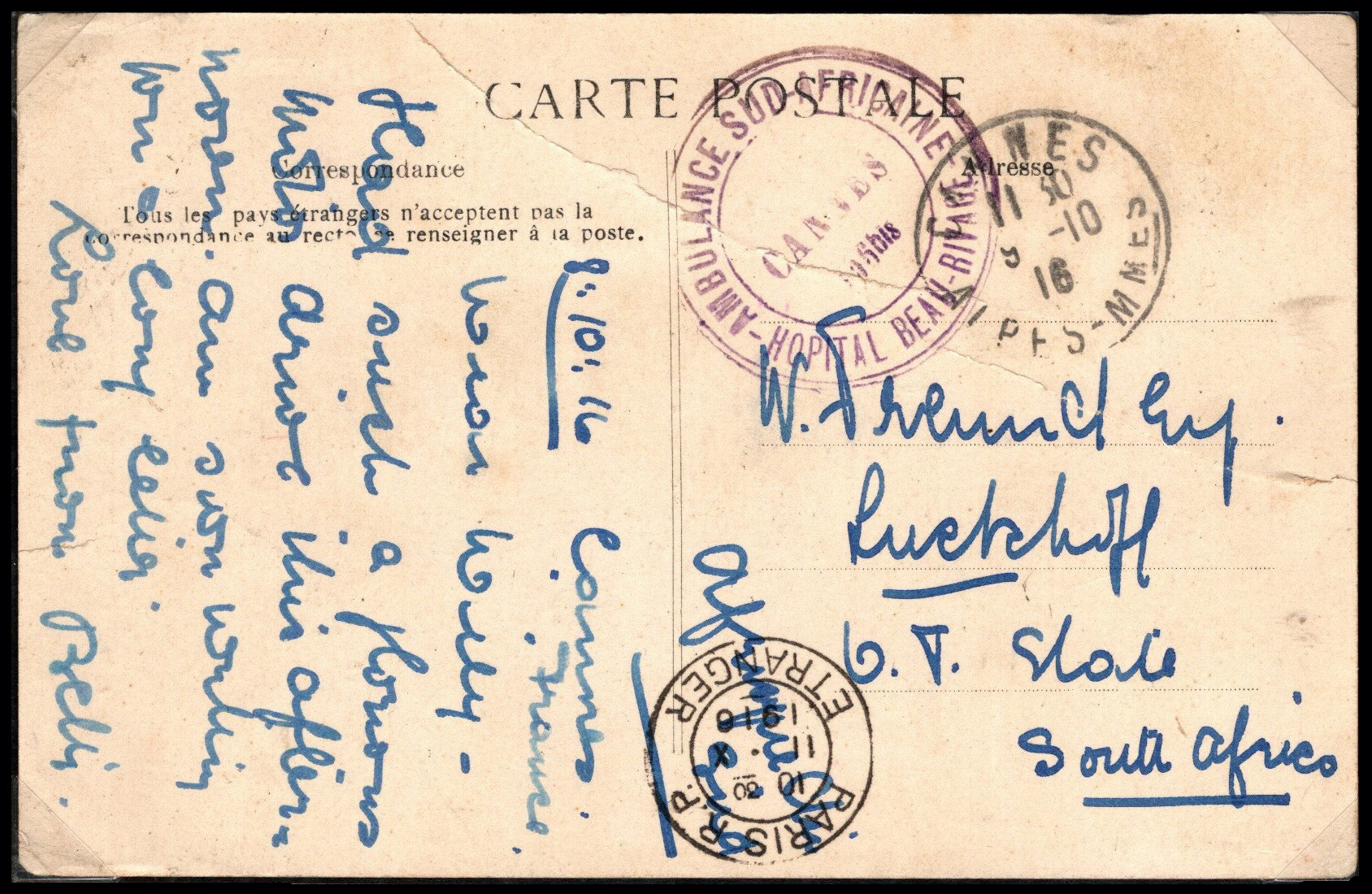
Postcard. Posted free. CANNES '9-10-16' via PARIS '11 X 1916' to LUCKHOF, OFS, SA.
According to Kathy Satchwell of the South African Miliatry History Society, "The South African Ambulance in Cannes 1914 - 18", a group of twenty nurses accompanied the ambulance. There is a memorial plaque to those who died in the Johannesburg Anglican Cathedral. In York Minster, England there is also a memorial to all the nurses who died in WWI with a special section for SA. One of the nurses named on the plaque in Johannesburg was Elizabeth Betty Freund from Luckhoff, OFS, (see postcard above). A great deal of information about the ambulance, the nurses and conditions at the hospital in France was culled from her letters to her family.
"When the war broke out the SA Red Cross Ambulance was immediately formed by a Dr Casalis. He was the son of Swiss medical missionaries and had served on the British side in the Anglo-Boer (South African) War. The ambulance was funded privately from both Cape Town and London so there was a great deal of publicity and name-dropping in their letters and reports, to encourage donations."
"The ambulance, Dr and Mrs Casalis and the nurses travelled first to London and then on to France where they were posted to Cannes. They were all disappointed not to be at the front line but the French military wanted to clear the wounded men away from there to safer and more salubrious places. Cannes was perfect as most of the hotels were turned into hospitals for the duration. The SA Ambulance and its medical team were posted to the Hotel Beau Rivage which was still in the process of conversion. Betty Freund wrote home about the beautiful surroundings and gardens. The hospital was under the command of the French Service de Sant‚ - the equivalent of the British RMC. The wards were large and airy but there was a constant shortage of basic supplies like cotton wool, disinfectants and bandages which volunteers made gigantic efforts to make on site. Dr Casalis owned a beautiful modern operating table made of specially shaped metal so it was easy to clean. Soon the other military hospitals were discarding their old wooden tables and installing copies."
"The SA team learned valuable lessons in dealing with appalling wounds and these often went against the received medical thinking of the day. They learned that washing and cleaning wounds regularly was far better than dry dressings as there was mud and filth everywhere in this war. They even developed a system of purifying sea water from the Mediterranean as it is very salty and therefore antiseptic for cleaning wounds. They also found that they must always probe wounds even when they appeared clean and neat as there could all sorts of debris and filth inside. They discovered that putting patients outside in the sunshine for up to two hours really assisted the healing of wounds. They further learnt how to cope with wounded men who had spent several days on a train with no change of the dressings they had received at the front line - these were put into the SA ambulance for transport to the hospital where they had established a procedure to wash and clean them.*
"Betty Freund died of cancer in Cannes in 1918."
"After the war many of the SA Ambulance group returned to live in the South of France."
Quote from Steve on March 3, 2026, 9:44 amHMHS Ebani: 1914 - 1919
Perhaps the best known WW1 Hospital ship of the GSWA campaign is HMHS (His Majesty's Hospital Ship) Ebani. SS Ebani was registered as a Hospital Ship on 1st December 1914. Until mid-1915 she transferred wounded SA and Germans to Cape Town, as well as POWs. At the end of the GSWA campaign she was used in GEA by the British until 1919.
1915. HMHS Ebani entering Cape Town Docks, Table Bay.
This PDF article by Dave and Sue Young with input by Deon Brand and Hugh Amoore remains the best on the subject. Click here to see it.
The heading of the PDF is incorrect. This is my fault. It reads "THE SOUTH AFRICAN NAVY HOSPITAL SHIP". It should, of course, be the "THE SOUTH AFRICAN HOSPITAL SHIP". The South African Navy did not exists at this time and would not for some years. It was formed on 1st April (April Fools Day) 1922 as the South African Naval Service (SANS).Today the ANC has turned it into something of a joke!
HMHS Ebani: 1914 - 1919
Perhaps the best known WW1 Hospital ship of the GSWA campaign is HMHS (His Majesty's Hospital Ship) Ebani. SS Ebani was registered as a Hospital Ship on 1st December 1914. Until mid-1915 she transferred wounded SA and Germans to Cape Town, as well as POWs. At the end of the GSWA campaign she was used in GEA by the British until 1919.
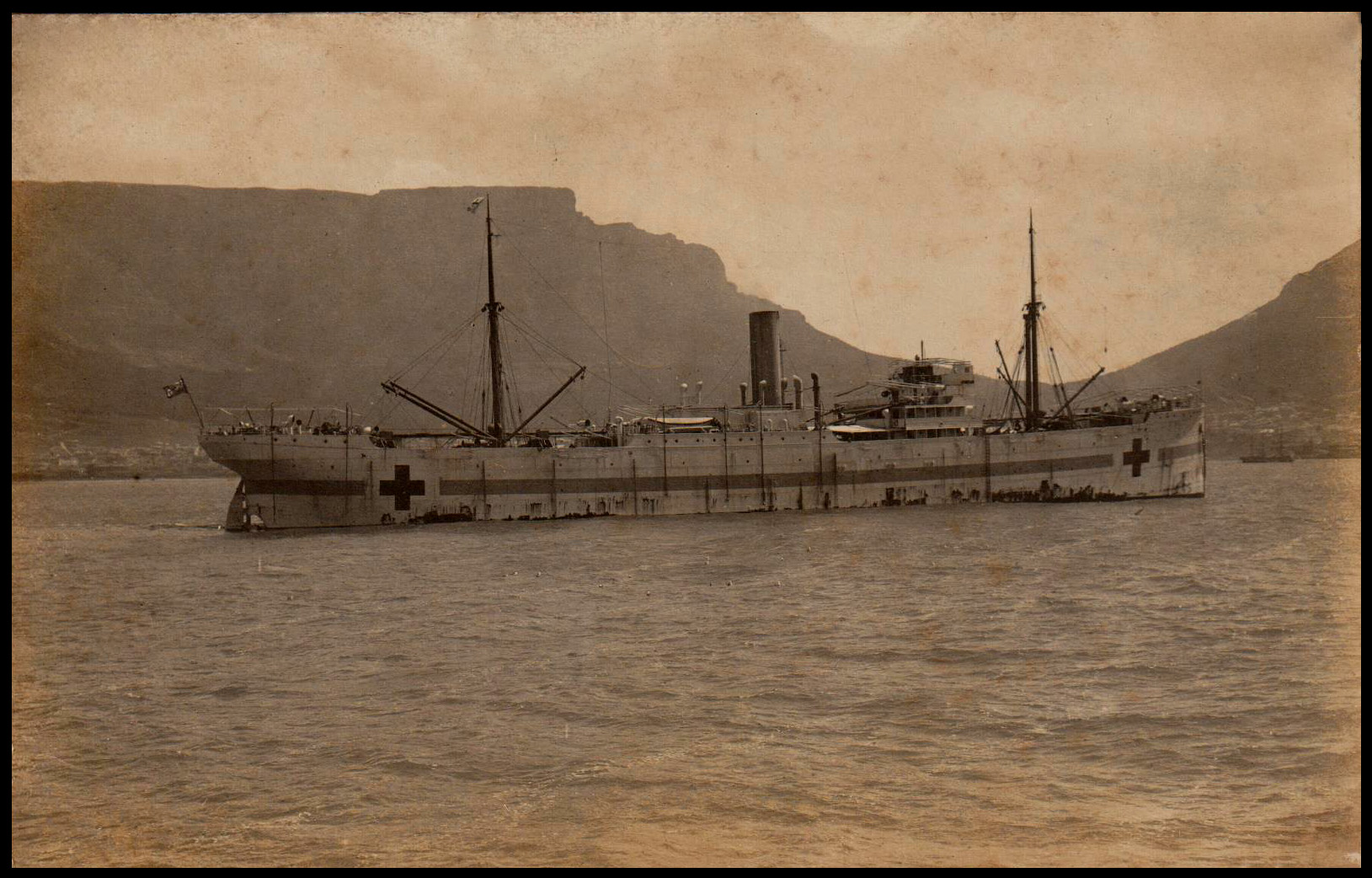
1915. HMHS Ebani entering Cape Town Docks, Table Bay.
This PDF article by Dave and Sue Young with input by Deon Brand and Hugh Amoore remains the best on the subject. Click here to see it.
The heading of the PDF is incorrect. This is my fault. It reads "THE SOUTH AFRICAN NAVY HOSPITAL SHIP". It should, of course, be the "THE SOUTH AFRICAN HOSPITAL SHIP". The South African Navy did not exists at this time and would not for some years. It was formed on 1st April (April Fools Day) 1922 as the South African Naval Service (SANS).Today the ANC has turned it into something of a joke!