New Republic (Nieuwe Republiek)
Quote from Steve on January 23, 2026, 10:26 amThe Nieuwe Republiek (New Republic)
2026. Facsimile. Photoshop montage of New Republic stamp with Putzel's hand-drawn postmark.
The New Republic emerged from turmoil caused by the British Army's invasion of Zululand in 1879, (Zulu War). This created a schism within the Zulu tribal hierarchy which allowed a usurper to seize the throne. Commandant Lukas Meyer and a young Louis Botha led a successful Boer commando that restored Dinuzulu, the deposed son of the Zulu chief Cetshwayo, to the Zulu throne in 1884.
In appreciation of the services of the 'Dinizulu Volunteers', Dinuzulu granted the Boers a huge tract of land in northern Zululand that ran from the southeastern ZAR (Transvaal) border to the sea. This became 'Die Nieuwe Republiek', (the New Republic), centred on its capital, Vryheid (Afr. Freedom), the only town of any size. The New Republic would struggle for political recognition, stability and finances.
A Marriage made in Heaven - Botha and Meyer still together 16 years later!
1900. Boer General Louis Botha, left, and Lukas Meyer, right, with their wives during the South African War (1899 - 1902).
Both these ex-Dinizulu Volunteers remained in the veld to the end and participated in the Peace talks in 1902.
I would like to link to Tinus le Roux but there is no one specific site for his amazing work. 'Dankie Tinus!'British imperialism wanted keep the Boer republics dependent on British ports and railways. It worried that the New Republic might provide them with a corridor to the sea at St Lucia Bay. After Germany recognised it, the British demanded that the New Republic first return the coastal part of its territory to the Zulus before they recognised it in 1886. The consequent return of land to the Zulus explains why there are two differing maps of the New Republic. Some show the original land grant stretching all the way round to the Swaziland while others show it later, truncated and land-locked. If anyone can share a decent map I will be grateful. Thanks.
In July 1888, the New Republic was forced to merge with the Transvaal Republic (ZAR), though it maintained some local autonomy. This was not welcomed by Britain who feared that the ZAR would acquire land and influence in Zululad. To prevent this Britain annexed the independent kingdom of Zululand, declaring it a Crown Colony in 1887. Following the South African War, Britain cut the territory that had comprised the New Republic from the Transvaal and gave it to Natal in 1903.
I am grateful to Kenny Napier Auctions for most of the items shown here, all except two covers which I found on the Grosvenor Auction site.
Email Kenny to get on his auction list.
Click here to visit the Grosvenor Auction website.Nieuwe Republiek stamps were issued between 9th January 1886 and 13th January 1887. All stamps were handstamped using a rubber stamp in various shades of violet on pre-perforated, unwatermarked gummed paper. Designs have an outer frame line with NIEUWE / REPUBLIEK top, the value of the stamp in large letters in the centre, often date below the value and ZUID-AFRIKA at bottom.
1886. Block x 9 New Republic 2d stamps prepared '24 NOV 86'.
These handstamped stamps are erratically placed between the perforations
There is no accurate placement of the handstamp. Each strike is different to the last and the next.Unlike most cancelled stamps, the date shown is not the date of use but rather the date on which the particular batch to which the stamp belongs first appeared. Stamps were produced when stocks were required, each printing (handstamping) including within its design the date on which the stamps were prepared. All stamps were handstamped by rubber stamp in various shades of violet, 1886-87. Various types Include dated and undated issues with some on embossed paper, (both shades), Some values are missing due to errors.
The Stanley Gibbons and SACC (South African Colour Catalogue) both include lists of the New Republic stamps showing their dates of production with the applied value. While it is six of one and half a dozen of the other I prefer SACC's simpler presentation.
1886. A baker's dozen of New Republic stamps showing two types of paper with different values.
They were printed on either yellow or grey-blue granite paper.The paper used is sometimes embossed with the republic's arms. The embossing can be seen most clearly in the grey-blue stamps (top row), also the 9d (undated), 6d (undated) and the £1 (undated) also being good examples.
1885. Pre-New Republic postage stamp cover. NEW REPUBLIC m/s '18 8 85' to PIETSBURG, TRANSVAAL.
ZAR 1885 Halve Penny overprint on Celliers Drie Pence cancelled with 'POSKANTOOR NIEUWE REPUBLIEK'. (Putzel No. 2).
At this time the NEW REPUBLIC POST OFFICE had an undated canceller but no stamps.
The first printingon yellow paper of 1d stamps would be on 9th January 1886.Postally used examples are rare but fiscally used material is much more common before the territory became part of Natal. New Republic stamps were never accepted for postage use internationally. Most use was domestic and fiscal. Depending on the route taken, (ZAR - Utrecht) or Natal - Dundee) external mail required ZAR or Natal stamps used in combination with New Republic ones. Below are two remarkable items recentlly sold by Grosvenor Auctions which perfectly illustrate international postage rates from the New Republic. Whoever snapped these up acquired remarkably scarce late 19th century rarities. Genuine postally used classics such as these are rarely seen!
1886 New Republic cover. VRYHEID 'FEB 14 1887' via ZAR (UTRECHT) to CAPE TOWN.
New Republic 2d. with embossed Arms on granite paper with violet oval datestamp. (Putzel No. 3.)
Plus ZAR 2d. brown-purple cancelled with UTRECHT Circular datestamp.
(Ex-Grosvenor Auctions.)
1886 New Republic cover. VRYHEID 'undated' via NATAL (DUNDEE) to CAPE TOWN.
New Republic 2d. unembossed Arms on granite paper cancelled with violet circular datestamp Putzel No. 1.
Plus NATAL 1886 (January) TWO PENCE on 3d grey cancelled with Dundee Circular Datestamp.
(Ex-Grosvenor Auctions.)New Republic stamps are divided into numerous categories on either yellow or granite paper with or without dates. These rather plain and unattractive stamps are generally diminished by wear, tears, thins, faults, general grubbiness and poor strikes when postally used. Of the seven stamps below all but one is cancelled with the more common VRYHEID violet oval dated handstamp. Both of the two types of this handstamp can be seen in the top 2nd and 3rd stamp along. Refer to Putzel at base.
Circa 1887 - 1888. Examples of the oval datestamp used to cancel New Republic stamps, postally and fiscally.
Some 64 varieties are listed. Numerous forgeries exist even on genuine paper. Genuine stamps are said to show a small blurry sliver above the top of the first "E" in "REPUBLIEK" as well as a diagonal slice removed from the lower right of the bottom leg of the second "E" of "REPUBLIEK". These flws are not always obvious singly ot together. Their absence is not proof of forgery.
Check this site out for Examples of Forgeries.
Circa 1886. Fiscal piece. VRIJHEID rubber stamp buckle design inscribed Nieuwe Republiek
A. de Vletter Vrijheid manuscript inserted 1/6d duty in black.
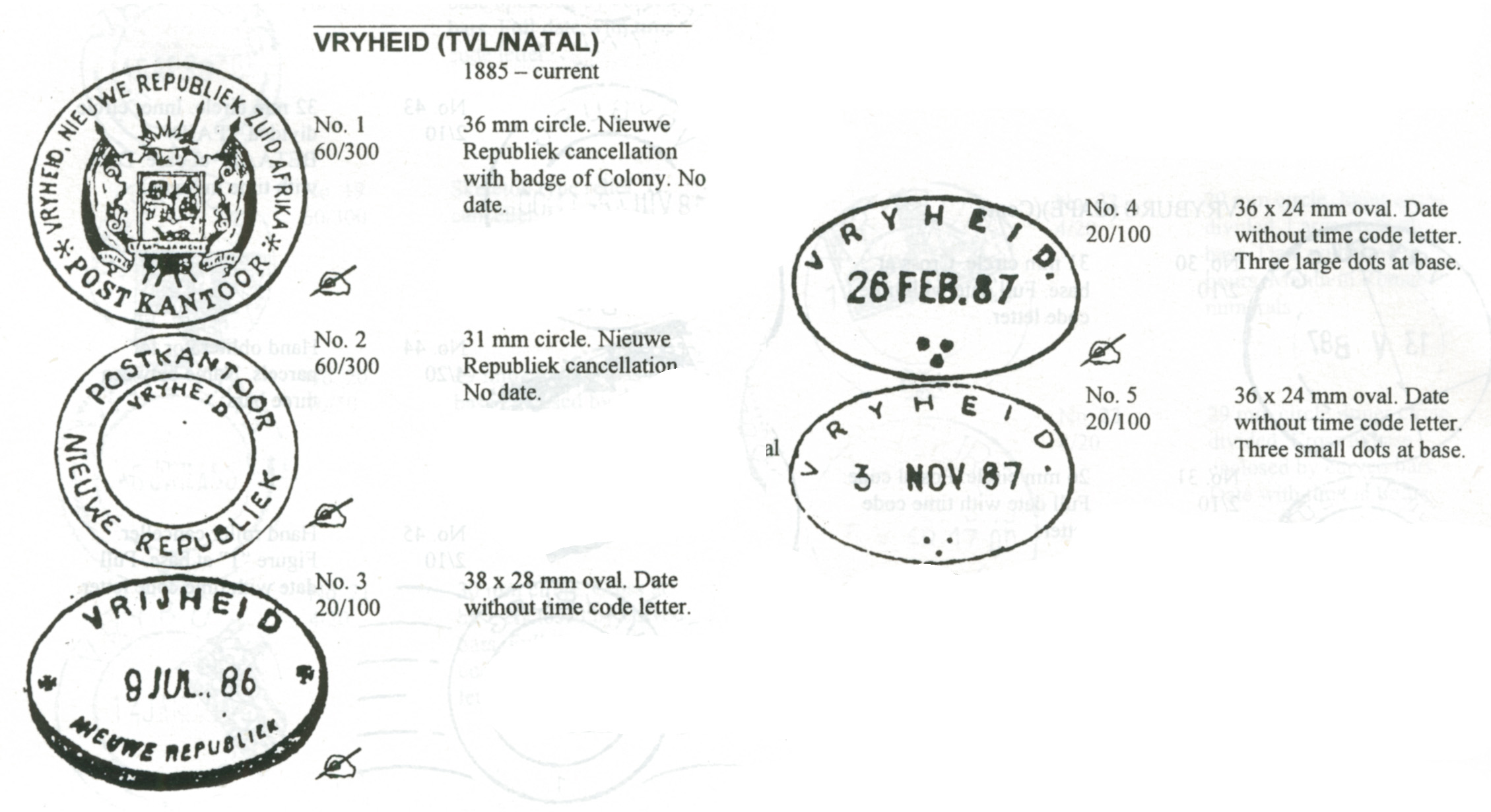
Additional handstampe one line cachet with the word 'Zegel' (Revenue/Duty).Below are the handstamps, datestamps and cachets recorded used in the New Republic by Ralph Putzel RDPSA, (The Postmarks of South Africa and Former States and Colonies.) The first three, Nos. 1 - 3, are shown on the covers above; the last two ovals with three large or small dots are both shown on the used stamps above.
The Nieuwe Republiek (New Republic)
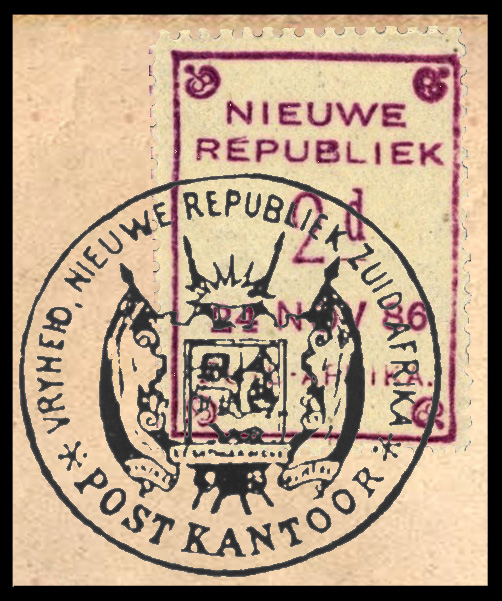
2026. Facsimile. Photoshop montage of New Republic stamp with Putzel's hand-drawn postmark.
The New Republic emerged from turmoil caused by the British Army's invasion of Zululand in 1879, (Zulu War). This created a schism within the Zulu tribal hierarchy which allowed a usurper to seize the throne. Commandant Lukas Meyer and a young Louis Botha led a successful Boer commando that restored Dinuzulu, the deposed son of the Zulu chief Cetshwayo, to the Zulu throne in 1884.
In appreciation of the services of the 'Dinizulu Volunteers', Dinuzulu granted the Boers a huge tract of land in northern Zululand that ran from the southeastern ZAR (Transvaal) border to the sea. This became 'Die Nieuwe Republiek', (the New Republic), centred on its capital, Vryheid (Afr. Freedom), the only town of any size. The New Republic would struggle for political recognition, stability and finances.
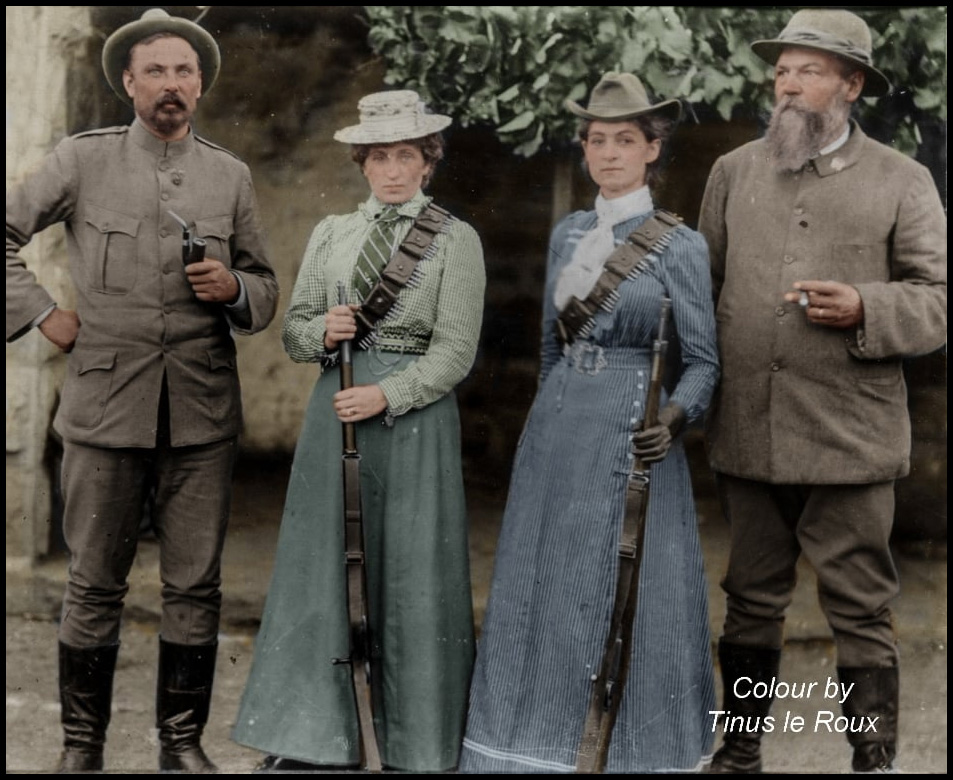
A Marriage made in Heaven - Botha and Meyer still together 16 years later!
1900. Boer General Louis Botha, left, and Lukas Meyer, right, with their wives during the South African War (1899 - 1902).
Both these ex-Dinizulu Volunteers remained in the veld to the end and participated in the Peace talks in 1902.
I would like to link to Tinus le Roux but there is no one specific site for his amazing work. 'Dankie Tinus!'
British imperialism wanted keep the Boer republics dependent on British ports and railways. It worried that the New Republic might provide them with a corridor to the sea at St Lucia Bay. After Germany recognised it, the British demanded that the New Republic first return the coastal part of its territory to the Zulus before they recognised it in 1886. The consequent return of land to the Zulus explains why there are two differing maps of the New Republic. Some show the original land grant stretching all the way round to the Swaziland while others show it later, truncated and land-locked. If anyone can share a decent map I will be grateful. Thanks.
In July 1888, the New Republic was forced to merge with the Transvaal Republic (ZAR), though it maintained some local autonomy. This was not welcomed by Britain who feared that the ZAR would acquire land and influence in Zululad. To prevent this Britain annexed the independent kingdom of Zululand, declaring it a Crown Colony in 1887. Following the South African War, Britain cut the territory that had comprised the New Republic from the Transvaal and gave it to Natal in 1903.
I am grateful to Kenny Napier Auctions for most of the items shown here, all except two covers which I found on the Grosvenor Auction site.
Email Kenny to get on his auction list.
Click here to visit the Grosvenor Auction website.
Nieuwe Republiek stamps were issued between 9th January 1886 and 13th January 1887. All stamps were handstamped using a rubber stamp in various shades of violet on pre-perforated, unwatermarked gummed paper. Designs have an outer frame line with NIEUWE / REPUBLIEK top, the value of the stamp in large letters in the centre, often date below the value and ZUID-AFRIKA at bottom.
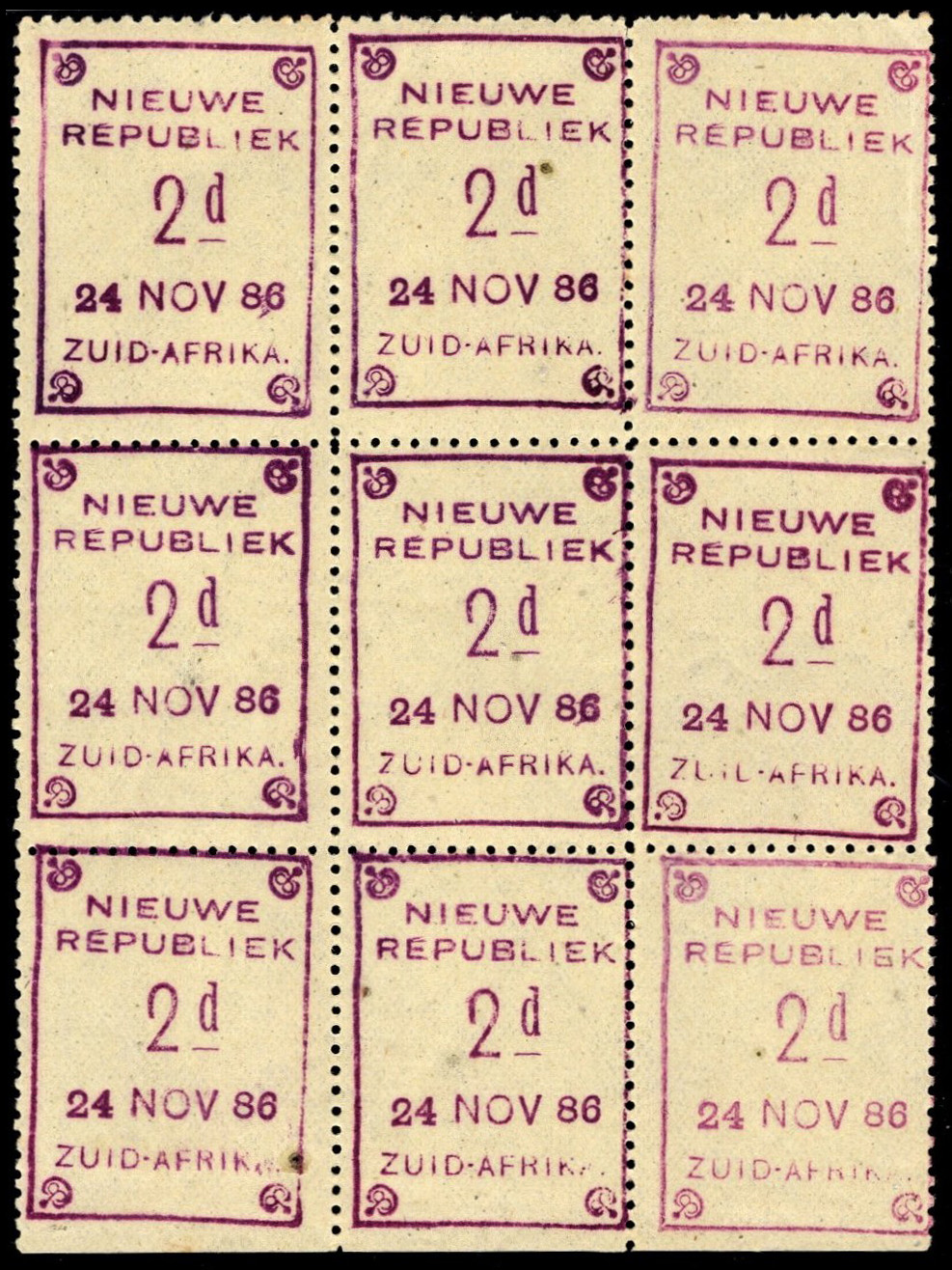
1886. Block x 9 New Republic 2d stamps prepared '24 NOV 86'.
These handstamped stamps are erratically placed between the perforations
There is no accurate placement of the handstamp. Each strike is different to the last and the next.
Unlike most cancelled stamps, the date shown is not the date of use but rather the date on which the particular batch to which the stamp belongs first appeared. Stamps were produced when stocks were required, each printing (handstamping) including within its design the date on which the stamps were prepared. All stamps were handstamped by rubber stamp in various shades of violet, 1886-87. Various types Include dated and undated issues with some on embossed paper, (both shades), Some values are missing due to errors.
The Stanley Gibbons and SACC (South African Colour Catalogue) both include lists of the New Republic stamps showing their dates of production with the applied value. While it is six of one and half a dozen of the other I prefer SACC's simpler presentation.
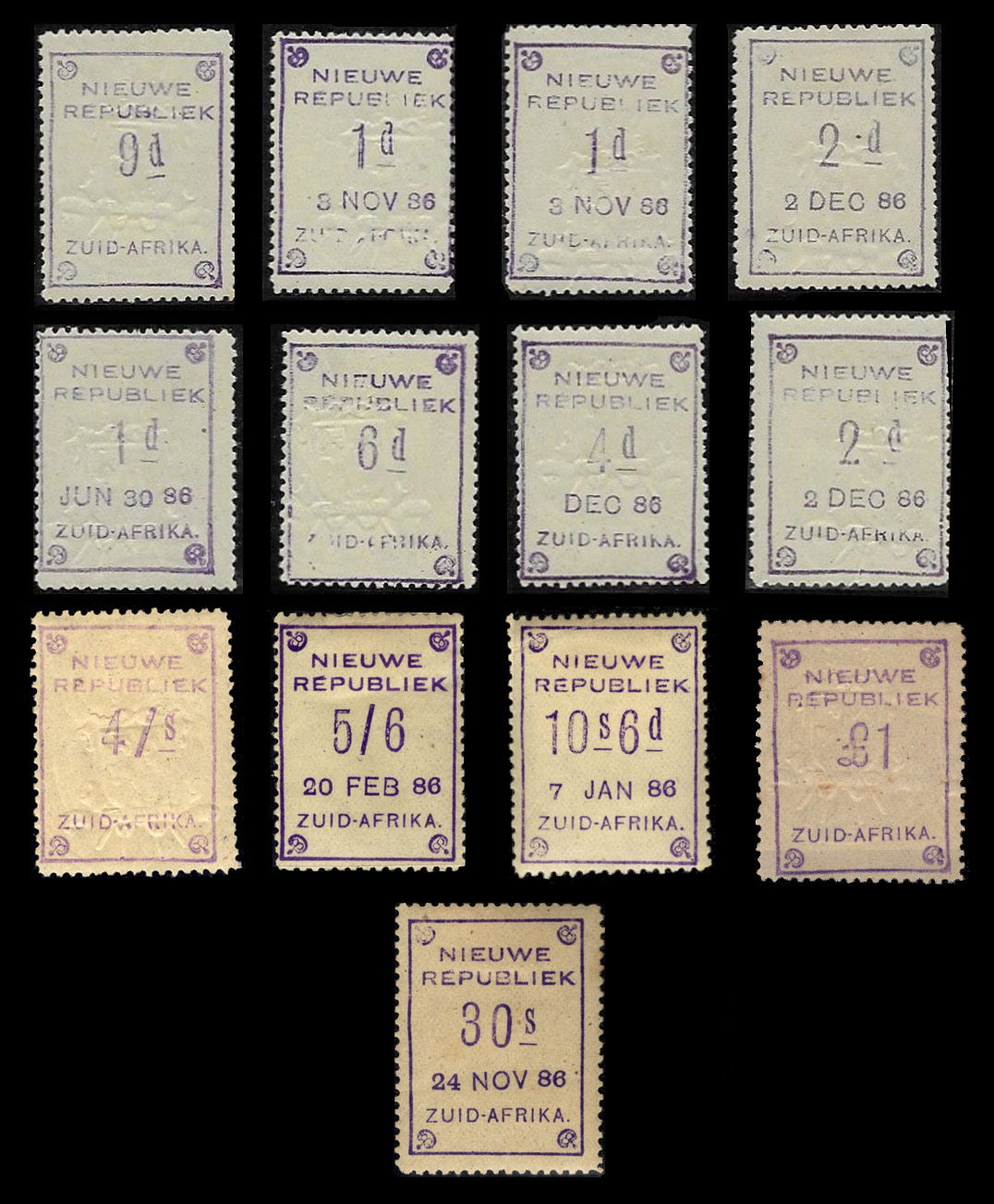
1886. A baker's dozen of New Republic stamps showing two types of paper with different values.
They were printed on either yellow or grey-blue granite paper.
The paper used is sometimes embossed with the republic's arms. The embossing can be seen most clearly in the grey-blue stamps (top row), also the 9d (undated), 6d (undated) and the £1 (undated) also being good examples.
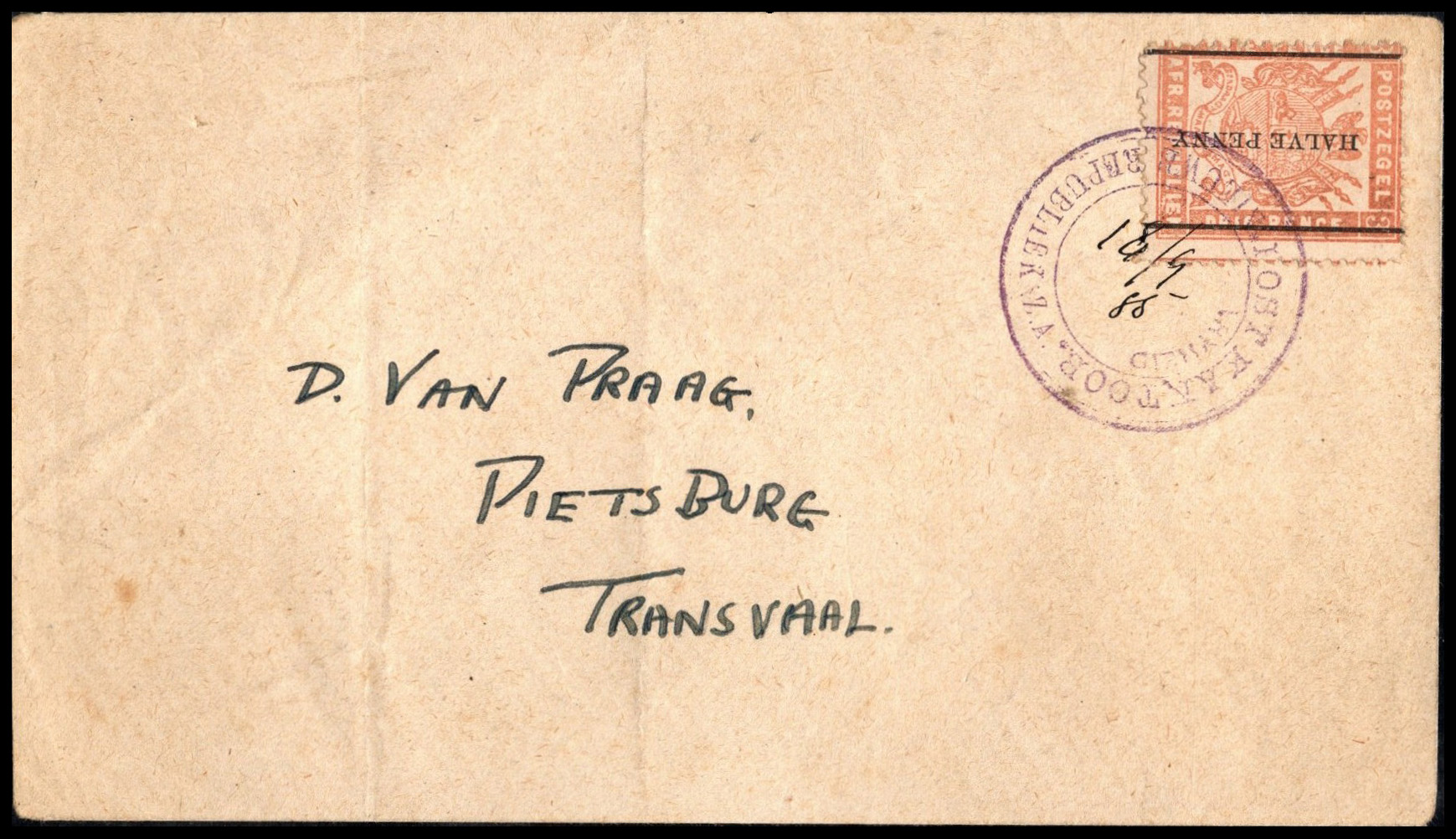
1885. Pre-New Republic postage stamp cover. NEW REPUBLIC m/s '18 8 85' to PIETSBURG, TRANSVAAL.
ZAR 1885 Halve Penny overprint on Celliers Drie Pence cancelled with 'POSKANTOOR NIEUWE REPUBLIEK'. (Putzel No. 2).
At this time the NEW REPUBLIC POST OFFICE had an undated canceller but no stamps.
The first printingon yellow paper of 1d stamps would be on 9th January 1886.
Postally used examples are rare but fiscally used material is much more common before the territory became part of Natal. New Republic stamps were never accepted for postage use internationally. Most use was domestic and fiscal. Depending on the route taken, (ZAR - Utrecht) or Natal - Dundee) external mail required ZAR or Natal stamps used in combination with New Republic ones. Below are two remarkable items recentlly sold by Grosvenor Auctions which perfectly illustrate international postage rates from the New Republic. Whoever snapped these up acquired remarkably scarce late 19th century rarities. Genuine postally used classics such as these are rarely seen!
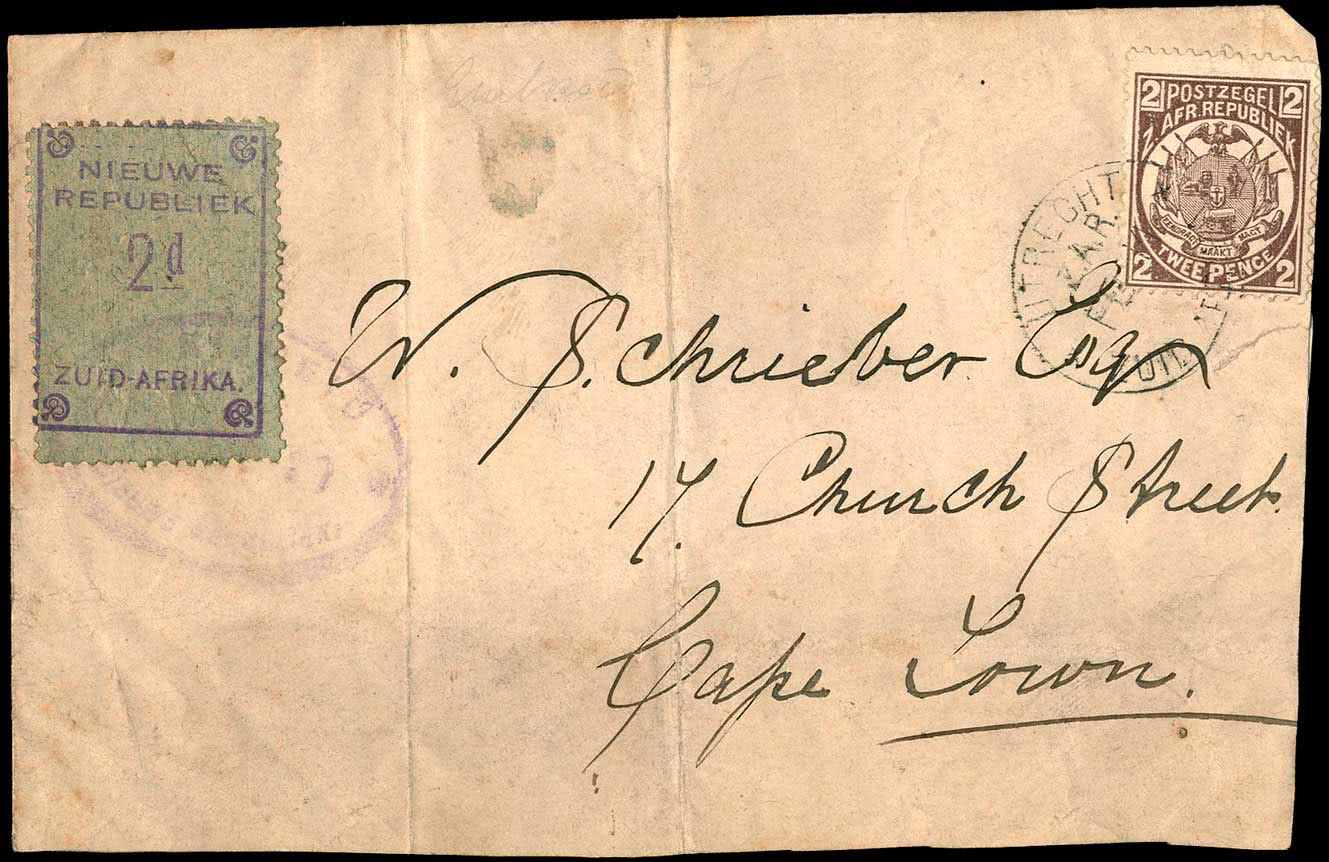
1886 New Republic cover. VRYHEID 'FEB 14 1887' via ZAR (UTRECHT) to CAPE TOWN.
New Republic 2d. with embossed Arms on granite paper with violet oval datestamp. (Putzel No. 3.)
Plus ZAR 2d. brown-purple cancelled with UTRECHT Circular datestamp.
(Ex-Grosvenor Auctions.)
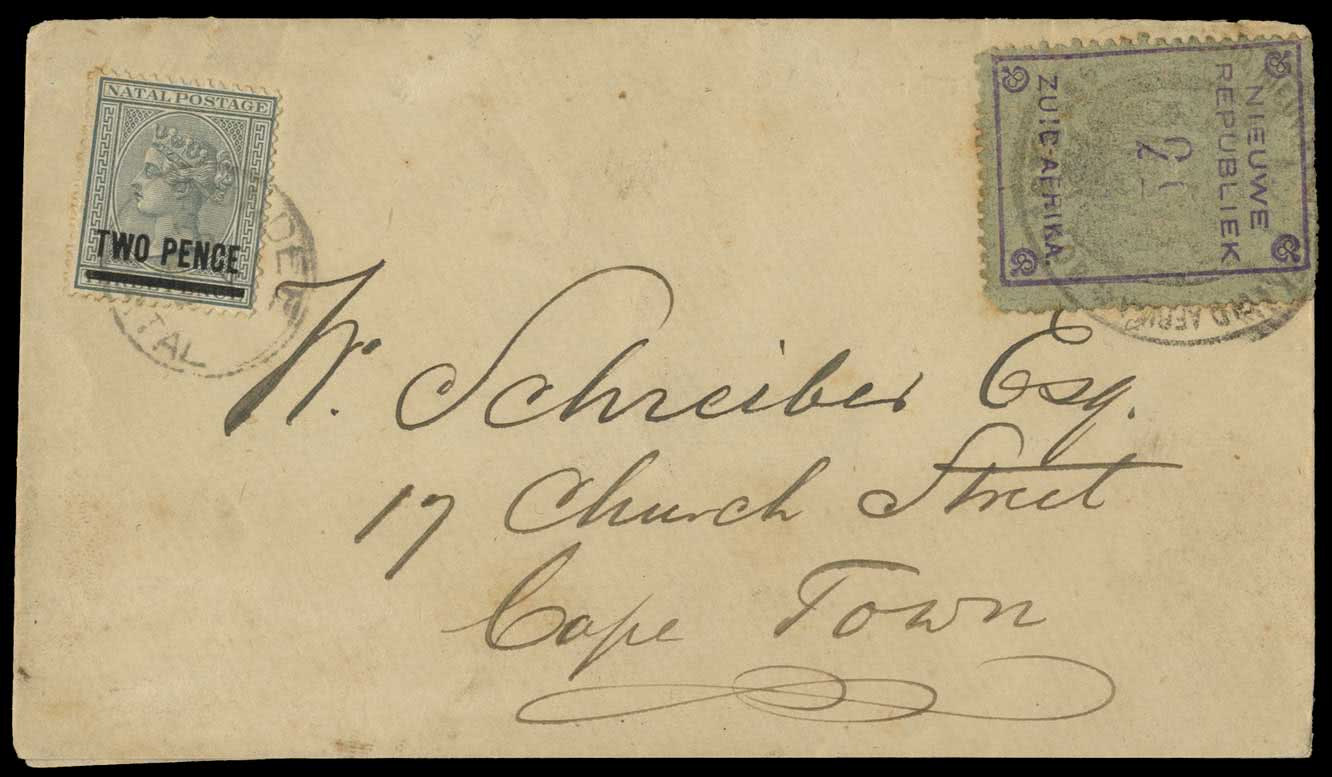
1886 New Republic cover. VRYHEID 'undated' via NATAL (DUNDEE) to CAPE TOWN.
New Republic 2d. unembossed Arms on granite paper cancelled with violet circular datestamp Putzel No. 1.
Plus NATAL 1886 (January) TWO PENCE on 3d grey cancelled with Dundee Circular Datestamp.
(Ex-Grosvenor Auctions.)
New Republic stamps are divided into numerous categories on either yellow or granite paper with or without dates. These rather plain and unattractive stamps are generally diminished by wear, tears, thins, faults, general grubbiness and poor strikes when postally used. Of the seven stamps below all but one is cancelled with the more common VRYHEID violet oval dated handstamp. Both of the two types of this handstamp can be seen in the top 2nd and 3rd stamp along. Refer to Putzel at base.
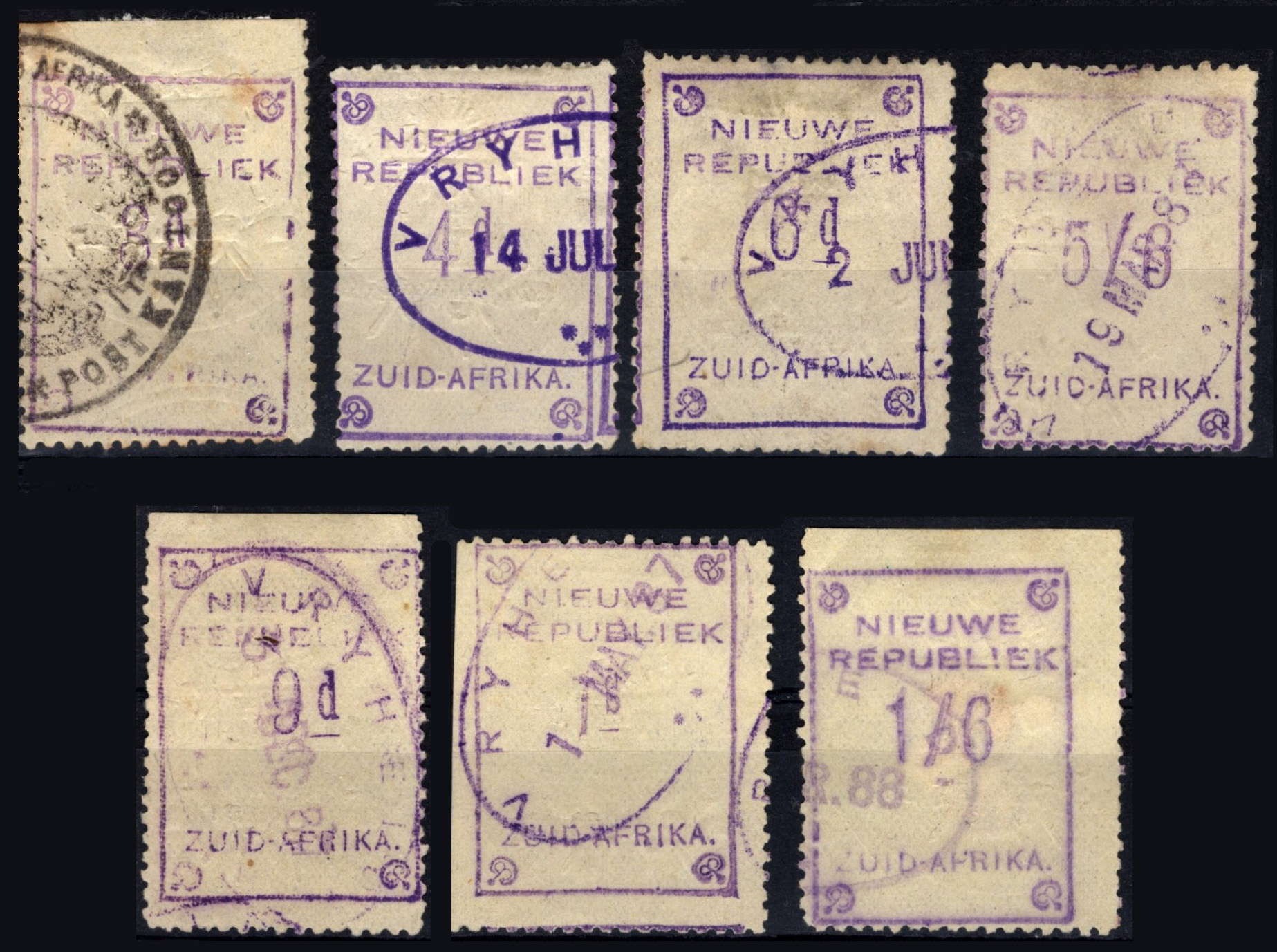
Circa 1887 - 1888. Examples of the oval datestamp used to cancel New Republic stamps, postally and fiscally.
Some 64 varieties are listed. Numerous forgeries exist even on genuine paper. Genuine stamps are said to show a small blurry sliver above the top of the first "E" in "REPUBLIEK" as well as a diagonal slice removed from the lower right of the bottom leg of the second "E" of "REPUBLIEK". These flws are not always obvious singly ot together. Their absence is not proof of forgery.
Check this site out for Examples of Forgeries.
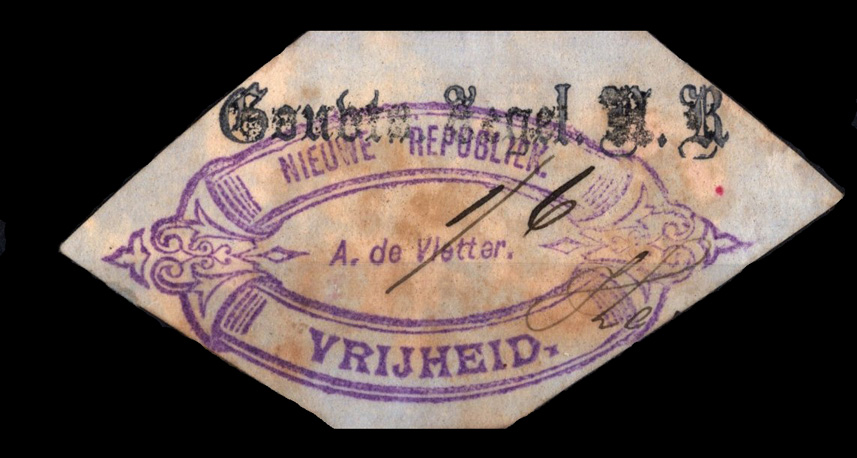
Circa 1886. Fiscal piece. VRIJHEID rubber stamp buckle design inscribed Nieuwe Republiek
A. de Vletter Vrijheid manuscript inserted 1/6d duty in black.
Additional handstampe one line cachet with the word 'Zegel' (Revenue/Duty).
Below are the handstamps, datestamps and cachets recorded used in the New Republic by Ralph Putzel RDPSA, (The Postmarks of South Africa and Former States and Colonies.) The first three, Nos. 1 - 3, are shown on the covers above; the last two ovals with three large or small dots are both shown on the used stamps above.