
Personalities - Some South Africans
Quote from Steve on January 12, 2026, 11:12 pmCharles Chudleigh, Johannesburg
I bought this cover in a small lot and it recently resurfaced on my desk. I wondered what it was and who it was from. It has a very nice JOHANNESBURG 9 postmark dated '1 DEC 06' cancelling a Transvaal 1905 ½d green (Printed Matter rate) to GB.
I did a quick spot of Googling and ... surprise ... it was was from soon-to-be Mayor of Johannesburg, Charles Chudleigh. Given that our hobby is built on letters and postcards from minor and greater personalities of a long time ago, some of whom influenced our history in one way or another, it gave me the idea to open a Topic where we could resurrect them through their contribution to postal history.
The contents of this letter is a Christmas card of sort, a commercial 'thanks for your business past and present' and also a "look how well I am doing". His address says it all.... The Summit.
Chudleigh (right) was a successful merchant and draper in 1906 when this letter was posted. He was a co-founder of the well-known soft goods store, Chudleigh Bros, on the corner of Eloff and Pritchard Streets. A leading figure in Johannesburg's commercial life, he is considered to have been a prominent and influential force in the development of the City of Gold. His unwavering optimism played a crucial role in the city's growth after the South African War (1899 - 1902) and before Union when he was Mayor of Johannesburg from 1908 to 1909. "The Summit" was likely the name of a significant residence or property belonging to him located in or near the prestigious Hospital Hill area, which was a desirable residential area for the city's elite at the time, one with a good view both north (to Pretoria) and south.
Chudleigh was born in the Scilly Islands off the south-west cost of Cornwall. The surname 'Chudleigh' is Devonian in origin. Cornwall and Devon are neighbouring counties. The Scilly Isles were once connected to Cornwall by a landbridge. The sea between them is rich in recent prehistoric artefacts. The name 'Chudleigh' first appears c. 1150. It refers to Ceddelegam, 'clearing of a man named Ciedda' or 'clearing in a hollow'. It derives from Old English ceod(e) + leah. The primary language spoken in the Isles of Scilly is English with a Scillonian dialect which comes from a Cornish heritage. The native Cornish language (Kernewek) died out centuries ago, leaving behind many local place names. It's no longer a living language but its influence remains in the unique Scillonian English spoken on the islands.
The slogan on the Christmas card is curious. 'BENNATH DEW CENOUGH WHY' is likely an ancient phrase from Cornish translating roughly to "Beneath the water is enough" or "Under the sea is enough", possibly a reference to shipwrecks, the abundance of life-sustaining marine life or maybe just the lost land beneath the sea. Given the Scilly Isles' history of shipwrecks and its rich maritime environment, the phrase likely speaks to the treasures found beneath the waves, that there's plenty to be found below the surface and that the sea provides all that is needed in terms of food. It expresses a deep connection to the ocean that defines the islands. Used in the context of Johannesburg, this is possibly an oblique reference to its underground gold wealth without which the city would not exist.
So, in a nutshell, this cover describes a British economic migrant, a resented Uitlander (Boer. foreigner) and an abeblungu, (Xhosa. 'the scum from the sea), who succeeds commercially in Johannesburg. He celebrates his good fortune at Christmas time by writing to friends in the old country, in part sending them a coded mesage written in an ancient language only they understand, one that was lost long ago, telling them that he remains at heart a Scillonian, Kernewek, Devonian, Englishman and or Anglo-Briton. But a South African?
Charles Chudleigh, Johannesburg
I bought this cover in a small lot and it recently resurfaced on my desk. I wondered what it was and who it was from. It has a very nice JOHANNESBURG 9 postmark dated '1 DEC 06' cancelling a Transvaal 1905 ½d green (Printed Matter rate) to GB.
I did a quick spot of Googling and ... surprise ... it was was from soon-to-be Mayor of Johannesburg, Charles Chudleigh. Given that our hobby is built on letters and postcards from minor and greater personalities of a long time ago, some of whom influenced our history in one way or another, it gave me the idea to open a Topic where we could resurrect them through their contribution to postal history.
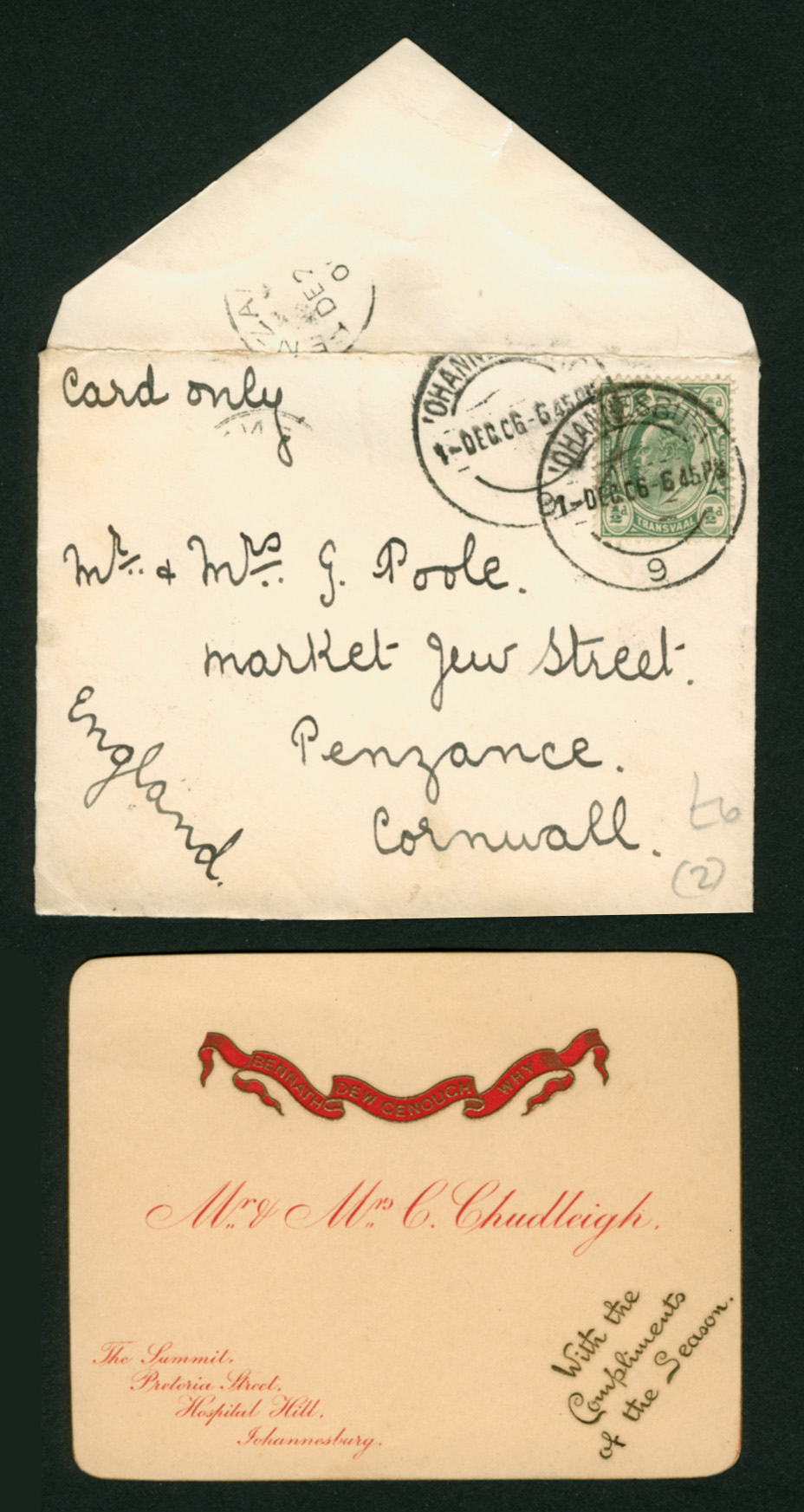
The contents of this letter is a Christmas card of sort, a commercial 'thanks for your business past and present' and also a "look how well I am doing". His address says it all.... The Summit.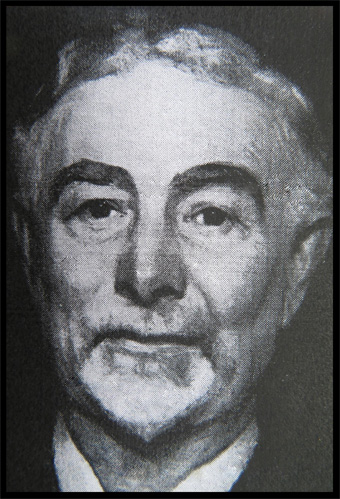
Chudleigh (right) was a successful merchant and draper in 1906 when this letter was posted. He was a co-founder of the well-known soft goods store, Chudleigh Bros, on the corner of Eloff and Pritchard Streets. A leading figure in Johannesburg's commercial life, he is considered to have been a prominent and influential force in the development of the City of Gold. His unwavering optimism played a crucial role in the city's growth after the South African War (1899 - 1902) and before Union when he was Mayor of Johannesburg from 1908 to 1909. "The Summit" was likely the name of a significant residence or property belonging to him located in or near the prestigious Hospital Hill area, which was a desirable residential area for the city's elite at the time, one with a good view both north (to Pretoria) and south.
Chudleigh was born in the Scilly Islands off the south-west cost of Cornwall. The surname 'Chudleigh' is Devonian in origin. Cornwall and Devon are neighbouring counties. The Scilly Isles were once connected to Cornwall by a landbridge. The sea between them is rich in recent prehistoric artefacts. The name 'Chudleigh' first appears c. 1150. It refers to Ceddelegam, 'clearing of a man named Ciedda' or 'clearing in a hollow'. It derives from Old English ceod(e) + leah. The primary language spoken in the Isles of Scilly is English with a Scillonian dialect which comes from a Cornish heritage. The native Cornish language (Kernewek) died out centuries ago, leaving behind many local place names. It's no longer a living language but its influence remains in the unique Scillonian English spoken on the islands.
The slogan on the Christmas card is curious. 'BENNATH DEW CENOUGH WHY' is likely an ancient phrase from Cornish translating roughly to "Beneath the water is enough" or "Under the sea is enough", possibly a reference to shipwrecks, the abundance of life-sustaining marine life or maybe just the lost land beneath the sea. Given the Scilly Isles' history of shipwrecks and its rich maritime environment, the phrase likely speaks to the treasures found beneath the waves, that there's plenty to be found below the surface and that the sea provides all that is needed in terms of food. It expresses a deep connection to the ocean that defines the islands. Used in the context of Johannesburg, this is possibly an oblique reference to its underground gold wealth without which the city would not exist.
So, in a nutshell, this cover describes a British economic migrant, a resented Uitlander (Boer. foreigner) and an abeblungu, (Xhosa. 'the scum from the sea), who succeeds commercially in Johannesburg. He celebrates his good fortune at Christmas time by writing to friends in the old country, in part sending them a coded mesage written in an ancient language only they understand, one that was lost long ago, telling them that he remains at heart a Scillonian, Kernewek, Devonian, Englishman and or Anglo-Briton. But a South African?