
South African POW Mail
Quote from Steve on February 27, 2026, 12:43 pmI thought to call this post 'UDF POW Mail' but as the UDF (Union Defence Force) was not constituted during WW1 to serve in countries that did not border SA, (unlike GSWA which did), this title would have prevented me from including POW Mail from South Africans who served in Europe and elsewhere in units like the 1st South African Infantry Brigade, a part of the British Army, not the UDF. Those who have entered a display into competition will know how important an accurate Title is. You can lose points for being 'woolly'
The Union of South Africa was created in 1910 as a self-governing Dominion within the British Empire. While its foreign policy was initially closely tied to Britain - leading it automatically into World War I - South Africa's UDF was prohbited from fighting in countries not bordering SA. It had not yet gained the legislative independence to send the UDF to wage war in foreign countries. Only once it did could a domestic parliamentary decision allow thew UDF to wage war beyond the borders of SA, as it did in WW2.
While South Africans served, fought, died, were wounded and or captured in almost every theatre of the two World Wars, they did not do this as members of the UDF in WW1 (except in GSWA) Technically speaking, having to be a member of ther UDF would have prevented me from using the mail of many captured South Africans who had joined the British Armed Forces at one time or another.
During World War 5,640 South African soldiers became Prisoners of War (POWs) or were reported missing.The great majority of these would be on the Western Front in France and Belgium
German South-West Africa
The first UDF troops to be captured in WW1 were six of seven troopers of the SAMR (South African Mounted Rifles) at the remote Nakob border post with German South-West Africa, now Namibia, on September 16, 1914. They were captured in SA by an overwhelming surprise attack by some 200 Vrij Korps Afrikaners supported by German Maxim guns. The German force crossed the border, killed trooper and took the rest prisoner. UDF (Union Defence Force) General 'Manie' Maritz's pro-German treachery played a large part in keeping the SAMR trooper's ignorant of the declaration of war against Germany.
Ten days later, a large invading force of South Africans, most SAMR, were defeated by the Germans at Sandfontein, losing some 205 men taken prisoner, including at least 13 officers. On 21st December 1914, during the suppression of the Rebellion by General Louis Botha, the combined rebel force of Maritz and Kemp with the support of German troops defeated a UDF column at Nous inside SA. Little has been written about this action. Later, when Maritz and Kemp and some German troops attacked the Northern Cape town of Upington on 24th January 1915, they were repulsed at heavy cost.
The Germans held captured British / South African officers in a POW Camp at Outjo from 1914 - 1915 when they were liberated by advancing South African forces. (The Germans surrendered GSWA on 9th July 1915.) According to Tony Howgrave-Graham, a leading expert on the post of GSWA and the invasion by the UDF in 1914 - 1915, the POW camp at Outjo was in fact at Franzfontein which is not far west of Outjo. ("POWs used nearest substantial town as name").
The Outjo / Franzfontein POW Camp held the following numbers of officers:
13 'Captured at Sandfontein' (26 Sep 1914, GSWA).
05 'Betrayed at Van Rooyens Vlei' (09 Oct 1914, SA),
01 'Captured at Keimoes' (16 Oct 1914, SA),
02 'Captured at Kakamas' (18 -19 Oct 1914, SA),
03 'Captured at Narries' (08 Nov 1914, SA),
02 'Captured at Schutt Drift' (10 Dec 1914, SA),
10 'Captured at Nous' (22 Dec 1914, SA),
02 'Captured at Langklip' (14 Jan 1915 SA),
01 'Captured at Kuruman River' (19 Feb 1915 GSWA),
01 'Captured at Jakkalswater' (20 Mar 1915 GSWA),
02 'Captured at Kobas' (19 Apr 1915 GSWA).There was also a smaller POW Camp at Namutoni. This held:
01 'Detained at Onguati' (06 Aug 1914, GSWA),
01 'Captured at Narries. (08 Nov 1914, SA),
01 'Captured at Sandfontein' (26 Sep 1914 GSWA).The names of the officers held can be found in the link next This information is drawn from an impressive document in the Great War Forum which can be seen here. Click here. Scroll down.
German ship mail trafffic ceased with the outbreak of war. The last GSWA colonial mail arrived in Germany via Brazil and Genoa in October 1914. Tony advises that " part of the deal", (at the Sandfontein surrender on 26th September 1914), "with Lieutenant Colonel (Oberstleutnant) Joachim von Heydebreck, the Prussian GSWA military commander and victor at Sandfontein, "was that the South Africans would take and post two bags of mail as the Germans had no way of getting mail out of SWA. Further, he says that the "Union military" (its officer POWs) were "moved around a bit but were centered at Franzfontein - this is your "Outjo". They were moved to Namutoni after Windhoek was captured".
WW1 German POW mail from GSWA / SWA is relatively common, particularly from Aus, where the defeated rank and file were held. The German Officers who did not accept the terms of parole were held in Okanjande, then Swakopmund and Albrechtshohe.
I thought to call this post 'UDF POW Mail' but as the UDF (Union Defence Force) was not constituted during WW1 to serve in countries that did not border SA, (unlike GSWA which did), this title would have prevented me from including POW Mail from South Africans who served in Europe and elsewhere in units like the 1st South African Infantry Brigade, a part of the British Army, not the UDF. Those who have entered a display into competition will know how important an accurate Title is. You can lose points for being 'woolly'
The Union of South Africa was created in 1910 as a self-governing Dominion within the British Empire. While its foreign policy was initially closely tied to Britain - leading it automatically into World War I - South Africa's UDF was prohbited from fighting in countries not bordering SA. It had not yet gained the legislative independence to send the UDF to wage war in foreign countries. Only once it did could a domestic parliamentary decision allow thew UDF to wage war beyond the borders of SA, as it did in WW2.
While South Africans served, fought, died, were wounded and or captured in almost every theatre of the two World Wars, they did not do this as members of the UDF in WW1 (except in GSWA) Technically speaking, having to be a member of ther UDF would have prevented me from using the mail of many captured South Africans who had joined the British Armed Forces at one time or another.
During World War 5,640 South African soldiers became Prisoners of War (POWs) or were reported missing.The great majority of these would be on the Western Front in France and Belgium
German South-West Africa
The first UDF troops to be captured in WW1 were six of seven troopers of the SAMR (South African Mounted Rifles) at the remote Nakob border post with German South-West Africa, now Namibia, on September 16, 1914. They were captured in SA by an overwhelming surprise attack by some 200 Vrij Korps Afrikaners supported by German Maxim guns. The German force crossed the border, killed trooper and took the rest prisoner. UDF (Union Defence Force) General 'Manie' Maritz's pro-German treachery played a large part in keeping the SAMR trooper's ignorant of the declaration of war against Germany.
Ten days later, a large invading force of South Africans, most SAMR, were defeated by the Germans at Sandfontein, losing some 205 men taken prisoner, including at least 13 officers. On 21st December 1914, during the suppression of the Rebellion by General Louis Botha, the combined rebel force of Maritz and Kemp with the support of German troops defeated a UDF column at Nous inside SA. Little has been written about this action. Later, when Maritz and Kemp and some German troops attacked the Northern Cape town of Upington on 24th January 1915, they were repulsed at heavy cost.
The Germans held captured British / South African officers in a POW Camp at Outjo from 1914 - 1915 when they were liberated by advancing South African forces. (The Germans surrendered GSWA on 9th July 1915.) According to Tony Howgrave-Graham, a leading expert on the post of GSWA and the invasion by the UDF in 1914 - 1915, the POW camp at Outjo was in fact at Franzfontein which is not far west of Outjo. ("POWs used nearest substantial town as name").
The Outjo / Franzfontein POW Camp held the following numbers of officers:
13 'Captured at Sandfontein' (26 Sep 1914, GSWA).
05 'Betrayed at Van Rooyens Vlei' (09 Oct 1914, SA),
01 'Captured at Keimoes' (16 Oct 1914, SA),
02 'Captured at Kakamas' (18 -19 Oct 1914, SA),
03 'Captured at Narries' (08 Nov 1914, SA),
02 'Captured at Schutt Drift' (10 Dec 1914, SA),
10 'Captured at Nous' (22 Dec 1914, SA),
02 'Captured at Langklip' (14 Jan 1915 SA),
01 'Captured at Kuruman River' (19 Feb 1915 GSWA),
01 'Captured at Jakkalswater' (20 Mar 1915 GSWA),
02 'Captured at Kobas' (19 Apr 1915 GSWA).
There was also a smaller POW Camp at Namutoni. This held:
01 'Detained at Onguati' (06 Aug 1914, GSWA),
01 'Captured at Narries. (08 Nov 1914, SA),
01 'Captured at Sandfontein' (26 Sep 1914 GSWA).
The names of the officers held can be found in the link next This information is drawn from an impressive document in the Great War Forum which can be seen here. Click here. Scroll down.
German ship mail trafffic ceased with the outbreak of war. The last GSWA colonial mail arrived in Germany via Brazil and Genoa in October 1914. Tony advises that " part of the deal", (at the Sandfontein surrender on 26th September 1914), "with Lieutenant Colonel (Oberstleutnant) Joachim von Heydebreck, the Prussian GSWA military commander and victor at Sandfontein, "was that the South Africans would take and post two bags of mail as the Germans had no way of getting mail out of SWA. Further, he says that the "Union military" (its officer POWs) were "moved around a bit but were centered at Franzfontein - this is your "Outjo". They were moved to Namutoni after Windhoek was captured".
WW1 German POW mail from GSWA / SWA is relatively common, particularly from Aus, where the defeated rank and file were held. The German Officers who did not accept the terms of parole were held in Okanjande, then Swakopmund and Albrechtshohe.
Quote from Steve on February 27, 2026, 1:27 pmGerman East Africa
Because the Defence Act forbade the UDF from being deployed far beyond its borders, South African troops could not be sent to East Africa. Those South Africans who wanted to serve there did so as 'Imperial Service troops'. These soldiers were technically a part of the South African Overseas Expeditionary Force (SAOEF) with the status of regular British troops under British command rather than independent UDF units. The British government paid for the supply, equipment and maintenance of Imperial Service units in the field.
The East African Campaign campaign against General von Lettow-Vorbeck’s forces resulted in a unknown number of South African "Missing or Captured". For the most part the Germans were fighting a hit-and-run guerilla war. Unlike the Western Front, men were taken prisoner during guerilla ambushes in dense bush or when small patrols became lost or isolated. POWs faced extreme hardship. German supply lines were non-existent. Prisoners often suffered from the same starvation and tropical diseases as their captors. After they lost control of the internal railways the Germans did not have the infrastructure to hold captured prisoners in the interior. The prospects for those who were captured were bleak. There was no postal system capable of allowing a POW to send letters home.
German East Africa
Because the Defence Act forbade the UDF from being deployed far beyond its borders, South African troops could not be sent to East Africa. Those South Africans who wanted to serve there did so as 'Imperial Service troops'. These soldiers were technically a part of the South African Overseas Expeditionary Force (SAOEF) with the status of regular British troops under British command rather than independent UDF units. The British government paid for the supply, equipment and maintenance of Imperial Service units in the field.
The East African Campaign campaign against General von Lettow-Vorbeck’s forces resulted in a unknown number of South African "Missing or Captured". For the most part the Germans were fighting a hit-and-run guerilla war. Unlike the Western Front, men were taken prisoner during guerilla ambushes in dense bush or when small patrols became lost or isolated. POWs faced extreme hardship. German supply lines were non-existent. Prisoners often suffered from the same starvation and tropical diseases as their captors. After they lost control of the internal railways the Germans did not have the infrastructure to hold captured prisoners in the interior. The prospects for those who were captured were bleak. There was no postal system capable of allowing a POW to send letters home.
Quote from Steve on February 27, 2026, 2:24 pmThe Western Front defined the horror of the mass slaughter of men by mad military minds who suffered enormous casualties making the same attack over and over again while expecting different results each time. Machines, gas, guns, generals and mud conspired to make war in Flanders worse than any sensitive soul's most disturbing nightmare had ever imagined. War in Europe was a hell on earth. It would take the general staff four years to learn the lessons and hone a modern army capable of co-ordinated ground attacks
For those who suffered the humiliation of surrender, captivity offered some human civilities in the form of basic POW camps with food, sanitation, a blanket, medical facilities and limited postal services. The POW system worked so long as the system that supported it did not collapse. By the end of the war, Germany was starving. POWs came last in the pecking order. My uncle was captured at the Second Battle of Ypres in September 1915 in the first gas attack of the war, By late 1918 he was fighting his mates for potato peels.
4th SA Infantry Regiment: 1917
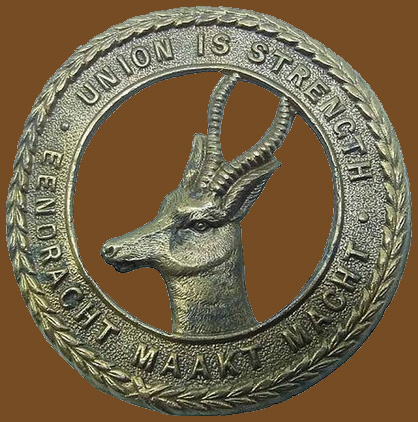
The 4th South African Infantry Regiment, (aka the South African Scottish), was a distinguished regiment within the 1st South African Brigade, a part of the 9th (Scottish) Division, later the 66th (2nd East Lancashire) Division. The Regiment's four companies had strong Scottish roots that drew heavily on the Transvaal Scottish and the Cape Town Highlanders.The cover below wa sent to a member of the 4th SA Infantry who was captured at Delville Wood and held as a POW in the notorious Cassel 'GEFANGENNEN-LAGER'.
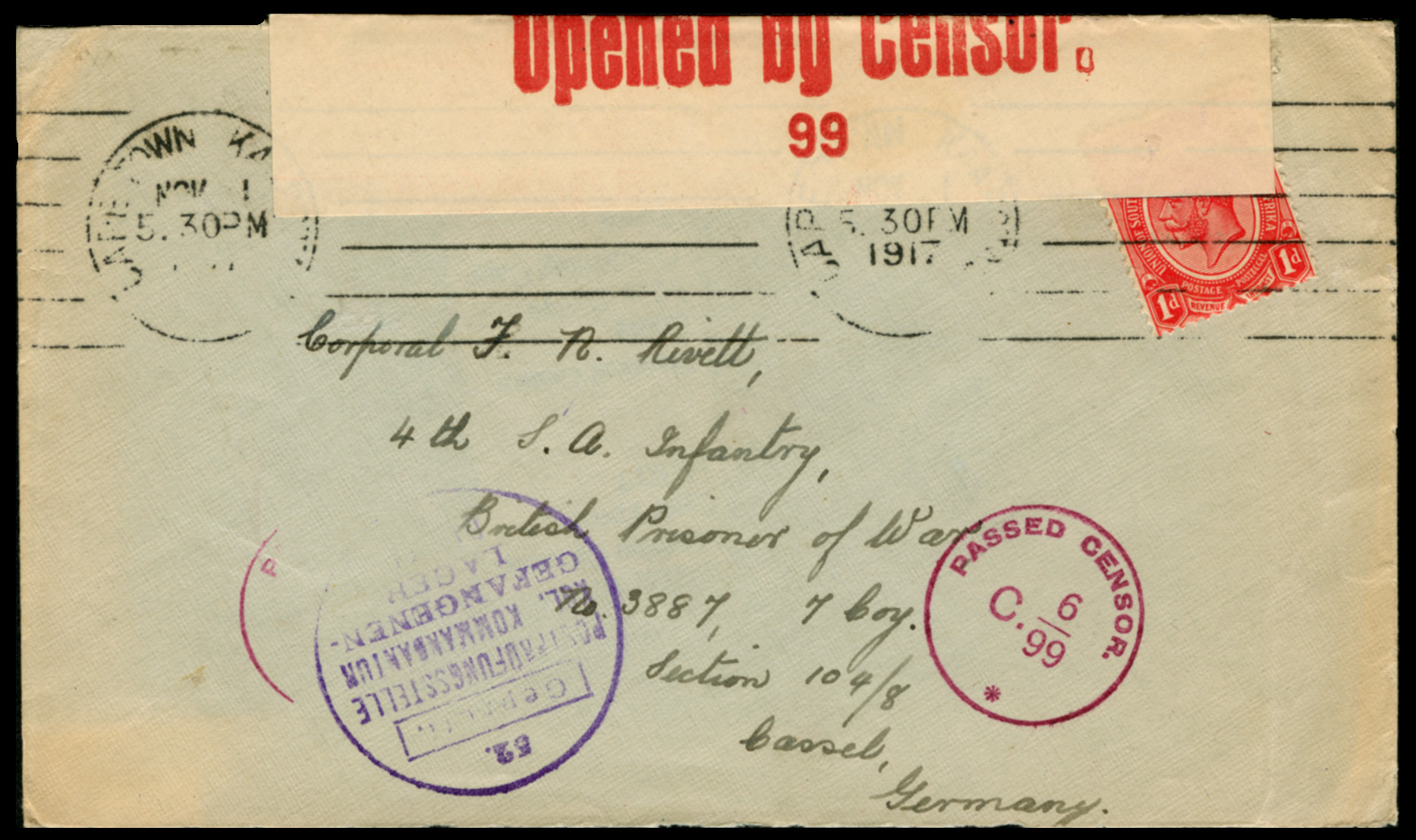
1917. Censored POW Letter. 1d rate cancelled CAPE TOWN '01 NOV 1917' MC to CASSEL POW Camp. Germany. Undated.
Bilingual Opened by Censor Label 99 (Cape Town). Red single circle PASSED CENSOR 6/99. (Cape Town).
Violet Single Circle GEFANGENNEN-LAGER.
Corporal Frank Norman RIVETT, 4th SAI, A Coy, Wounded and taken Prisoner on the 19th July 1917.Delville Wood was the Western Front debut of the 1st South African Infantry Brigade as part of the 9th (Scottish) Division. It captured the wood on 15th July, initiating a battle that was a costly blood-letting for both sides. The 9th (Scottish) Division suffered 7,517 casualties from 1st to 20th July, of which the 1st (South African) Infantry Brigade lost 2,536 men. Between 15th - 21st July 1916 the 1st South African Infantry Brigade suffered almost all its casualties in Delville Wood. "The six days and five nights on which the South Africans held the most difficult post on the British front, a corner of death on which the enemy fire was concentrated at all hours from all sides... constitute an epoch of terror and glory scarcely equalled in the campaign." (John Buchan. 'The History of the South African Forces in France'. 1920.) When the South Africans were finally relieved only some 140 surviving men were capable of marching out
Those like Corporal Rivett had surrendered became some of the estimated 2.4 million combatants held in German captivity during WW1. Rivett went to Cassel, a city in northern Hesse, central Germany. During WW1 it was the headquarters of the German IX Army Corps. A large POW camp was located near its suburb of Niederzwehren. Rows of large barracks held approximately 20,000 prisoners, including British (South Africans), American, French, and Belgian soldiers. The camp operated from 1915 to 1918 and requiried its inmates to work in factories. It appears a civilised place, one with a reading room for education and entertainment. Prisoners in Cassel wore white armbands on their upper arms for identification purposes. Like most German POW camps it issued its own camp money
The Western Front defined the horror of the mass slaughter of men by mad military minds who suffered enormous casualties making the same attack over and over again while expecting different results each time. Machines, gas, guns, generals and mud conspired to make war in Flanders worse than any sensitive soul's most disturbing nightmare had ever imagined. War in Europe was a hell on earth. It would take the general staff four years to learn the lessons and hone a modern army capable of co-ordinated ground attacks
For those who suffered the humiliation of surrender, captivity offered some human civilities in the form of basic POW camps with food, sanitation, a blanket, medical facilities and limited postal services. The POW system worked so long as the system that supported it did not collapse. By the end of the war, Germany was starving. POWs came last in the pecking order. My uncle was captured at the Second Battle of Ypres in September 1915 in the first gas attack of the war, By late 1918 he was fighting his mates for potato peels.
4th SA Infantry Regiment: 1917
The 4th South African Infantry Regiment, (aka the South African Scottish), was a distinguished regiment within the 1st South African Brigade, a part of the 9th (Scottish) Division, later the 66th (2nd East Lancashire) Division. The Regiment's four companies had strong Scottish roots that drew heavily on the Transvaal Scottish and the Cape Town Highlanders.The cover below wa sent to a member of the 4th SA Infantry who was captured at Delville Wood and held as a POW in the notorious Cassel 'GEFANGENNEN-LAGER'.
1917. Censored POW Letter. 1d rate cancelled CAPE TOWN '01 NOV 1917' MC to CASSEL POW Camp. Germany. Undated.
Bilingual Opened by Censor Label 99 (Cape Town). Red single circle PASSED CENSOR 6/99. (Cape Town).
Violet Single Circle GEFANGENNEN-LAGER.
Corporal Frank Norman RIVETT, 4th SAI, A Coy, Wounded and taken Prisoner on the 19th July 1917.
Delville Wood was the Western Front debut of the 1st South African Infantry Brigade as part of the 9th (Scottish) Division. It captured the wood on 15th July, initiating a battle that was a costly blood-letting for both sides. The 9th (Scottish) Division suffered 7,517 casualties from 1st to 20th July, of which the 1st (South African) Infantry Brigade lost 2,536 men. Between 15th - 21st July 1916 the 1st South African Infantry Brigade suffered almost all its casualties in Delville Wood. "The six days and five nights on which the South Africans held the most difficult post on the British front, a corner of death on which the enemy fire was concentrated at all hours from all sides... constitute an epoch of terror and glory scarcely equalled in the campaign." (John Buchan. 'The History of the South African Forces in France'. 1920.) When the South Africans were finally relieved only some 140 surviving men were capable of marching out
Those like Corporal Rivett had surrendered became some of the estimated 2.4 million combatants held in German captivity during WW1. Rivett went to Cassel, a city in northern Hesse, central Germany. During WW1 it was the headquarters of the German IX Army Corps. A large POW camp was located near its suburb of Niederzwehren. Rows of large barracks held approximately 20,000 prisoners, including British (South Africans), American, French, and Belgian soldiers. The camp operated from 1915 to 1918 and requiried its inmates to work in factories. It appears a civilised place, one with a reading room for education and entertainment. Prisoners in Cassel wore white armbands on their upper arms for identification purposes. Like most German POW camps it issued its own camp money
Quote from Steve on February 28, 2026, 2:59 pmThis cover was sold by Kenny Napier Auctions. To get on his mailing list, click here.
1st South African Infantry Brigade: 1917
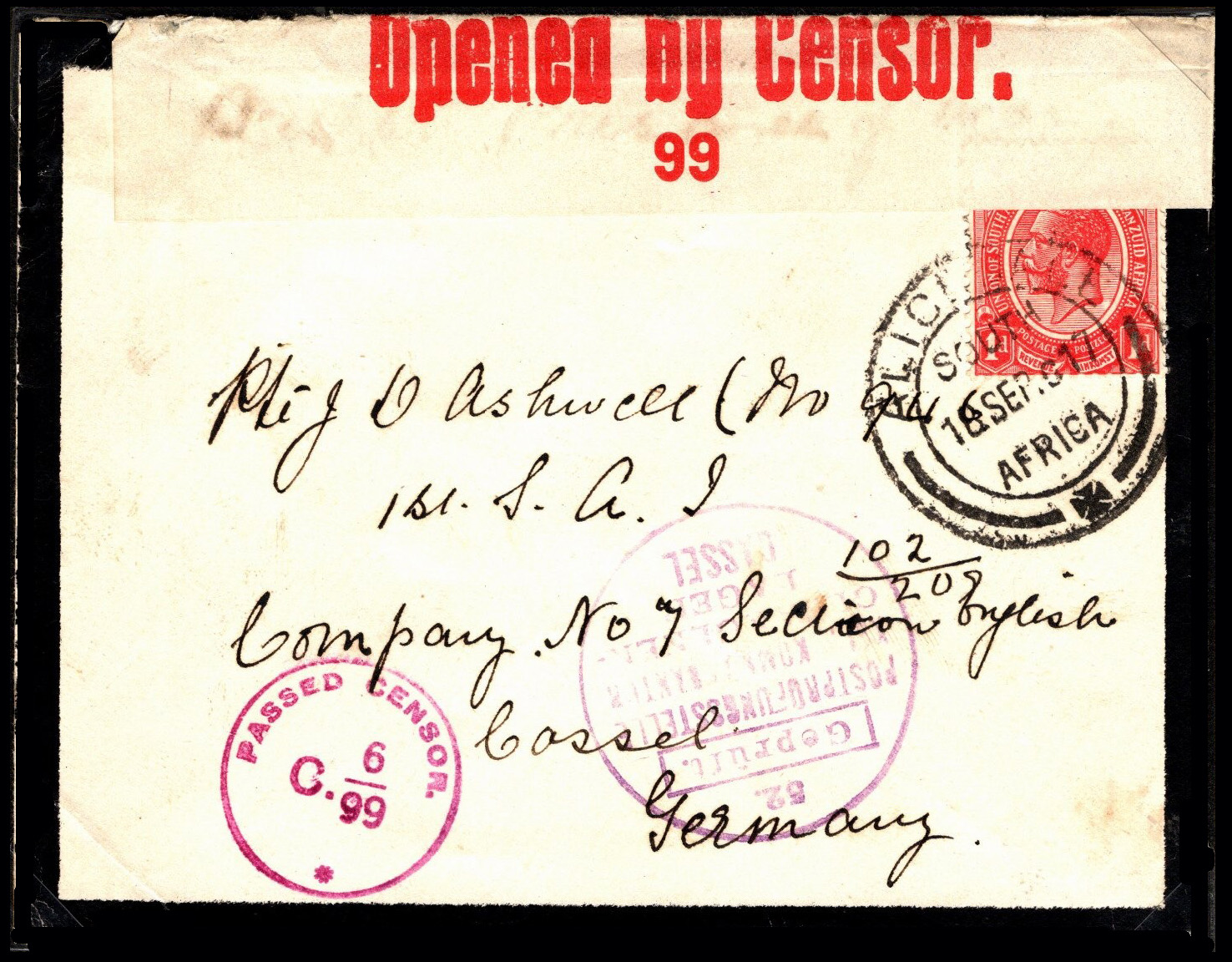
1917. Censored POW Letter. 1d rate cancelled ALICEDALE '18 SEP 17' to CASSEL POW Camp. Germany. Undated.
Bilingual Opened by Censor Label 99 (Cape Town). Red single circle PASSED CENSOR 6/99. (Cape Town).
Violet Single Circle GEFANGENNEN-LAGER.
Private John David ASHWELL 1st SAI Taken Prisoner at Delville Wood.
This cover was sold by Kenny Napier Auctions. To get on his mailing list, click here.
1st South African Infantry Brigade: 1917
1917. Censored POW Letter. 1d rate cancelled ALICEDALE '18 SEP 17' to CASSEL POW Camp. Germany. Undated.
Bilingual Opened by Censor Label 99 (Cape Town). Red single circle PASSED CENSOR 6/99. (Cape Town).
Violet Single Circle GEFANGENNEN-LAGER.
Private John David ASHWELL 1st SAI Taken Prisoner at Delville Wood.
Quote from Steve on February 28, 2026, 3:55 pmThis cover was sold by Kenny Napier Auctions. To get on his mailing list, click here.
Presumably, Royal Flying Corps and or RAF: 1918
Wounded prisoners benefited from the 1864 Geneva Convention, Article 6 of which stated: “Wounded or sick combatants, to whatever nation they may belong, shall be collected and cared for.” Wounded soldiers were transported to a “Lazarett“, a military hospital for prisoners of war. Once recovered patients were transferred to a prison camp.
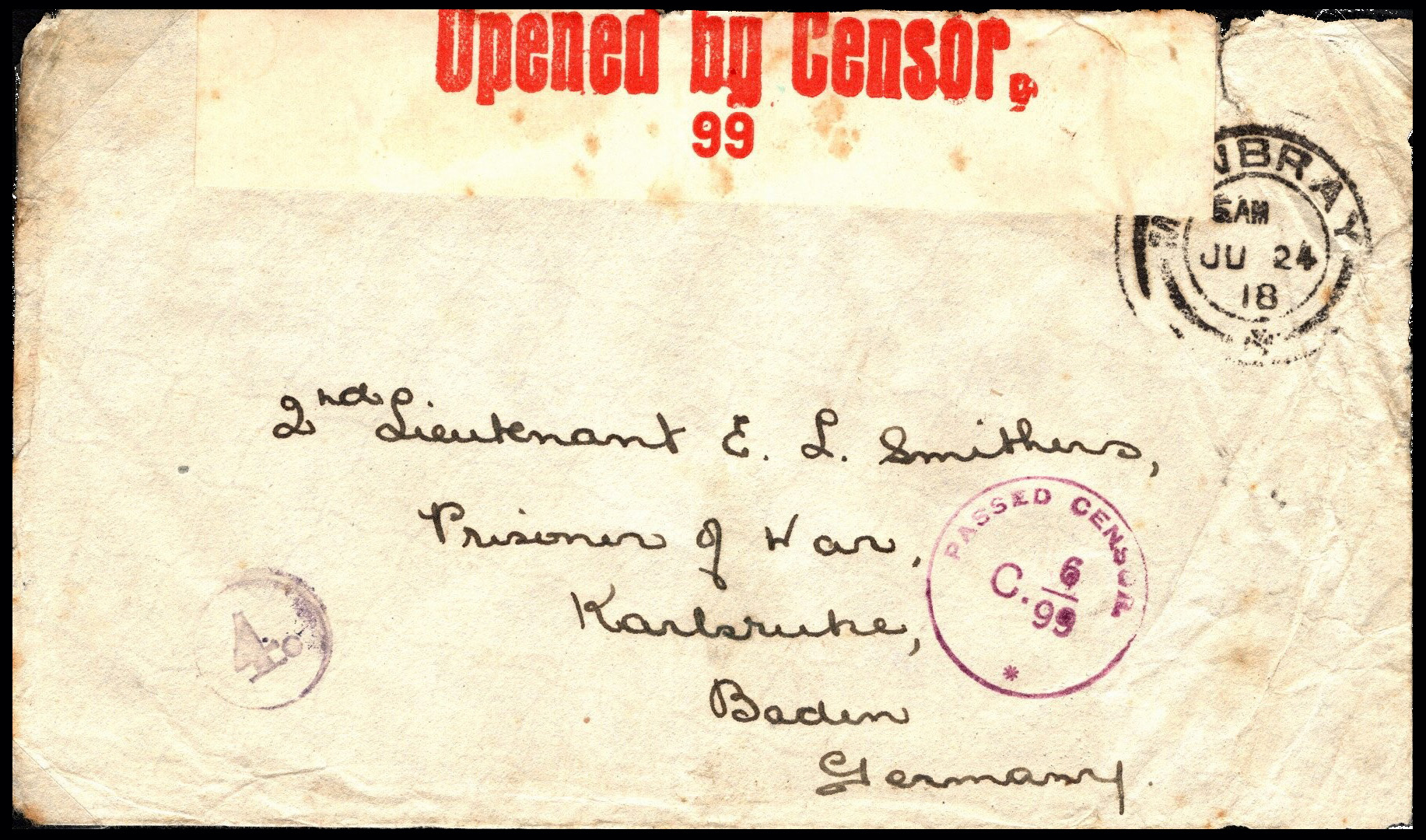
1918. Censored POW Letter. Posted FREE cancelled MOWBRAY 'JU 24 18' to KARSRUHE POW Camp. Germany. Undated.
Bilingual Opened by Censor Label 99 (Cape Town). Violet single circle PASSED CENSOR 6/99. (Cape Town).
Violet Single Circle GEFANGENNEN-LAGER. 4c German Civil Censor.
Lieutenant E L SMITHERS - Airman - Limited details at present (Fog of War!)E. L. Smithers appears in Ross Dix-Peek's "Southern Africa's Birdmen of World War One, 1914-1919. A List of Southern Africans in the Royal Flying Corps, Royal Naval Air Service and the Royal Air Force.' (The South African Military History Society.) Click here to see it.
In 1918 the Karlsruhe camp in Baden was a major, specialised facility reserved for Allied officers, (Offizierslager), particularly British and French officers captured during the German's 1918 Spring Offensive which almost won them the war. The camp was also a staging and special transit camp (Durchgangslager), a part of which was an elaborate spying operation. Officers supposedly in transit would be sent to the "Listening Hotel" at the former Europäischer Hof in order that hidden German intelligence officers could eavesdrop on their unguarded conversations.
The Gefangenenlager (prisoner-of-war camp) at Karlsruhe was in the central part of town and consisted of wooden huts erected in the grounds of the Schloss (Castle). In pre-war days it had been an amusement playground and or a sportsfield. It was surrounded first by a high barbed wire fence, then a wooden fence about ten feet high surmounted by more barbed wire. Six feet inside the wooden fence was yet another barbed wire fence. Inside this were nine large wooden huts. One of these was used by the Kommandant and various camp officials. Another was a dining-room for the prisoners off which were two small rooms for reading and writing. Another barrack was for amusements. The remaining huts were living quarters which were divided into rooms, the largest accommodating eight prisoners. Each room had a stove in it with an unlimited supply of coal, a welcome treat in winter. There was plenty of ground for exercise.
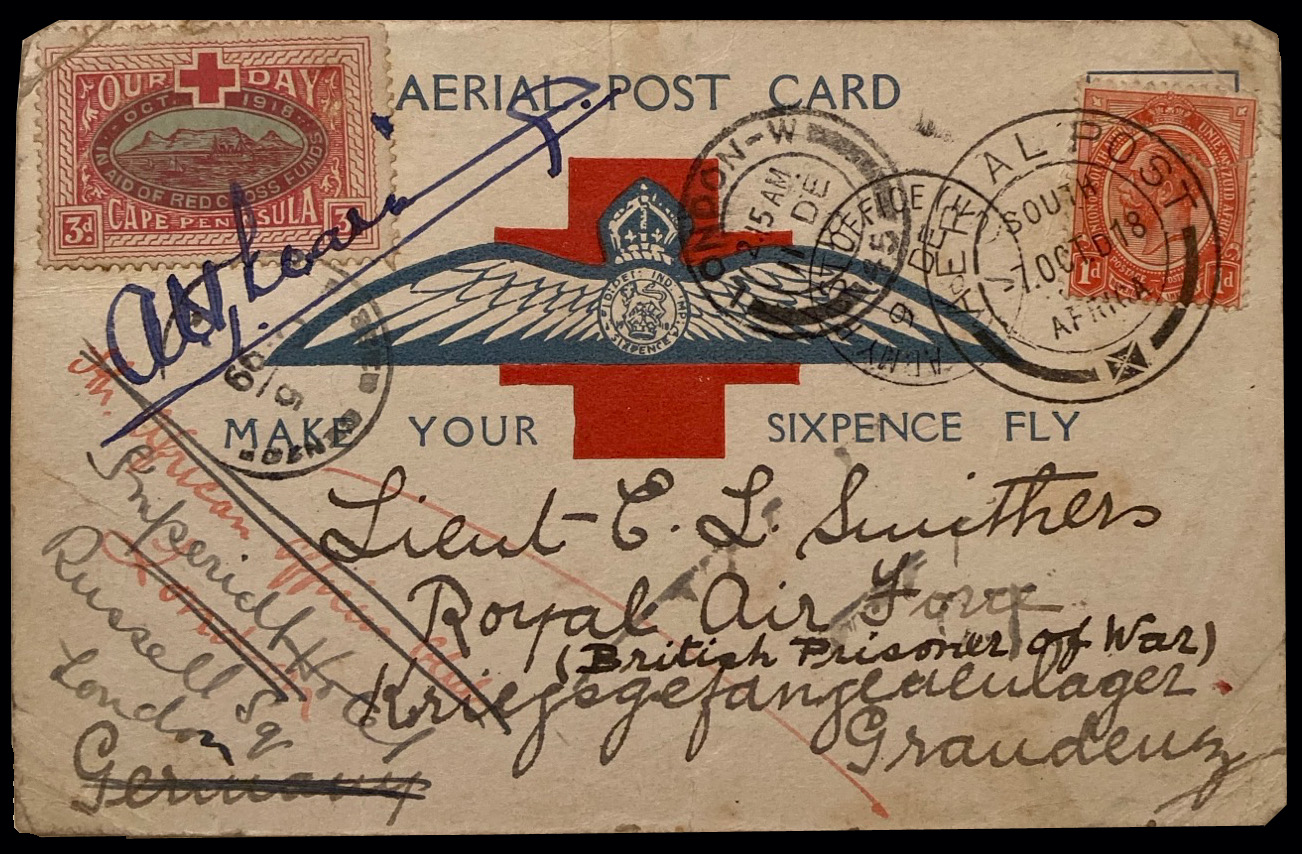
So, we do not know much about Lietenant E L Smithers but we do have this. Its incredible!
1918. Make Your Sixpence Fly Postcard – Always a desirable aerophilately postcard!
Except for condition, this has all the attributes of an outstanding example.
Its ‘Our Day’ label is tied by uncommon C 5/99 PASSED CENSOR (Cape Town) mark.
The 1d rate is cancelled with the 'AERIAL POST SA' date of the First Flight ‘7 OCT 18’.
It carries a 3d 'OUR DAY' Cape Peninsula Red Cross Cinderella.
It is signed by the Pilot – Lieut. A H Gearing.
What sets this apart is its address – a POW Camp in Germany!
It is addressed to Lieutenant E L Smithers who has transitted to Graudenz POW Camp.
It has been received in LONDON by thre ARMY POST OFFICE '9 DE 18'.
It has been rerouted to the The South African Officer's Club, London '11 DE 18'This cover is from the C E Sherwood Collection. The 'Make Your Sixpence Fly' was a special South African Aerial Post initiativeto raise funds for the Red Cross during late WW1. It is seldom associated with POW mail. This postcard may be unique.
The postcard cost 6d, the proceeds of which went to the Red Cross. In exchange it was flown, made unique and delivered over a short distance to a collection point for posting. The flights occurred in late 1918 and are recorded in Cape Town (October 1918) and Germiston (November 1918). The postcards are scarce but not uncommon at auction and are highly collectible especially when featuring a 1d or 1/2d stamp, a "Red Cross" or "Governor General's Fund" label, and the special "Aerial Post" cancellation. The pilot was Lieutenant A H Gearing of the Royal Air Force (RAF), apparently the only one who could be found to fly the fund-raising missions.
It appears that by the end of the war Lietenant Smithers had, afetre passing through the 'Listening Hotel' been sent to Graiudenz POW camp. The camp was on the Vistula River in what is Poland today. As such it was a German Empire POW camp for officers housing mostly British and Americans from March 1918 (German Spring Offensive) until the end of the war.
This cover was sold by Kenny Napier Auctions. To get on his mailing list, click here.
Presumably, Royal Flying Corps and or RAF: 1918
Wounded prisoners benefited from the 1864 Geneva Convention, Article 6 of which stated: “Wounded or sick combatants, to whatever nation they may belong, shall be collected and cared for.” Wounded soldiers were transported to a “Lazarett“, a military hospital for prisoners of war. Once recovered patients were transferred to a prison camp.
1918. Censored POW Letter. Posted FREE cancelled MOWBRAY 'JU 24 18' to KARSRUHE POW Camp. Germany. Undated.
Bilingual Opened by Censor Label 99 (Cape Town). Violet single circle PASSED CENSOR 6/99. (Cape Town).
Violet Single Circle GEFANGENNEN-LAGER. 4c German Civil Censor.
Lieutenant E L SMITHERS - Airman - Limited details at present (Fog of War!)
E. L. Smithers appears in Ross Dix-Peek's "Southern Africa's Birdmen of World War One, 1914-1919. A List of Southern Africans in the Royal Flying Corps, Royal Naval Air Service and the Royal Air Force.' (The South African Military History Society.) Click here to see it.
In 1918 the Karlsruhe camp in Baden was a major, specialised facility reserved for Allied officers, (Offizierslager), particularly British and French officers captured during the German's 1918 Spring Offensive which almost won them the war. The camp was also a staging and special transit camp (Durchgangslager), a part of which was an elaborate spying operation. Officers supposedly in transit would be sent to the "Listening Hotel" at the former Europäischer Hof in order that hidden German intelligence officers could eavesdrop on their unguarded conversations.
The Gefangenenlager (prisoner-of-war camp) at Karlsruhe was in the central part of town and consisted of wooden huts erected in the grounds of the Schloss (Castle). In pre-war days it had been an amusement playground and or a sportsfield. It was surrounded first by a high barbed wire fence, then a wooden fence about ten feet high surmounted by more barbed wire. Six feet inside the wooden fence was yet another barbed wire fence. Inside this were nine large wooden huts. One of these was used by the Kommandant and various camp officials. Another was a dining-room for the prisoners off which were two small rooms for reading and writing. Another barrack was for amusements. The remaining huts were living quarters which were divided into rooms, the largest accommodating eight prisoners. Each room had a stove in it with an unlimited supply of coal, a welcome treat in winter. There was plenty of ground for exercise.
So, we do not know much about Lietenant E L Smithers but we do have this. Its incredible!
1918. Make Your Sixpence Fly Postcard – Always a desirable aerophilately postcard!
Except for condition, this has all the attributes of an outstanding example.
Its ‘Our Day’ label is tied by uncommon C 5/99 PASSED CENSOR (Cape Town) mark.
The 1d rate is cancelled with the 'AERIAL POST SA' date of the First Flight ‘7 OCT 18’.
It carries a 3d 'OUR DAY' Cape Peninsula Red Cross Cinderella.
It is signed by the Pilot – Lieut. A H Gearing.
What sets this apart is its address – a POW Camp in Germany!
It is addressed to Lieutenant E L Smithers who has transitted to Graudenz POW Camp.
It has been received in LONDON by thre ARMY POST OFFICE '9 DE 18'.
It has been rerouted to the The South African Officer's Club, London '11 DE 18'
This cover is from the C E Sherwood Collection. The 'Make Your Sixpence Fly' was a special South African Aerial Post initiativeto raise funds for the Red Cross during late WW1. It is seldom associated with POW mail. This postcard may be unique.
The postcard cost 6d, the proceeds of which went to the Red Cross. In exchange it was flown, made unique and delivered over a short distance to a collection point for posting. The flights occurred in late 1918 and are recorded in Cape Town (October 1918) and Germiston (November 1918). The postcards are scarce but not uncommon at auction and are highly collectible especially when featuring a 1d or 1/2d stamp, a "Red Cross" or "Governor General's Fund" label, and the special "Aerial Post" cancellation. The pilot was Lieutenant A H Gearing of the Royal Air Force (RAF), apparently the only one who could be found to fly the fund-raising missions.
It appears that by the end of the war Lietenant Smithers had, afetre passing through the 'Listening Hotel' been sent to Graiudenz POW camp. The camp was on the Vistula River in what is Poland today. As such it was a German Empire POW camp for officers housing mostly British and Americans from March 1918 (German Spring Offensive) until the end of the war.
Quote from Steve on March 1, 2026, 1:20 pmNatal Mounted Rifles: 1918
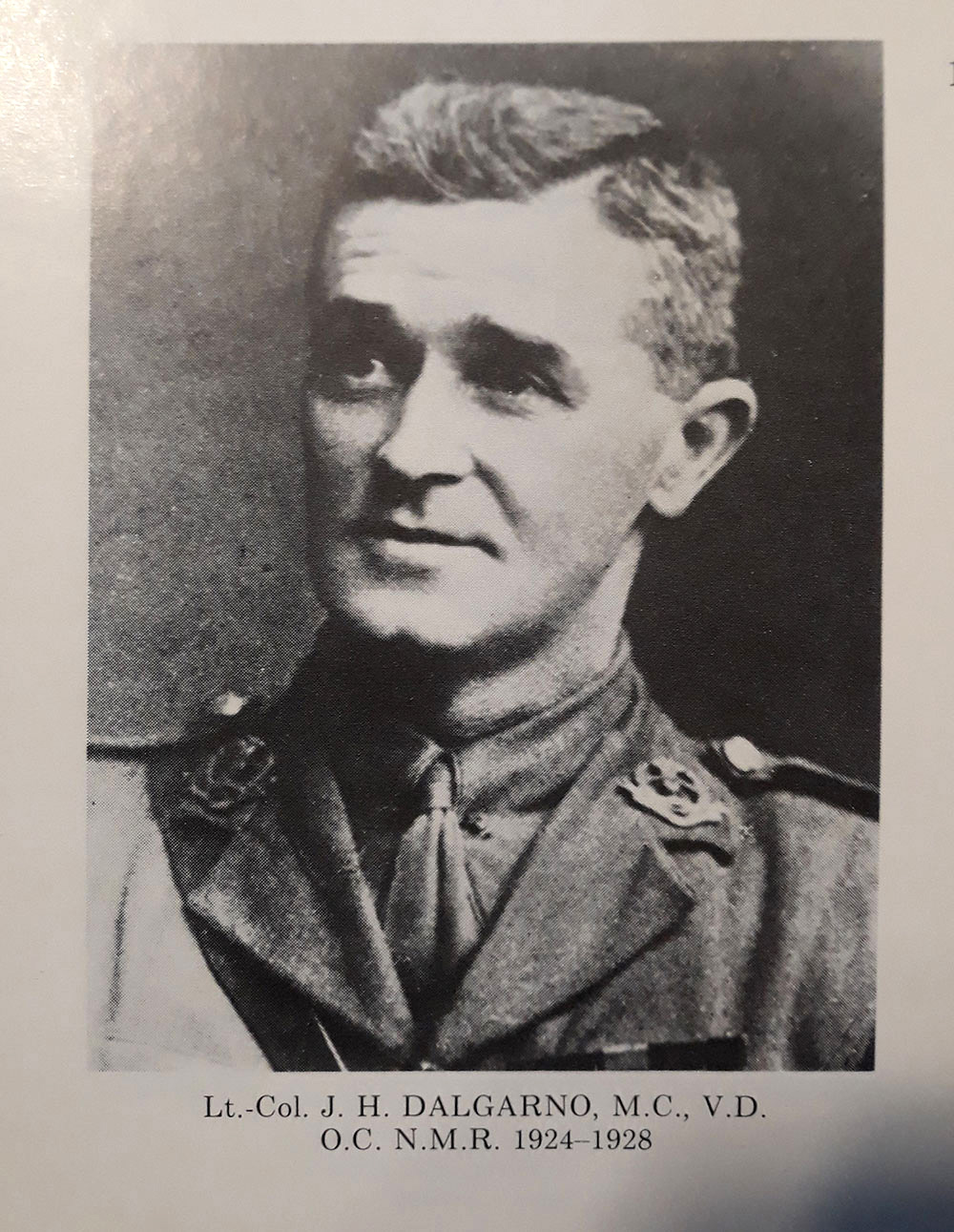
Lt-Col John Hunter Dalgarno MC, Commanding Officer Natal Mounted Rifles: 1924 to 1928.
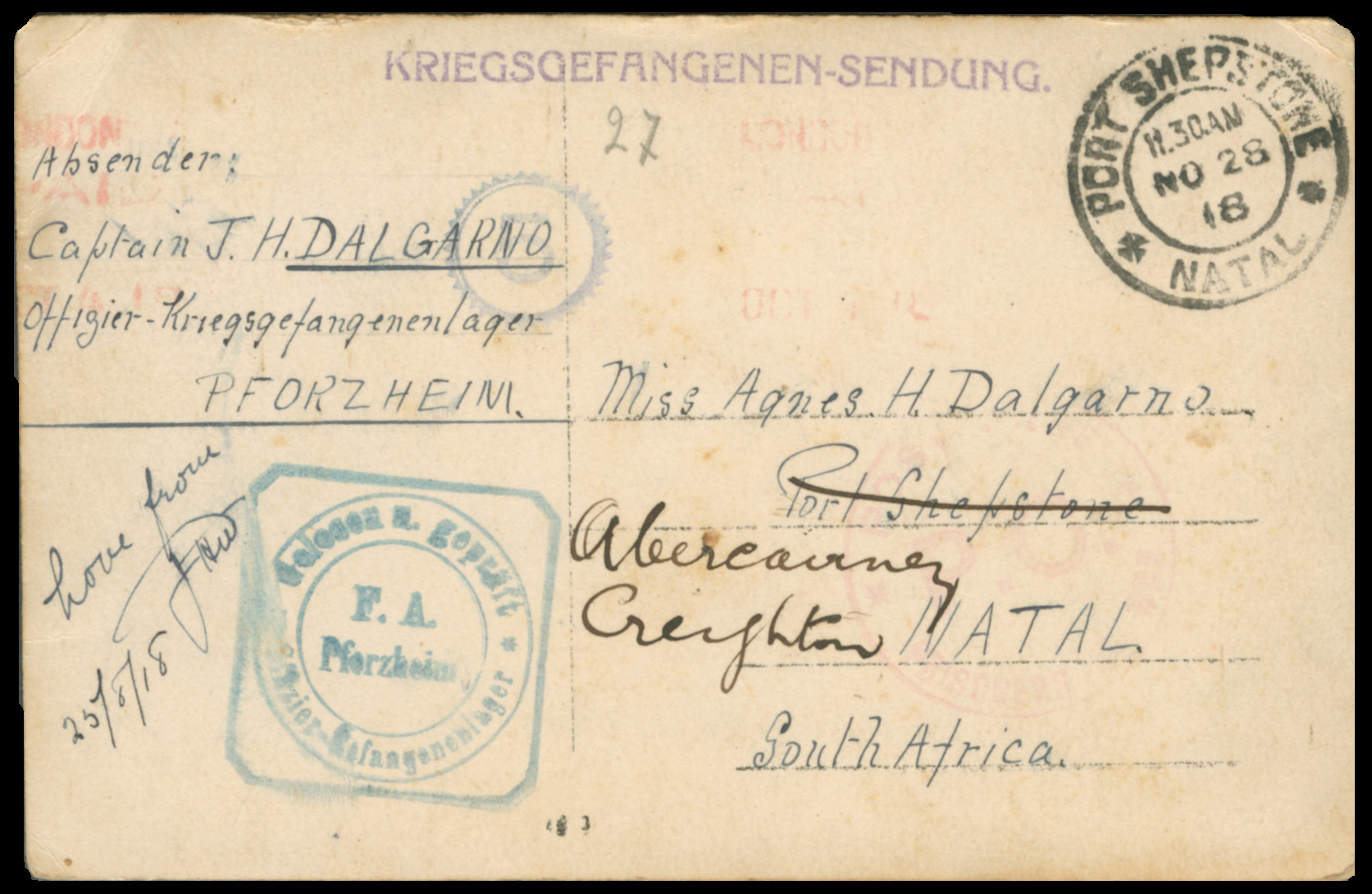
1918. German POW Postcard. Posted FREE. Written '25 8 18'.
Faint machine cancelled LONDON 'OC 1x 18' to PORT SHEPSTONE, Natal 'NO 28 18'.
The war was still raging when the PC was written. It was received after it had ended.
Blue chamfered Pforzheim POW Camp cachet. Gear-ringed German civil censor 5.
Headed Purple KRIEGSGEFANGENEN-SENDING (POW MAIL) top.
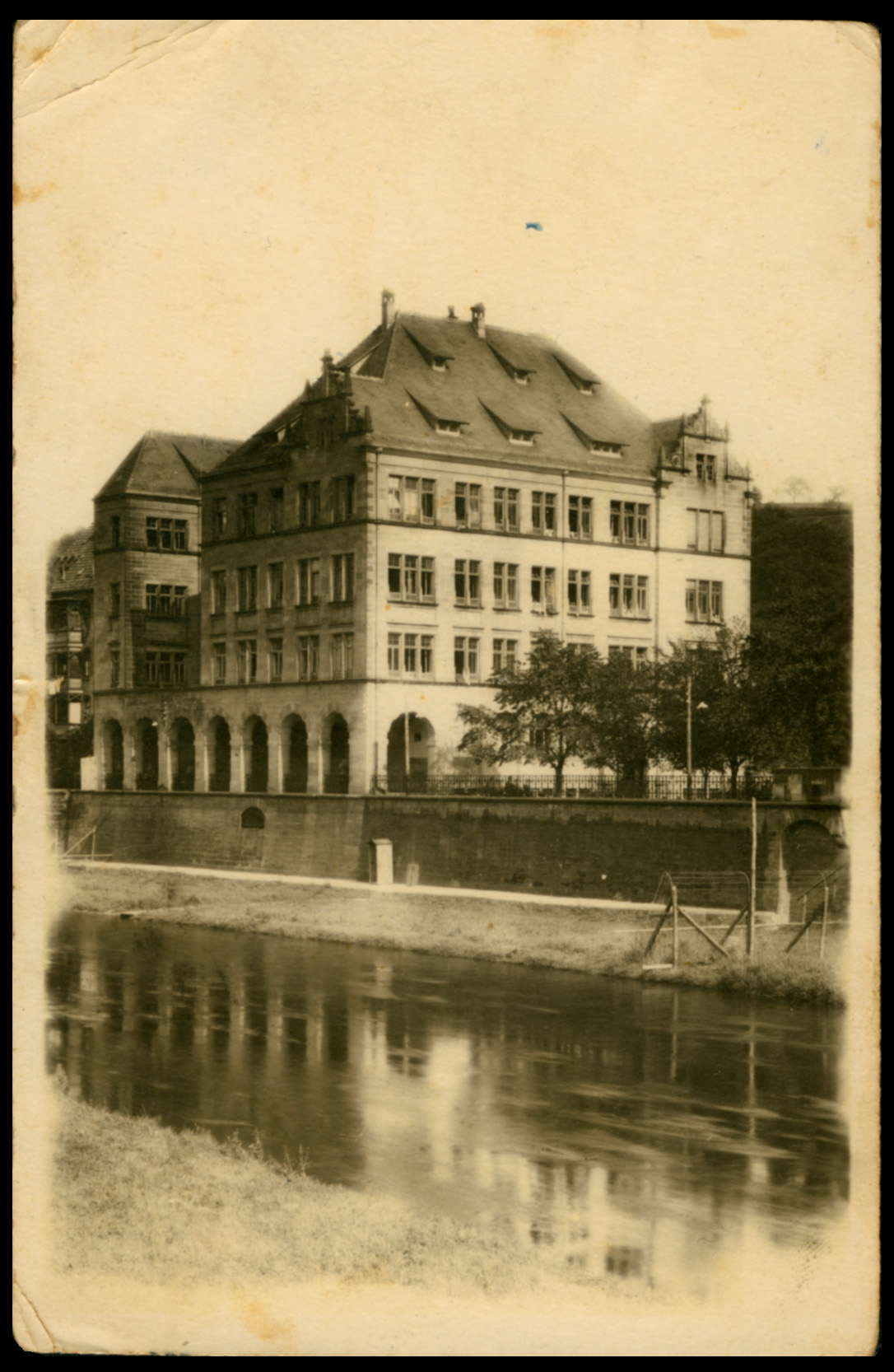
Circa 1914. Postcard. The Pforzheim POW Camp, previously a hotel.
Nice 'digs' if you can get it! One of the perks of being an 'ossifer'.John Hunter Dalgarno was born in Perthshire, Scotland in 1872 and came to Natal in 1886. His family settled in the Dronkvlei area. He joined a Troop of the NMR (Natal Mounted Rifles) and served in the South African War, 1899 - 1902, becoming a Corporal, He also served during the 1906 Bambatha Rebellion and in the 1915 German South West Africa campaign by which time he had been commissioned. He won an MC (Military Cross) in that campaign. The 1913 SA Officers list shows Dalgarno as a Captain with the 3rd NMR (Natal Mounted Rifles). He volunteered for overseas service, joining the Middlesex Regiment, possibly as a junior lieutenant and seeing action as a Captain in the 3rd Battle of Ypres, Cambrai, 2nd Battle of the Somme and the Battle of the Lys. It is not yet known where and when he was taken prisoner. It was presumably during the Battle of the Lys, aka the 'Fourth Battle of Ypres', which was fought in April 1918 as part of the German Spring Offensive, their last throw of the dice in WW1. On his return to SA, Delgarno continued his service with the 3rd Mounted Rifles (NMR), commanding the Regiment from 1924 to 1928, when he retired.
Natal Mounted Rifles: 1918
Lt-Col John Hunter Dalgarno MC, Commanding Officer Natal Mounted Rifles: 1924 to 1928.
1918. German POW Postcard. Posted FREE. Written '25 8 18'.
Faint machine cancelled LONDON 'OC 1x 18' to PORT SHEPSTONE, Natal 'NO 28 18'.
The war was still raging when the PC was written. It was received after it had ended.
Blue chamfered Pforzheim POW Camp cachet. Gear-ringed German civil censor 5.
Headed Purple KRIEGSGEFANGENEN-SENDING (POW MAIL) top.
Circa 1914. Postcard. The Pforzheim POW Camp, previously a hotel.
Nice 'digs' if you can get it! One of the perks of being an 'ossifer'.
John Hunter Dalgarno was born in Perthshire, Scotland in 1872 and came to Natal in 1886. His family settled in the Dronkvlei area. He joined a Troop of the NMR (Natal Mounted Rifles) and served in the South African War, 1899 - 1902, becoming a Corporal, He also served during the 1906 Bambatha Rebellion and in the 1915 German South West Africa campaign by which time he had been commissioned. He won an MC (Military Cross) in that campaign. The 1913 SA Officers list shows Dalgarno as a Captain with the 3rd NMR (Natal Mounted Rifles). He volunteered for overseas service, joining the Middlesex Regiment, possibly as a junior lieutenant and seeing action as a Captain in the 3rd Battle of Ypres, Cambrai, 2nd Battle of the Somme and the Battle of the Lys. It is not yet known where and when he was taken prisoner. It was presumably during the Battle of the Lys, aka the 'Fourth Battle of Ypres', which was fought in April 1918 as part of the German Spring Offensive, their last throw of the dice in WW1. On his return to SA, Delgarno continued his service with the 3rd Mounted Rifles (NMR), commanding the Regiment from 1924 to 1928, when he retired.