Hotels of southern Africa
Quote from Steve on November 16, 2025, 12:27 pmPolley's Hotel, Bloemfontein
I believe that Bloemfontein's Hotel Cecil later became Polley's Hotel. I have postcards of both but right now can only find the one below. Please bear with me and I will post Hotel Cecil shortly.
1918. Postcard. BLOEMFONTEIN '3 AUG 18' to LONDON, GB.
Circa 1920. Luggage Label.
Polley's Hotel, Bloemfontein
I believe that Bloemfontein's Hotel Cecil later became Polley's Hotel. I have postcards of both but right now can only find the one below. Please bear with me and I will post Hotel Cecil shortly.
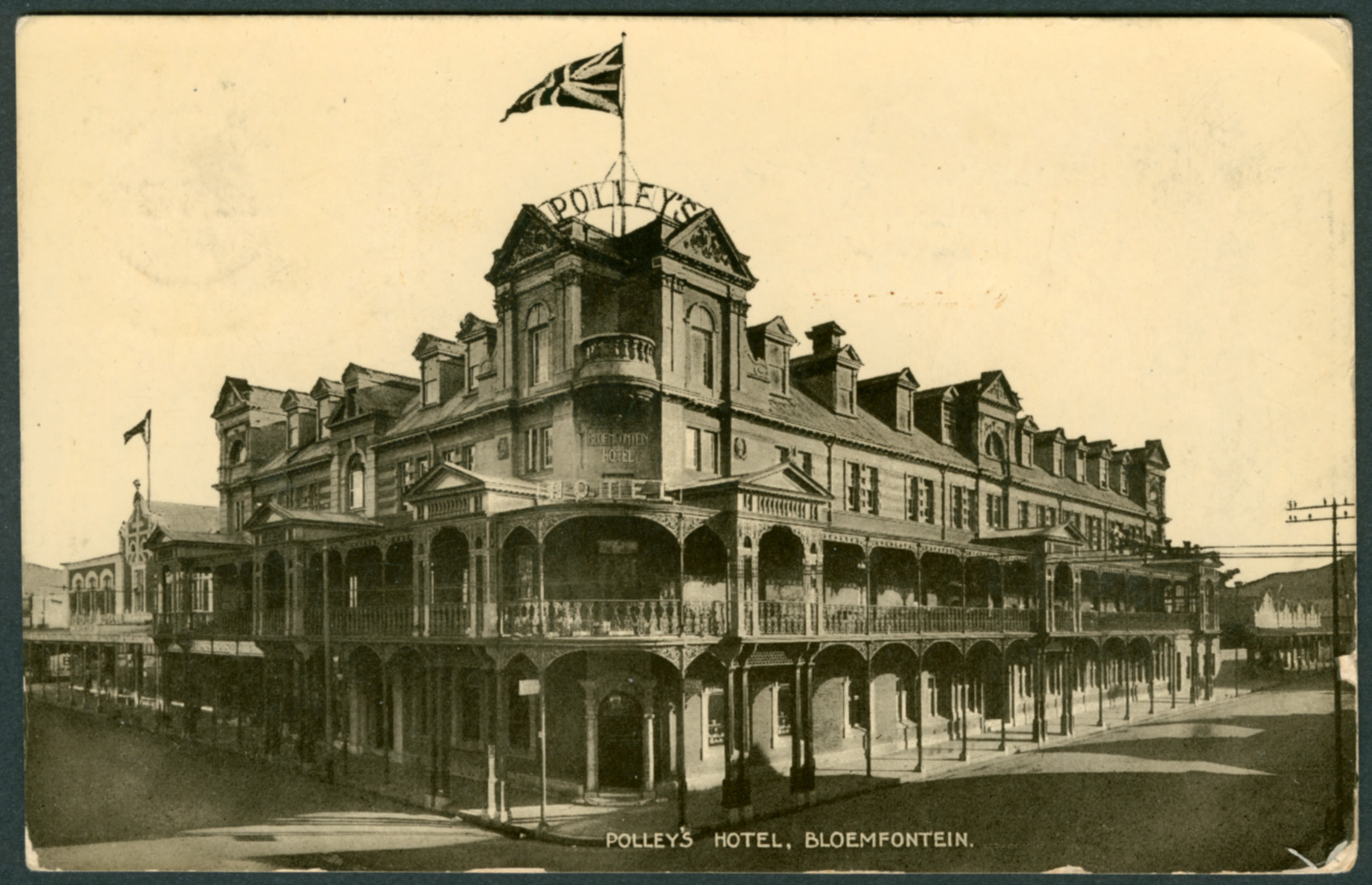
1918. Postcard. BLOEMFONTEIN '3 AUG 18' to LONDON, GB.
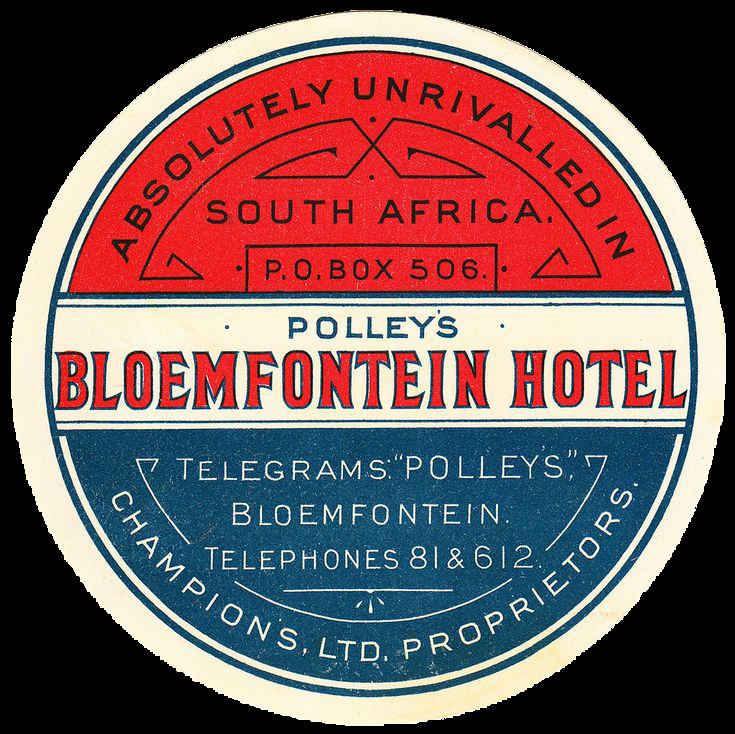
Circa 1920. Luggage Label.
Quote from Steve on December 16, 2025, 2:04 pmAmalgamated African Hotels Ltd - Kings Hotel, East London
The item below, a 1947 Royal Tour brochure, is said to have been "produced by the Kings Hotel, East London". This was more likely produced by the Amalgamated African Hotels group and supplied to their hotels for their use as a menu card. There is no mention of any specific hotel in this brochure, only of the group. This would have saved on the cost of individualising the brochure for each hotel.
The typewritten menu is dated 21 - 3 - 1947. According to the brochure's itinerary, this places the Royal Tour in Durban.
1947. Menu Card. '21 3 47'.
An excellent item of interest to collectors of the 1947 Royal Tour, SA Hotels and or Maps.
Amalgamated African Hotels Ltd - Kings Hotel, East London
The item below, a 1947 Royal Tour brochure, is said to have been "produced by the Kings Hotel, East London". This was more likely produced by the Amalgamated African Hotels group and supplied to their hotels for their use as a menu card. There is no mention of any specific hotel in this brochure, only of the group. This would have saved on the cost of individualising the brochure for each hotel.
The typewritten menu is dated 21 - 3 - 1947. According to the brochure's itinerary, this places the Royal Tour in Durban.
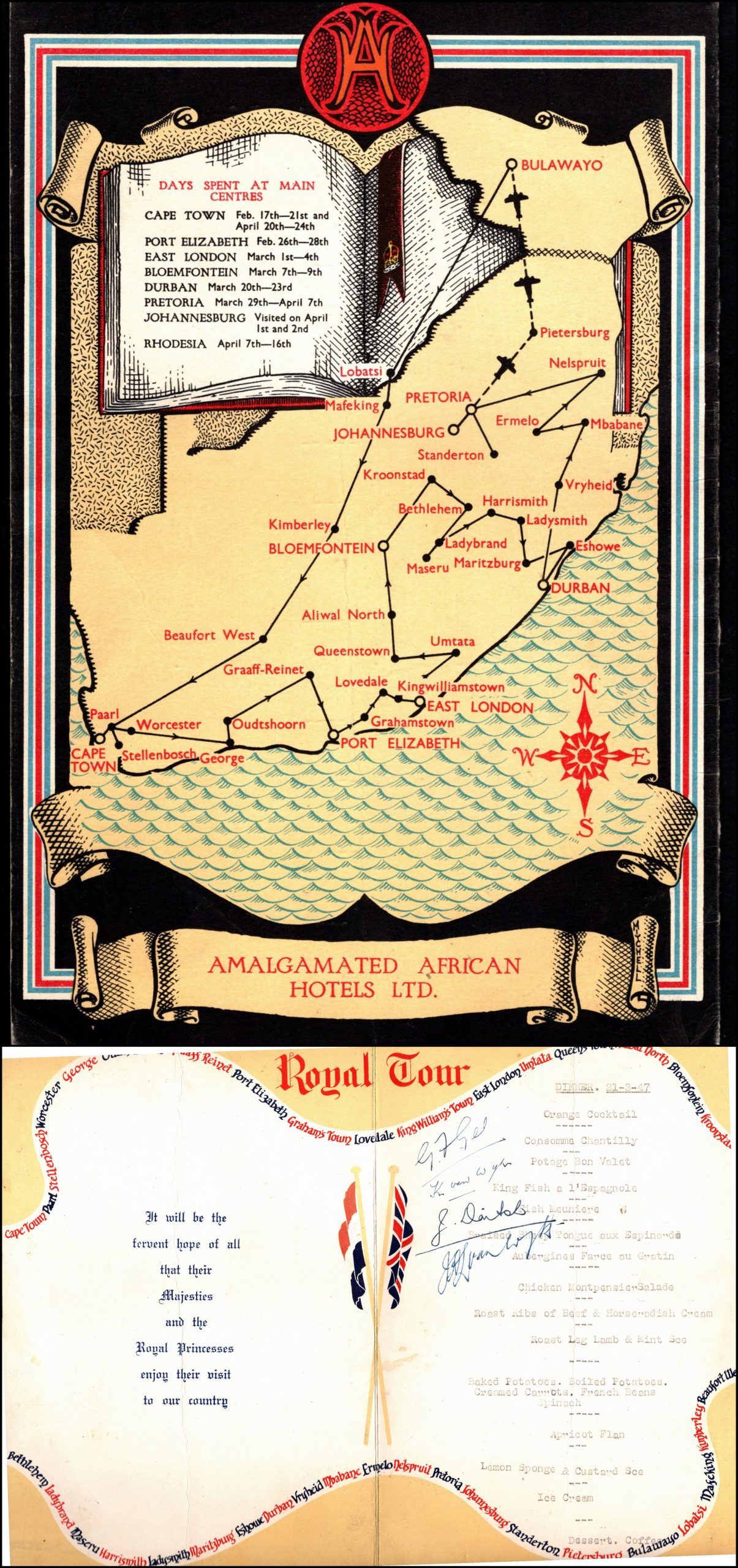
1947. Menu Card. '21 3 47'.
An excellent item of interest to collectors of the 1947 Royal Tour, SA Hotels and or Maps.
Quote from Steve on December 18, 2025, 4:55 pmDeal's Hotel, East London.
There are at least three different postcards that show a view of this, the first Deal's Hotel in East London. It is thought to have stood on the corner of Terminus and Oxford Street. The two other postcards are early black and white ones showing horse-drawn transport outside. Both are titled 'Deal's Central Hotel, East London' (G. G. Deal, Proprietor.). As this, the third postcard, is in colour ('Oilette') and shows a motor car it the most modern. I have not been able to find a date for its construction. The postcard was mailed in 1906.
1906. Postcard. EAST LONDON 3 'SP 24 06' to CAMDEN TOWN, LONDON. GB.
A second Deal's Hotel, a high-rise (six storey) building was built in 1938 as an addition to this one above. It was built adjoining this hotel on the site of the white building left. At the time it was claimed to be 'the most modern in the country'. A third Deal's Hotel was built alongside the second Deal's Hotel on the site of the first, shown above, which was demolished to make way for the biggest third hotel. At some point the owners quit the hotel businnes and turned the building into a commerical one known as Deals House.
Deal's Hotel, East London.
There are at least three different postcards that show a view of this, the first Deal's Hotel in East London. It is thought to have stood on the corner of Terminus and Oxford Street. The two other postcards are early black and white ones showing horse-drawn transport outside. Both are titled 'Deal's Central Hotel, East London' (G. G. Deal, Proprietor.). As this, the third postcard, is in colour ('Oilette') and shows a motor car it the most modern. I have not been able to find a date for its construction. The postcard was mailed in 1906.
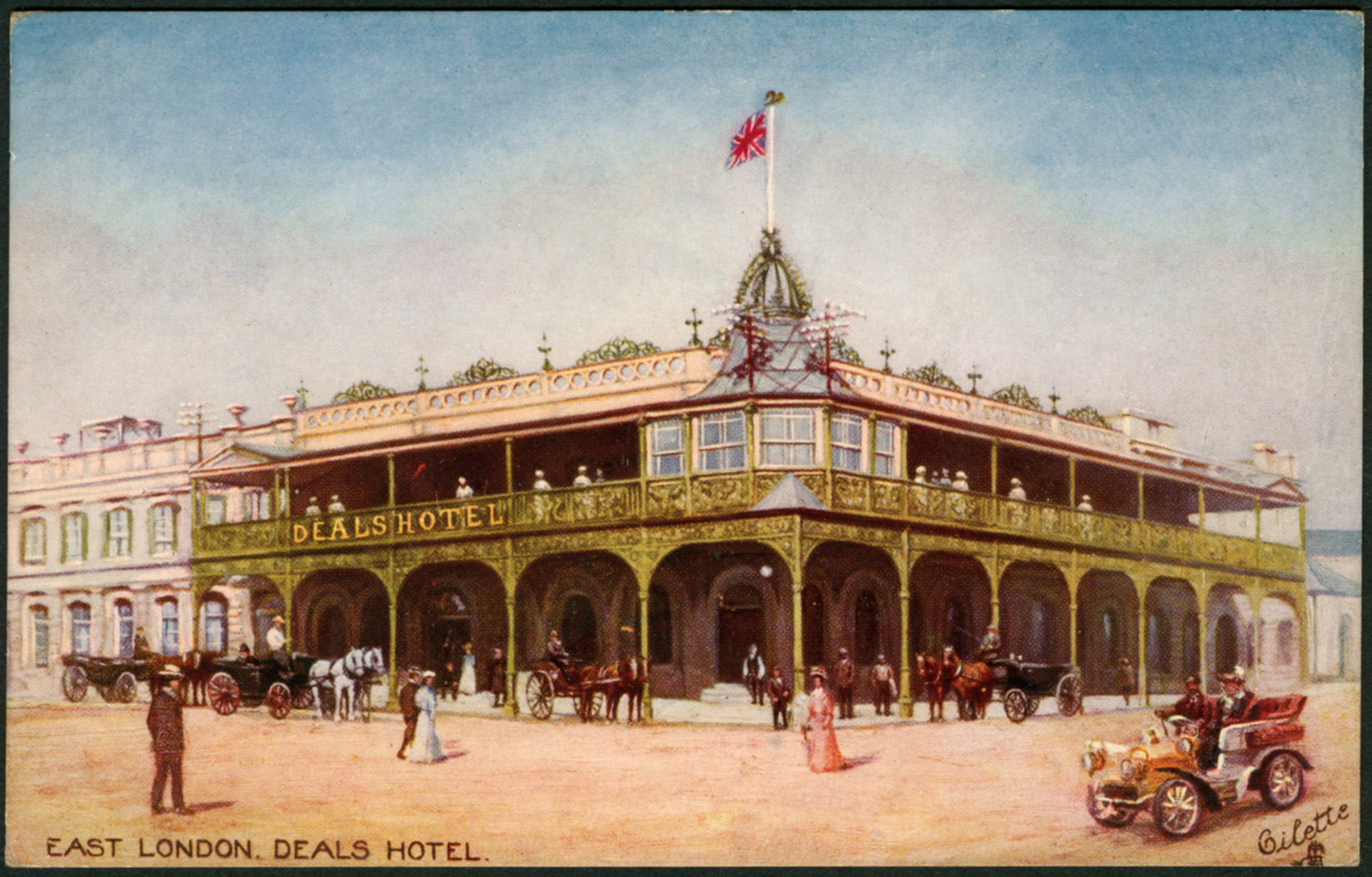
1906. Postcard. EAST LONDON 3 'SP 24 06' to CAMDEN TOWN, LONDON. GB.
A second Deal's Hotel, a high-rise (six storey) building was built in 1938 as an addition to this one above. It was built adjoining this hotel on the site of the white building left. At the time it was claimed to be 'the most modern in the country'. A third Deal's Hotel was built alongside the second Deal's Hotel on the site of the first, shown above, which was demolished to make way for the biggest third hotel. At some point the owners quit the hotel businnes and turned the building into a commerical one known as Deals House.
Quote from Steve on December 18, 2025, 5:25 pmBeach Hotel, East London
This postcard of the Beach Hotel, East London, is a side view, most being photographed looking towards the main entrance, left.
1904. Postcard. EAST LONDON 'xx xx 04' to CROMER, NORFOLK, GB.
The stamp has been removed by a stamp-collecting vandal.
The hotel was central to a popular beach-front promenade.
According to ChatGPT AI, (which should never be trusted or used with back-up research), the historic Beach Hotel in East London, was built in 1894 and was the city's first seaside hotel. It was a prominent landmark known for its elegant Edwardian architecture. The hotel opened its doors on January 22, 1894, near the old tram terminus on the East London beachfront. (The preceding postcard showed Deal's Hotel wjich was situated on the corner of Terminus and Oxford Street.) For many years, it was the only hotel on the beachfront and was renowned throughout South Africa for its charm and elegance. Many postcards of the East London's beach-front promenade include this hotel in the background.A "second" Beach Hotel was built on an adjacent property in 1936, after additions were made to the original building in 1935. The original hotel operated for 70 years before it was flattened in 1964 to make way for the construction of the modern Kennaway Hotel.
Beach Hotel, East London
This postcard of the Beach Hotel, East London, is a side view, most being photographed looking towards the main entrance, left.
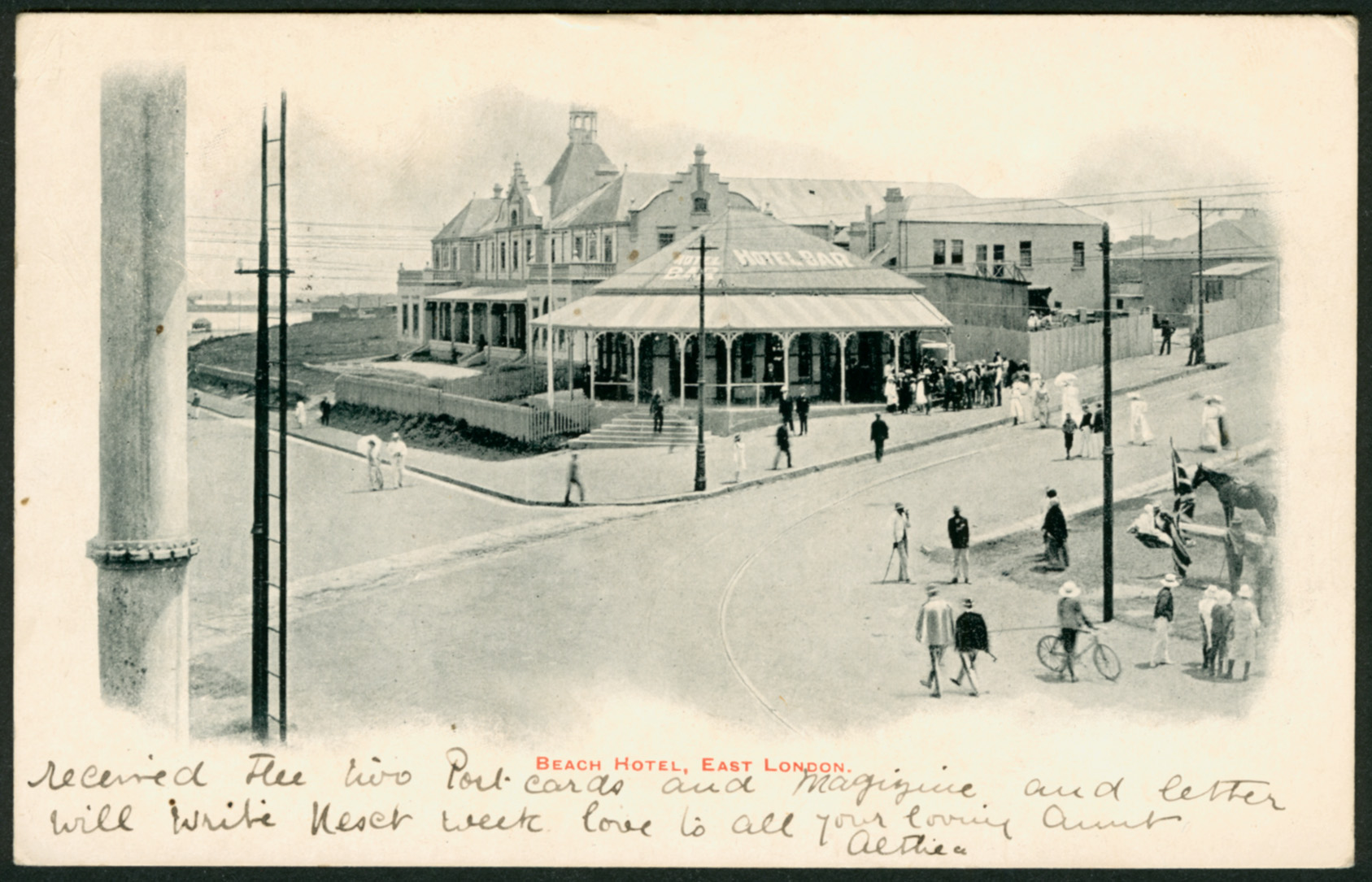
1904. Postcard. EAST LONDON 'xx xx 04' to CROMER, NORFOLK, GB.
The stamp has been removed by a stamp-collecting vandal.
The hotel was central to a popular beach-front promenade.
According to ChatGPT AI, (which should never be trusted or used with back-up research), the historic Beach Hotel in East London, was built in 1894 and was the city's first seaside hotel. It was a prominent landmark known for its elegant Edwardian architecture. The hotel opened its doors on January 22, 1894, near the old tram terminus on the East London beachfront. (The preceding postcard showed Deal's Hotel wjich was situated on the corner of Terminus and Oxford Street.) For many years, it was the only hotel on the beachfront and was renowned throughout South Africa for its charm and elegance. Many postcards of the East London's beach-front promenade include this hotel in the background.
A "second" Beach Hotel was built on an adjacent property in 1936, after additions were made to the original building in 1935. The original hotel operated for 70 years before it was flattened in 1964 to make way for the construction of the modern Kennaway Hotel.
Quote from Steve on December 27, 2025, 1:29 pmRoyal Hotel, Ladysmith, Natal
Postcards are sometimes more interesting than they appear at first glance. I thought this one ordinary at first.
What interested me at first about this postcard was the early car with an NL (Natal Ladysmith) number plate, the flags and bunting (what's the occassion?) and the change of hotel proprietorship from W. Flanagan (an Irishman, presumably) to C. G. Jones, presumably a Welshman. Presumably, again, both men have prospered in Natal as a part of the wider British Empire. As the recent change of ownership is not strongly marked by the purple handstamp, Jones has signed his name over Flanagan's.
Perhaps this postcard celebrates the opening of the Royal Hotel under new management? It seems a proper do with top local knobs!
1923. Postcard. LADYSMITH ' 12 MAR 23' to PIETERMARITZBURG.
The sender, 'C, is possibly C. G. Jones writing to the proprietor of the Commercial Hotel in Pietermaritzburg.
The addressee, F. Sutherland, is presumably an Englishman. 'Home' is presumably 'Blighty'.Note the optimistic price of £15 on this card. This is presumably based on 'Ladysmith Siege' interest! It's not really worth it However, after doing a little research into the hotel's history, I realised that this postcard is key to a wonderful tale of colonial and imperial life and death.
"Look after my poor cat!"
Before the railway was built Ladysmith was a one of the last stops in northern Natal for wagons and coaches making their way to the diamond mines of Kimberley and the gold mines of the Witwatersrand. The Royal was built just before the Anglo-Zulu War, in about 1878, to serve the needs of travellers and transport drivers. It's proprietor, a Mr Hamilton, is recorded requesting a liquor licence in 1886.
Ladysmith is most famous for the siege it endured during the South African War. During this conflict the English artist and war correspondent Melton Prior was besieged in Ladysmith while working for the Illustrated London News. During the Siege Prior wrote that “perhaps on a Sunday afternoon one would be asked to afternoon tea and it was somewhat depressing when visiting the Royal Hotel to be graciously offered a glass of hot water”. The Royal’s proximity to the Town Hall and the fact that it hosted “the most privileged of the besieged” meant the building was shelled several times. During the siege “The Bombshell”, the town's wartime flysheet, commented that “there was a time at the Royal when you had eggs inside and shells outside, now you don’t”.
One unfortunate resident of the Royal Hotel was Dr Arthur Cowell Stark, a 54 year-old widower from Torquay, England, a naturalist who had travelled extensively and written an ornithological work on “Birds of South Africa”. After the death of his wife Rosa in 1892, he settled in Cape Town where he practiced as medical doctorand also travelling regularly to collect animal specimens for the South African Museum. While staying at the Royal Hotel, he became trapped in Ladysmith when the Siege began. He is said to have been sympathetic to the Boer cause. As a vigorous public denouncer of Chamberlain's policies he was suspected of being a spy but being an affable fellow he had friends enough to vouch for him.
Despite a shortage of doctors he did not practice his profession during the Siege. On the 18th November 1899, Dr Stark, with his cat in his arms, was standing in the hotel entrance talking to R. J. McHugh, a journalist for the Daily Telegraph. The Boer Long Tom cannon on Pepworth Hill fired tow rounds at the town. The second struck the roof of the Royal Hotel, came down the stairs, ricocheted against a wall and hit Dr Stark where he stood on the verandah. Although the shell did not explode, it took off one of Dr Stark's legs and seriously injured the other. He died shortly afterwards. It is said that his last words were “Look after my poor cat.” At Stark's funeral the Engish was correspondent Henry Woodd Nevinson noted the irony in the death of this apparent Boer sympathiser.
After the war Lord Roberts visited Ladysmith and lunched at the Royal. The hotel still exists today but in a much renovated form. It is central to the Battlefield Tours of the area. Visit it and cool off. Hot water is no longer a tea-time option.
There is a thread on the postcard history of Ladysmith during the Siege. Click here to view the Siege of Ladysmith.
Royal Hotel, Ladysmith, Natal
Postcards are sometimes more interesting than they appear at first glance. I thought this one ordinary at first.
What interested me at first about this postcard was the early car with an NL (Natal Ladysmith) number plate, the flags and bunting (what's the occassion?) and the change of hotel proprietorship from W. Flanagan (an Irishman, presumably) to C. G. Jones, presumably a Welshman. Presumably, again, both men have prospered in Natal as a part of the wider British Empire. As the recent change of ownership is not strongly marked by the purple handstamp, Jones has signed his name over Flanagan's.
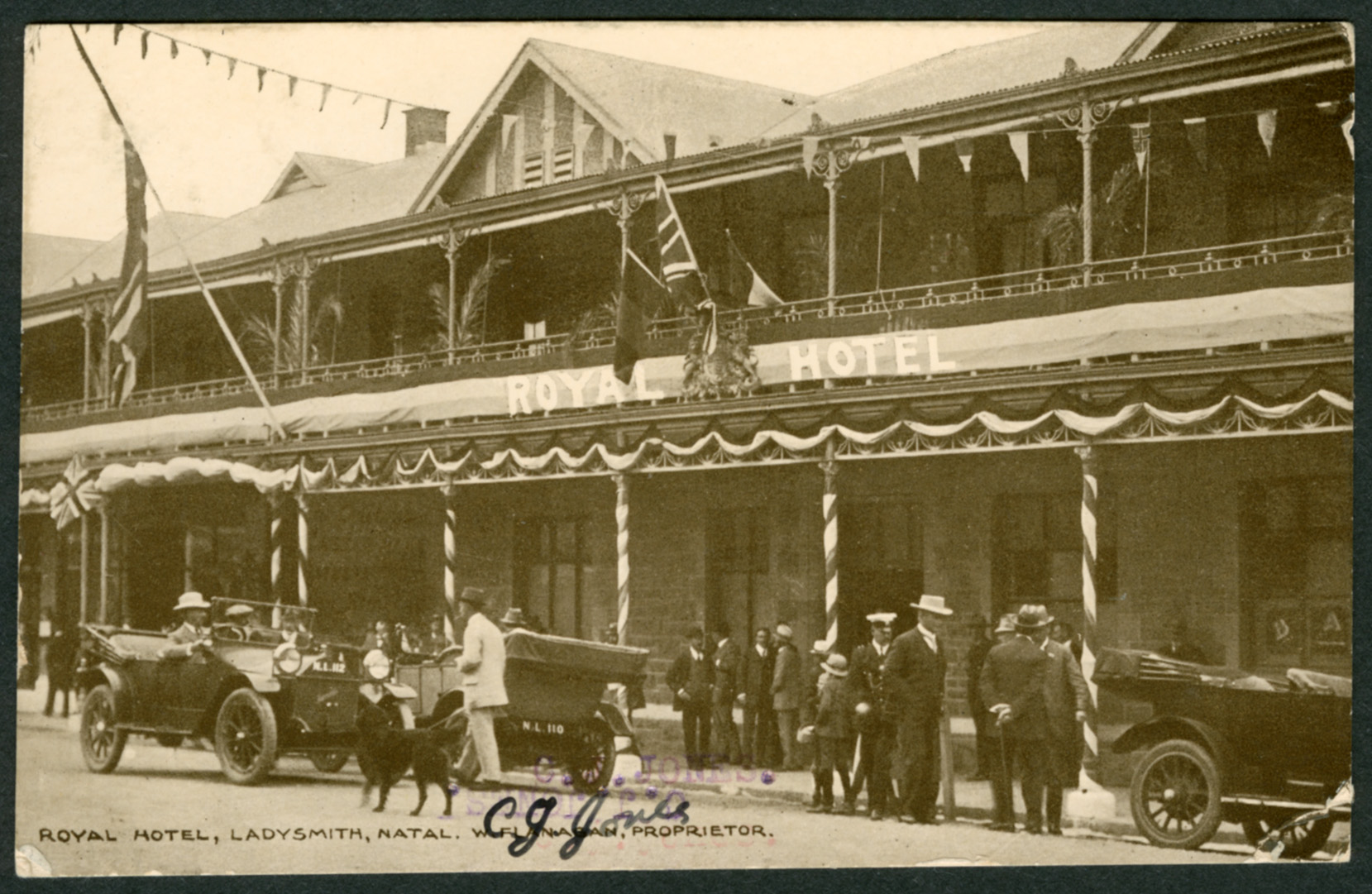
Perhaps this postcard celebrates the opening of the Royal Hotel under new management? It seems a proper do with top local knobs!
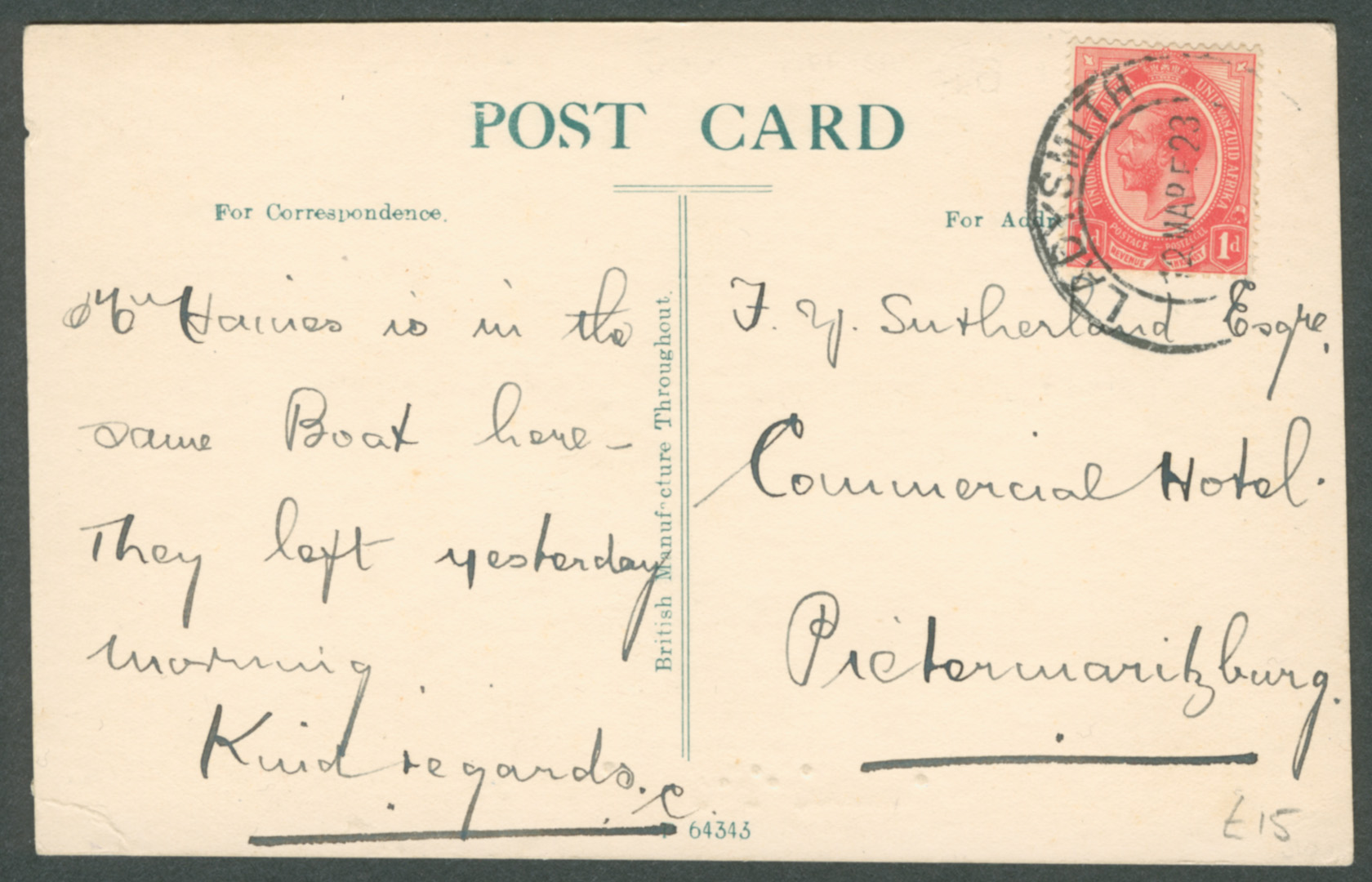
1923. Postcard. LADYSMITH ' 12 MAR 23' to PIETERMARITZBURG.
The sender, 'C, is possibly C. G. Jones writing to the proprietor of the Commercial Hotel in Pietermaritzburg.
The addressee, F. Sutherland, is presumably an Englishman. 'Home' is presumably 'Blighty'.
Note the optimistic price of £15 on this card. This is presumably based on 'Ladysmith Siege' interest! It's not really worth it However, after doing a little research into the hotel's history, I realised that this postcard is key to a wonderful tale of colonial and imperial life and death.
"Look after my poor cat!"
Before the railway was built Ladysmith was a one of the last stops in northern Natal for wagons and coaches making their way to the diamond mines of Kimberley and the gold mines of the Witwatersrand. The Royal was built just before the Anglo-Zulu War, in about 1878, to serve the needs of travellers and transport drivers. It's proprietor, a Mr Hamilton, is recorded requesting a liquor licence in 1886.
Ladysmith is most famous for the siege it endured during the South African War. During this conflict the English artist and war correspondent Melton Prior was besieged in Ladysmith while working for the Illustrated London News. During the Siege Prior wrote that “perhaps on a Sunday afternoon one would be asked to afternoon tea and it was somewhat depressing when visiting the Royal Hotel to be graciously offered a glass of hot water”. The Royal’s proximity to the Town Hall and the fact that it hosted “the most privileged of the besieged” meant the building was shelled several times. During the siege “The Bombshell”, the town's wartime flysheet, commented that “there was a time at the Royal when you had eggs inside and shells outside, now you don’t”.
One unfortunate resident of the Royal Hotel was Dr Arthur Cowell Stark, a 54 year-old widower from Torquay, England, a naturalist who had travelled extensively and written an ornithological work on “Birds of South Africa”. After the death of his wife Rosa in 1892, he settled in Cape Town where he practiced as medical doctorand also travelling regularly to collect animal specimens for the South African Museum. While staying at the Royal Hotel, he became trapped in Ladysmith when the Siege began. He is said to have been sympathetic to the Boer cause. As a vigorous public denouncer of Chamberlain's policies he was suspected of being a spy but being an affable fellow he had friends enough to vouch for him.
Despite a shortage of doctors he did not practice his profession during the Siege. On the 18th November 1899, Dr Stark, with his cat in his arms, was standing in the hotel entrance talking to R. J. McHugh, a journalist for the Daily Telegraph. The Boer Long Tom cannon on Pepworth Hill fired tow rounds at the town. The second struck the roof of the Royal Hotel, came down the stairs, ricocheted against a wall and hit Dr Stark where he stood on the verandah. Although the shell did not explode, it took off one of Dr Stark's legs and seriously injured the other. He died shortly afterwards. It is said that his last words were “Look after my poor cat.” At Stark's funeral the Engish was correspondent Henry Woodd Nevinson noted the irony in the death of this apparent Boer sympathiser.
After the war Lord Roberts visited Ladysmith and lunched at the Royal. The hotel still exists today but in a much renovated form. It is central to the Battlefield Tours of the area. Visit it and cool off. Hot water is no longer a tea-time option.
There is a thread on the postcard history of Ladysmith during the Siege. Click here to view the Siege of Ladysmith.
Quote from Steve on January 25, 2026, 2:10 pmInternational Hotel, Cape Town
'Het Zuid-Afrikaansche Jaarboek en Algemeene Gids, 1906, page 314'. 'Hollandsch Gesproken'.
'The South African Year Book and General Guide, 1906, page 314'. 'Dutch Spoken'.
The Mill Street Post and Telegraph Office is in the small building on the left.The International Hotel stood on Mill Street on the corner of Schoonder Street. Apparently it was demolished in the 1970s. I have no memory of it. Despite the 1960s in Cape Town - oh wow man! - and 1970s - spooky - I retain vivid memories of the area, like being humiliatingly beaten up by the Mill Street Crew who for no reason picked on me and almost broke my jaw at the Capri tearoom cinema (bioscope) in Parliament Street in the late 1960s! Peace and Love, man! I saw stars and can't to this day remember what movie it was! A friend who was with me at the time said it was 'Spartacus' with Kirk Douglas!
At a SACS meeeting some years ago someone asked for advice on the whereabouts of the Mill Street Post Office. I believe it is the small building on the left on the ad above. This was both an off-licence (bottle shop) and a Post and Telegraph Office. Its entrance is on Mill Street, as is the International Hotel's. Apparently, it had "a Victoria Regina post box let into the wall, above which hung a square lantern, the name of the hotel shining white through the deep blue glass". (Picton-Seymour 1977:84)
The International Hotel was already a leading Cape Town hotel in Cape Town by 1897. It was sited on the lower foothills of Table Mountain and had a good view over the city to the sea. It was only a short walk through the cool and leafy Gardens from the hotel to the centre of Cape Town through Its publicity material claimed that it was as one of the leading hotels in Cape Town at the time."the most beautifully situated hotel in Cape Town .... unrivalled for Pure Air, Health, Comfort and Pleasant Surroundings, enabling visitors to enjoy perefct rest, and yet be in touch with the principal places of Business and Amusement."
1909. Postcard. MILL STREET, CAPE TOWN 'FE 9 10' HOLLAND '27 2 10'.
The postcard is unsurprisingly written in Dutch. Did the sender chose the International because 'Holland Gesproken'!
It was certainly posted in the PO attached to the Hotel entrance shown above.The Mount Nelson Hotel opened a half mile away on March 6, 1899. It was South Africa's first hotel with hot and cold running water in all the rooms. No doubt, it offered a serious challenge to the International that used servants to bring hot water in jugs to the guests in their rooms. Guests would wash themselves in their roons using a flannel in a wash basin that usually sat on a marble-topped surface.
1913. Postcard. MILL STREET CAPE TOWN '5 DEC 13' to LONDON, GB.
MILL STREET GARDENS was listed 1892 to 1897. (Putzel Encyclopedia.)
MILL STREET CAPE TOWN was listed 1913 to current (1987). (Putzel Encyclopedia.)
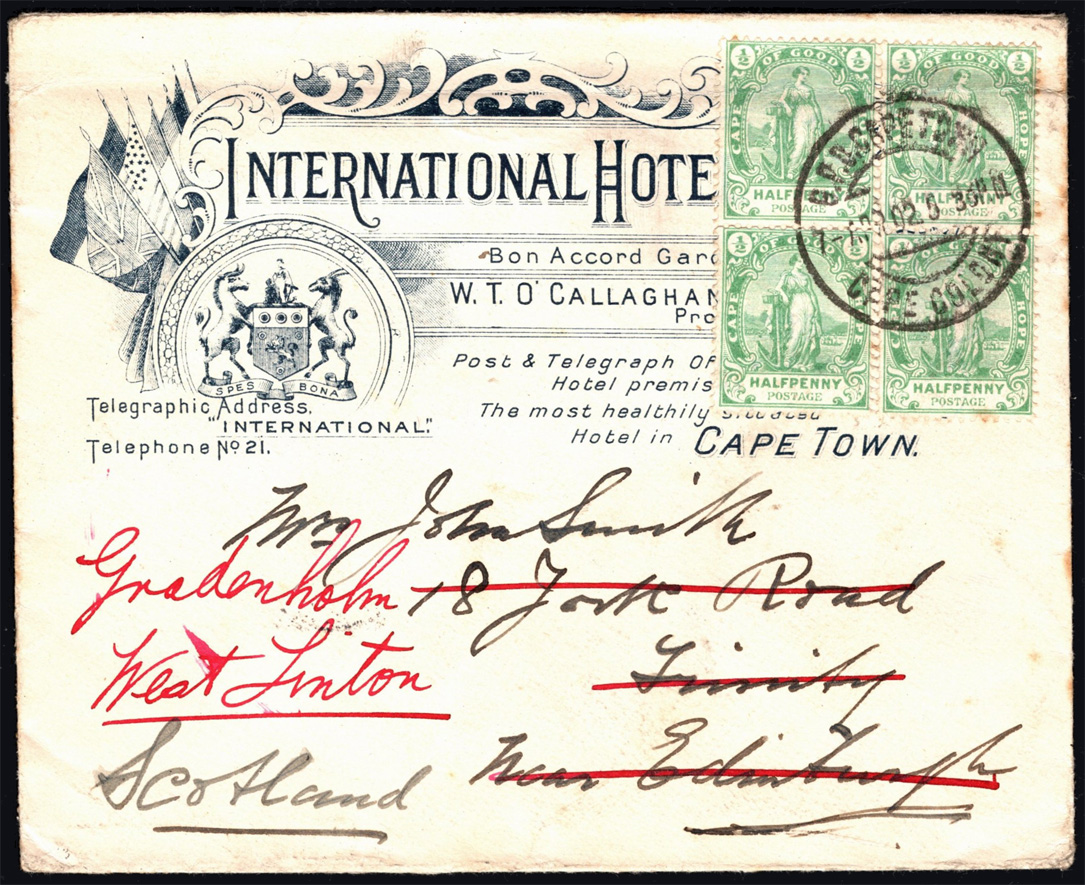
If it was demolished in the 1970s, did its post office remain intact and functioning until at least 1987?The cover below comes courtesy of a Kenny Napier Auction. Email Kenny to get his auction advice.
International Hotel, Cape Town
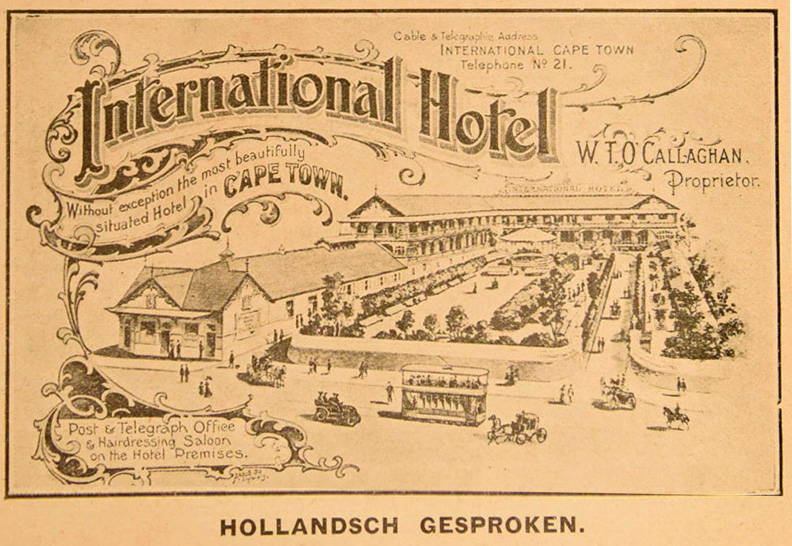
'Het Zuid-Afrikaansche Jaarboek en Algemeene Gids, 1906, page 314'. 'Hollandsch Gesproken'.
'The South African Year Book and General Guide, 1906, page 314'. 'Dutch Spoken'.
The Mill Street Post and Telegraph Office is in the small building on the left.
The International Hotel stood on Mill Street on the corner of Schoonder Street. Apparently it was demolished in the 1970s. I have no memory of it. Despite the 1960s in Cape Town - oh wow man! - and 1970s - spooky - I retain vivid memories of the area, like being humiliatingly beaten up by the Mill Street Crew who for no reason picked on me and almost broke my jaw at the Capri tearoom cinema (bioscope) in Parliament Street in the late 1960s! Peace and Love, man! I saw stars and can't to this day remember what movie it was! A friend who was with me at the time said it was 'Spartacus' with Kirk Douglas!
At a SACS meeeting some years ago someone asked for advice on the whereabouts of the Mill Street Post Office. I believe it is the small building on the left on the ad above. This was both an off-licence (bottle shop) and a Post and Telegraph Office. Its entrance is on Mill Street, as is the International Hotel's. Apparently, it had "a Victoria Regina post box let into the wall, above which hung a square lantern, the name of the hotel shining white through the deep blue glass". (Picton-Seymour 1977:84)
The International Hotel was already a leading Cape Town hotel in Cape Town by 1897. It was sited on the lower foothills of Table Mountain and had a good view over the city to the sea. It was only a short walk through the cool and leafy Gardens from the hotel to the centre of Cape Town through Its publicity material claimed that it was as one of the leading hotels in Cape Town at the time."the most beautifully situated hotel in Cape Town .... unrivalled for Pure Air, Health, Comfort and Pleasant Surroundings, enabling visitors to enjoy perefct rest, and yet be in touch with the principal places of Business and Amusement."
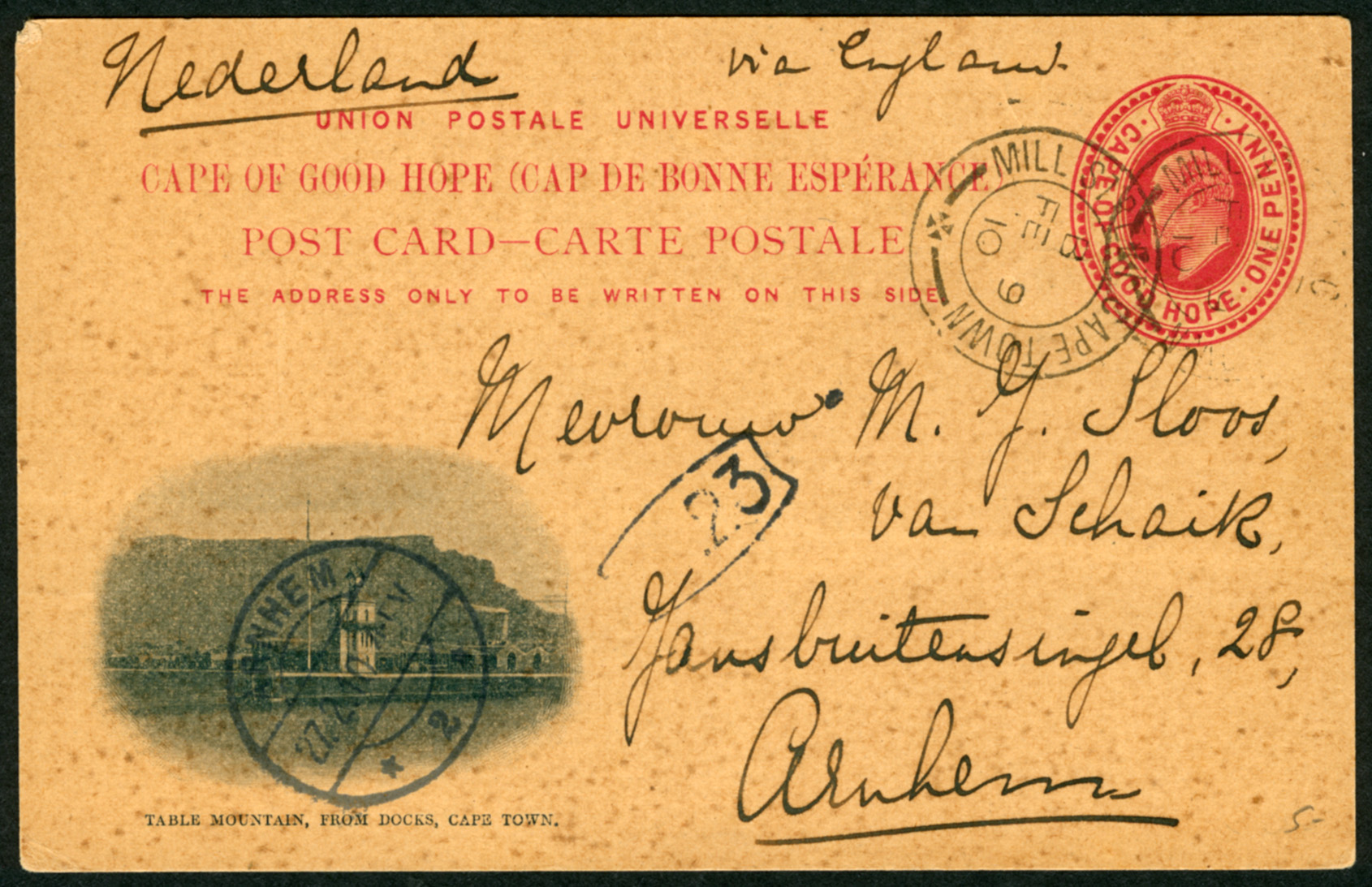
1909. Postcard. MILL STREET, CAPE TOWN 'FE 9 10' HOLLAND '27 2 10'.
The postcard is unsurprisingly written in Dutch. Did the sender chose the International because 'Holland Gesproken'!
It was certainly posted in the PO attached to the Hotel entrance shown above.
The Mount Nelson Hotel opened a half mile away on March 6, 1899. It was South Africa's first hotel with hot and cold running water in all the rooms. No doubt, it offered a serious challenge to the International that used servants to bring hot water in jugs to the guests in their rooms. Guests would wash themselves in their roons using a flannel in a wash basin that usually sat on a marble-topped surface.
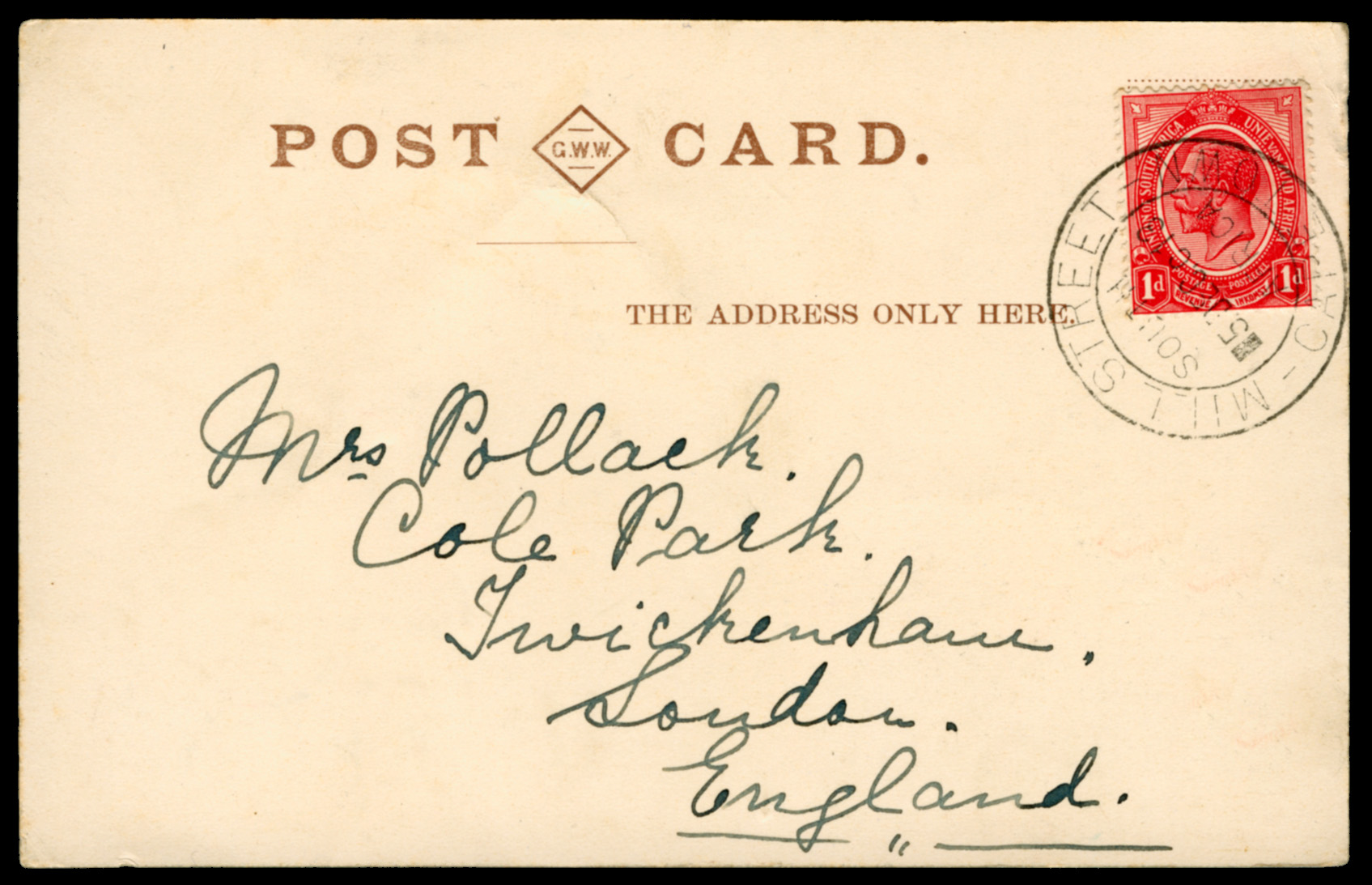
1913. Postcard. MILL STREET CAPE TOWN '5 DEC 13' to LONDON, GB.
MILL STREET GARDENS was listed 1892 to 1897. (Putzel Encyclopedia.)
MILL STREET CAPE TOWN was listed 1913 to current (1987). (Putzel Encyclopedia.)
If it was demolished in the 1970s, did its post office remain intact and functioning until at least 1987?
The cover below comes courtesy of a Kenny Napier Auction. Email Kenny to get his auction advice.
Quote from Steve on March 17, 2026, 12:40 pmGrand Hotel, Bulawayo, Rhodesia
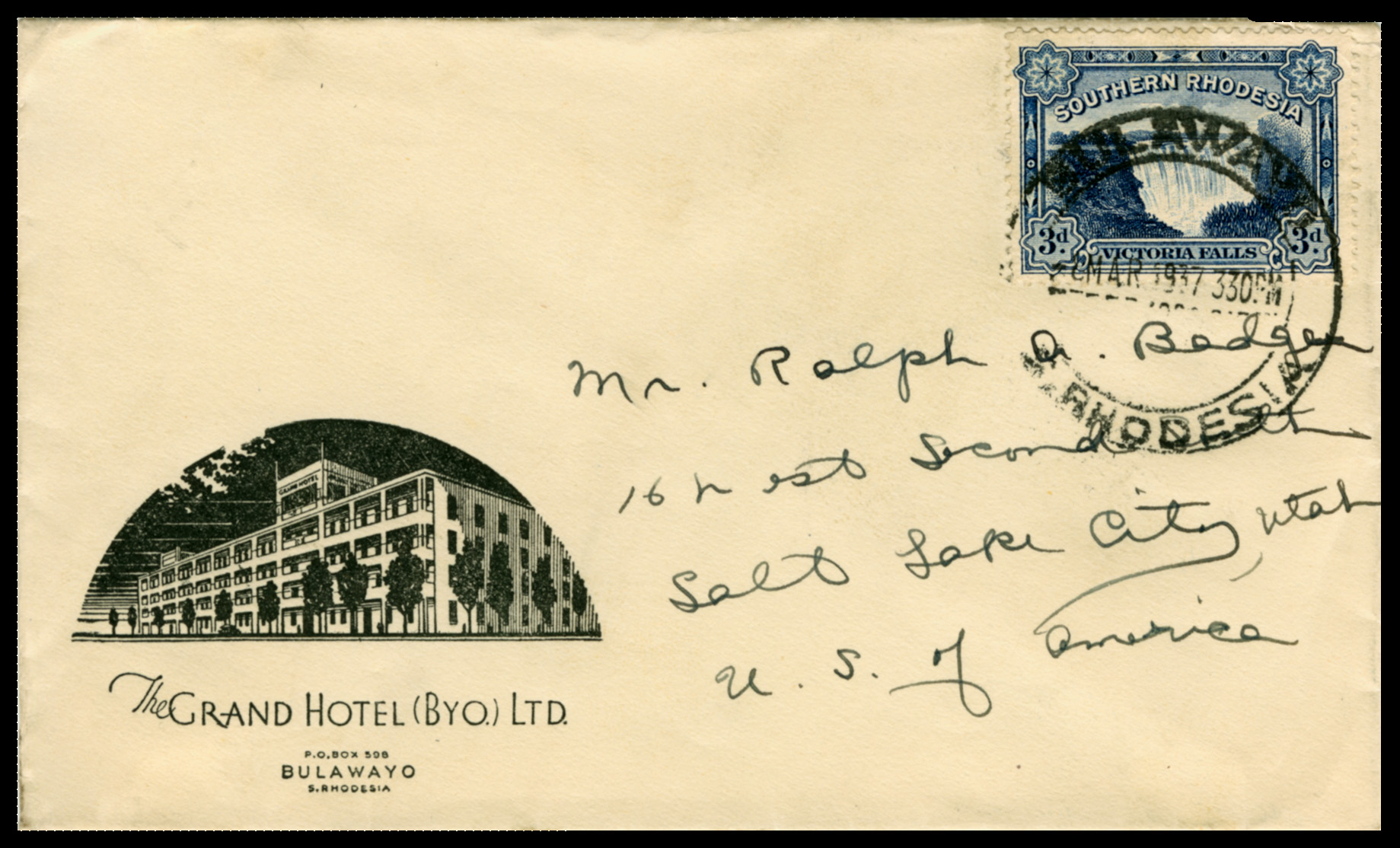
The Grand Hotel shown on the cover below is the new Grand Hotel, Bulawayo, built in 1933 by Thomas Meikle. It replaced an older Grand Hotel that had been built in 1899 in a classic colonial hotel style much like the Grand in Cape Town. This original Grand Hotel was known as Marshall's Building after a part of it became offices. The new Grand Hotel was incorporated into the Bulawayo Centre.
What is notable in its compnay name, bottom left, is 'BYO' for Bulawayo. No doubt this is intended to distinguish it from the many other 'Grand Hotels' that populated southern Africa.
The printed cover below shows a modern hotel of the sort that one would expect of Rhodesia as a developing country. The cover's printed text and its image is done in a slight art deco style. The stamp is the first 3d large Waterfall. The handwriting is slewed across the cover which with its scruffy postmark spoils the appearance of what would otherwise be an attractiver item of postal history.
1937. Bulawayo '8 MAR 1937' to SALT LAKE CITY, USA.
Grand Hotel, Bulawayo, Rhodesia
The Grand Hotel shown on the cover below is the new Grand Hotel, Bulawayo, built in 1933 by Thomas Meikle. It replaced an older Grand Hotel that had been built in 1899 in a classic colonial hotel style much like the Grand in Cape Town. This original Grand Hotel was known as Marshall's Building after a part of it became offices. The new Grand Hotel was incorporated into the Bulawayo Centre.
What is notable in its compnay name, bottom left, is 'BYO' for Bulawayo. No doubt this is intended to distinguish it from the many other 'Grand Hotels' that populated southern Africa.
The printed cover below shows a modern hotel of the sort that one would expect of Rhodesia as a developing country. The cover's printed text and its image is done in a slight art deco style. The stamp is the first 3d large Waterfall. The handwriting is slewed across the cover which with its scruffy postmark spoils the appearance of what would otherwise be an attractiver item of postal history.
1937. Bulawayo '8 MAR 1937' to SALT LAKE CITY, USA.
Quote from Steve on March 17, 2026, 1:14 pmGrand Hotel, Khartoum, Sudan
I realise that the Sudan is somewhat outside of the orbit of southern African Hotels but as the country is dear to my colleague Jamie I include this here. It shows that there were African 'Grand Hotels' outside of southern Africa.
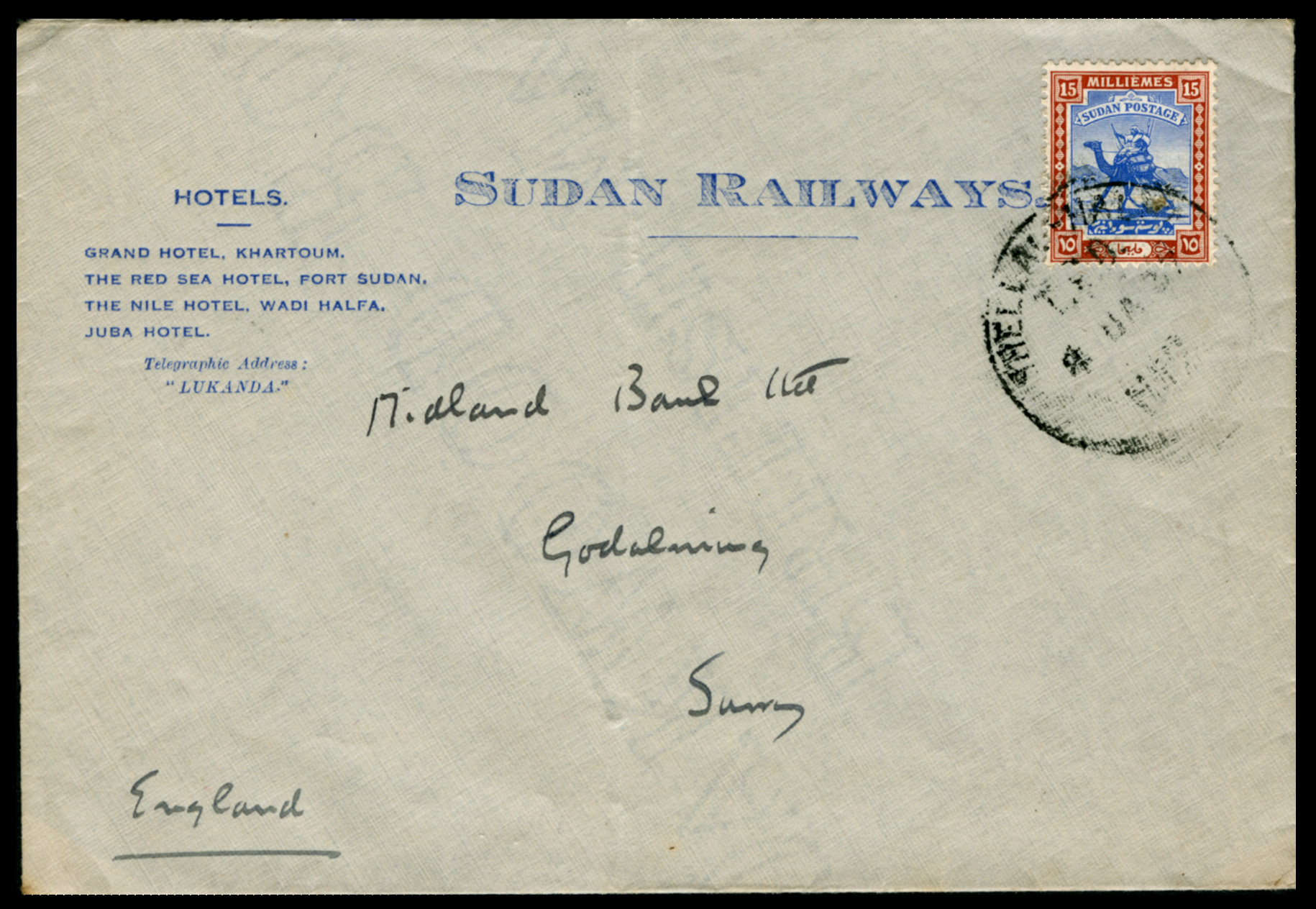
The Sudan is a wonderful collecting field which I wish I had stuck with after I first started collecting it. TheSudan Railways cover below is nice but unremarkable. It includes a list of four Hotels on the front of which the Grand Hotel, Khartoum is top, followed by The Red Sea Hotel, Port Sudan; The Nile Hotel, Wadi Halfa; and the Juba Hotel (way down south!). Many years ago I attempted to hitch-hike from Norway to South Africa. Hitch-hiking was impossible after I arrived in Egypt. The only way to travel was by train. I travelled 4th Class on the roof of the train from Wadi Halfa across the Nubian Desert to Khartoum. I probably bought this cover remembering that adventure.
1937. Sudan Railways printed cover. Postmark indecipherable, '4 JA 37' to GB.
If you can advise which postmark it is, please email me.
Grand Hotel, Khartoum, Sudan
I realise that the Sudan is somewhat outside of the orbit of southern African Hotels but as the country is dear to my colleague Jamie I include this here. It shows that there were African 'Grand Hotels' outside of southern Africa.
The Sudan is a wonderful collecting field which I wish I had stuck with after I first started collecting it. TheSudan Railways cover below is nice but unremarkable. It includes a list of four Hotels on the front of which the Grand Hotel, Khartoum is top, followed by The Red Sea Hotel, Port Sudan; The Nile Hotel, Wadi Halfa; and the Juba Hotel (way down south!). Many years ago I attempted to hitch-hike from Norway to South Africa. Hitch-hiking was impossible after I arrived in Egypt. The only way to travel was by train. I travelled 4th Class on the roof of the train from Wadi Halfa across the Nubian Desert to Khartoum. I probably bought this cover remembering that adventure.
 1937. Sudan Railways printed cover. Postmark indecipherable, '4 JA 37' to GB.
If you can advise which postmark it is, please email me.
Quote from Steve on March 17, 2026, 6:15 pmThe Victoria Falls Hotel, Rhodesia.
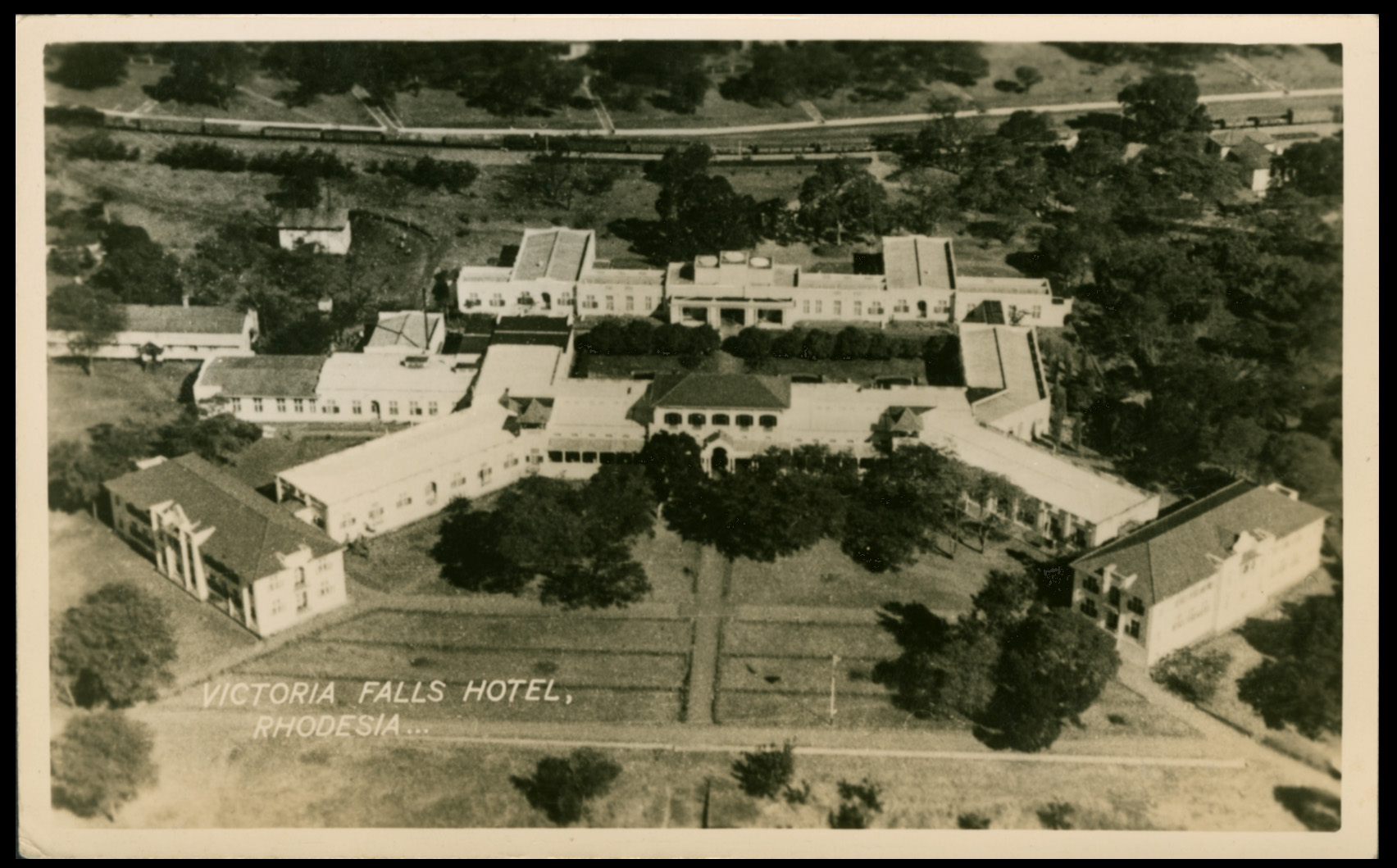
The Victoria Falls Hotel was built in 1904. It was originally conceived of as accommodation for workers constructing the bridge and railway line across the Zambezi gorge. Today it is world famous luxury hotel brand that offers wealthy travellers serene lily ponds, arched loggias, broad verandas and dramatic views of the gorges of Zimbabwe's spectacular Victoria Falls.
Circa 1950. Postcard, Unposted. 'Victoria Falls, Hotel, Rhodesia'.
The railway line can be seen passing behind the back of the hotel, top.The history of the Victoria Falls Hotel is incomplete without a reference to the development of the railway system in south-central Africa. Cecil Rhodes tasked his friend and colleague Sir Charles Metcalfe with the job of realising his dream, the development of a railway system stretching “from the Cape to Cairo”. Metcalfe initiated the plans for the first railway bridge to span the mighty Zambezi above the falls. Rhodes insisted that the bridge be built in a place where the spray from the 'smoke that thunders' would fall on passing trains. The site that was chosen was just a little below the Boiling Pot, almost at right angles and in very close proximity to the falls.
1966. Hotel Postcard. 9d QE2 Tobacco stamp cancelled VICTORIA FALLS '15 AUG 1966' to FRANCE.
The Victoria Falls Hotel was built and operated by the railways administration. As a result many mid-to-late 20th c. postcards are published by Rhodesia Railways Limited. Many are B&W postcards that show fairly dull views of the hotel.
In the early 1970s the hotel was leased to the then Southern Sun hotel group, the forerunner of today's African Sun Limited. A significant development in the late 1990s was the involvement in the hotel of another leading Zimbabwean hospitality operation, Meikles Africa Hotels. Today the property itself still belongs to the National Railways of Zimbabwe and there is a shared 50/50 partnership operation between African Sun and Meikles Africa.
See the Victoria Falls Forum Post by clicking HERE!
The Victoria Falls Hotel, Rhodesia.
The Victoria Falls Hotel was built in 1904. It was originally conceived of as accommodation for workers constructing the bridge and railway line across the Zambezi gorge. Today it is world famous luxury hotel brand that offers wealthy travellers serene lily ponds, arched loggias, broad verandas and dramatic views of the gorges of Zimbabwe's spectacular Victoria Falls.
Circa 1950. Postcard, Unposted. 'Victoria Falls, Hotel, Rhodesia'.
The railway line can be seen passing behind the back of the hotel, top.
The history of the Victoria Falls Hotel is incomplete without a reference to the development of the railway system in south-central Africa. Cecil Rhodes tasked his friend and colleague Sir Charles Metcalfe with the job of realising his dream, the development of a railway system stretching “from the Cape to Cairo”. Metcalfe initiated the plans for the first railway bridge to span the mighty Zambezi above the falls. Rhodes insisted that the bridge be built in a place where the spray from the 'smoke that thunders' would fall on passing trains. The site that was chosen was just a little below the Boiling Pot, almost at right angles and in very close proximity to the falls.
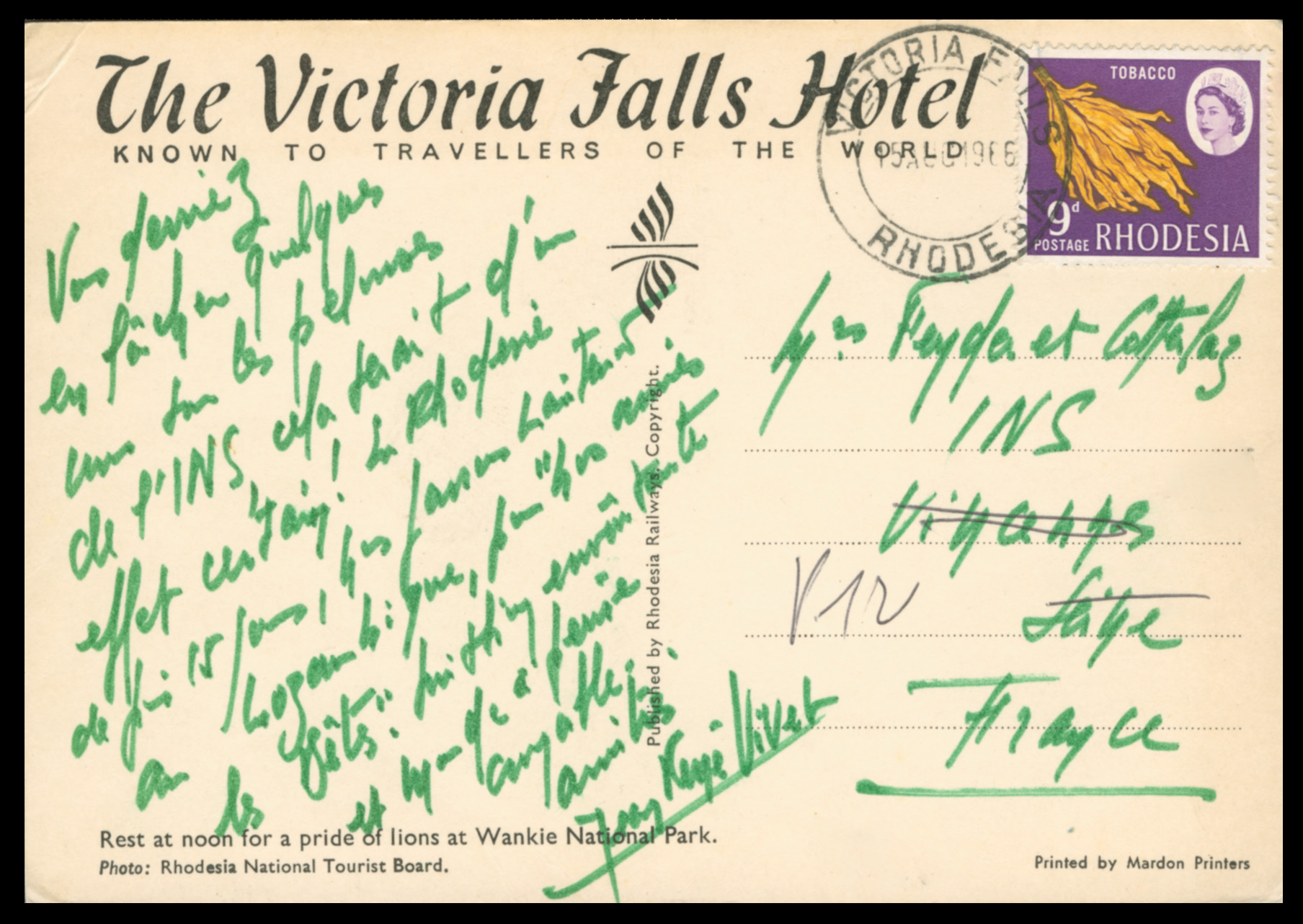
1966. Hotel Postcard. 9d QE2 Tobacco stamp cancelled VICTORIA FALLS '15 AUG 1966' to FRANCE.
The Victoria Falls Hotel was built and operated by the railways administration. As a result many mid-to-late 20th c. postcards are published by Rhodesia Railways Limited. Many are B&W postcards that show fairly dull views of the hotel.
In the early 1970s the hotel was leased to the then Southern Sun hotel group, the forerunner of today's African Sun Limited. A significant development in the late 1990s was the involvement in the hotel of another leading Zimbabwean hospitality operation, Meikles Africa Hotels. Today the property itself still belongs to the National Railways of Zimbabwe and there is a shared 50/50 partnership operation between African Sun and Meikles Africa.
See the Victoria Falls Forum Post by clicking HERE!
Quote from Steve on June 6, 2026, 10:50 amUmhlanga Rocks Hotel, Natal
The cover below from May 1938 was bought from Simon Peetoom (Africa Stamps) at the two day SACS Kenilworth meeting a week ago tomorrow. It was a good, enjoyable and well-attended meeting, one that I wasn't looking forward to beforehand but on the day and at the time it greatly exceeded my expectations and I came away having really enjoyed it. All South Africa collectors living in the UK should give some thought to joining SACS (SA Collectors' Society). It costs just £10 pa. Besides attending the optional meetings, membership of SACS entitles you to bid in their regular auction where the quality of material is high and the prices relatively low compared to the market!
Back to Umhlanga Rocks Hotel.... The original Umhlanga Rocks Hotel as shown below was built in 1923 by Marcus McCausland and was the first hotel to be built in Umhlanga. That was the time to visit the place. The well-known The Oyster Box Hotel had been built as a private beach cottage in 1863 and over time it evolved into a tea garden, a restaurant and finally a hotel by 1954 when it attempted to emulate the success of the Umhlanga Rocks Hotel which had almost single-handedly transformed what was a quiet sugar-farming enclave into one of South Africa's most iconic coastal resorts. As I prefer simple holidays in unpoiled rustic locations, I doubt I would want to visit Umhlanga Rocks today! Rather like my boyhood in Hermanus, 'been there, done that' when it was at its best as a fishing 'dorp!'.
The cover has been posted from MOUNT EDGECOMBE. At the time UMHLANGA ROCKS had a Postal Agency known as UMHLANGA BEACH 1930 - 1939, (H/O MOUNT EDGECOMBE). It was renamed UMHLANGA ROCKS in 1939.
This cover pretty much has everything a 'Hotel' collector might want in terms of South African postal history.
1938. Advertising cover. MOUNT EDGECOMBE '18 MAY 38' to BIRMINGHAM '25 MAY 38'.
To reach the UK in one week, this cover would have to gone by AIRMAIL.
A Postage rate of 1d to GB in 1938 is correct for Surface mail but not for airmail, which is why it was Taxed.
NOTE: This cover is not marked 'AIRMAIL'. This error must be SAPO's fault!This advertising covert promotes the hotel with name, address and contact details. (Telegram 'SLANGAROX'.) The second feature of the front of this cover is a road map which shows MOUNT EDGCOMBE where the cover was cancelled on '18 MAY 38'. Mount Edgecombe is where one turns off the main road going north-east from Durban to head down to the Indian Ocean and the Umhlanga Rocks Hotel.
Thirdly, there is the mystery of its postage. It reached the UK one week after posting in MOUNT EDGECOMBE. It can only have travelled airmail yet it carries the 1d SURFACE mail rate. Nowhere does it demand an AIRMAIL service. As it has been underpaid for the AIRMAIL rate, it has been taxed 'T 10c' in SA and '1d to Pay' in GB. I imagine that the purpose of the contents of this cover was probably to get the recipient to publicise the hotel. Presumably the mistake made by the Mount Edgecome Post Office in sending this AIRMAIL instead of SURFACE mail to GB at the correctly paid 1d rate may have prejudiced the favourable opinions of the recipient.
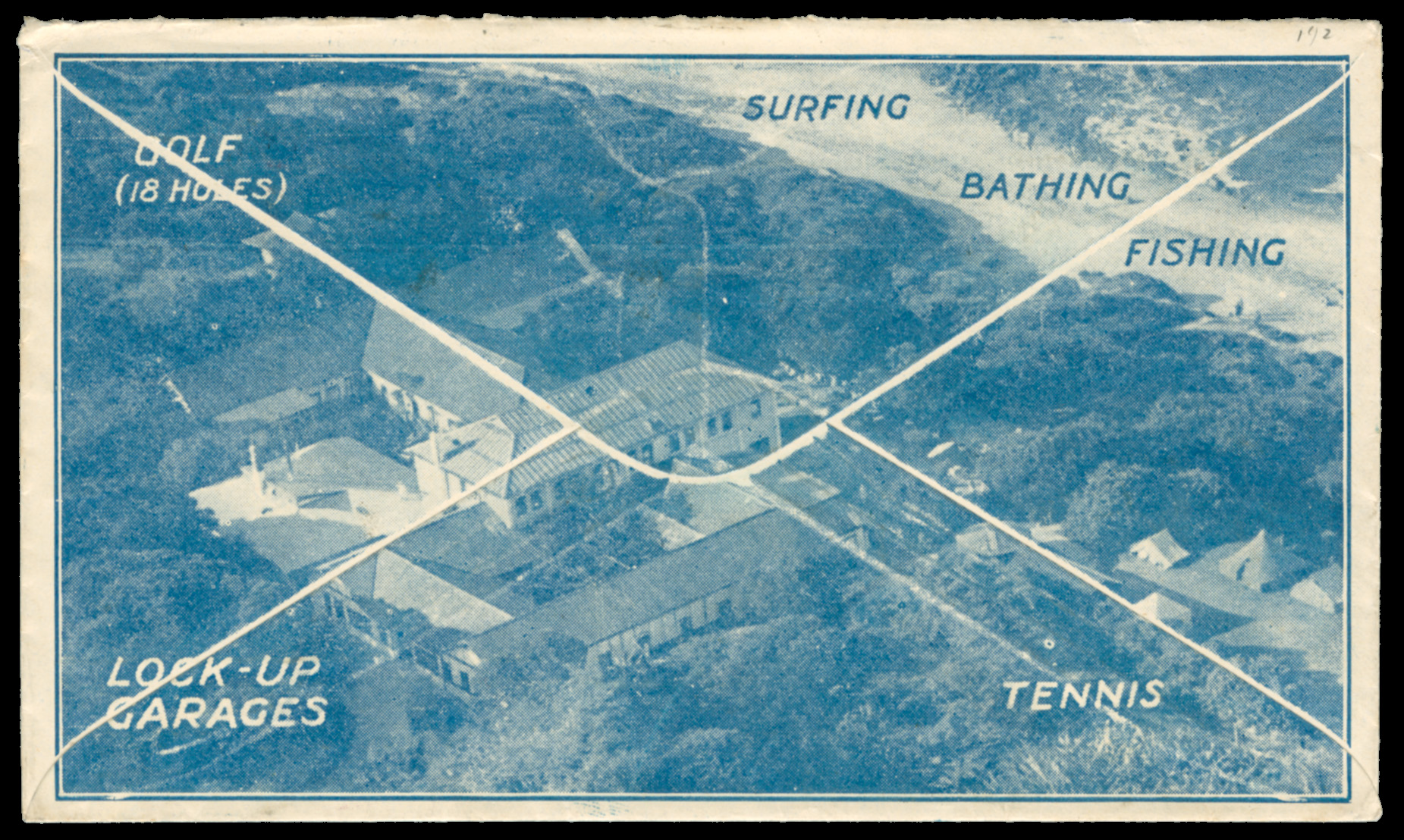
Finally, the reverse of the cover shows an aerial view of the hotel with all its main perceived benefits highlighted.
Umhlanga Rocks Hotel, Natal
The cover below from May 1938 was bought from Simon Peetoom (Africa Stamps) at the two day SACS Kenilworth meeting a week ago tomorrow. It was a good, enjoyable and well-attended meeting, one that I wasn't looking forward to beforehand but on the day and at the time it greatly exceeded my expectations and I came away having really enjoyed it. All South Africa collectors living in the UK should give some thought to joining SACS (SA Collectors' Society). It costs just £10 pa. Besides attending the optional meetings, membership of SACS entitles you to bid in their regular auction where the quality of material is high and the prices relatively low compared to the market!
Back to Umhlanga Rocks Hotel.... The original Umhlanga Rocks Hotel as shown below was built in 1923 by Marcus McCausland and was the first hotel to be built in Umhlanga. That was the time to visit the place. The well-known The Oyster Box Hotel had been built as a private beach cottage in 1863 and over time it evolved into a tea garden, a restaurant and finally a hotel by 1954 when it attempted to emulate the success of the Umhlanga Rocks Hotel which had almost single-handedly transformed what was a quiet sugar-farming enclave into one of South Africa's most iconic coastal resorts. As I prefer simple holidays in unpoiled rustic locations, I doubt I would want to visit Umhlanga Rocks today! Rather like my boyhood in Hermanus, 'been there, done that' when it was at its best as a fishing 'dorp!'.
The cover has been posted from MOUNT EDGECOMBE. At the time UMHLANGA ROCKS had a Postal Agency known as UMHLANGA BEACH 1930 - 1939, (H/O MOUNT EDGECOMBE). It was renamed UMHLANGA ROCKS in 1939.
This cover pretty much has everything a 'Hotel' collector might want in terms of South African postal history.
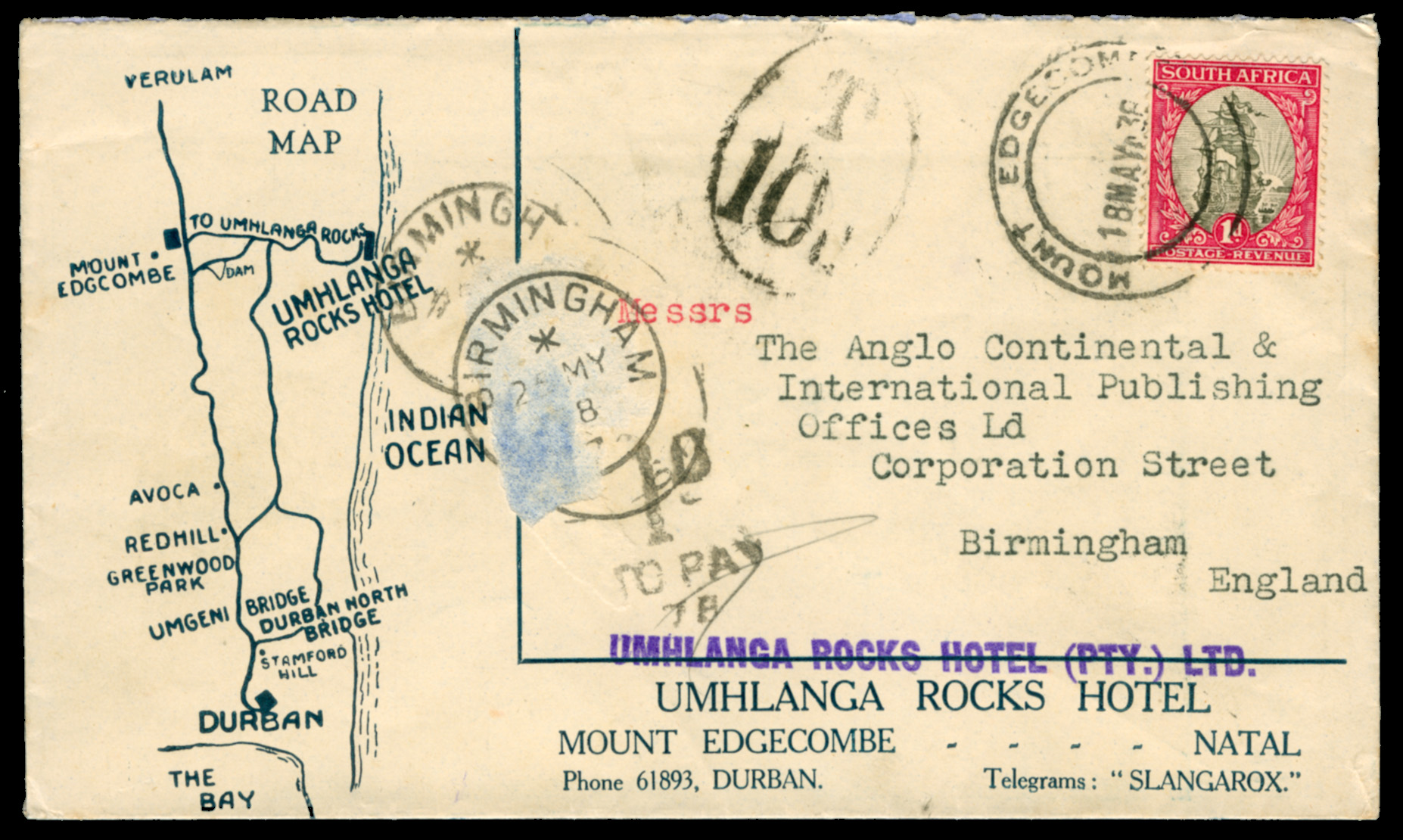
1938. Advertising cover. MOUNT EDGECOMBE '18 MAY 38' to BIRMINGHAM '25 MAY 38'.
To reach the UK in one week, this cover would have to gone by AIRMAIL.
A Postage rate of 1d to GB in 1938 is correct for Surface mail but not for airmail, which is why it was Taxed.
NOTE: This cover is not marked 'AIRMAIL'. This error must be SAPO's fault!
This advertising covert promotes the hotel with name, address and contact details. (Telegram 'SLANGAROX'.) The second feature of the front of this cover is a road map which shows MOUNT EDGCOMBE where the cover was cancelled on '18 MAY 38'. Mount Edgecombe is where one turns off the main road going north-east from Durban to head down to the Indian Ocean and the Umhlanga Rocks Hotel.
Thirdly, there is the mystery of its postage. It reached the UK one week after posting in MOUNT EDGECOMBE. It can only have travelled airmail yet it carries the 1d SURFACE mail rate. Nowhere does it demand an AIRMAIL service. As it has been underpaid for the AIRMAIL rate, it has been taxed 'T 10c' in SA and '1d to Pay' in GB. I imagine that the purpose of the contents of this cover was probably to get the recipient to publicise the hotel. Presumably the mistake made by the Mount Edgecome Post Office in sending this AIRMAIL instead of SURFACE mail to GB at the correctly paid 1d rate may have prejudiced the favourable opinions of the recipient.
Finally, the reverse of the cover shows an aerial view of the hotel with all its main perceived benefits highlighted.