
Armistice Day Silence and the Wearing of the Poppy
Quote from Steve on November 9, 2026, 5:03 pmMy wife's family have long held that their mother and grandmother lost her sweetheart in WW1. Little was said about this tragedy. It was never openly discussed. It was the age of the stiff upper lip. The bereaved were expected to 'soldier on'. The poppy shown below was found pressed in a book that had belonged to her. The poppy is of indeterminate age, a fairly early example rather than anything modern.
WWI resulted in the slaughter of an estimated 9 to 11 million combatants, with about 7 to 8 million being direct combat fatalities (KIA or died of wounds). The remaining military losses were due to disease, accidents, and severe conditions in POW camps. The Allies bore the heaviest burden in absolute numbers, losing roughly 5.4 to 6 million soldiers, compared to about 4 million military deaths suffered by the Central Powers. The Germans suffered the biggest losses, some 2m dead out of an 11m army. The larger Russian army of some 12m lost 1.8m men killed. France lost some 1.4m men out of an Armee of 8m. Britain and its Empire lost some 900,000 men out of the 9m who served, about 1 in 10.
Circa 1930. Haig's Fund Poppy. Unusual five petal variety. (Most are two or four petals.)
The Royal British Legion was founded in 1921 and the first official Poppy Day was held in November of that year. A year later Major George Howson established a poppy factory in London but such was the demand for poppies that few were reaching Scotland. In 1926 Earl Haig's wife established a poppy factory in Edinburgh to produce poppies exclusively for sale in Scotland. The poppies produced by Lady Haig's poppy factory have four petals. This is still true today for the poppies sold in aid of Poppyscotland, which differ from the two-petal design sold by the Royal British Legion in England, Wales and Northern Ireland. (National Army Museum).
With reference to the origin of the Armistice Day’s two minute silence, the following extract is taken from ‘THE LEGEND OF THE POPPY’ by Ken Gillings, Pinetown, KwaZulu-Natal, 26th October 2015.
“There is a South African connection in Remembrance Day, the 11th November. On the 27th October 1919, Sir Percy Fitzpatrick (who had lost two brothers in WW1) suggested that a minute’s silence be observed annually on the 11th November the date when the War ended. His suggestion was forwarded to King George V, who proclaimed on the 9th November 1919: “That at the hour when the Armistice came into force, the 11th hour of the 11th day of the 11th month, there may be for the brief space of two minutes a complete suspension of all normal activities – so that in perfect silence the thoughts of everyone may be concentrated in reverent remembrance of the glorious dead.”
The King’s private secretary, Lord Stamfordham, wrote the following letter to Fitzpatrick:
“Dear Sir Percy,The King, who learns that you are shortly to leave for South Africa, desires me to assure you that he ever gratefully remembers that the idea of the two minute Pause on Armistice Day was due to your initiation – a suggestion readily adopted and carried out with heartfelt sympathy throughout the Empire.” ”
1984. South African English Authors.
40c. Sir Henry Fitzpatrick, Author of 'Jock of the Bushveld'.Sir James Percy Fitzpatrick, KCMG, was born on 24th July 1862 in King William’s Town,and died on 24th January 1931 in Uitenhage, Cape Province. His Irish-born parents were Judge James Coleman Fitzpatrick of the Supreme Court of the Cape Colony and Jenny FitzGerald, daughter of Peter Nugent Fitzgerald, of ‘Soho House’, Multyfarnham, County Westmeath.
During WW1, Sir Percy Fitzpatrick toured South Africa, lecturing about the war. His son, Major Percy Nugent Fitzpatrick, was killed at Bourlon Wood, near Cambrai, France on 14th December 1917. After the Armistice, apart from the two-minute-silence, he also conceived the idea of the National South African War Memorial at Delville Wood, Somme, France and was the Committee Chairman for it.
My wife's family have long held that their mother and grandmother lost her sweetheart in WW1. Little was said about this tragedy. It was never openly discussed. It was the age of the stiff upper lip. The bereaved were expected to 'soldier on'. The poppy shown below was found pressed in a book that had belonged to her. The poppy is of indeterminate age, a fairly early example rather than anything modern.
WWI resulted in the slaughter of an estimated 9 to 11 million combatants, with about 7 to 8 million being direct combat fatalities (KIA or died of wounds). The remaining military losses were due to disease, accidents, and severe conditions in POW camps. The Allies bore the heaviest burden in absolute numbers, losing roughly 5.4 to 6 million soldiers, compared to about 4 million military deaths suffered by the Central Powers. The Germans suffered the biggest losses, some 2m dead out of an 11m army. The larger Russian army of some 12m lost 1.8m men killed. France lost some 1.4m men out of an Armee of 8m. Britain and its Empire lost some 900,000 men out of the 9m who served, about 1 in 10.
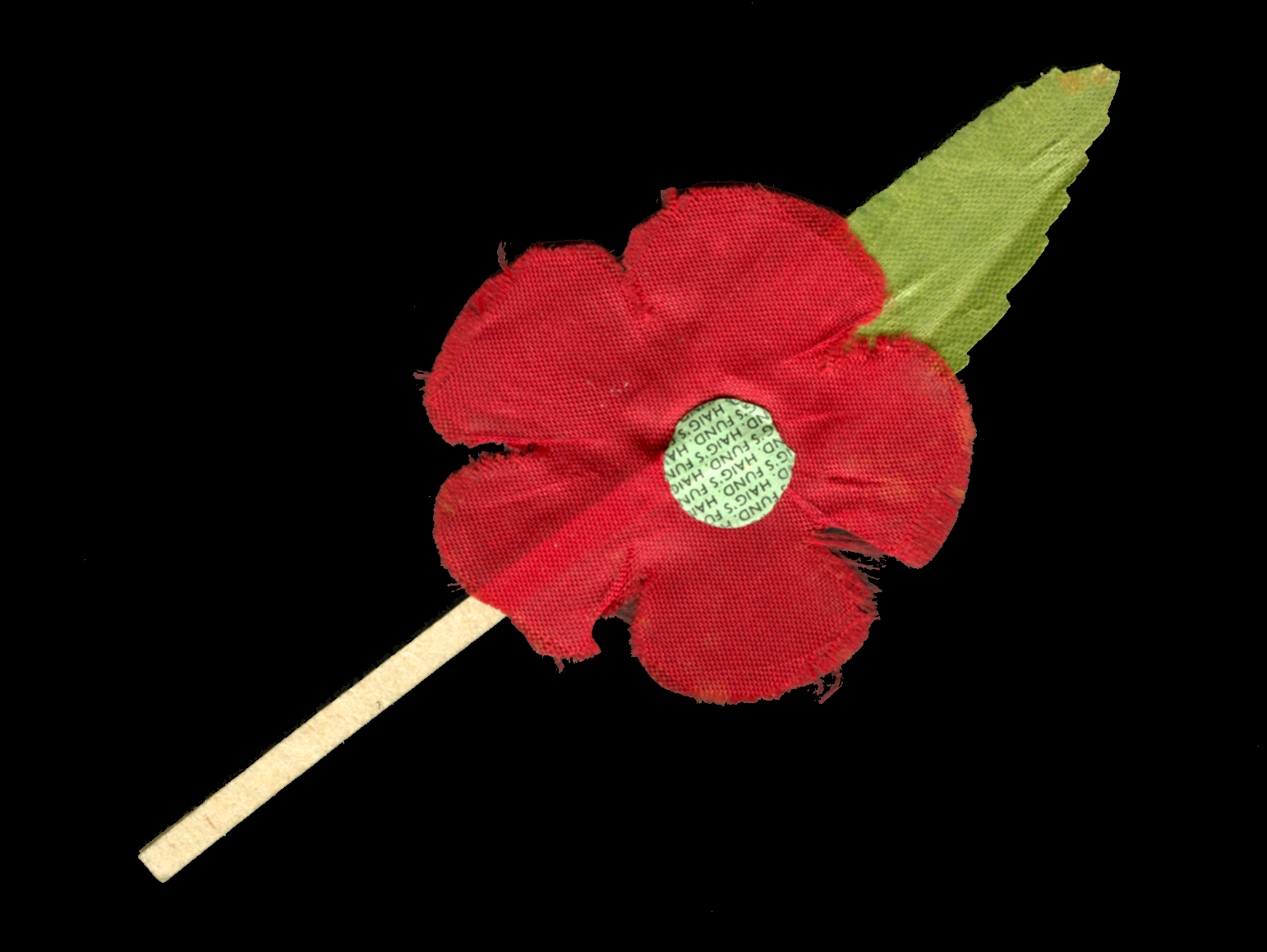
Circa 1930. Haig's Fund Poppy. Unusual five petal variety. (Most are two or four petals.)
The Royal British Legion was founded in 1921 and the first official Poppy Day was held in November of that year. A year later Major George Howson established a poppy factory in London but such was the demand for poppies that few were reaching Scotland. In 1926 Earl Haig's wife established a poppy factory in Edinburgh to produce poppies exclusively for sale in Scotland. The poppies produced by Lady Haig's poppy factory have four petals. This is still true today for the poppies sold in aid of Poppyscotland, which differ from the two-petal design sold by the Royal British Legion in England, Wales and Northern Ireland. (National Army Museum).
With reference to the origin of the Armistice Day’s two minute silence, the following extract is taken from ‘THE LEGEND OF THE POPPY’ by Ken Gillings, Pinetown, KwaZulu-Natal, 26th October 2015.
“There is a South African connection in Remembrance Day, the 11th November. On the 27th October 1919, Sir Percy Fitzpatrick (who had lost two brothers in WW1) suggested that a minute’s silence be observed annually on the 11th November the date when the War ended. His suggestion was forwarded to King George V, who proclaimed on the 9th November 1919: “That at the hour when the Armistice came into force, the 11th hour of the 11th day of the 11th month, there may be for the brief space of two minutes a complete suspension of all normal activities – so that in perfect silence the thoughts of everyone may be concentrated in reverent remembrance of the glorious dead.”
The King’s private secretary, Lord Stamfordham, wrote the following letter to Fitzpatrick:
“Dear Sir Percy,The King, who learns that you are shortly to leave for South Africa, desires me to assure you that he ever gratefully remembers that the idea of the two minute Pause on Armistice Day was due to your initiation – a suggestion readily adopted and carried out with heartfelt sympathy throughout the Empire.” ”
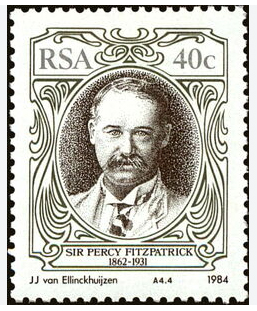
1984. South African English Authors.
40c. Sir Henry Fitzpatrick, Author of 'Jock of the Bushveld'.
Sir James Percy Fitzpatrick, KCMG, was born on 24th July 1862 in King William’s Town,and died on 24th January 1931 in Uitenhage, Cape Province. His Irish-born parents were Judge James Coleman Fitzpatrick of the Supreme Court of the Cape Colony and Jenny FitzGerald, daughter of Peter Nugent Fitzgerald, of ‘Soho House’, Multyfarnham, County Westmeath.
During WW1, Sir Percy Fitzpatrick toured South Africa, lecturing about the war. His son, Major Percy Nugent Fitzpatrick, was killed at Bourlon Wood, near Cambrai, France on 14th December 1917. After the Armistice, apart from the two-minute-silence, he also conceived the idea of the National South African War Memorial at Delville Wood, Somme, France and was the Committee Chairman for it.
Quote from Steve on November 10, 2026, 7:36 amField Marshall Douglas Haig (1861–1928) was one of Britain's most influential and controversial military commanders of WW1. His actions were viciously satirised in the anti-establishment fim, 'Oh What a Lovely War', Richard Attenborough's 1969 directorial debut that included a Who's Who ensemble cast of pretty much all the leading British actors of the period. It defined the view that the British soldiery were 'Lions lead by Donkeys'. The Donkey in Chief was the callous and indifferent Haig. The truth, however , is someewhere inbetween.
1969. 'Oh! What a Lovely War' movie poster.
Field Marshal Sir Douglas Haig played by John Mills advances alone through row-on-row of crosses.Haig was a direct descendant of the founding Haig whisky family and the son of John Richard Haig, the head of the Haig & Haig distillery. He chose a military career instead of joining the family business. Haig had served with distinction in the South African War (1899 - 1902) as a key staff officer and cavalry commander. The experience played a major role in shaping his military career and tactical mindset.
In late 1899, he narrowly escaped the Siege of Ladysmith, departing on the last train before it began. He worked closely with General Sir John French, helping to plan cavalry operations, manage logistics, and support actions such as the Battle of Elandslaagte, the relief of Kimberley, and the captures of Bloemfontein and Pretoria. He commanded the 3rd Cavalry Brigade (1900) and later the 17th Lancers (1901–1903), leading a mobile column of about 2,500 men. He participated in and implemented counter-insurgency 'scorched earth' measures, including burning farms and supporting the relocation of Boer civilians into concentration camps. He did not apologise for this. It would have ruined his career if he had.
He subsequently held senior positions in the British Army. He succeeded Sir John French as Commander-in-Chief of the British Expeditionary Force on the Western Front in December 1915. He directed British operations during some of the war's bloodiest battles, including the Somme (1916), Arras and Passchendaele (Third Ypres, 1917), where enormous casualties were incurred for limited territorial gain. While Haig believed that sustained attrition would eventually exhaust the German Army, he also supported and encouraged the development of new military tactics, particularly the use of tanks to support infantry, coordinated artillery bombardments, ground attacks by aircraft in close air support of advancing infantry and mobile radio communications.
In the spring of 1918, Haig faced the German Spring Offensive, issuing his famous “Backs to the Wall” order in April, urging his troops to resist at all costs. His leadership subsequently proved crucial during the Allied Hundred Days Offensive (August–November 1918), when British and Dominion forces helped break the German Army and advance through the Hindenburg Line towards victory. Haig's legacy remains sharply divided: once celebrated as a national hero and elevated to Earl Haig in 1919, he has been criticised for the enormous human cost of his offensives. Increasingly, however, modern historians now recognise his contribution to the development of the British Army as arguably the best and most modern on the 1918 battlefield, one that ultimately marched to the Rhine and victory.
To some extent Haig was horrified by his part in WW1's slaughter. The Haig Fund Poppy appeal was his way of making amends for the sacrificed lives of the soldiers under his command and finding some degree of peace within himself and with the British people.
Field Marshall Douglas Haig (1861–1928) was one of Britain's most influential and controversial military commanders of WW1. His actions were viciously satirised in the anti-establishment fim, 'Oh What a Lovely War', Richard Attenborough's 1969 directorial debut that included a Who's Who ensemble cast of pretty much all the leading British actors of the period. It defined the view that the British soldiery were 'Lions lead by Donkeys'. The Donkey in Chief was the callous and indifferent Haig. The truth, however , is someewhere inbetween.
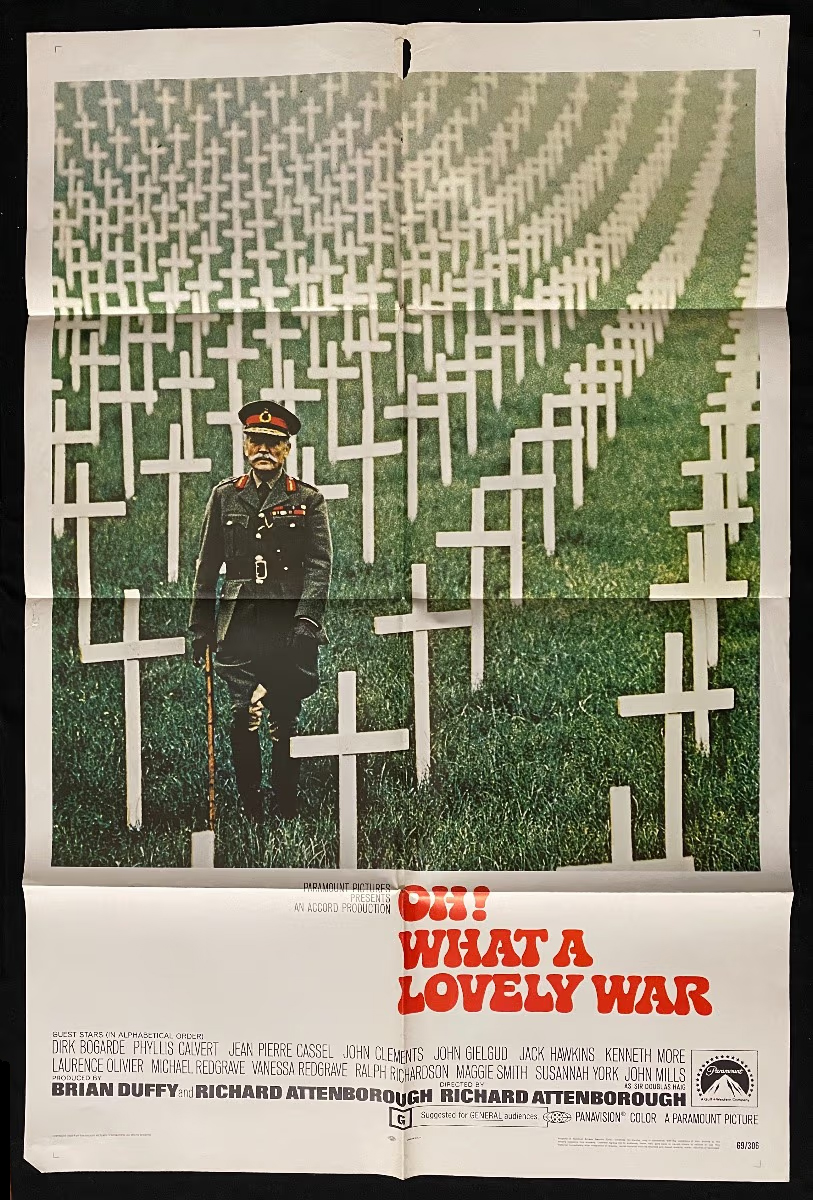
1969. 'Oh! What a Lovely War' movie poster.
Field Marshal Sir Douglas Haig played by John Mills advances alone through row-on-row of crosses.
Haig was a direct descendant of the founding Haig whisky family and the son of John Richard Haig, the head of the Haig & Haig distillery. He chose a military career instead of joining the family business. Haig had served with distinction in the South African War (1899 - 1902) as a key staff officer and cavalry commander. The experience played a major role in shaping his military career and tactical mindset.
In late 1899, he narrowly escaped the Siege of Ladysmith, departing on the last train before it began. He worked closely with General Sir John French, helping to plan cavalry operations, manage logistics, and support actions such as the Battle of Elandslaagte, the relief of Kimberley, and the captures of Bloemfontein and Pretoria. He commanded the 3rd Cavalry Brigade (1900) and later the 17th Lancers (1901–1903), leading a mobile column of about 2,500 men. He participated in and implemented counter-insurgency 'scorched earth' measures, including burning farms and supporting the relocation of Boer civilians into concentration camps. He did not apologise for this. It would have ruined his career if he had.
He subsequently held senior positions in the British Army. He succeeded Sir John French as Commander-in-Chief of the British Expeditionary Force on the Western Front in December 1915. He directed British operations during some of the war's bloodiest battles, including the Somme (1916), Arras and Passchendaele (Third Ypres, 1917), where enormous casualties were incurred for limited territorial gain. While Haig believed that sustained attrition would eventually exhaust the German Army, he also supported and encouraged the development of new military tactics, particularly the use of tanks to support infantry, coordinated artillery bombardments, ground attacks by aircraft in close air support of advancing infantry and mobile radio communications.
In the spring of 1918, Haig faced the German Spring Offensive, issuing his famous “Backs to the Wall” order in April, urging his troops to resist at all costs. His leadership subsequently proved crucial during the Allied Hundred Days Offensive (August–November 1918), when British and Dominion forces helped break the German Army and advance through the Hindenburg Line towards victory. Haig's legacy remains sharply divided: once celebrated as a national hero and elevated to Earl Haig in 1919, he has been criticised for the enormous human cost of his offensives. Increasingly, however, modern historians now recognise his contribution to the development of the British Army as arguably the best and most modern on the 1918 battlefield, one that ultimately marched to the Rhine and victory.
To some extent Haig was horrified by his part in WW1's slaughter. The Haig Fund Poppy appeal was his way of making amends for the sacrificed lives of the soldiers under his command and finding some degree of peace within himself and with the British people.
Quote from yannisl on November 10, 2026, 3:14 pmNice write-up Steve, thanks. I also read one of your previous posts about promoting more "social" and "postal history". WWI material survived in the millions and very cheap to pick up. A little bit of a difficult area to collect with all the censors and regiment stamps but neverthelss a very interesting area.
Keep-them-coming
Nice write-up Steve, thanks. I also read one of your previous posts about promoting more "social" and "postal history". WWI material survived in the millions and very cheap to pick up. A little bit of a difficult area to collect with all the censors and regiment stamps but neverthelss a very interesting area.
Keep-them-coming