
B. & F. P. P. 28 - how was this used?
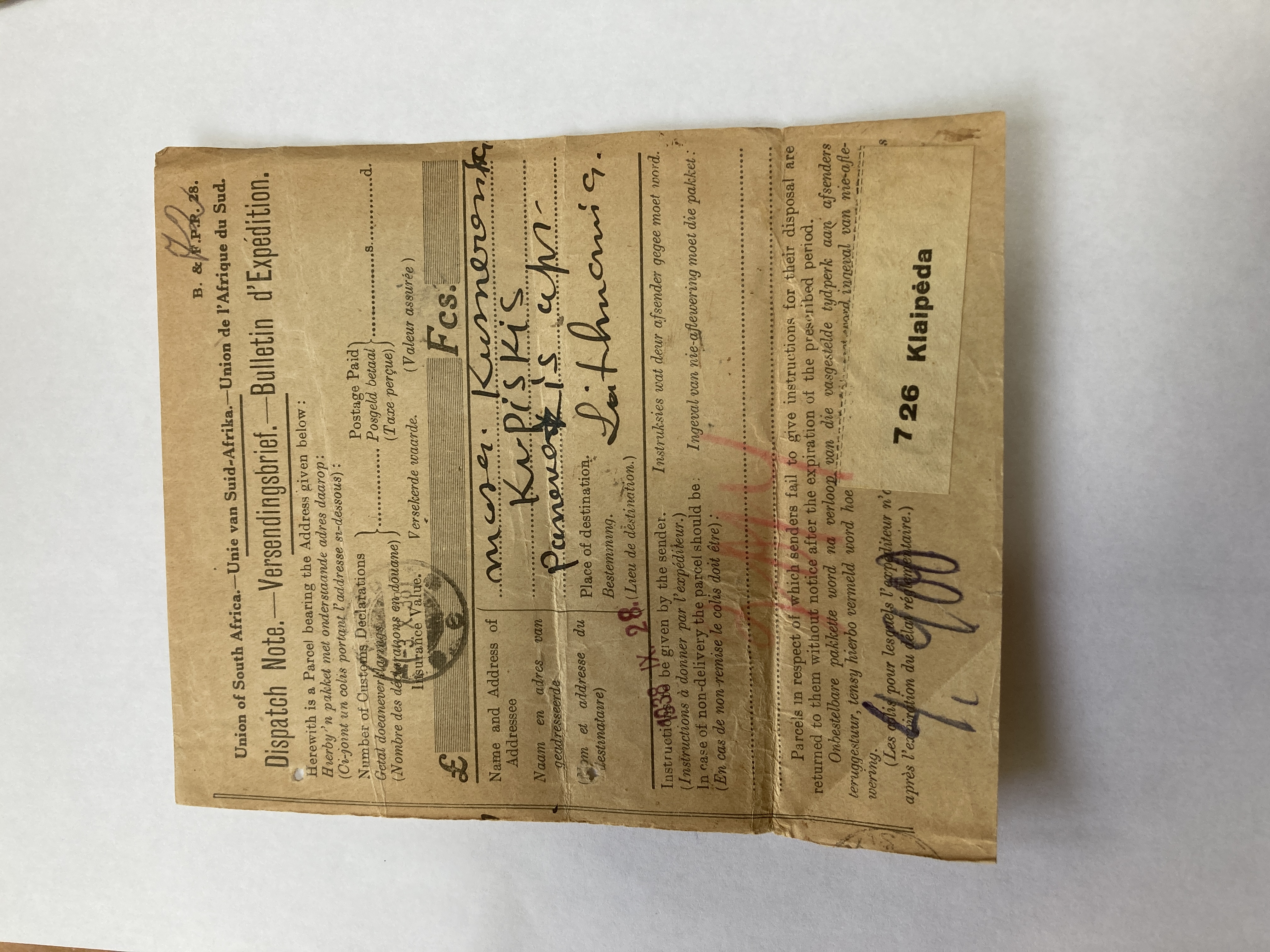
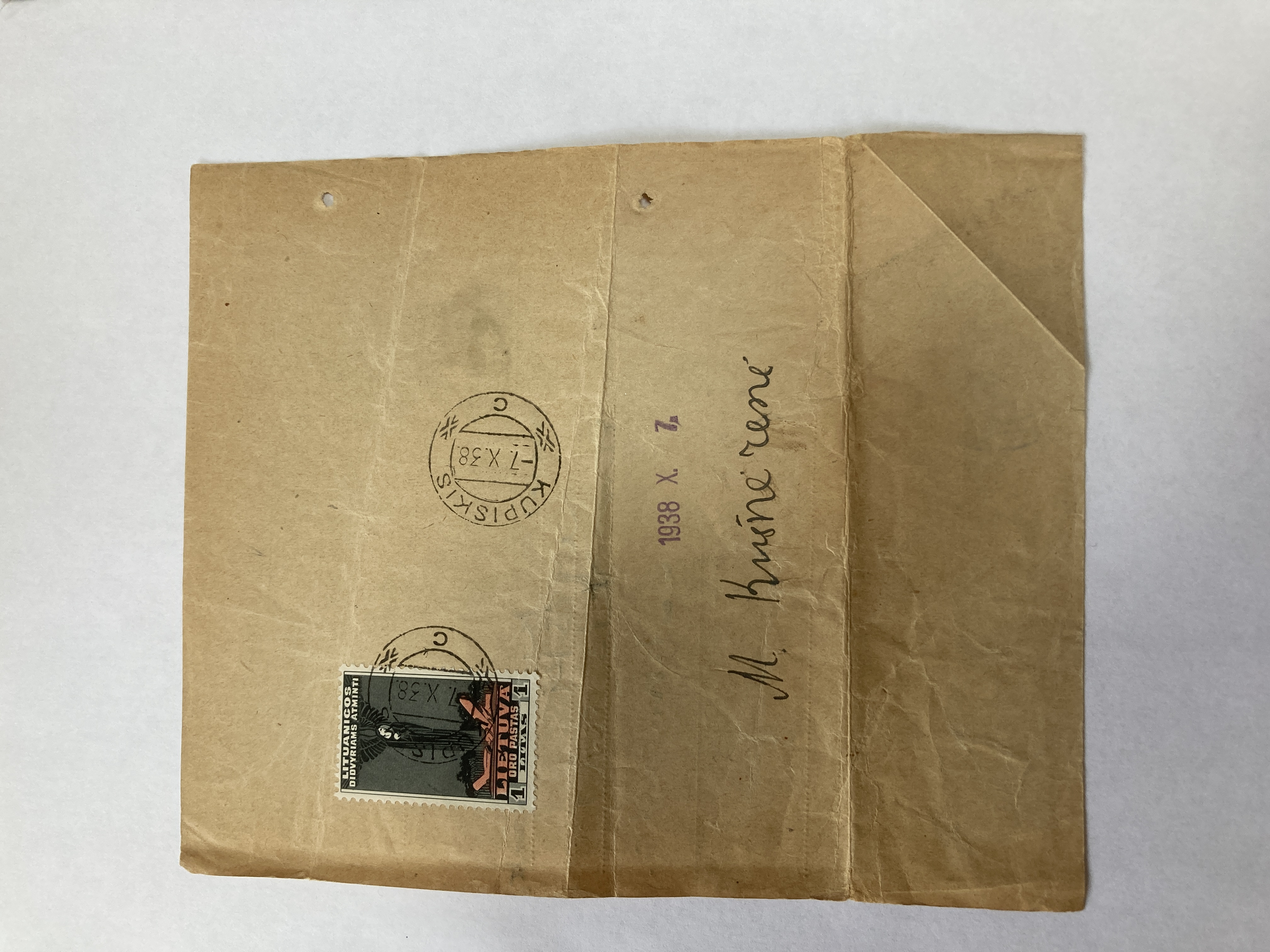
Quote from Bas PAYNE on June 15, 2026, 2:03 pmI have just acquired an example of this form - images of front and back attached; I haven't seen one like it before.
It clearly relates to a parcel sent from South Africa to Lithuania in 1938; and appears to be incomplete - the left side appears to have been cut, and there is a small part of a circular ?postmark bottom left. It looks as if it was attached to the parcel, to give information about customs declaration(s) and postage paid, and instructions about disposal in the event of non-delivery. but the spaces are all blank - all we have is the intended recipient's name and address. The reverse carries a Lithuanian stamp, postmarked KUPISKIS 7 X 38, and the name of the intended recipient; there are two holes which may be from its attachment to the parcel.
Has anyone seen other examples? - and can they cast any light on what this form was for and how it was used?
I have just acquired an example of this form - images of front and back attached; I haven't seen one like it before.
It clearly relates to a parcel sent from South Africa to Lithuania in 1938; and appears to be incomplete - the left side appears to have been cut, and there is a small part of a circular ?postmark bottom left. It looks as if it was attached to the parcel, to give information about customs declaration(s) and postage paid, and instructions about disposal in the event of non-delivery. but the spaces are all blank - all we have is the intended recipient's name and address. The reverse carries a Lithuanian stamp, postmarked KUPISKIS 7 X 38, and the name of the intended recipient; there are two holes which may be from its attachment to the parcel.
Has anyone seen other examples? - and can they cast any light on what this form was for and how it was used?
Uploaded files:
Quote from Jamie Smith on June 15, 2026, 3:17 pmBas, This is not my area, but in a case like this I put it into AI to get a feel of what it is and how it was used and in theis case the history behind it. AI is not alwaays right but it gives one a place to start. I did try it and this is what I got.
Bas, This is not my area, but in a case like this I put it into AI to get a feel of what it is and how it was used and in theis case the history behind it. AI is not alwaays right but it gives one a place to start. I did try it and this is what I got.
Quote from Jamie Smith on June 15, 2026, 3:21 pmThis appears to be an old South African postal dispatch note (parcel mailing form) from the Union of South Africa, likely dating from the period between 1910 and 1961 (when South Africa officially used the name "Union of South Africa").
What the document is
The form is titled:
Dispatch Note – Versendingsbrief – Bulletin d’Expédition
It is printed in English, Afrikaans, and French, reflecting international postal requirements of the era. These forms accompanied parcels sent through the postal system, particularly overseas shipments.
Destination
The handwritten address appears to read approximately:
Mr. Kusnerontas (or similar spelling)
Kupiškis
Panevėžys aps. (Panevėžys district/county)
LithuaniaThe label at the bottom reads:
"726 Klaipėda"
Klaipėda is the major port city in western Lithuania. This may have been a routing, customs, or postal handling label.
Postal markings
I can see:
- A circular postal cancellation stamp.
- A red handstamp that appears to include "1938" and "IX 28" (28 September 1938), although the year is somewhat difficult to read with certainty.
- Additional manuscript and inspection markings.
If the date is indeed 28 September 1938, this would place the parcel in the period just before World War II.
Historical significance
A parcel sent from South Africa to Lithuania in the late 1930s would be of interest because:
- Lithuania was an independent republic at the time (1918–1940).
- International mail between South Africa and the Baltic states was relatively uncommon.
- Such documents are useful for postal-history collectors because they show routes, customs procedures, and international connections.
Estimated collector interest
As a standalone document:
- Common postal forms: typically modest value.
- If linked to an intact parcel, rare route, or immigrant/family correspondence, value and historical interest can increase.
- Postal historians specializing in South Africa, Lithuania, or pre-war international mail would find it more interesting than general collectors.
If you'd like, I can also try to:
- Transcribe the handwriting more accurately.
- Analyze the postal cancel and date stamp.
- Estimate its postal-history/collector value.
- Research the route from South Africa to Lithuania in 1938.
Yes. In fact, your document fits into a very interesting historical migration story.
Lithuanian Jews in South Africa
Between roughly 1880 and 1930, thousands of Jews emigrated from what was then part of the Russian Empire, especially from areas that are now Lithuania. Many settled in South Africa, particularly after the discovery of diamonds and gold.
A remarkable feature of South African Jewry is that it became overwhelmingly Litvak (Lithuanian Jewish) in origin. Historians estimate that a large majority of South Africa's Jewish population descended from immigrants from Lithuanian towns and villages.
Places like Kupiškis and Panevėžys
The address on your dispatch note appears to reference:
- Kupiškis (a town in northern Lithuania)
- Panevėžys district (county)
These were significant centers of Jewish life before World War II. Many emigrants from these areas went to:
- South Africa
- United States
- United Kingdom
- Palestine
A common pattern was:
- One family member emigrated to South Africa.
- He established a business (often trading, shopkeeping, or dealing).
- Parcels, money, and letters were sent back home to relatives.
- Eventually additional family members emigrated.
Your dispatch note could easily be an example of this kind of family connection.
Why parcels mattered
Before widespread international banking, emigrants often sent:
- Clothing
- Food items
- Household goods
- Gifts
- Religious items
- Money hidden in parcels or correspondence
A parcel from South Africa to Lithuania in the late 1930s suggests that the sender still had close ties to family in the old country.
The tragic timing
If the date is indeed 1938, that is particularly poignant.
Lithuania's Jewish communities still existed then, but within a few years:
- Lithuania was occupied by the Soviet Union (1940).
- Nazi Germany invaded (1941).
- Approximately 90–95% of Lithuanian Jews were murdered during the Holocaust, one of the highest destruction rates in Europe.
The Jewish community of Kupiškis was almost entirely destroyed during 1941.
That means this parcel may represent communication between relatives only a short time before those communities disappeared.
What your document may reveal
The surname is difficult to read from the image, but if we can identify it accurately, there is a chance to:
- Trace the family in Lithuanian records.
- Check South African immigration records.
- Look for descendants.
- Determine whether the recipient belonged to the Jewish community of Kupiškis.
The handwriting looks somewhat like Kuzner, Kushner, Kusner, or a related Litvak surname, though I would not want to be definitive from this image alone.
If you'd like, I can zoom in on the handwriting and try to produce a detailed transcription of the recipient's name and address, which could open the door to genealogical research.
Yes. The reverse side actually helps explain the purpose of the document.
What this form was
This was essentially a postal dispatch note/customs declaration wrapper that accompanied an overseas parcel. Think of it as a combination of:
- a mailing receipt,
- a customs declaration,
- and a routing label.
The parcel itself would have been wrapped separately. This form was attached to it or enclosed in a postal pouch so that customs and postal officials along the route could identify the sender, recipient, value, and postage status.
What happened to this particular form
The front side (your first image) was completed in South Africa when the parcel was mailed.
The back side (your second image) shows what happened after it arrived in Lithuania:
- The Lithuanian postage stamp was affixed after arrival.
- The circular postmark reads KUPIŠKIS and is dated 7.X.38 (7 October 1938).
- The purple handstamp reads 1938 X. 7 — another date marking in Lithuanian format.
This suggests the parcel reached Kupiškis on 7 October 1938, about a week after being dispatched from South Africa.
Why is there a Lithuanian stamp?
This is one of the most interesting features.
The 1 litas Lithuanian stamp was probably used as a:
- delivery fee,
- customs clearance fee,
- parcel receipt tax,
- or accounting stamp used by the Lithuanian post office.
Many countries required incoming parcels to be presented at a post office for customs assessment, where additional fees were collected and documented with postage stamps and cancellations.
The stamp itself
The stamp reads:
"Lietuvos Didvyriams Atminti"
("In Memory of Lithuania's Heroes")and
"Lietuva 1 Oro Paštas"
("Lithuania 1 Litas Air Mail")Although originally issued as an airmail stamp, such stamps were often used for fiscal and postal accounting purposes on parcel documents.
The manuscript notation
The handwritten name on the back appears very close to:
M. Kušnerienė
or
M. Kusneriene
The ending -ienė is significant. In Lithuanian naming conventions:
- Kušneris = a married man
- Kušnerienė = his wife
This strongly suggests the person signing or receiving the parcel was a married woman, probably Mrs. Kušneris (Kushner/Kusner).
That fits remarkably well with the surname that appears on the front.
What may have happened
A plausible reconstruction:
- A Lithuanian Jewish emigrant living in South Africa sends a parcel home.
- The parcel is addressed to relatives in Kupiškis.
- It travels by ship and rail through Europe.
- It arrives at Kupiškis post office on 7 October 1938.
- The recipient (possibly Mrs. Kušnerienė) signs or acknowledges receipt.
- The Lithuanian post office affixes and cancels a stamp as proof that customs/delivery formalities were completed.
Why postal historians would like this
This is not just a form; it documents:
- South Africa → Lithuania mail.
- A precise arrival date.
- A named recipient.
- A Lithuanian receiving postmark.
- A connection between the South African Litvak diaspora and a Lithuanian town shortly before World War II.
The date is especially evocative. In October 1938, nobody yet knew that within three years the Jewish community of Kupiškis would be devastated during the Holocaust. Documents showing ordinary family contact between South Africa and Lithuania at that moment are tangible evidence of those transnational family networks.
The combination of the South African dispatch note, the Kupiškis arrival markings, and the likely Jewish surname makes this a much more historically interesting item than an ordinary postal form.
This appears to be an old South African postal dispatch note (parcel mailing form) from the Union of South Africa, likely dating from the period between 1910 and 1961 (when South Africa officially used the name "Union of South Africa").
What the document is
The form is titled:
Dispatch Note – Versendingsbrief – Bulletin d’Expédition
It is printed in English, Afrikaans, and French, reflecting international postal requirements of the era. These forms accompanied parcels sent through the postal system, particularly overseas shipments.
Destination
The handwritten address appears to read approximately:
Mr. Kusnerontas (or similar spelling)
Kupiškis
Panevėžys aps. (Panevėžys district/county)
Lithuania
The label at the bottom reads:
"726 Klaipėda"
Klaipėda is the major port city in western Lithuania. This may have been a routing, customs, or postal handling label.
Postal markings
I can see:
- A circular postal cancellation stamp.
- A red handstamp that appears to include "1938" and "IX 28" (28 September 1938), although the year is somewhat difficult to read with certainty.
- Additional manuscript and inspection markings.
If the date is indeed 28 September 1938, this would place the parcel in the period just before World War II.
Historical significance
A parcel sent from South Africa to Lithuania in the late 1930s would be of interest because:
- Lithuania was an independent republic at the time (1918–1940).
- International mail between South Africa and the Baltic states was relatively uncommon.
- Such documents are useful for postal-history collectors because they show routes, customs procedures, and international connections.
Estimated collector interest
As a standalone document:
- Common postal forms: typically modest value.
- If linked to an intact parcel, rare route, or immigrant/family correspondence, value and historical interest can increase.
- Postal historians specializing in South Africa, Lithuania, or pre-war international mail would find it more interesting than general collectors.
If you'd like, I can also try to:
- Transcribe the handwriting more accurately.
- Analyze the postal cancel and date stamp.
- Estimate its postal-history/collector value.
- Research the route from South Africa to Lithuania in 1938.
Yes. In fact, your document fits into a very interesting historical migration story.
Lithuanian Jews in South Africa
Between roughly 1880 and 1930, thousands of Jews emigrated from what was then part of the Russian Empire, especially from areas that are now Lithuania. Many settled in South Africa, particularly after the discovery of diamonds and gold.
A remarkable feature of South African Jewry is that it became overwhelmingly Litvak (Lithuanian Jewish) in origin. Historians estimate that a large majority of South Africa's Jewish population descended from immigrants from Lithuanian towns and villages.
Places like Kupiškis and Panevėžys
The address on your dispatch note appears to reference:
- Kupiškis (a town in northern Lithuania)
- Panevėžys district (county)
These were significant centers of Jewish life before World War II. Many emigrants from these areas went to:
- South Africa
- United States
- United Kingdom
- Palestine
A common pattern was:
- One family member emigrated to South Africa.
- He established a business (often trading, shopkeeping, or dealing).
- Parcels, money, and letters were sent back home to relatives.
- Eventually additional family members emigrated.
Your dispatch note could easily be an example of this kind of family connection.
Why parcels mattered
Before widespread international banking, emigrants often sent:
- Clothing
- Food items
- Household goods
- Gifts
- Religious items
- Money hidden in parcels or correspondence
A parcel from South Africa to Lithuania in the late 1930s suggests that the sender still had close ties to family in the old country.
The tragic timing
If the date is indeed 1938, that is particularly poignant.
Lithuania's Jewish communities still existed then, but within a few years:
- Lithuania was occupied by the Soviet Union (1940).
- Nazi Germany invaded (1941).
- Approximately 90–95% of Lithuanian Jews were murdered during the Holocaust, one of the highest destruction rates in Europe.
The Jewish community of Kupiškis was almost entirely destroyed during 1941.
That means this parcel may represent communication between relatives only a short time before those communities disappeared.
What your document may reveal
The surname is difficult to read from the image, but if we can identify it accurately, there is a chance to:
- Trace the family in Lithuanian records.
- Check South African immigration records.
- Look for descendants.
- Determine whether the recipient belonged to the Jewish community of Kupiškis.
The handwriting looks somewhat like Kuzner, Kushner, Kusner, or a related Litvak surname, though I would not want to be definitive from this image alone.
If you'd like, I can zoom in on the handwriting and try to produce a detailed transcription of the recipient's name and address, which could open the door to genealogical research.
Yes. The reverse side actually helps explain the purpose of the document.
What this form was
This was essentially a postal dispatch note/customs declaration wrapper that accompanied an overseas parcel. Think of it as a combination of:
- a mailing receipt,
- a customs declaration,
- and a routing label.
The parcel itself would have been wrapped separately. This form was attached to it or enclosed in a postal pouch so that customs and postal officials along the route could identify the sender, recipient, value, and postage status.
What happened to this particular form
The front side (your first image) was completed in South Africa when the parcel was mailed.
The back side (your second image) shows what happened after it arrived in Lithuania:
- The Lithuanian postage stamp was affixed after arrival.
- The circular postmark reads KUPIŠKIS and is dated 7.X.38 (7 October 1938).
- The purple handstamp reads 1938 X. 7 — another date marking in Lithuanian format.
This suggests the parcel reached Kupiškis on 7 October 1938, about a week after being dispatched from South Africa.
Why is there a Lithuanian stamp?
This is one of the most interesting features.
The 1 litas Lithuanian stamp was probably used as a:
- delivery fee,
- customs clearance fee,
- parcel receipt tax,
- or accounting stamp used by the Lithuanian post office.
Many countries required incoming parcels to be presented at a post office for customs assessment, where additional fees were collected and documented with postage stamps and cancellations.
The stamp itself
The stamp reads:
"Lietuvos Didvyriams Atminti"
("In Memory of Lithuania's Heroes")
and
"Lietuva 1 Oro Paštas"
("Lithuania 1 Litas Air Mail")
Although originally issued as an airmail stamp, such stamps were often used for fiscal and postal accounting purposes on parcel documents.
The manuscript notation
The handwritten name on the back appears very close to:
M. Kušnerienė
or
M. Kusneriene
The ending -ienė is significant. In Lithuanian naming conventions:
- Kušneris = a married man
- Kušnerienė = his wife
This strongly suggests the person signing or receiving the parcel was a married woman, probably Mrs. Kušneris (Kushner/Kusner).
That fits remarkably well with the surname that appears on the front.
What may have happened
A plausible reconstruction:
- A Lithuanian Jewish emigrant living in South Africa sends a parcel home.
- The parcel is addressed to relatives in Kupiškis.
- It travels by ship and rail through Europe.
- It arrives at Kupiškis post office on 7 October 1938.
- The recipient (possibly Mrs. Kušnerienė) signs or acknowledges receipt.
- The Lithuanian post office affixes and cancels a stamp as proof that customs/delivery formalities were completed.
Why postal historians would like this
This is not just a form; it documents:
- South Africa → Lithuania mail.
- A precise arrival date.
- A named recipient.
- A Lithuanian receiving postmark.
- A connection between the South African Litvak diaspora and a Lithuanian town shortly before World War II.
The date is especially evocative. In October 1938, nobody yet knew that within three years the Jewish community of Kupiškis would be devastated during the Holocaust. Documents showing ordinary family contact between South Africa and Lithuania at that moment are tangible evidence of those transnational family networks.
The combination of the South African dispatch note, the Kupiškis arrival markings, and the likely Jewish surname makes this a much more historically interesting item than an ordinary postal form.
Quote from Jamie Smith on June 15, 2026, 3:22 pmIf nothing else it is a starting point!
If nothing else it is a starting point!
Quote from Steve on June 16, 2026, 7:46 amNice try with AI but I think all you have proven is that if there is no information out there then AI has no knowledge to draw on and comes up with a clever blank. It's not-so cunning back-up plan is to do its best to impress with generalised waffle that most of us could have made up also. Please, this is not a criticism of you or anyone else trying to use AI to get to the bottom of Bas' query. As I said, 'nice try!'. It really just shows that until a brain does the research and posts a document online AI is as useless as the proverbial chocolate tea pot.
From my side - the left side of my brain - I am in my right mind - I cannot add anything about this postal form. It is a curious first for me, as it is for AI who I imagine now has the benefit of ever remembering it, unlike me who grows ever more forgetful.
Nice try with AI but I think all you have proven is that if there is no information out there then AI has no knowledge to draw on and comes up with a clever blank. It's not-so cunning back-up plan is to do its best to impress with generalised waffle that most of us could have made up also. Please, this is not a criticism of you or anyone else trying to use AI to get to the bottom of Bas' query. As I said, 'nice try!'. It really just shows that until a brain does the research and posts a document online AI is as useless as the proverbial chocolate tea pot.
From my side - the left side of my brain - I am in my right mind - I cannot add anything about this postal form. It is a curious first for me, as it is for AI who I imagine now has the benefit of ever remembering it, unlike me who grows ever more forgetful.
Quote from Jamie Smith on June 16, 2026, 8:24 amAs I said, it is a starting point! and it certainelly got you going!
As I said, it is a starting point! and it certainelly got you going!
Quote from Bas PAYNE on June 16, 2026, 4:45 pmMany thanks to both. I found the AI response very interesting as background - many thanks; but I'm still puzzled philatelically.
There was a standard Foreign Parcel Post form, B. & F. P.P. 4, which appears to have been in use right through the Union period; I'll attach a scan of a typical example. The sender was expected to declare on that form what the parcel contained, and its value. The B&FPP 28 form asks for the same information, but the sender hasn't provided it - what, then, is the purpose of the form and why was this form used for this parcel rather than a B&FPP 4? And why do they appear to be so scarce - I must have seen tens and possibly hundreds of B&FPP4 forms.
Many thanks to both. I found the AI response very interesting as background - many thanks; but I'm still puzzled philatelically.
There was a standard Foreign Parcel Post form, B. & F. P.P. 4, which appears to have been in use right through the Union period; I'll attach a scan of a typical example. The sender was expected to declare on that form what the parcel contained, and its value. The B&FPP 28 form asks for the same information, but the sender hasn't provided it - what, then, is the purpose of the form and why was this form used for this parcel rather than a B&FPP 4? And why do they appear to be so scarce - I must have seen tens and possibly hundreds of B&FPP4 forms.
Uploaded files: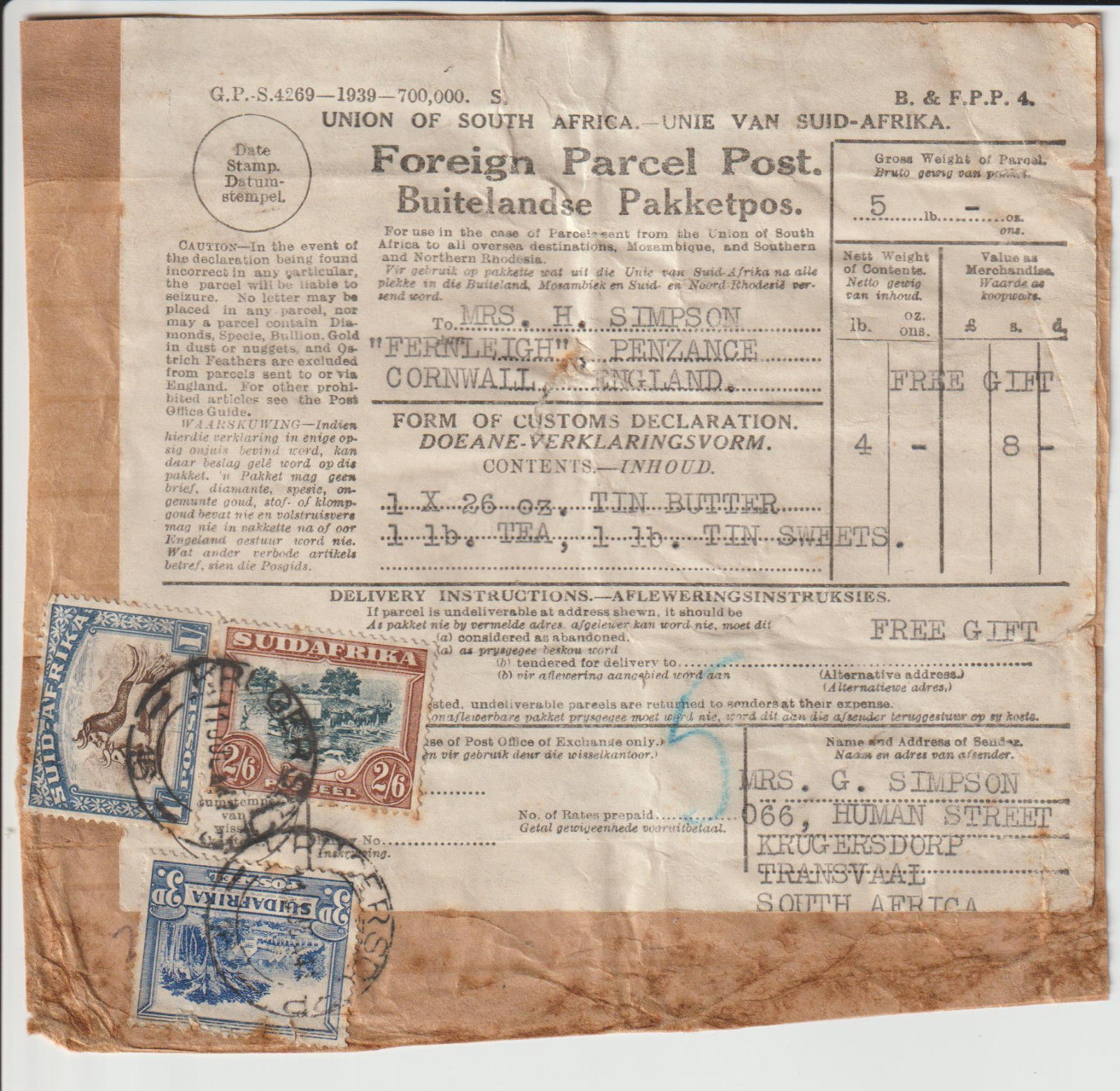
Quote from Jamie Smith on June 17, 2026, 12:20 amHave you asked Alex Visser from Pretoria P/S? He maybe able to help.
Have you asked Alex Visser from Pretoria P/S? He maybe able to help.
Quote from Jamie Smith on June 30, 2026, 1:09 amSteve, the Home page is looking great!
Steve, the Home page is looking great!