
EGYPT
Quote from Steve on October 21, 2026, 8:33 pmAlexandria to Pretoria
Following Jamie's wonderful Egyptian tour d' force, I thought not to add my mediocre material to his presentation as it is perfect by itself. I have rather added my Egyptian material separately, below. My relatively poor but hopefully still interesting Egyptian postal history cannot compare with Jamie's. So, without further explanation here are some of the best bits from my accumulation.
1944. Airmail Cover. ALEXANDRIA '7 NO 44' via CAIRO '14 NO 44' to PRETORIA.
There are no PRETORIA or South African receiving datestamps. Did it ever arrive?The stamps are the 'Young King Farouk' definitive postage stamp series issued between 1937 and 1946. These feature a youthful portrait of King Farouk I who ascended the throne in 1936 when just sixteen. The complete set ranges from low millieme (m) values to £E1 stamps.
I suspect that this is a philatelic fishing exercise. The cover is printed 'Leon Belilos, PO Box 65, Alexandria, Egypt' on the reverse.. It meets the censorship requirements of the day, stating it is an 'English language' letter. It is addressed to 'The Private Secretary of Marshall Jan Smuts, Prime Ministers Office, Pretoria, South Africa.' Strictly speaking, Smuts' correct title is 'Field Marshall'. It was censored and passed with a nice example of a six-sided civil 'Postal Censor' cachet. The sender was probably hoping for a collectable reply. As there are no SA receiving marks, I wonder if it was ever sent.
King Farouk I was the last reigning monarch of Egypt, ascending the throne in 1936 at just 16 years old amid great public popularity. His early promise quickly dissolved as his reign became defined by political instability, British interference, and a notoriously extravagant, playboy lifestyle that alienated his citizens. (He was an extravagant stamp collector!) He became deeply unpopular following Egypt's defeat in the 1948 Arab-Israeli War and was overthrown in a 1952 military coup, dying in exile in Italy.
The 1952 Egyptian Revolution, also known as the 'July 23 Revolution', was a military coup led by the Free Officers Movement - a group of nationalist army officers headed by Muhammad Naguib and Gamal Abdel Nasser. The movement successfully abolished the monarchy, forcing King Farouk into exile and officially declaring Egypt a republic in 1953. The revolt was driven by widespread anger over British colonial occupation, systemic government corruption and Egypt's defeat in the 1948 Arab-Israeli War. Nasser and the revolution reshaped the Middle East by introducing sweeping agrarian reforms and launching a new era of pan-Arab nationalism.
Alexandria to Pretoria
Following Jamie's wonderful Egyptian tour d' force, I thought not to add my mediocre material to his presentation as it is perfect by itself. I have rather added my Egyptian material separately, below. My relatively poor but hopefully still interesting Egyptian postal history cannot compare with Jamie's. So, without further explanation here are some of the best bits from my accumulation.
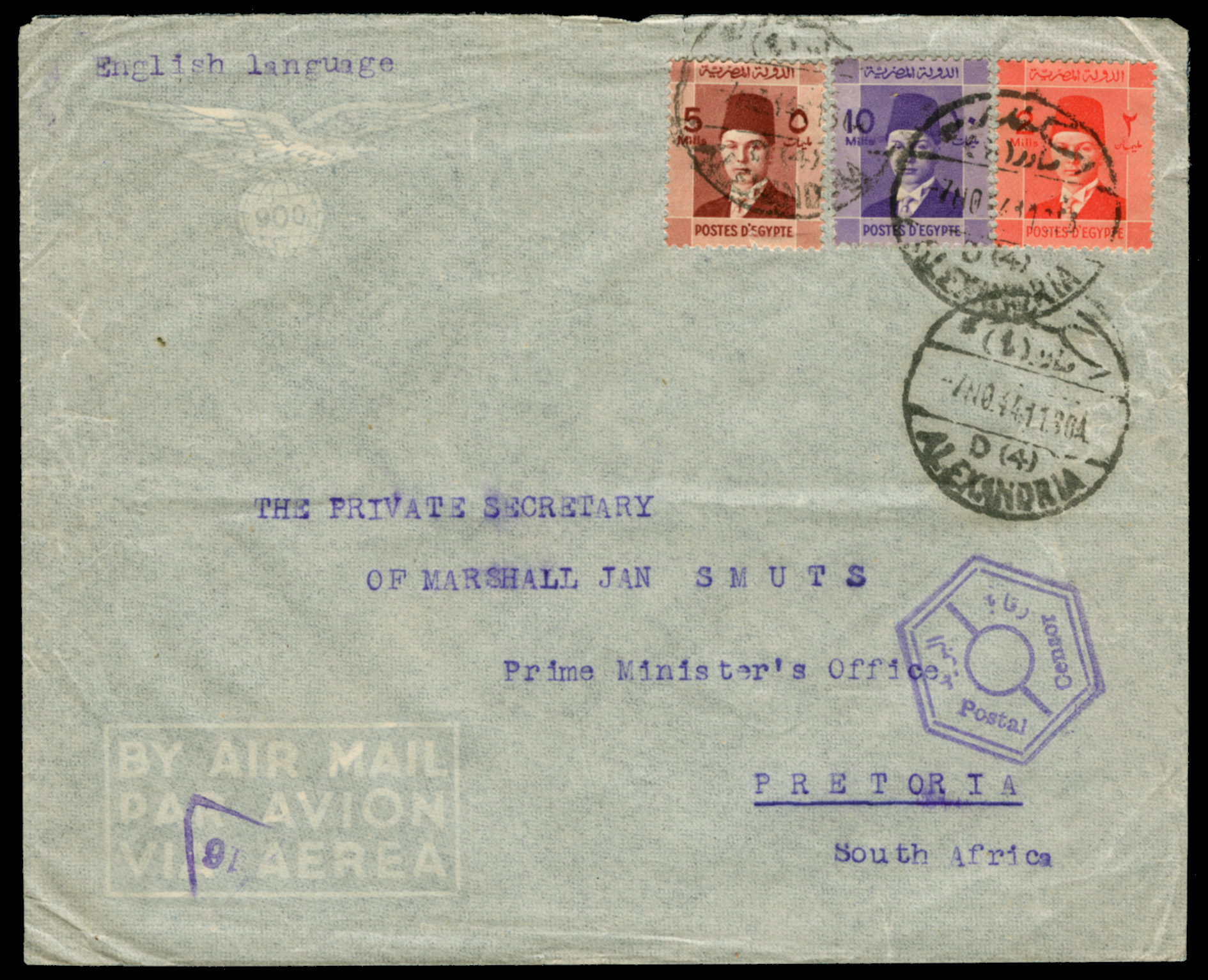
1944. Airmail Cover. ALEXANDRIA '7 NO 44' via CAIRO '14 NO 44' to PRETORIA.
There are no PRETORIA or South African receiving datestamps. Did it ever arrive?
The stamps are the 'Young King Farouk' definitive postage stamp series issued between 1937 and 1946. These feature a youthful portrait of King Farouk I who ascended the throne in 1936 when just sixteen. The complete set ranges from low millieme (m) values to £E1 stamps.
I suspect that this is a philatelic fishing exercise. The cover is printed 'Leon Belilos, PO Box 65, Alexandria, Egypt' on the reverse.. It meets the censorship requirements of the day, stating it is an 'English language' letter. It is addressed to 'The Private Secretary of Marshall Jan Smuts, Prime Ministers Office, Pretoria, South Africa.' Strictly speaking, Smuts' correct title is 'Field Marshall'. It was censored and passed with a nice example of a six-sided civil 'Postal Censor' cachet. The sender was probably hoping for a collectable reply. As there are no SA receiving marks, I wonder if it was ever sent.
King Farouk I was the last reigning monarch of Egypt, ascending the throne in 1936 at just 16 years old amid great public popularity. His early promise quickly dissolved as his reign became defined by political instability, British interference, and a notoriously extravagant, playboy lifestyle that alienated his citizens. (He was an extravagant stamp collector!) He became deeply unpopular following Egypt's defeat in the 1948 Arab-Israeli War and was overthrown in a 1952 military coup, dying in exile in Italy.
The 1952 Egyptian Revolution, also known as the 'July 23 Revolution', was a military coup led by the Free Officers Movement - a group of nationalist army officers headed by Muhammad Naguib and Gamal Abdel Nasser. The movement successfully abolished the monarchy, forcing King Farouk into exile and officially declaring Egypt a republic in 1953. The revolt was driven by widespread anger over British colonial occupation, systemic government corruption and Egypt's defeat in the 1948 Arab-Israeli War. Nasser and the revolution reshaped the Middle East by introducing sweeping agrarian reforms and launching a new era of pan-Arab nationalism.
Quote from Jamie Smith on October 21, 2026, 10:37 pmNice cover, would be proud to have it in my collection. Although Smuts was a Field Marshall in the British Army he was a General in the South African Army and prefered the later title.
Nice cover, would be proud to have it in my collection. Although Smuts was a Field Marshall in the British Army he was a General in the South African Army and prefered the later title.
Quote from Steve on October 21, 2026, 11:09 pmThanks. I have just added a link to your display so anyone wanting to see it can just click on the link above and here.
Egyptian Salt Tax Fiscals
1952. Cover. ALEXANDRIA '13 x 52' to NEW YORK, USA.
Presumably sent surface mail. No US receiving datestamps.
This is the year of the revolution that overthrew King Farouk.This letter suggests a relationship between Egyptian industry and US capital via Messrs Lionello Perera and Co Bankers, Wall Street, New York. There is no record of a Silvio Perera, Esq. at the bank. It appears that he was not related to the influential Lionel Perera, 1871 – 1942, an Italian-American Jewish banker, philanthropist and patron of the arts and music active in New York from the beginning to mid-20th century. He was a significant figure in the Italian American Community then dominated by Mafia gangsters and Mussolini's apologists. A naturalised American, Perera campaigned against Mussolini in the USA before WW2. While Mussolini's Italian fascism was relatively more tolerant of Jews than Germany's, two of Perera's Italian sisters and their children died in the Auschwitz. Holocaust deniers can put that in their hookah and smoke it!.
The sender of this letter appears to be W (?) R Frascolla who used the printed stationery of of 'The Egyptian Salt and Soda Cy. Ltd. Alexandria, Egypt'. This company provides me with a cue to introduce Egyptian salt tax stamps. Egyptian Salt Department revenue stamps were first issued in 1892 when the Egyptian government established a wholesale monopoly on the salt trade to generate state revenue. The stamps were sold through local post offices. They were cancelled on signed salt requisition forms. The completed forms were handed to postal or government clerks for validation, allowing retailers to collect their allocated salt purchase from government stores. In 1899, the government monopoly was transferred to the Egyptian Salt & Soda Co. in exchange for fixed annual payments.
There were several issues of Salt Tax stamps between 1892 - 1899. This limited period of their use makes these fiscals uncommon compared to Egyptian postage stamps of the period. Below is the first issue of 4 values from 1892. I have downloaded these from the Internet as I have never seen them before. Being the earliest and used for less than a year they are the scarcest of the Egyptian salt tax stamps.
Below are three examples of the second issue, also of 1892. Four values were issued. These were also downloaded from the Internet.
1892 Second Issue: Egyptian Government Salt Tax Revenue stamps.
As I am currently moving house, much of my stuff is currently in boxes. However, a quick search revealed a few examples of my own. These are of mixed quality which I show below. As these Egyptian salt tax stamps were sold in post offices, some are cancelled with relatively rare Egyptian village postmarks. A good postmark definitely adds a lot of interest and value to these wonderful fiscals.
1892 Second Issue: Egyptian Government Salt Tax Revenue stamps.
Thanks. I have just added a link to your display so anyone wanting to see it can just click on the link above and here.
Egyptian Salt Tax Fiscals
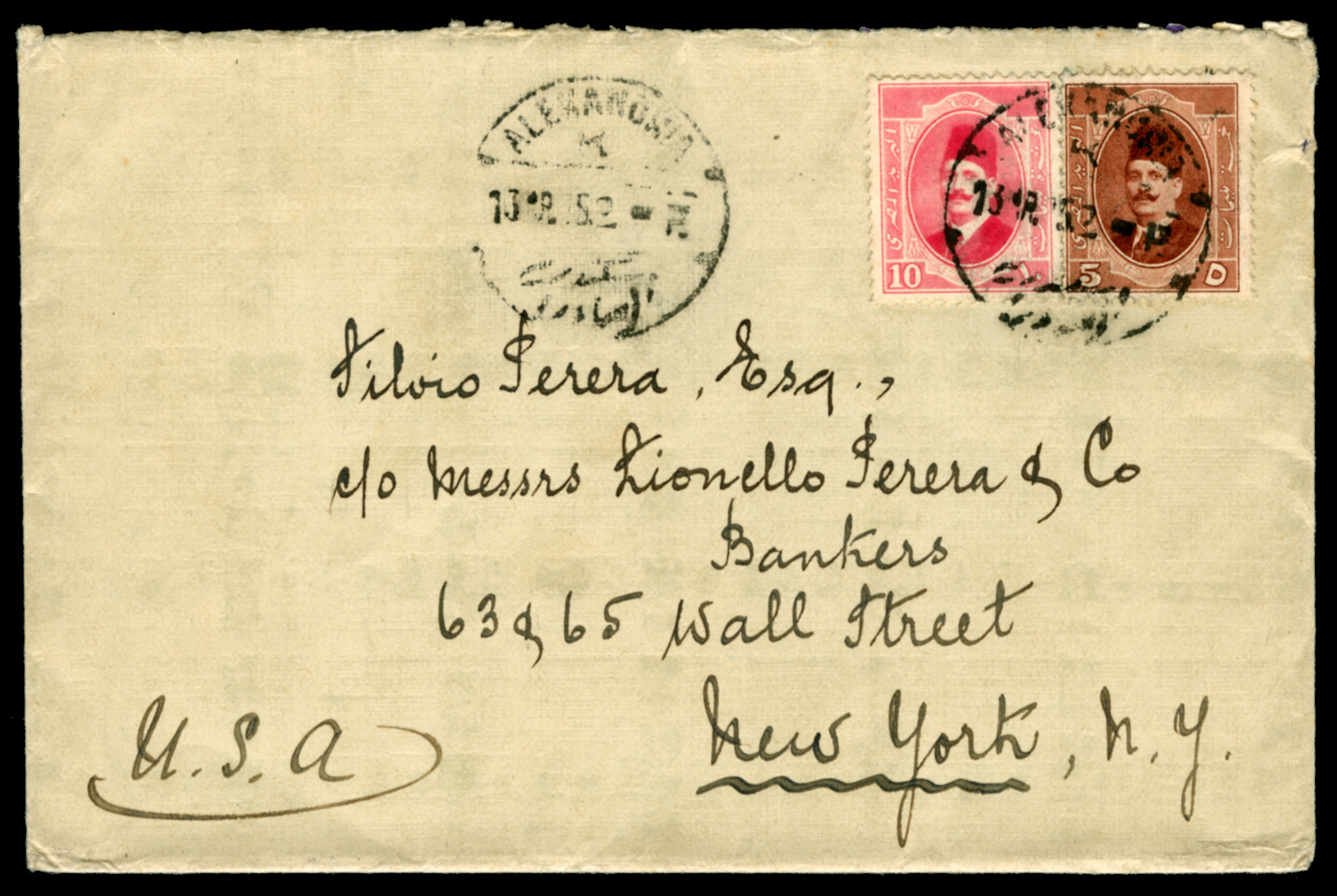
1952. Cover. ALEXANDRIA '13 x 52' to NEW YORK, USA.
Presumably sent surface mail. No US receiving datestamps.
This is the year of the revolution that overthrew King Farouk.
This letter suggests a relationship between Egyptian industry and US capital via Messrs Lionello Perera and Co Bankers, Wall Street, New York. There is no record of a Silvio Perera, Esq. at the bank. It appears that he was not related to the influential Lionel Perera, 1871 – 1942, an Italian-American Jewish banker, philanthropist and patron of the arts and music active in New York from the beginning to mid-20th century. He was a significant figure in the Italian American Community then dominated by Mafia gangsters and Mussolini's apologists. A naturalised American, Perera campaigned against Mussolini in the USA before WW2. While Mussolini's Italian fascism was relatively more tolerant of Jews than Germany's, two of Perera's Italian sisters and their children died in the Auschwitz. Holocaust deniers can put that in their hookah and smoke it!.
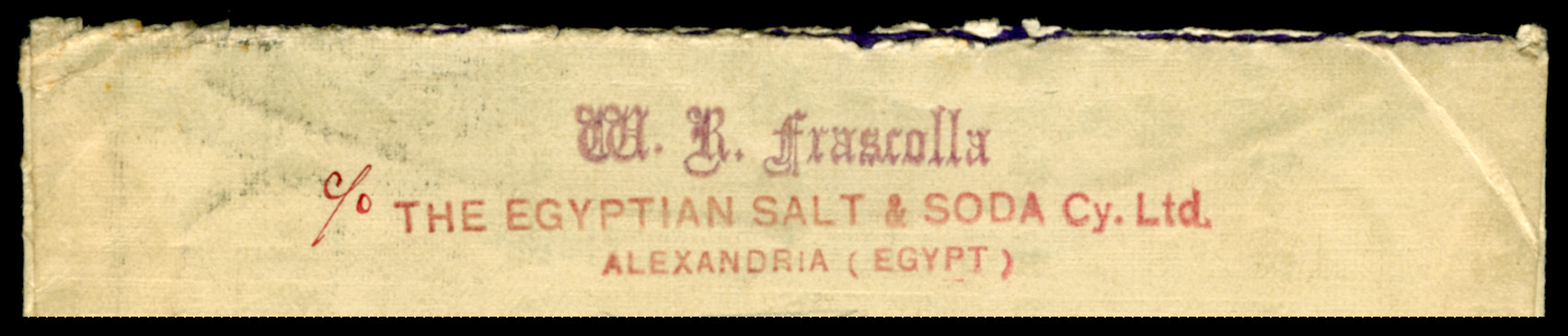
The sender of this letter appears to be W (?) R Frascolla who used the printed stationery of of 'The Egyptian Salt and Soda Cy. Ltd. Alexandria, Egypt'. This company provides me with a cue to introduce Egyptian salt tax stamps. Egyptian Salt Department revenue stamps were first issued in 1892 when the Egyptian government established a wholesale monopoly on the salt trade to generate state revenue. The stamps were sold through local post offices. They were cancelled on signed salt requisition forms. The completed forms were handed to postal or government clerks for validation, allowing retailers to collect their allocated salt purchase from government stores. In 1899, the government monopoly was transferred to the Egyptian Salt & Soda Co. in exchange for fixed annual payments.
There were several issues of Salt Tax stamps between 1892 - 1899. This limited period of their use makes these fiscals uncommon compared to Egyptian postage stamps of the period. Below is the first issue of 4 values from 1892. I have downloaded these from the Internet as I have never seen them before. Being the earliest and used for less than a year they are the scarcest of the Egyptian salt tax stamps.
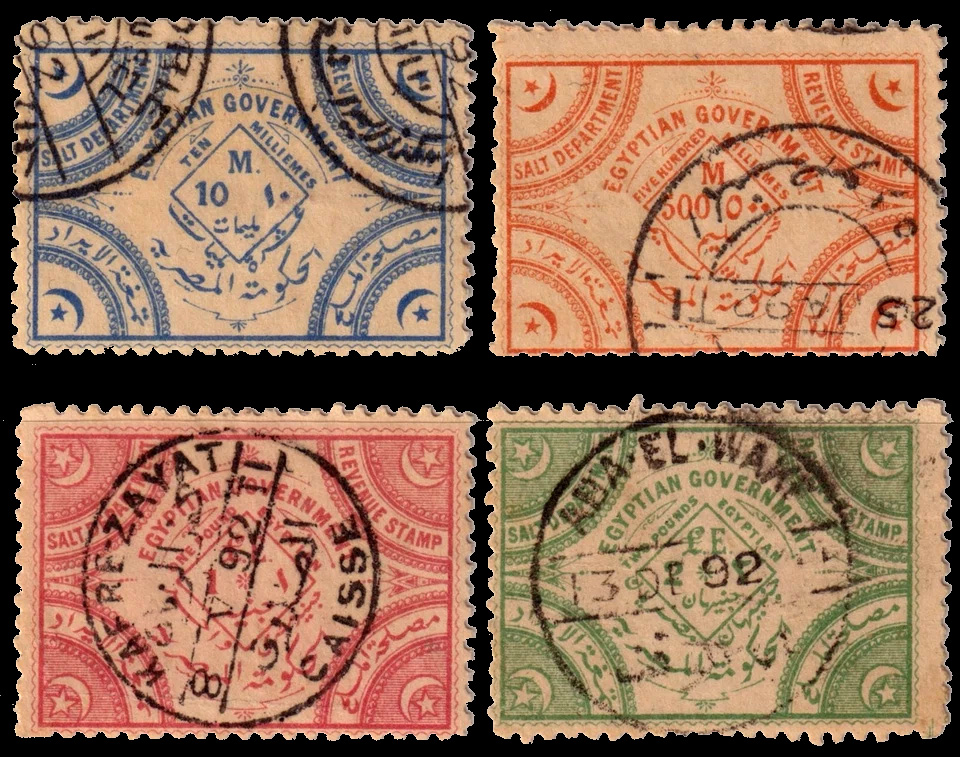
Below are three examples of the second issue, also of 1892. Four values were issued. These were also downloaded from the Internet.
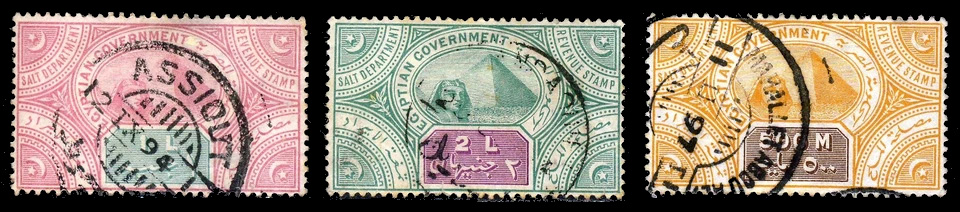
1892 Second Issue: Egyptian Government Salt Tax Revenue stamps.
As I am currently moving house, much of my stuff is currently in boxes. However, a quick search revealed a few examples of my own. These are of mixed quality which I show below. As these Egyptian salt tax stamps were sold in post offices, some are cancelled with relatively rare Egyptian village postmarks. A good postmark definitely adds a lot of interest and value to these wonderful fiscals.
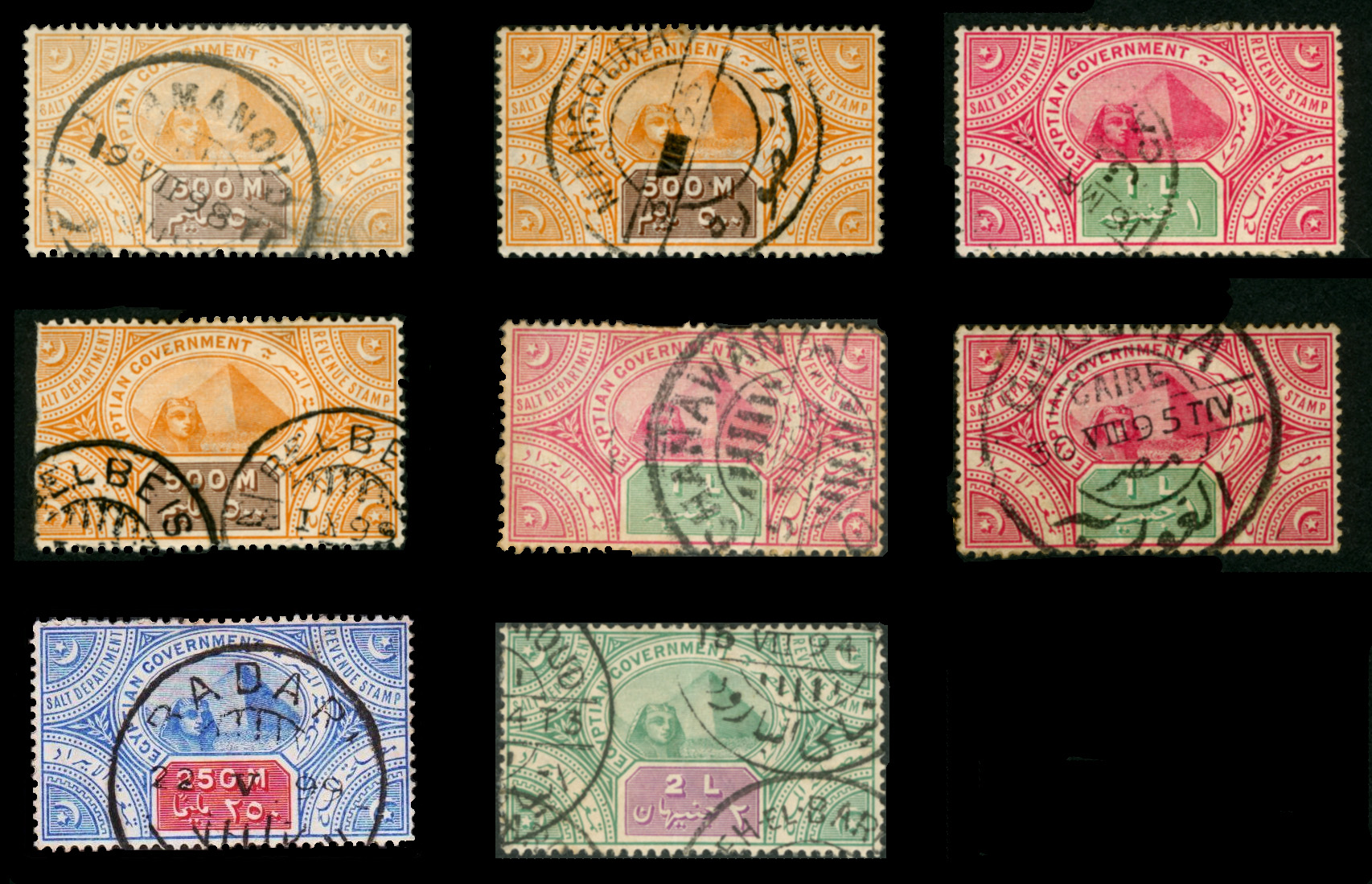
1892 Second Issue: Egyptian Government Salt Tax Revenue stamps.
Quote from Steve on October 23, 2026, 7:07 amThe Red Fez
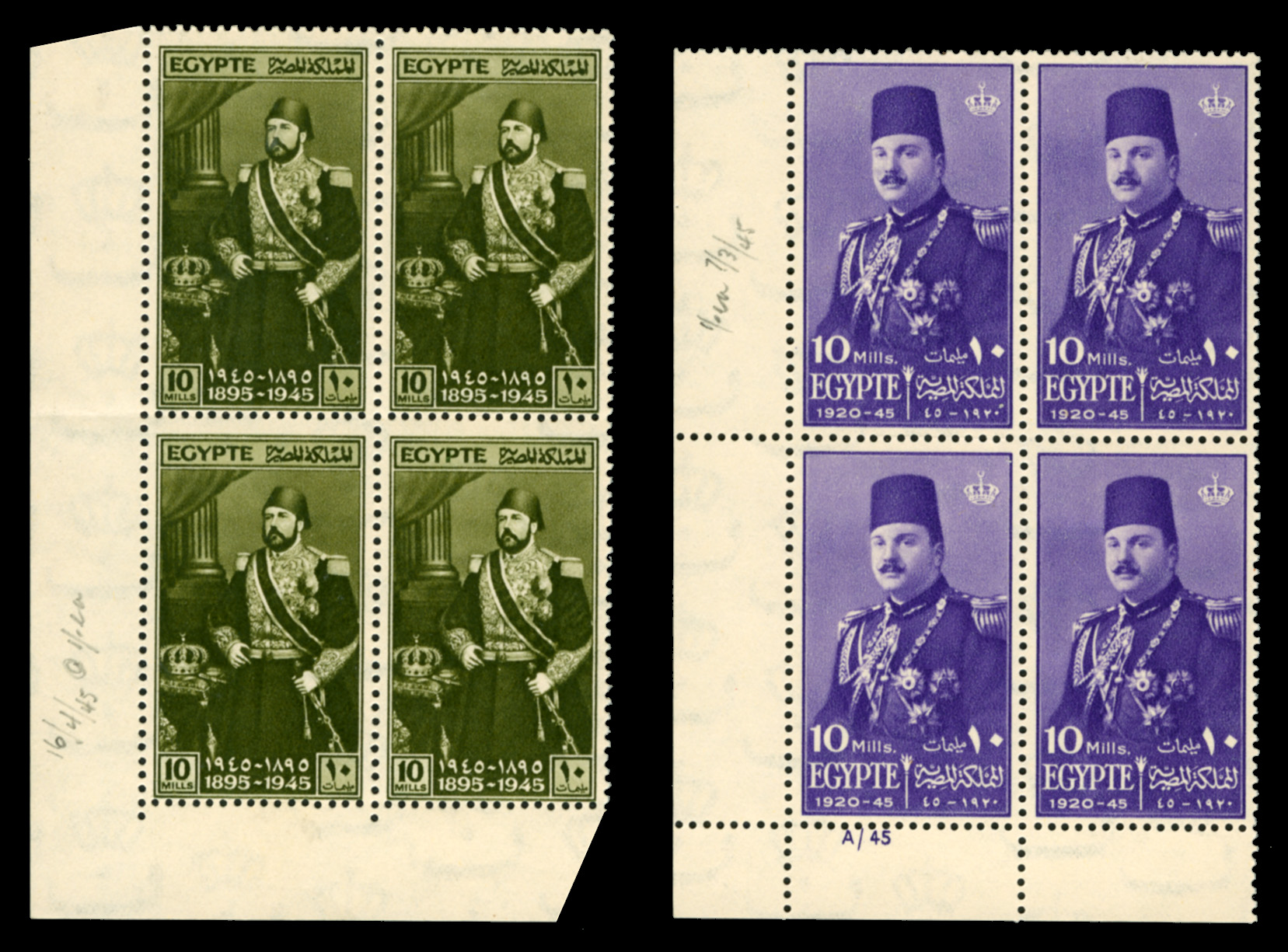
1945. Corner Blocks of EGYPT 10 Mills stamps
Left sage green Khedive Ismail Pasha and right King Farouk purple.
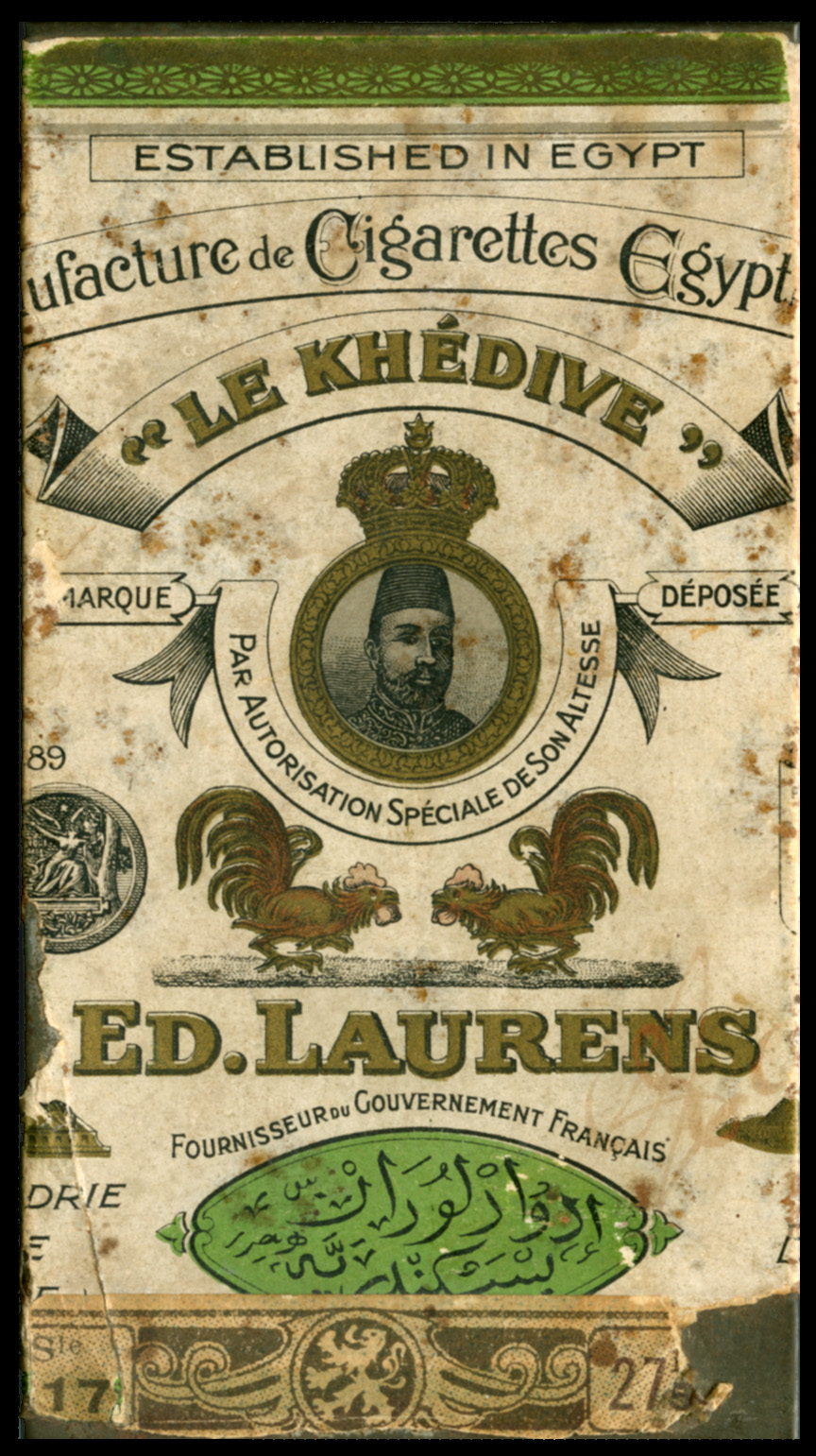
Both men are wearing the fez, a symbol of authority.The paper-covered tin cigarette box below is a product of its time, probably between 1900 - 1920. It comes from the Age of Cigarette Smoking, Empire and Philately, now as out-of-date as the Khedive and King of Egypt who are wearing a fez, originally a symbol of bureaucratic power in the Ottoman Turkish empire and by extension the Islamic world. It subsequently became an Islamic fashion.
As a boy and a young man I recall seeing many Moslem men in Cape Town in finely tailored suits wearing the fez as a snappy symbol of their culture. (At this time the required headgear of 'European' men was either a Homburg, Fedora or a Trilby hat, etc. PW Botha's 'boerekroon' [Afr. Boer crown] was a Homburg!) The fez is seen on Egyptian and other stamps of the Arab world. The popularity of the classic fez declined in the 1960s but is now possibly making a comeback. Perhaps Tommy Cooper has something to do with it!
Circa 1900 - 1920. Egyptian Cigarette Tin Showing Khedive Ismail Pasha.
In 1860, the Ottoman Empire was a centralised, reform-minded transcontinental state known as the "sick man of Europe" due to its declining military and economic power. (Britain suffered the same tag in the 1980s. It is worthy of reintroduction today!) Egypt was a province of the Ottoman Empire. In the 1860s Egypt was ruled by the Muhammad Ali Dynasty as an autonomous state within the Ottoman Empire with Sa'id Pasha and Isma'il Pasha serving as the country's leaders. Sa'id Pasha ruled until January 1863. It was he who granted the initial concession for the construction of the Suez Canal by the French civil engineer Ferdinand de Lesseps.
Isma'il Pasha began his rule in 1863. In 1867, Ottoman Sultan Abdulaziz officially recognised him as the ruler of Egypt by granting him the title of 'Khedive' (Viceroy). This elevated the status of the Muhammad Ali Dynasty under Ismail Pasha aka ('Ismail the Magnificent'). He was the grandson of Muhammad Ali Pasha, the founder of modern Egypt. He was Khedive from 1863 to 1879 and is remembered for modernising Egypt by expanding infrastructure, establishing modern ministeries and the building of the Suez Canal. Much of this came with the accumulation of massive national debt that led to his downfall.
Ismail Pasha's heavy spending and foreign loans bankrupted Egypt, forcing him to sell the country's shares in the Suez Canal to Britain. Under pressure from France and Britain he eventually abdicated in 1879. He died in exile in 1895. Ismail Pasha was the father of King Fuad I (who later became King of Egypt). King Fuad I was the father of King Farouk who reigned from 1936 until the 1952 Egyptian Revolution. All these rulers wore the fez as a symbol of their authority.
British rule in Egypt began in 1882 when British forces occupied the country following the Anglo-Egyptian War. It established a veiled protectorate while leaving the local Ottoman rulers nominally in power. During this period, Britain prioritised controlling the Suez Canal to secure its vital maritime trade route to India and SE Asia. It heavily restructured the Egyptian economy around cotton production. The British dismantled the old Egyptian military and rebuilt a new Anglo-Egyptian army under colonial oversight. The 'Sirdar' was the official title of the British Commander of the Egyptian Army during the Anglo occupation. Although Egypt gained nominal independence in 1922, British military occupation and political influence persisted there until the 1956 Suez Crisis when the Americans forcefully ended all British and French influence in the region. It was the start of Britain's decline as a global power.
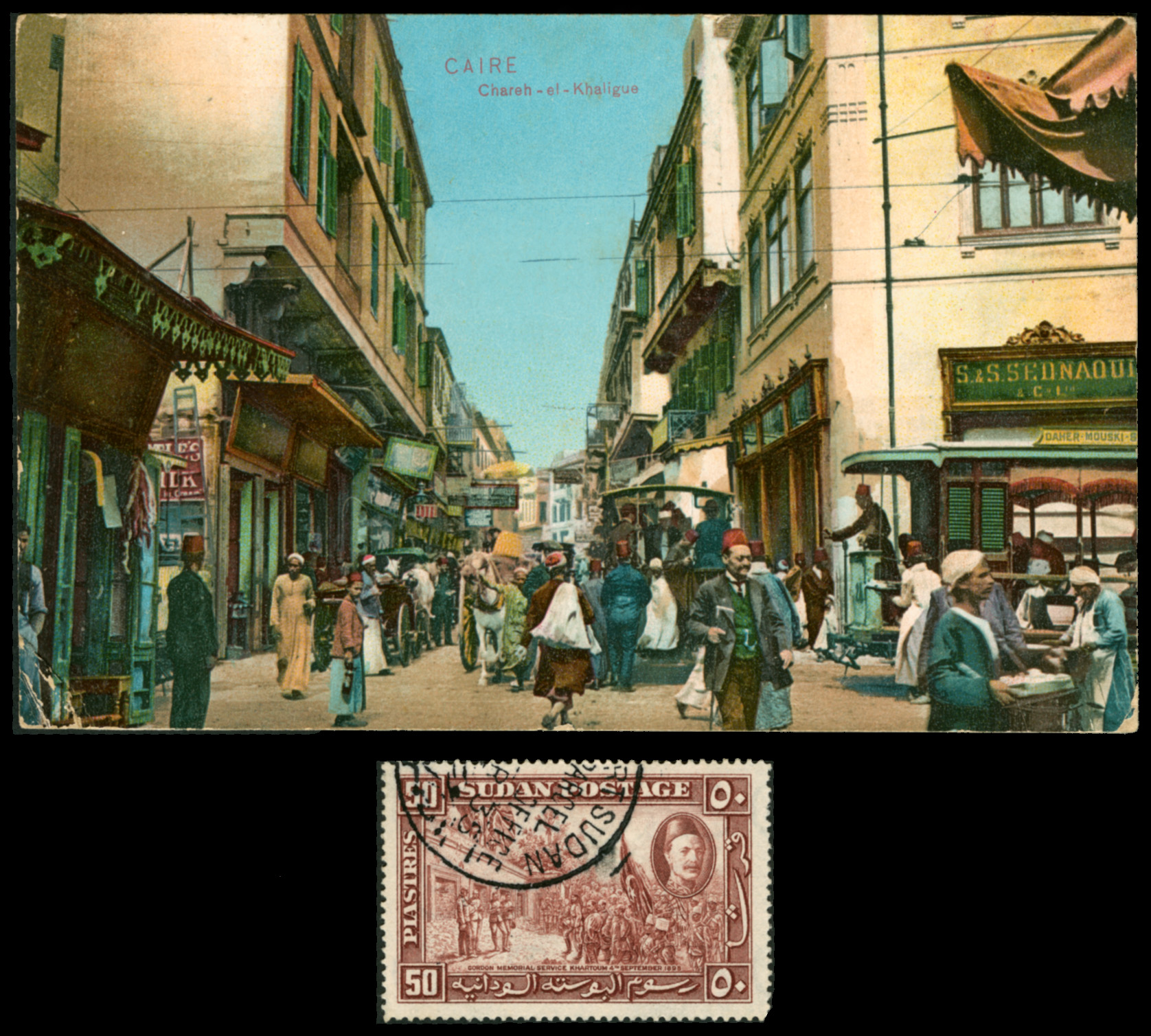
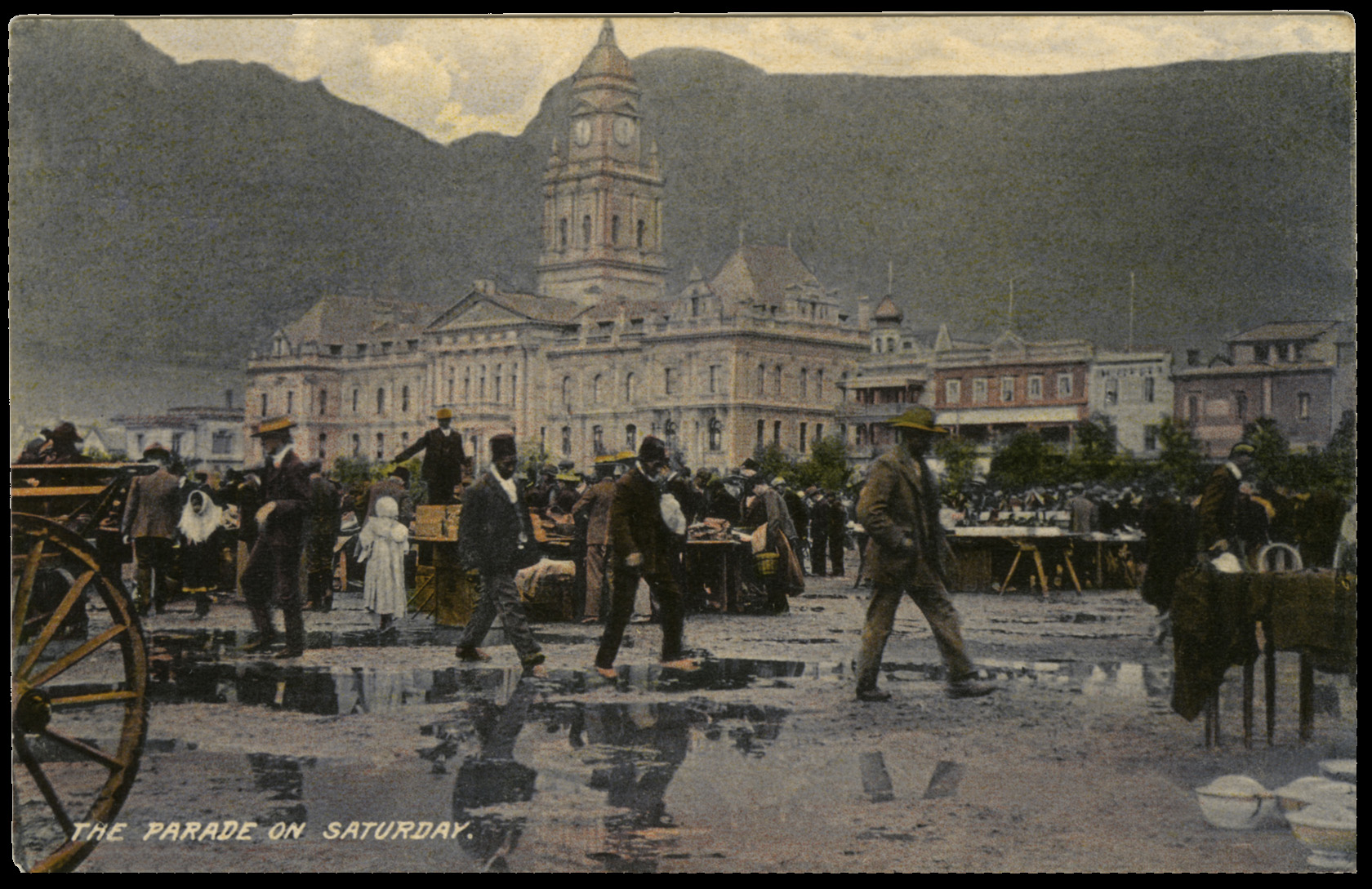
Below are three images that shows the wearing of a fez. The first postcard is a Cairo street scene probably circa 1910. I count at least 12 men wearing a red fez. The stamp is from the Sudan, a country that Egypt has coveted since the time of the Pharoahs. It shows the British Governor, the ill-fated General 'Chinese' Gordon, wearing a fez, no doubt as a symbol of British authority. Unfortunately the Mahdi disagreed. The second postcard is a scene from Cape Town's Parade market on a wet Saturday morning circa about 1910. Two Moslem men wearing the fez can be seen in the centre of the postcard walking through the crowd. It has been suggested that the fez came to Cape Town after WW1 when the returning Cape Corps who had fought the Turks in Palestine bought it back. This postcard suggests the fez arrived earlier and was already being worn by Moslem men before WW1. It is more likely that the fez arrived at the Cape with returning Moslem pilgrims who had been on Hadj to Mecca, then a part of the Ottoman empire.
The Red Fez
1945. Corner Blocks of EGYPT 10 Mills stamps
Left sage green Khedive Ismail Pasha and right King Farouk purple.
Both men are wearing the fez, a symbol of authority.
The paper-covered tin cigarette box below is a product of its time, probably between 1900 - 1920. It comes from the Age of Cigarette Smoking, Empire and Philately, now as out-of-date as the Khedive and King of Egypt who are wearing a fez, originally a symbol of bureaucratic power in the Ottoman Turkish empire and by extension the Islamic world. It subsequently became an Islamic fashion.
As a boy and a young man I recall seeing many Moslem men in Cape Town in finely tailored suits wearing the fez as a snappy symbol of their culture. (At this time the required headgear of 'European' men was either a Homburg, Fedora or a Trilby hat, etc. PW Botha's 'boerekroon' [Afr. Boer crown] was a Homburg!) The fez is seen on Egyptian and other stamps of the Arab world. The popularity of the classic fez declined in the 1960s but is now possibly making a comeback. Perhaps Tommy Cooper has something to do with it!
Circa 1900 - 1920. Egyptian Cigarette Tin Showing Khedive Ismail Pasha.
In 1860, the Ottoman Empire was a centralised, reform-minded transcontinental state known as the "sick man of Europe" due to its declining military and economic power. (Britain suffered the same tag in the 1980s. It is worthy of reintroduction today!) Egypt was a province of the Ottoman Empire. In the 1860s Egypt was ruled by the Muhammad Ali Dynasty as an autonomous state within the Ottoman Empire with Sa'id Pasha and Isma'il Pasha serving as the country's leaders. Sa'id Pasha ruled until January 1863. It was he who granted the initial concession for the construction of the Suez Canal by the French civil engineer Ferdinand de Lesseps.
Isma'il Pasha began his rule in 1863. In 1867, Ottoman Sultan Abdulaziz officially recognised him as the ruler of Egypt by granting him the title of 'Khedive' (Viceroy). This elevated the status of the Muhammad Ali Dynasty under Ismail Pasha aka ('Ismail the Magnificent'). He was the grandson of Muhammad Ali Pasha, the founder of modern Egypt. He was Khedive from 1863 to 1879 and is remembered for modernising Egypt by expanding infrastructure, establishing modern ministeries and the building of the Suez Canal. Much of this came with the accumulation of massive national debt that led to his downfall.
Ismail Pasha's heavy spending and foreign loans bankrupted Egypt, forcing him to sell the country's shares in the Suez Canal to Britain. Under pressure from France and Britain he eventually abdicated in 1879. He died in exile in 1895. Ismail Pasha was the father of King Fuad I (who later became King of Egypt). King Fuad I was the father of King Farouk who reigned from 1936 until the 1952 Egyptian Revolution. All these rulers wore the fez as a symbol of their authority.
British rule in Egypt began in 1882 when British forces occupied the country following the Anglo-Egyptian War. It established a veiled protectorate while leaving the local Ottoman rulers nominally in power. During this period, Britain prioritised controlling the Suez Canal to secure its vital maritime trade route to India and SE Asia. It heavily restructured the Egyptian economy around cotton production. The British dismantled the old Egyptian military and rebuilt a new Anglo-Egyptian army under colonial oversight. The 'Sirdar' was the official title of the British Commander of the Egyptian Army during the Anglo occupation. Although Egypt gained nominal independence in 1922, British military occupation and political influence persisted there until the 1956 Suez Crisis when the Americans forcefully ended all British and French influence in the region. It was the start of Britain's decline as a global power.
Below are three images that shows the wearing of a fez. The first postcard is a Cairo street scene probably circa 1910. I count at least 12 men wearing a red fez. The stamp is from the Sudan, a country that Egypt has coveted since the time of the Pharoahs. It shows the British Governor, the ill-fated General 'Chinese' Gordon, wearing a fez, no doubt as a symbol of British authority. Unfortunately the Mahdi disagreed. The second postcard is a scene from Cape Town's Parade market on a wet Saturday morning circa about 1910. Two Moslem men wearing the fez can be seen in the centre of the postcard walking through the crowd. It has been suggested that the fez came to Cape Town after WW1 when the returning Cape Corps who had fought the Turks in Palestine bought it back. This postcard suggests the fez arrived earlier and was already being worn by Moslem men before WW1. It is more likely that the fez arrived at the Cape with returning Moslem pilgrims who had been on Hadj to Mecca, then a part of the Ottoman empire.
Quote from Jamie Smith on October 23, 2026, 7:24 pmAnd I thought, I was the only idiot! Very nice, bring it on!
And I thought, I was the only idiot! Very nice, bring it on!
Quote from Steve on October 24, 2026, 12:47 pmGlad you approve. Enjoy this humble offering which I include because there is a lot of interest in mc (machine cancelled) slogans.
The Egyptian postal cover below is pretty ordinary, a fairly standard mc cover from Alexandria to New York with a 20-millième Egyptian stamp dated 7th December 1935. The slogan is in Arabic. It makes the cover particularly interesting because the cancellation appears to contain two different blocks of public-information text rather than simply just the name of the post office, Alexandria.
1935. Cover. ALEXANDRIA '7 DEC 35' to NEW YORK (GRAND CENTRAL ANNEX) '22 DEC 1935'.
As I do not read or speak Arabic I used AI to assist with the translation. It suggests that it is most likely an Egyptian Postal Savings Bank advertising slogan promoting the benefits of the National Postal Savings Service. The Egypt Study Circle’s specialist study, Vahe Varjabedian’s 'Slogans on Machine Cancellations 1922–1959', documents two Arabic-language slogans used in Egypt during this period:
- “The Postal Savings Bank gives you a 3% profit.”
- “You can withdraw all your money from your Postal Savings Bank at any time.”
These slogans are documented on Egyptian machine cancellations used from 1935 onwards.
Philatelic reference: Vahe Varjabedian, “Slogans on Machine Cancellations 1922–1959,” The Quarterly Circular of the Egypt Study Circle, no. 237, June 2011, pp. 29–33. The article includes illustrations of both slogans.
I and AI stand to be corrected!
Glad you approve. Enjoy this humble offering which I include because there is a lot of interest in mc (machine cancelled) slogans.
The Egyptian postal cover below is pretty ordinary, a fairly standard mc cover from Alexandria to New York with a 20-millième Egyptian stamp dated 7th December 1935. The slogan is in Arabic. It makes the cover particularly interesting because the cancellation appears to contain two different blocks of public-information text rather than simply just the name of the post office, Alexandria.
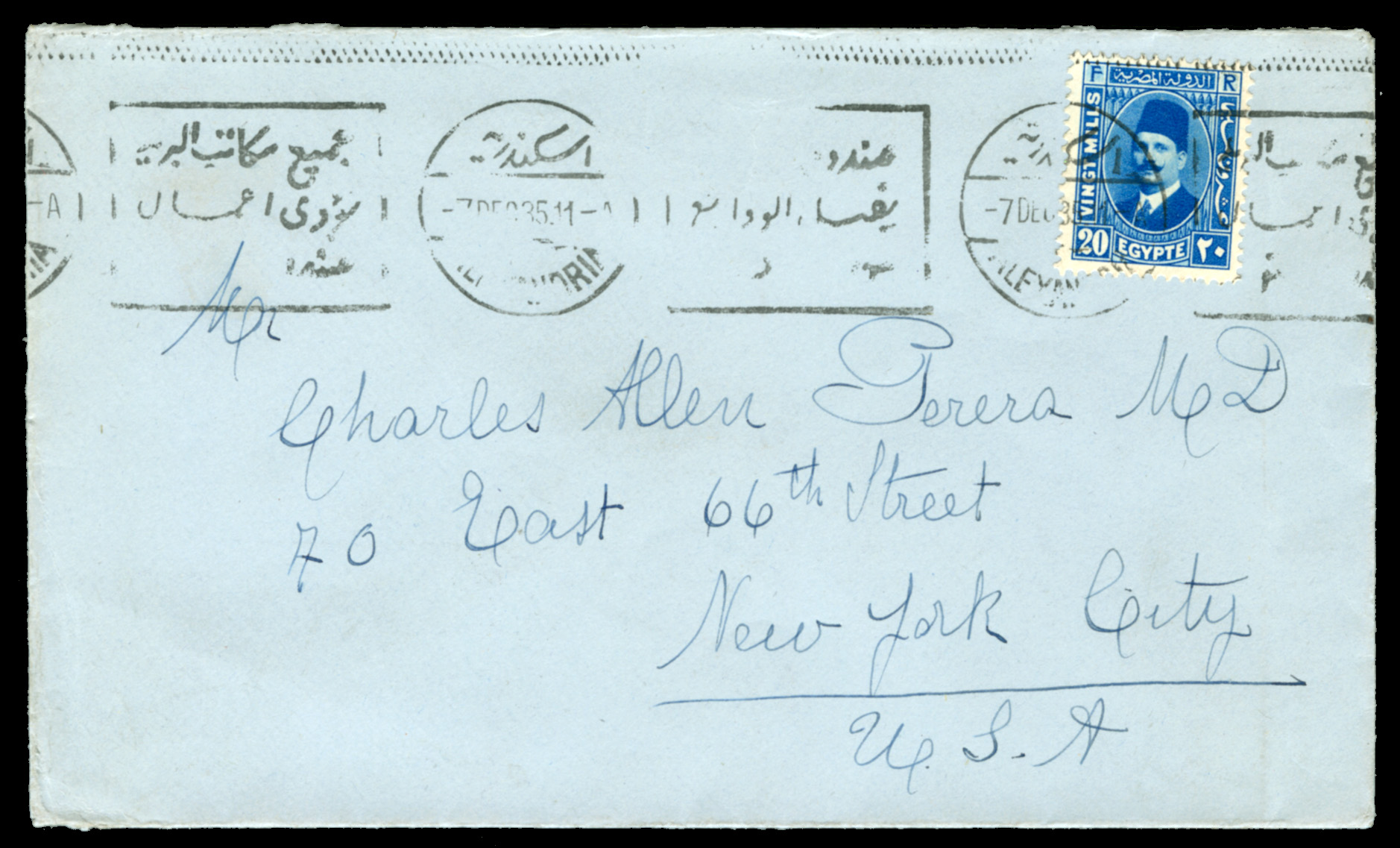
1935. Cover. ALEXANDRIA '7 DEC 35' to NEW YORK (GRAND CENTRAL ANNEX) '22 DEC 1935'.
As I do not read or speak Arabic I used AI to assist with the translation. It suggests that it is most likely an Egyptian Postal Savings Bank advertising slogan promoting the benefits of the National Postal Savings Service. The Egypt Study Circle’s specialist study, Vahe Varjabedian’s 'Slogans on Machine Cancellations 1922–1959', documents two Arabic-language slogans used in Egypt during this period:
- “The Postal Savings Bank gives you a 3% profit.”
- “You can withdraw all your money from your Postal Savings Bank at any time.”
These slogans are documented on Egyptian machine cancellations used from 1935 onwards.
Philatelic reference: Vahe Varjabedian, “Slogans on Machine Cancellations 1922–1959,” The Quarterly Circular of the Egypt Study Circle, no. 237, June 2011, pp. 29–33. The article includes illustrations of both slogans.
I and AI stand to be corrected!
Quote from Jamie Smith on October 24, 2026, 12:59 pmI am glad you are using AI - it all looks Greek to me!
I am glad you are using AI - it all looks Greek to me!
Quote from Steve on October 27, 2026, 11:35 amA Flying Fez on a Motorbike
1929 Egyptian 20-millième Express Post issue red and grey.
This Egyptian 20-mills Express Post issue of 1929 shows a motorcyclist dashing through a desert landscape with palm trees. As these were the days before crash helmets became mandatory and because this is Egypt in the 1920s, the postal rider is unsurprisingly wearing a fez. The original design of this stamp appeared in 1926 in dark green. This red and grey version followed in 1929. I have on a rare occasion been surprised to see a green fez being worn but the majority have always been red. It is safe to assume the rider's fez is red.
The identification of his postal-delivery motorcycle is tricky. Its exact make and model have not been conclusively identified. A useful clue comes from a specialist Egyptian philatelic (not motorbike) source. A philatelic article by Hans de Kloet identifies it as a Triumph Model P, a British motorcycle. This fits the timeframe of the stamp and British rule in Egypt. As the British ran Egypt the motobike is more likely to be one of theirs than from another country. This is made all the more likely by a report that states the Egyptian postal service purchased two such motorcycles for £30 each. The Triumph Model P was a landmark British motorcycle featuring a 494 cc side-valve single-cylinder engine. It debuted at the 1924 Motor Cycle Show before going into mass production at Triumph's Priory Street works in Coventry.
Peter A. S. Smith, a recognised specialist in Egyptian stamps and postal history, describes the motorcycle as difficult to identify because the printiing is so indistinct and lacking in detail. He notes that it appears to have a single-cylinder engine and belt drive. Identification as a Triumph Model P is plausible but is not proven. The stamp is simply too indistinct to establish the make with absolute certainty.
A Flying Fez on a Motorbike
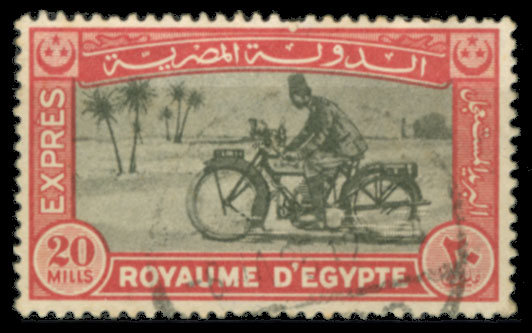
1929 Egyptian 20-millième Express Post issue red and grey.
This Egyptian 20-mills Express Post issue of 1929 shows a motorcyclist dashing through a desert landscape with palm trees. As these were the days before crash helmets became mandatory and because this is Egypt in the 1920s, the postal rider is unsurprisingly wearing a fez. The original design of this stamp appeared in 1926 in dark green. This red and grey version followed in 1929. I have on a rare occasion been surprised to see a green fez being worn but the majority have always been red. It is safe to assume the rider's fez is red.
The identification of his postal-delivery motorcycle is tricky. Its exact make and model have not been conclusively identified. A useful clue comes from a specialist Egyptian philatelic (not motorbike) source. A philatelic article by Hans de Kloet identifies it as a Triumph Model P, a British motorcycle. This fits the timeframe of the stamp and British rule in Egypt. As the British ran Egypt the motobike is more likely to be one of theirs than from another country. This is made all the more likely by a report that states the Egyptian postal service purchased two such motorcycles for £30 each. The Triumph Model P was a landmark British motorcycle featuring a 494 cc side-valve single-cylinder engine. It debuted at the 1924 Motor Cycle Show before going into mass production at Triumph's Priory Street works in Coventry.
Peter A. S. Smith, a recognised specialist in Egyptian stamps and postal history, describes the motorcycle as difficult to identify because the printiing is so indistinct and lacking in detail. He notes that it appears to have a single-cylinder engine and belt drive. Identification as a Triumph Model P is plausible but is not proven. The stamp is simply too indistinct to establish the make with absolute certainty.