
ETHIOPIA - Its History, Stamps, Overprints and Postmarks
Quote from Steve on November 1, 2024, 10:11 amHi Karel,
First, welcome to the SAPC (SA Philately Club). Please continue to use this Forum to post more comments and images like the preceding on any subject that you are interested in.
Second, I am far from an authority on Ethiopian stamps and its postal history. I am an enthusiastic fan of the subject, no more. Over the years I have acquired two small stockbooks at different times with an assortment of Ethiopian stamps, some early but most from the 1920s to 1960s. It was always my intention to do something with them but I never did. I would very occassionally buy items that caught my eye at fairs and online. I am a sucker for anything pretty and enchanting and a lot of early Ethiopia is just that.
However, I never did anything with this material until after Jamie and I started the SAPC site. A year or so ago I found myself without material to post and nobody except Jamie contributing anything. As a result, I decided to 'quickly' write up my Ethiopia. There are more experienced collectors who would probably not dare to do this given its complexities. More fool me. This article is probably about one month's work starting on a subject I knew nothing about. I guess I should have known better and shown more deference to all serious Ethiopian philatelists who would see my attempt for what it was, the entry-level work of a non-academic beginner.
In writing this up I began with a British dealer's 'Collect Ethiopia' handbook from the 1930s. It was not at all useful and I have now misplaced it. It only listed the issues this dealer had for sale. It certainly did not go into any detail about 'provincial blocks'. As I was frustrated by my lack of knowledge and the unavailabity of a useful reference work, I made an online purchase of the 'Handbook of the Postage Stamps of the Empire of Ethiopia and Her Postal System’. (Part 1. Ivan Adler, Knight of the Star Order of Ethiopia, Stockholm, Sweden. 1961.) I used this extensively to write the preceding article.
My rerefences to "a wrapper containing the original 200 ‘provincial blocks’" comes from it. Given the date that Adler's book is published, 1961, he was writing up what he thought was correct at the time. I should have known better and checked his references against more recent texts. In my haste get something up I did not. I apologise. Taking a positive out of this, we are now all the wiser for your joining the SAPC and making this contribution. Without excusing myself, we are allowed to make errors provided we are willing to be corrected. I certainly am. Perhaps the terror of being tripped up in public like this is what prevents many readers from contributing here. It should not. This is simply a Forum. Thank you for using it as it was intended.
If you think it worthwhile to continue, please add more material. Ethiopia is a wonderful collecting field, one which I now wish I had studied more fully. I agree with Jamie. If I have a second life to live I will pursue Ethiopia in the next with all the passion and disciplne that it deserves.
Hi Karel,
First, welcome to the SAPC (SA Philately Club). Please continue to use this Forum to post more comments and images like the preceding on any subject that you are interested in.
Second, I am far from an authority on Ethiopian stamps and its postal history. I am an enthusiastic fan of the subject, no more. Over the years I have acquired two small stockbooks at different times with an assortment of Ethiopian stamps, some early but most from the 1920s to 1960s. It was always my intention to do something with them but I never did. I would very occassionally buy items that caught my eye at fairs and online. I am a sucker for anything pretty and enchanting and a lot of early Ethiopia is just that.
However, I never did anything with this material until after Jamie and I started the SAPC site. A year or so ago I found myself without material to post and nobody except Jamie contributing anything. As a result, I decided to 'quickly' write up my Ethiopia. There are more experienced collectors who would probably not dare to do this given its complexities. More fool me. This article is probably about one month's work starting on a subject I knew nothing about. I guess I should have known better and shown more deference to all serious Ethiopian philatelists who would see my attempt for what it was, the entry-level work of a non-academic beginner.
In writing this up I began with a British dealer's 'Collect Ethiopia' handbook from the 1930s. It was not at all useful and I have now misplaced it. It only listed the issues this dealer had for sale. It certainly did not go into any detail about 'provincial blocks'. As I was frustrated by my lack of knowledge and the unavailabity of a useful reference work, I made an online purchase of the 'Handbook of the Postage Stamps of the Empire of Ethiopia and Her Postal System’. (Part 1. Ivan Adler, Knight of the Star Order of Ethiopia, Stockholm, Sweden. 1961.) I used this extensively to write the preceding article.
My rerefences to "a wrapper containing the original 200 ‘provincial blocks’" comes from it. Given the date that Adler's book is published, 1961, he was writing up what he thought was correct at the time. I should have known better and checked his references against more recent texts. In my haste get something up I did not. I apologise. Taking a positive out of this, we are now all the wiser for your joining the SAPC and making this contribution. Without excusing myself, we are allowed to make errors provided we are willing to be corrected. I certainly am. Perhaps the terror of being tripped up in public like this is what prevents many readers from contributing here. It should not. This is simply a Forum. Thank you for using it as it was intended.
If you think it worthwhile to continue, please add more material. Ethiopia is a wonderful collecting field, one which I now wish I had studied more fully. I agree with Jamie. If I have a second life to live I will pursue Ethiopia in the next with all the passion and disciplne that it deserves.
Uploaded files:
Quote from Karel on November 1, 2024, 9:26 pmHi Steve
Thank you for your quick reply, for the warm welcome to the SAPC and for sharing the background of your interest in postage stamps of Ethiopia.
I know very little about Ethiopian stamps and postal history, I am focused primarily on other territories (such as Stellaland and British Bechuanaland) but being also an ASFE (A Stamp From Everyone) collector and writing sometimes about stamps in my mother tongue (Czech) I have become a little bit interested in Ethiopia as well, have bought the book by Roberto Sciaky and have read some on-line texts such as the webpage of the Ethiopian Philatelic Society or your own text on this forum. I want to understand a bit better what is an authentic postal history or stamp item and what is a bogus or a forgery (ASFE collectors can be easily fooled as they may often lack the necessary depth of knowledge). Early Ethiopia appears to be inundated by various dubious issues (partly even produced by Mr Michel the Director of the Ethiopian Post in the early 1900s, either during or after his tenure) while at the same time it is indeed fascinating. That was why I asked you about the ‘province’ stamps / block. Your reference to Adler (1961) makes it clearer; Sciaky's more recent information (1999) which appears to be consistent with the description by Cherrystone (2017) might be closer to the current knowledge as you have suggested although we would probably need to ask the experts like Ulf Lindhal to be sure.
No need to apologise, in fact I was impressed by your presentation of early Ethiopia and the level of enthusiasm which is contagious and makes the reader search for more information!
Karel
Hi Steve
Thank you for your quick reply, for the warm welcome to the SAPC and for sharing the background of your interest in postage stamps of Ethiopia.
I know very little about Ethiopian stamps and postal history, I am focused primarily on other territories (such as Stellaland and British Bechuanaland) but being also an ASFE (A Stamp From Everyone) collector and writing sometimes about stamps in my mother tongue (Czech) I have become a little bit interested in Ethiopia as well, have bought the book by Roberto Sciaky and have read some on-line texts such as the webpage of the Ethiopian Philatelic Society or your own text on this forum. I want to understand a bit better what is an authentic postal history or stamp item and what is a bogus or a forgery (ASFE collectors can be easily fooled as they may often lack the necessary depth of knowledge). Early Ethiopia appears to be inundated by various dubious issues (partly even produced by Mr Michel the Director of the Ethiopian Post in the early 1900s, either during or after his tenure) while at the same time it is indeed fascinating. That was why I asked you about the ‘province’ stamps / block. Your reference to Adler (1961) makes it clearer; Sciaky's more recent information (1999) which appears to be consistent with the description by Cherrystone (2017) might be closer to the current knowledge as you have suggested although we would probably need to ask the experts like Ulf Lindhal to be sure.
No need to apologise, in fact I was impressed by your presentation of early Ethiopia and the level of enthusiasm which is contagious and makes the reader search for more information!
Karel
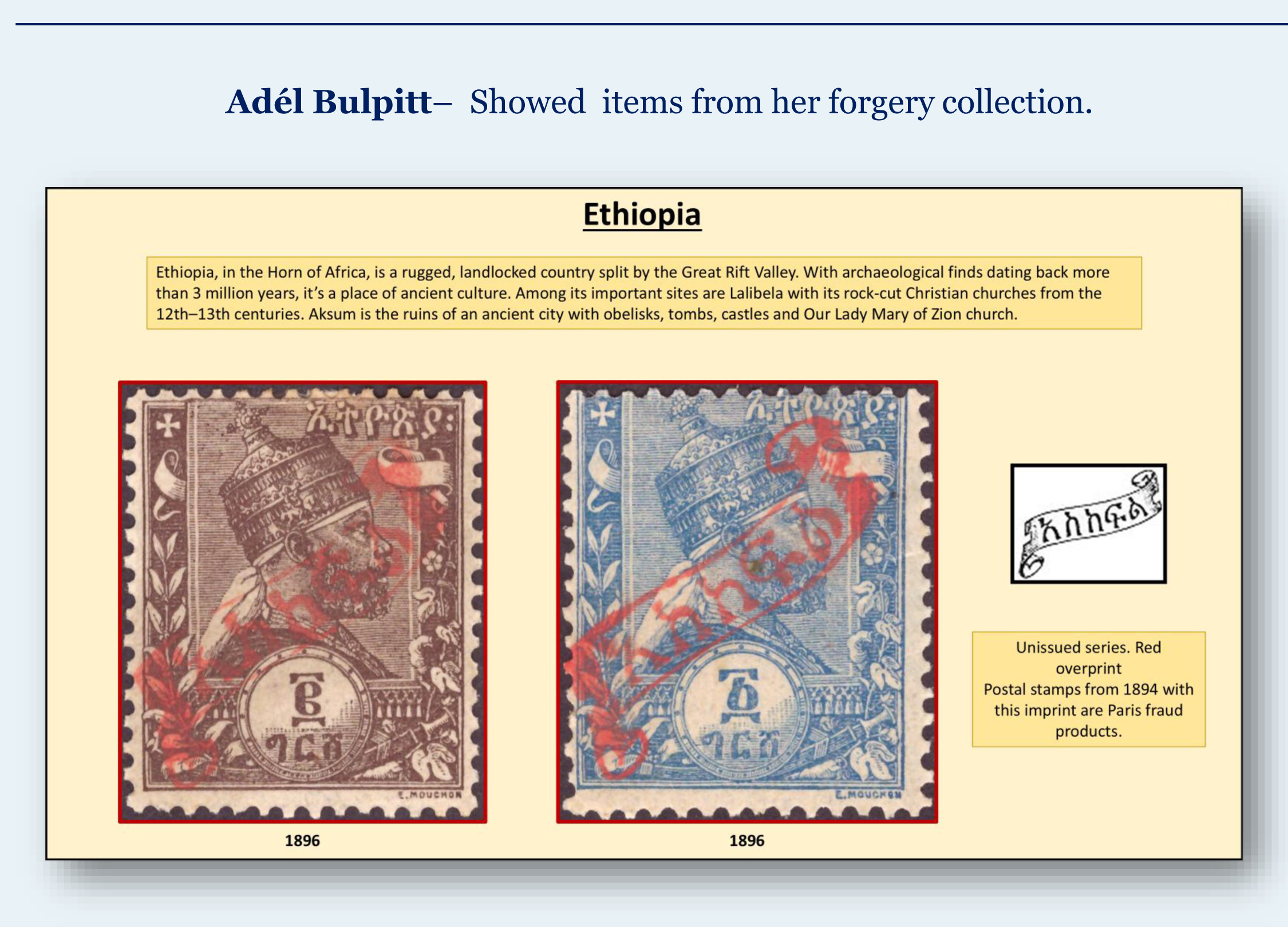
Quote from Steve on October 7, 2025, 2:54 pmAdel Bulpitt has shared these Ethiopia Overprints forged in Paris with us. They are from her October 2025 Newsletter.
Adel Bulpitt has shared these Ethiopia Overprints forged in Paris with us. They are from her October 2025 Newsletter.
Quote from Steve on December 10, 2025, 3:30 pmI began this post with "Ethiopia's First Postmarks and the Mystery of the Egyptian Harrar Canceller." I found a possible example of this canceller and created an image of the Maltese Cross handstamp cancelling Egyptian stamps as used in Harrar in 1875.
This certainly not the Egyptian Harrar canceller. The one above and below were used in Addis Abeba.
Recently I discoverd this item of postal stationery. It is a bit disappointing as it is not postally used. (It would have cost a small fortune if it was!) Generally I shy clear of cancelled stamps on cover or postcard that are unaddressed. What intrigued me about this postcard is the blue Maltese Cross postmark. I am willing to accept that both it and the card are is fake but I suggest thgey are not.
1896. Postal Stationery Card. 1/2g pre-cancelled with Blue Maltese Cross.
I have nothing known to be genuine to compare this to. Comparison with similar eBay items suggests that this is a genuine Ethiopian 1896 1/2 guerche postal stationery card, slight corner crease, top left, blank on reverse. (Engraved by E. Mouchon and typographed by Atelier de Fabrication des Timbres, Paris; Printed 15-17 June 1896. Cards were delivered to Chefneaux in Paris on 15 July 1896.)
The Harrar Maltese Cross canceller was used on Egyptian stamps in 1875. This card was produced in 1896. My thought is that this probaly some mischevious soul having a bit of philatelic fun. Whatever this is, it has a tale to tell. Can you add to it?
There are unused and uncancelled examples of this postcard selling on eBay for a lot of money.
I began this post with "Ethiopia's First Postmarks and the Mystery of the Egyptian Harrar Canceller." I found a possible example of this canceller and created an image of the Maltese Cross handstamp cancelling Egyptian stamps as used in Harrar in 1875.
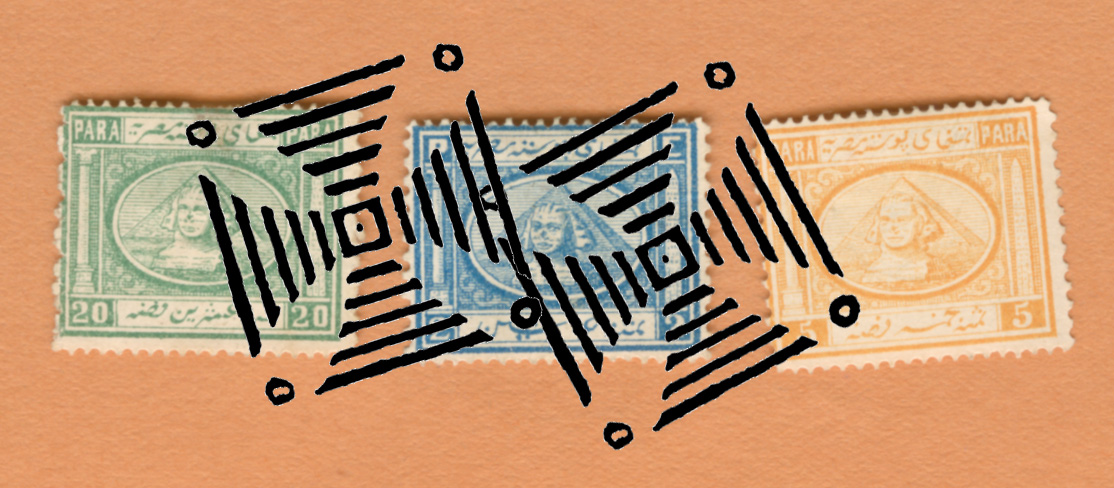
This certainly not the Egyptian Harrar canceller. The one above and below were used in Addis Abeba.
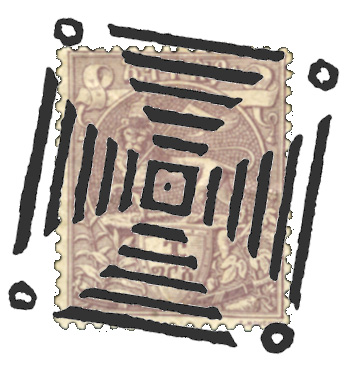
Recently I discoverd this item of postal stationery. It is a bit disappointing as it is not postally used. (It would have cost a small fortune if it was!) Generally I shy clear of cancelled stamps on cover or postcard that are unaddressed. What intrigued me about this postcard is the blue Maltese Cross postmark. I am willing to accept that both it and the card are is fake but I suggest thgey are not.
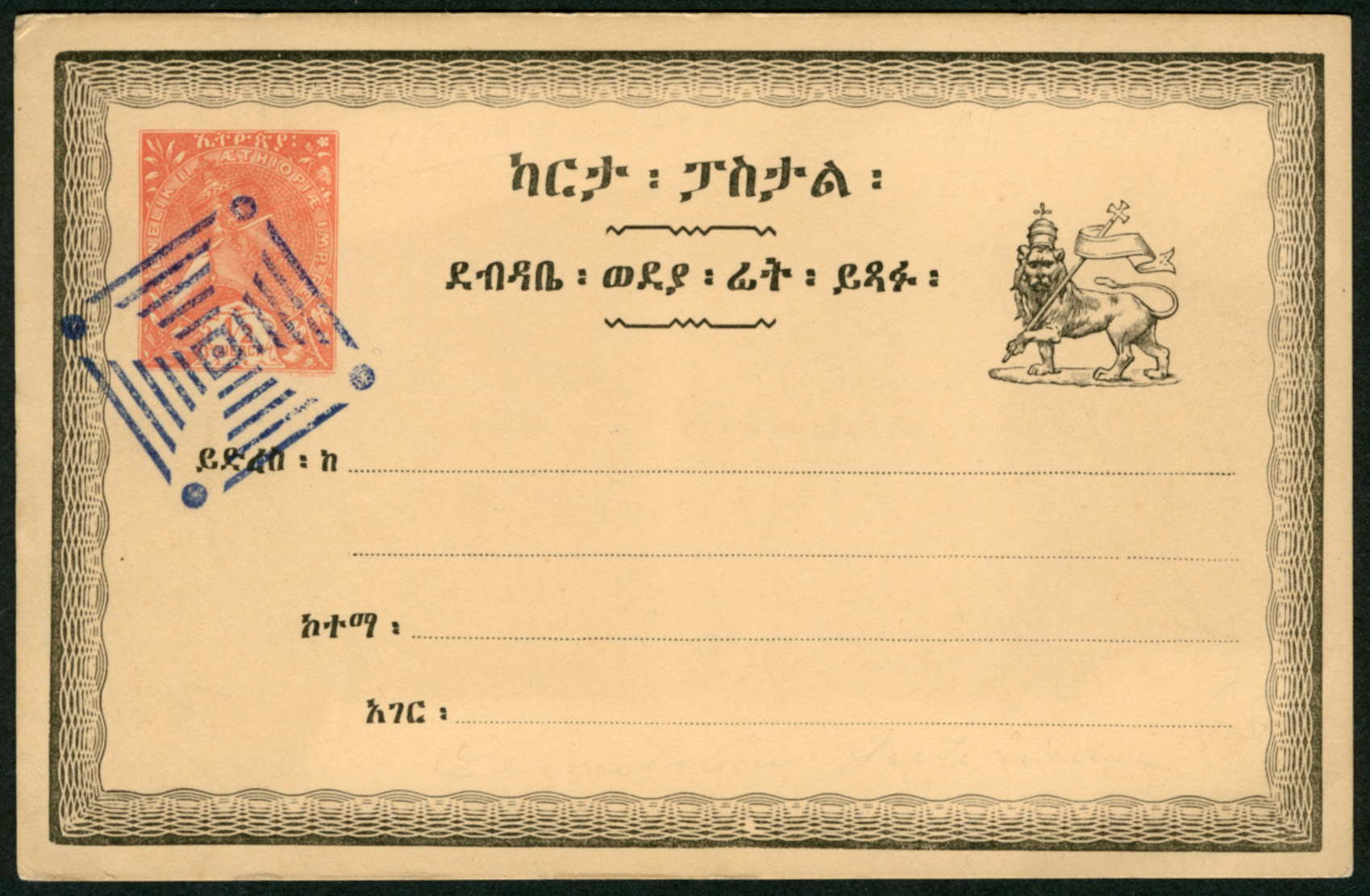 1896. Postal Stationery Card. 1/2g pre-cancelled with Blue Maltese Cross.
I have nothing known to be genuine to compare this to. Comparison with similar eBay items suggests that this is a genuine Ethiopian 1896 1/2 guerche postal stationery card, slight corner crease, top left, blank on reverse. (Engraved by E. Mouchon and typographed by Atelier de Fabrication des Timbres, Paris; Printed 15-17 June 1896. Cards were delivered to Chefneaux in Paris on 15 July 1896.)
The Harrar Maltese Cross canceller was used on Egyptian stamps in 1875. This card was produced in 1896. My thought is that this probaly some mischevious soul having a bit of philatelic fun. Whatever this is, it has a tale to tell. Can you add to it?
There are unused and uncancelled examples of this postcard selling on eBay for a lot of money.
Quote from Karel on December 12, 2025, 5:23 pmHi Steve, I am writing to follow up on your questions regarding the Maltese Cross postmark and its use in Ethiopia. You have mentioned the list of pre-UPU cover of Ethiopia compiled by Luciano Maria. The same Luciano Maria also wrote several articles which I believe shed more light on the subject and review and in some cases correct previous hypotheses made by Ivan Adler and Henri Tristant. In particular, the article "The first cancellors of Harar and Entoto" by Roberto Sciaky and Luciano Maria in Menelik's Journal Vol. XVII, No. 4 (Oct–Dec 2001), pages 5–11 (pages 10 and 11 are relevant), the article "The Maltese Cross and Its use in Addis Ababa in 1907" also by Roberto Sciaky and Luciano Maria in Menelik's Journal Vol. XVIII, No. 2 (Apr–Jun 2002), pages 12–14 and a more recent article "The Maltese Cross Postmark" by Luciano Maria in Menelik's Journal 35, No. 1 (Jan-Mar 2019), pages 22–30. For example, the first article says that "We demonstrated that the Maltese Cross was not used in Harar as previously reported but was used in Addis Abeba to face a lack of cancellers." The third article for example refers to previous findings that the Maltese Cross canceller was received in 1918 by J. A. Michel (together with other Ethiopian cancellers and postal material) as a payment for a credit he had against the Ethiopian government for his services as an advisor and then he probably created a number of faked items of "Ethiopian postal history". The same article also provides an updated list of genuine 1897 covers with the Maltese Cross canceller (7) and refers to the list of pre-UPU covers which includes 6 genuine 1907 covers with this canceller. I am not sure whether you have access to these articles or not but I wanted to mention them here just in case. I attach a picture of a small part of one of the articles.
Hi Steve, I am writing to follow up on your questions regarding the Maltese Cross postmark and its use in Ethiopia. You have mentioned the list of pre-UPU cover of Ethiopia compiled by Luciano Maria. The same Luciano Maria also wrote several articles which I believe shed more light on the subject and review and in some cases correct previous hypotheses made by Ivan Adler and Henri Tristant. In particular, the article "The first cancellors of Harar and Entoto" by Roberto Sciaky and Luciano Maria in Menelik's Journal Vol. XVII, No. 4 (Oct–Dec 2001), pages 5–11 (pages 10 and 11 are relevant), the article "The Maltese Cross and Its use in Addis Ababa in 1907" also by Roberto Sciaky and Luciano Maria in Menelik's Journal Vol. XVIII, No. 2 (Apr–Jun 2002), pages 12–14 and a more recent article "The Maltese Cross Postmark" by Luciano Maria in Menelik's Journal 35, No. 1 (Jan-Mar 2019), pages 22–30. For example, the first article says that "We demonstrated that the Maltese Cross was not used in Harar as previously reported but was used in Addis Abeba to face a lack of cancellers." The third article for example refers to previous findings that the Maltese Cross canceller was received in 1918 by J. A. Michel (together with other Ethiopian cancellers and postal material) as a payment for a credit he had against the Ethiopian government for his services as an advisor and then he probably created a number of faked items of "Ethiopian postal history". The same article also provides an updated list of genuine 1897 covers with the Maltese Cross canceller (7) and refers to the list of pre-UPU covers which includes 6 genuine 1907 covers with this canceller. I am not sure whether you have access to these articles or not but I wanted to mention them here just in case. I attach a picture of a small part of one of the articles.
Uploaded files:
Quote from Steve on December 13, 2025, 12:28 pmMy thanks to Karel for his impeccable advice. I shall endeavour to serve this subject better in future posts.
When I started this thread I simply hoped to make some sense out of my accumulation of Ethiopian stamps which I have always found confusing and to share any developing sense of order and knowledge with the reader. I cannot claim success in this endeavour. If anything, I have perpetuated too much old knowledge that I acquired through redundant sources. I remain as confused as ever. But, as it is said, it is always darkest just before the dawn. My thanks to Karl for pointing me towards the light. Again!
I have tried to access Menelik's Journal but found it awkward to navigate and to receive it in a digestible format like Karels uploaded file shown. For those who have an interest, you can find the articles Karel refers to here.
To clarify, "the Maltese Cross (canceller) was not used in Harar as previously reported but was used in Addis Abeba to face a lack of cancellers" . ("The First Cancellors of Harar and Entoto" by Roberto Sciaky and Luciano Maria, Menelik's Journal Vol. XVII, No. 4 (Oct–Dec 2001). Also, the Maltese Cross canceller was probably acquired in 1918 by J. A. Michel (together with other Ethiopian cancellers and postal material) as a payment for a credit he had against the Ethiopian government. He then created a number of fake items of "Ethiopian postal history". ("The Maltese Cross Postmark" by Luciano Maria. Menelik's Journal 35, No. 1 (Jan-Mar 2019).
Michel most probably cancelled the above postal stationery card after he received the Maltese Cross postmark in 1918 and sold this to a collector. It has now percolated its way down to me. As these cards were unaddressed and not made to appear postally used, they were not fakes as such, more a space-filler example of the postcard with the Maltese Cross canceller. Make of it what you will.
My thanks to Karel for his impeccable advice. I shall endeavour to serve this subject better in future posts.
When I started this thread I simply hoped to make some sense out of my accumulation of Ethiopian stamps which I have always found confusing and to share any developing sense of order and knowledge with the reader. I cannot claim success in this endeavour. If anything, I have perpetuated too much old knowledge that I acquired through redundant sources. I remain as confused as ever. But, as it is said, it is always darkest just before the dawn. My thanks to Karl for pointing me towards the light. Again!
I have tried to access Menelik's Journal but found it awkward to navigate and to receive it in a digestible format like Karels uploaded file shown. For those who have an interest, you can find the articles Karel refers to here.
To clarify, "the Maltese Cross (canceller) was not used in Harar as previously reported but was used in Addis Abeba to face a lack of cancellers" . ("The First Cancellors of Harar and Entoto" by Roberto Sciaky and Luciano Maria, Menelik's Journal Vol. XVII, No. 4 (Oct–Dec 2001). Also, the Maltese Cross canceller was probably acquired in 1918 by J. A. Michel (together with other Ethiopian cancellers and postal material) as a payment for a credit he had against the Ethiopian government. He then created a number of fake items of "Ethiopian postal history". ("The Maltese Cross Postmark" by Luciano Maria. Menelik's Journal 35, No. 1 (Jan-Mar 2019).
Michel most probably cancelled the above postal stationery card after he received the Maltese Cross postmark in 1918 and sold this to a collector. It has now percolated its way down to me. As these cards were unaddressed and not made to appear postally used, they were not fakes as such, more a space-filler example of the postcard with the Maltese Cross canceller. Make of it what you will.
Quote from Steve on December 25, 2025, 2:16 pmHaile Selassie (1892 - 1975)
I want to keep this post 'alive'. The early stamps of Ethiopia are hard to find on historic covers at an affordable price. However, moden First Day cover material is abundant and affordable. Following are some examples from the reign of Ethiopia's last emperor, Haile Selassi.
Emperor Haile Selassie I was Ethiopia’s last monarch, ruling from 1930 to 1974. After Italy invaded his country in 1935 he went into exile, returning after the Italians were kicked out by Allied Forces early in WW2. He became a global icon of anti-colonial resistance and Pan-Africanism, modernising his nation, abolishing slavery and championing African independence through the Organization of African Unity (now the African Union) which was based in Ethiopia’s capital and Africa's diplomatic hub, Addis Ababa. He was courted by both East and West (see below) but remained non-aligned. Revered by the ex-slave West Indian Rastafari movement as a messianic figure, his reign ended when he was deposed in 1974 and strangled by the communist Derg while under house arrest.
The following are out of chronological order. I will probaly move them when I have addressed earlier Ethiopian issue and inserted them here. I hope readers do not find this too confusing and messy!
1947. Album page with three of five 1945 Suez Canal Conference issue. They are quite remarkable and wonderful, I think.
Ethiopia issued a set of five stamps in 1947 to commemorate the historic February 1945 meeting between Emperor Haile Selassie I and U.S. President Franklin D. Roosevelt on the Great Bitter Lake section of the Suez Canal. The stamps are generally available and are not considered rare, unlike some specific Suez Canal Company stamps from the 19th century. They were issued in 1947, two years after the actual meeting, as part of a series honoring the late President Roosevelt.
Haile Selassie (1892 - 1975)
I want to keep this post 'alive'. The early stamps of Ethiopia are hard to find on historic covers at an affordable price. However, moden First Day cover material is abundant and affordable. Following are some examples from the reign of Ethiopia's last emperor, Haile Selassi.
Emperor Haile Selassie I was Ethiopia’s last monarch, ruling from 1930 to 1974. After Italy invaded his country in 1935 he went into exile, returning after the Italians were kicked out by Allied Forces early in WW2. He became a global icon of anti-colonial resistance and Pan-Africanism, modernising his nation, abolishing slavery and championing African independence through the Organization of African Unity (now the African Union) which was based in Ethiopia’s capital and Africa's diplomatic hub, Addis Ababa. He was courted by both East and West (see below) but remained non-aligned. Revered by the ex-slave West Indian Rastafari movement as a messianic figure, his reign ended when he was deposed in 1974 and strangled by the communist Derg while under house arrest.
The following are out of chronological order. I will probaly move them when I have addressed earlier Ethiopian issue and inserted them here. I hope readers do not find this too confusing and messy!
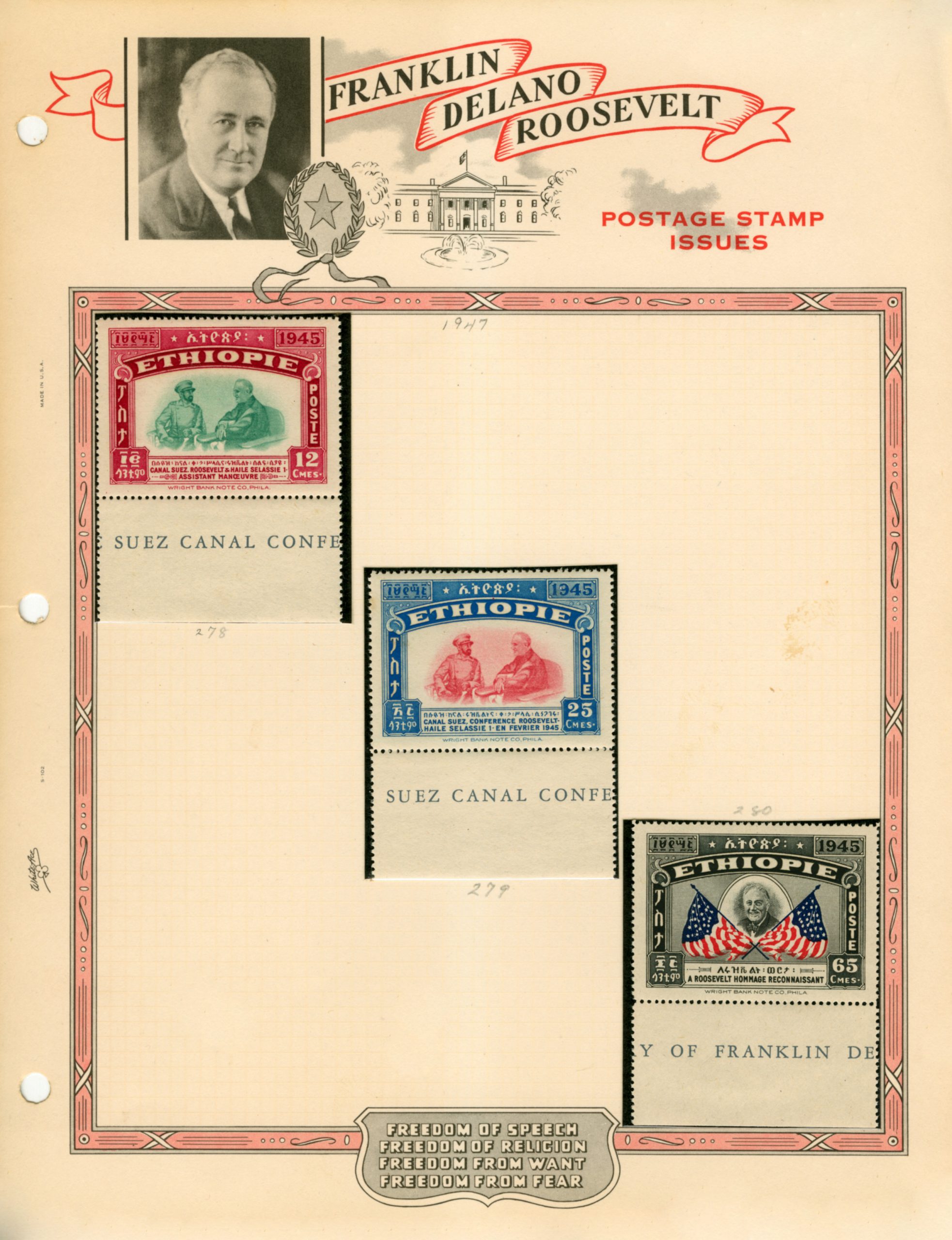
1947. Album page with three of five 1945 Suez Canal Conference issue. They are quite remarkable and wonderful, I think.
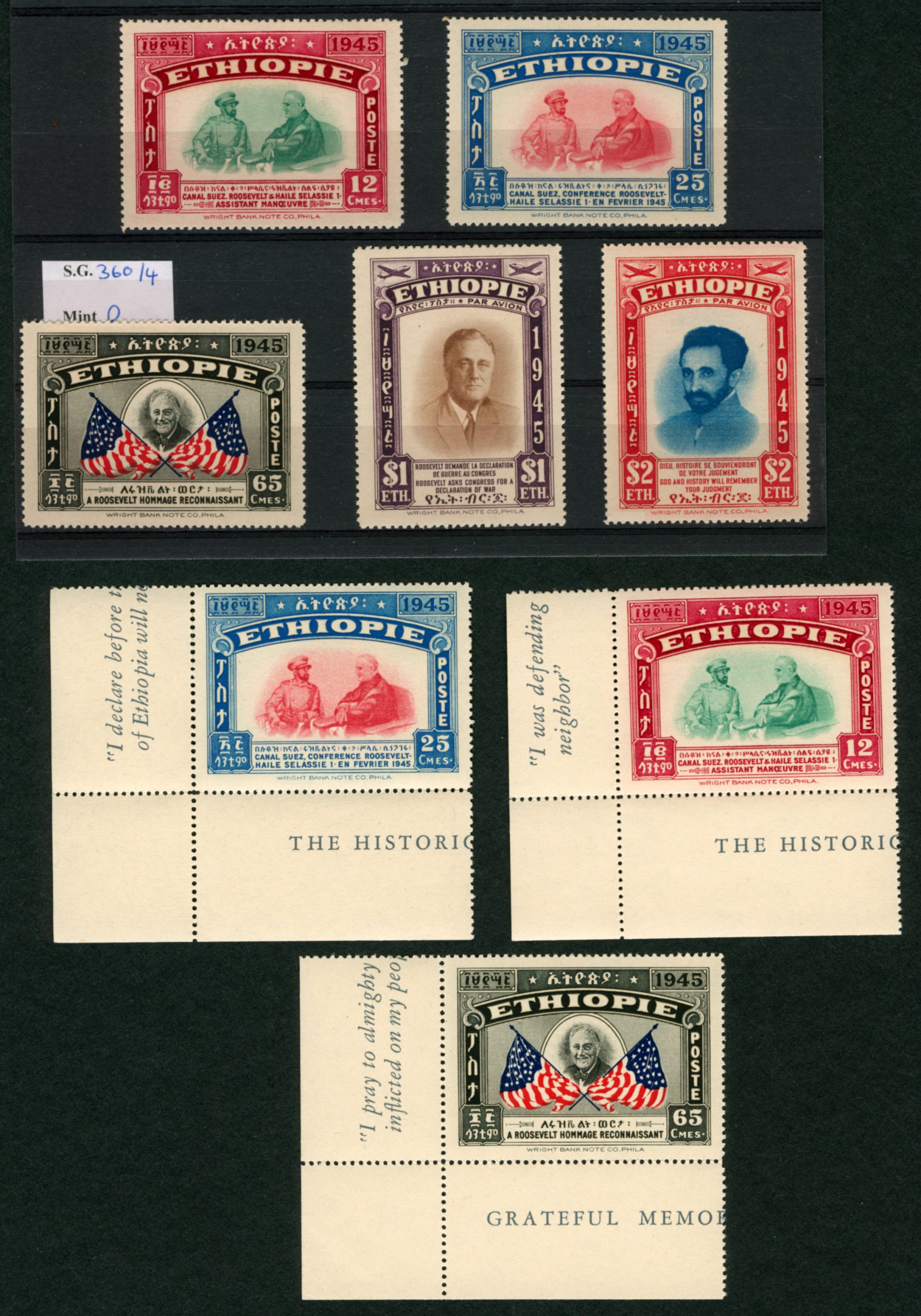 1947. Some more examples showing what I think is the full set of Suez Canal Conference Stamps.
Ethiopia issued a set of five stamps in 1947 to commemorate the historic February 1945 meeting between Emperor Haile Selassie I and U.S. President Franklin D. Roosevelt on the Great Bitter Lake section of the Suez Canal. The stamps are generally available and are not considered rare, unlike some specific Suez Canal Company stamps from the 19th century. They were issued in 1947, two years after the actual meeting, as part of a series honoring the late President Roosevelt.
Quote from Steve on July 7, 2026, 9:34 amHaile Selassie and the Shah of Iran: 1968
Two imperial peas in a pod .... both were emperors who would be deposed
The term 'imperial' derives from 'empire', ie. subordinate territories and colonies beyond the border of the emperor's or empress' country. In 1952, Emperor Hailie Selassie seized Eritrea, a Muslim country on the Red Sea. This gave his landlocked country access to the sea and trade. Like Ethiopia, Eritrea had previously been an Italian colony. Selassie's pretext for seizing it was that it had once been part of a kingdom that over time morphed in Ethiopia ie. it was originally Ethiopian territory (a 1000 years ago!). It was a thin claim but one largely supported by the post-WW2 West. The cover below was cancelled in Asmara, Eritrea. It emphasises Ethiopia's claim to Eritrea. It is propaganda of a subtle sort. After Ethiopia annexed the territory it resulted in a bitter war for Eritrean independence.
One can easily argue that Selassie was a hypocrite. Colonialism was bad .... except when he did it!
1968. First Day Cover. ASMARA '3 6 1968' to TURIN, ITALY.
This cover celebrates the' State Visit of His Imperial Majesy Emperor of Iran' to Ethiopia.
Haile Selassie and the Shah of Iran: 1968
Two imperial peas in a pod .... both were emperors who would be deposed
The term 'imperial' derives from 'empire', ie. subordinate territories and colonies beyond the border of the emperor's or empress' country. In 1952, Emperor Hailie Selassie seized Eritrea, a Muslim country on the Red Sea. This gave his landlocked country access to the sea and trade. Like Ethiopia, Eritrea had previously been an Italian colony. Selassie's pretext for seizing it was that it had once been part of a kingdom that over time morphed in Ethiopia ie. it was originally Ethiopian territory (a 1000 years ago!). It was a thin claim but one largely supported by the post-WW2 West. The cover below was cancelled in Asmara, Eritrea. It emphasises Ethiopia's claim to Eritrea. It is propaganda of a subtle sort. After Ethiopia annexed the territory it resulted in a bitter war for Eritrean independence.
One can easily argue that Selassie was a hypocrite. Colonialism was bad .... except when he did it!
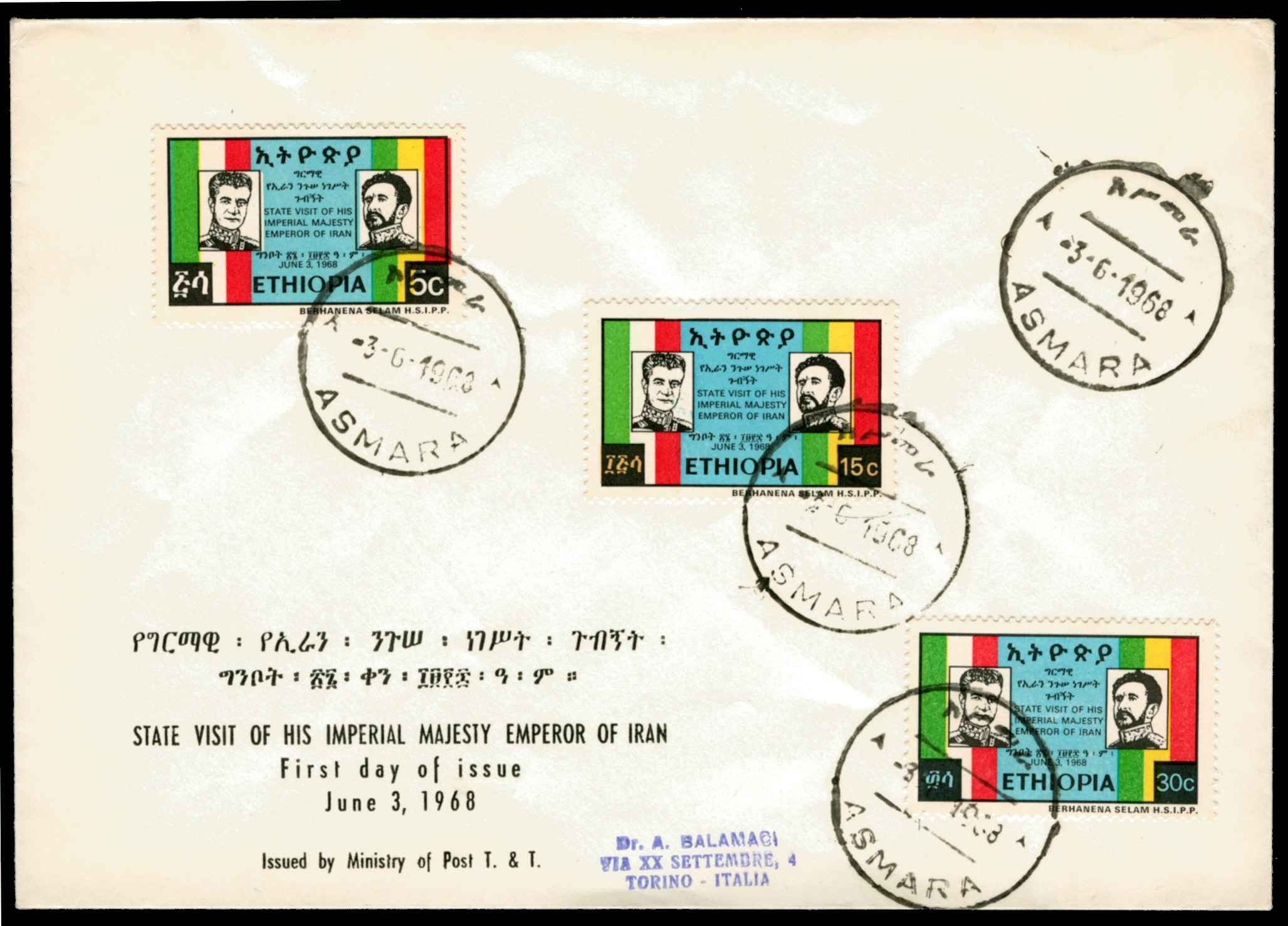
1968. First Day Cover. ASMARA '3 6 1968' to TURIN, ITALY.
This cover celebrates the' State Visit of His Imperial Majesy Emperor of Iran' to Ethiopia.
Quote from Steve on July 8, 2026, 9:04 amEthiopia's annexation of Eritrea (1)
Here are two more FDC's with 'propaganda postmarks'. These are from the Eretrean port of MASSAWA in Ethiopian possession.
1965. First Day Cover. MASSAWA '17 5 65' to TURIN, ITALY.
This cover celebrates the 'Centenary of the ITU (International Telecommunications Union)'.As a landlocked country, Ethiopia needed access to the Red Sea. Asmara (the capital of Eritrea) and Massawa (its principal Red Sea port) are historically and geopolitically important as Ethiopia's nearest main gateway to the sea. Massawa was the port serving Ethiopian international trade while Asmara, (perched on the edge of the highland escarpment from which Ethiopia as 'Abyssinia' possibly took its name). was a vital logistical railway hub connecting the port to Ethiopia and the rest of the Horn of Africa. Understandably, Ethiopians coveted Eritrean (and Somali) access to the sea.
Massawa has been ruled by a succession of historic forces ever since the Dahlak Sultanate prospered as a medieval Islamic kingdom (960–1557). The Ottoman (Turkish) Empire, the Khedivate of Egypt (an autonomous tributary state of the Ottoman Empire ruled by members of a dynasty) and the Kingdom of Italy all followed. Massawa was the capital of the Italian Colony of Eritrea until it moved the seat of colonial government to Asmara in 1897. When Italy invaded Ethiopia in October 1935 it was a stepping stone to WW2.
Following the defeat of Italy in World War II, the former Italian colony was placed under British Military Administration until its future could be decided. When the Allied Powers failed to reach an agreement, they handed the issue over to the UN (United Nations). In 1952, the UN decided to federate Eritrea with Ethiopia. It hoped to reconcile Ethiopian claims of sovereignty and Eritrean aspirations for independence. The UN effectively gave Eritrea to Ethiopia when it passed a resolution in 1950 to federate Eritrea with Ethiopia. The UN hoped this would reconcile Ethiopian claims of sovereignty and Eritrean aspirations for independence. However, the anti-imperialist, anti-colonial Emperor Haile Selassie of Ethiopia dissolved this federation in 1961, annexing Eritrea entirely.
1965. First Day Cover. MASSAWA '12 10 1968' to TURIN, ITALY.
This cover celebrates the 'Olympic Games, 1968'.Selassie's autocratic action precipitated a disastrous and debilitating regional war during a time of famine, Following Eritrea's independence in 1993, Ethiopia lost direct access to the sea, making its reliance on Massawa a recurring point of political tension. Agreements such as the historic 2018 peace accord have attempted to restore Ethiopian commercial access to Eritrean ports like Massawa and Assab.
These two MASSAWA postmarks are slightly different, the bottom 1968 one being a bit larger with bigger letters..
Ethiopia's annexation of Eritrea (1)
Here are two more FDC's with 'propaganda postmarks'. These are from the Eretrean port of MASSAWA in Ethiopian possession.
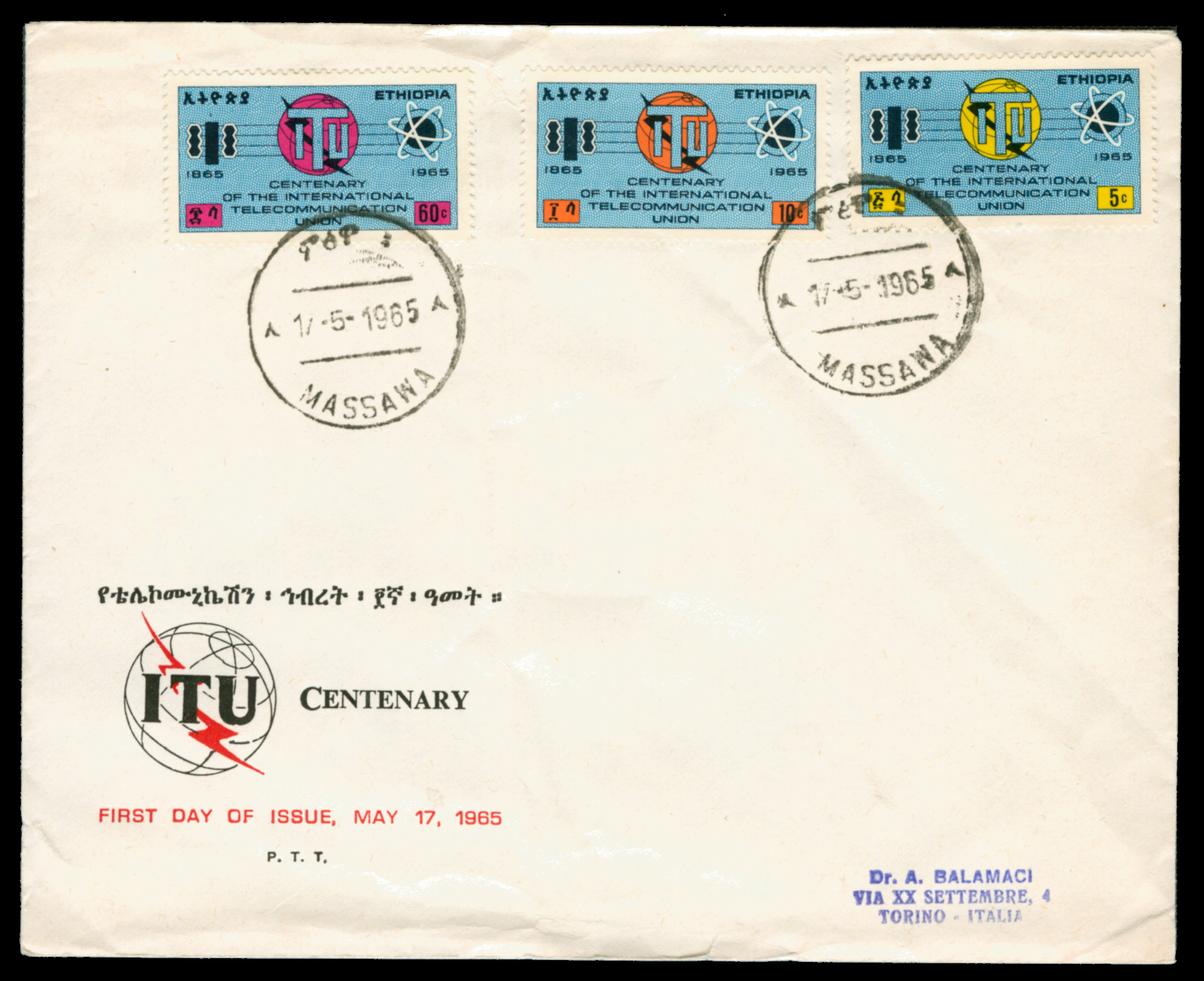
1965. First Day Cover. MASSAWA '17 5 65' to TURIN, ITALY.
This cover celebrates the 'Centenary of the ITU (International Telecommunications Union)'.
As a landlocked country, Ethiopia needed access to the Red Sea. Asmara (the capital of Eritrea) and Massawa (its principal Red Sea port) are historically and geopolitically important as Ethiopia's nearest main gateway to the sea. Massawa was the port serving Ethiopian international trade while Asmara, (perched on the edge of the highland escarpment from which Ethiopia as 'Abyssinia' possibly took its name). was a vital logistical railway hub connecting the port to Ethiopia and the rest of the Horn of Africa. Understandably, Ethiopians coveted Eritrean (and Somali) access to the sea.
Massawa has been ruled by a succession of historic forces ever since the Dahlak Sultanate prospered as a medieval Islamic kingdom (960–1557). The Ottoman (Turkish) Empire, the Khedivate of Egypt (an autonomous tributary state of the Ottoman Empire ruled by members of a dynasty) and the Kingdom of Italy all followed. Massawa was the capital of the Italian Colony of Eritrea until it moved the seat of colonial government to Asmara in 1897. When Italy invaded Ethiopia in October 1935 it was a stepping stone to WW2.
Following the defeat of Italy in World War II, the former Italian colony was placed under British Military Administration until its future could be decided. When the Allied Powers failed to reach an agreement, they handed the issue over to the UN (United Nations). In 1952, the UN decided to federate Eritrea with Ethiopia. It hoped to reconcile Ethiopian claims of sovereignty and Eritrean aspirations for independence. The UN effectively gave Eritrea to Ethiopia when it passed a resolution in 1950 to federate Eritrea with Ethiopia. The UN hoped this would reconcile Ethiopian claims of sovereignty and Eritrean aspirations for independence. However, the anti-imperialist, anti-colonial Emperor Haile Selassie of Ethiopia dissolved this federation in 1961, annexing Eritrea entirely.
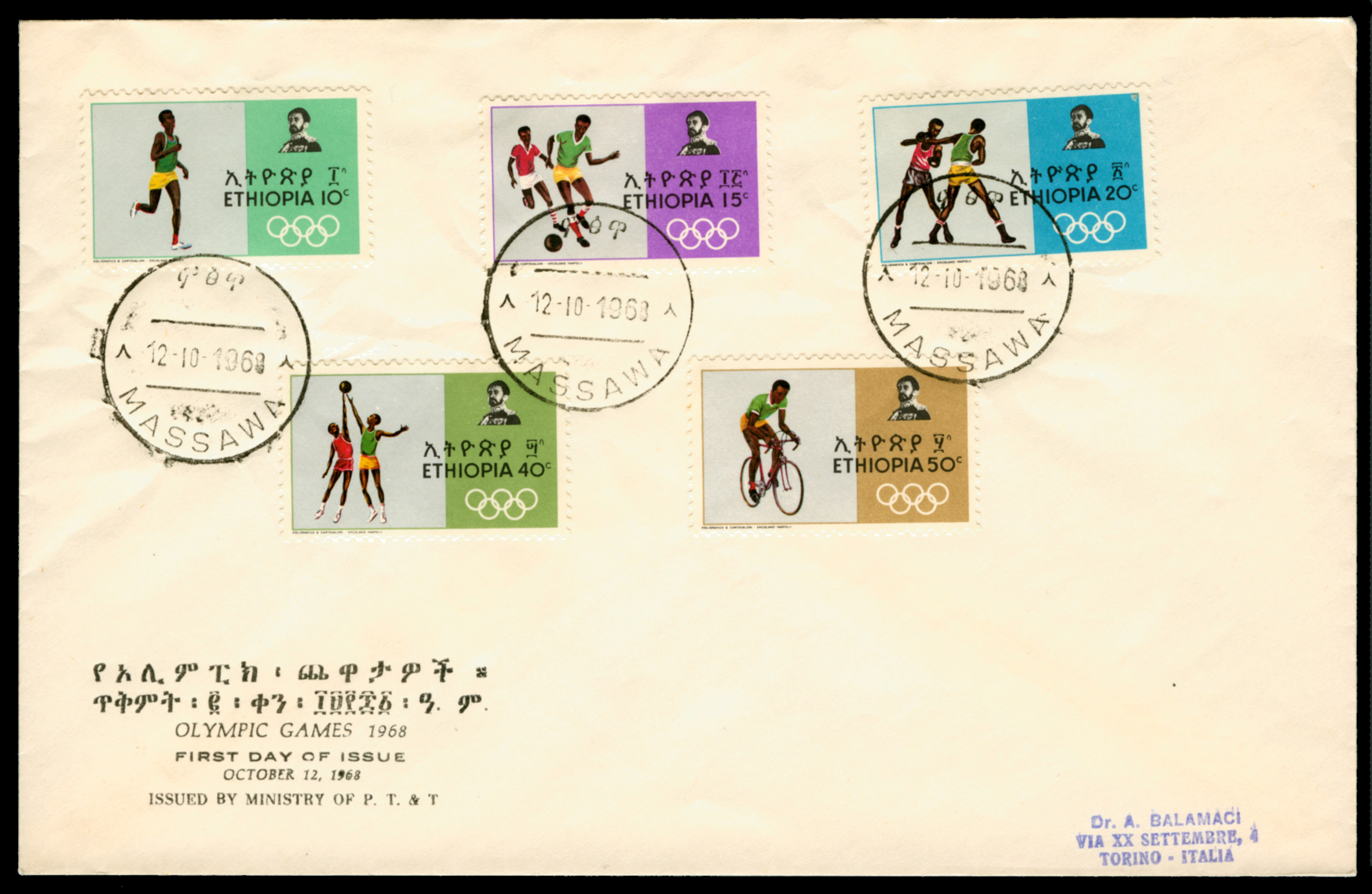
1965. First Day Cover. MASSAWA '12 10 1968' to TURIN, ITALY.
This cover celebrates the 'Olympic Games, 1968'.
Selassie's autocratic action precipitated a disastrous and debilitating regional war during a time of famine, Following Eritrea's independence in 1993, Ethiopia lost direct access to the sea, making its reliance on Massawa a recurring point of political tension. Agreements such as the historic 2018 peace accord have attempted to restore Ethiopian commercial access to Eritrean ports like Massawa and Assab.
These two MASSAWA postmarks are slightly different, the bottom 1968 one being a bit larger with bigger letters..
Quote from Steve on July 19, 2026, 9:38 amEthiopia's annexation of Eritrea (2)
The following is a pretty ordinary First Day cover that reading between the lines of its postmark tells us something about the state of Ethiopia, its Emperor, Eritrea and African countries winning independence from European colonialism in the 1960s.
1960. First Day Cover. ASMARA ERITREA '14 6 60'.
Possibly posted to Circolo Filatelico PO BOX 164. ASMARA. ERITREA, ETHIOPIA.
Stamps cancelled with datestamp that has ETHIOPIA above ERITREA (above 'DEPART ASMARA').This set of stamps has the head of Emperor Haile Selassie of Ethiopia and a woman with a child. She appears to be an Ethiopian mother who is holding high the flame and light of freedom. This is how Selassie imagined Ethiopia's relationship with the rest of Africa. The stamp issue celebrates the 2nd Conference of Independent African States. Ethiopia and Liberia were the only two African countries not under European colonial control at the end of WW2.
The stamps have been cancelled with a bilingual Amharic / English datestamp that has ETHIOPIA above ERITREA at base which is above 'DEPART ASMARA'. This issue is from the time of the UN-approved federation of Eritrea and Ethiopia. The UN hoped this would reconcile Ethiopian claims of sovereignty over Eritrea and Eritrean aspirations for independence. This set precedes the anti-imperialist, anti-colonial, pro-African independence Emperor Haile Selassie of Ethiopia dissolving this UN federation in 1961, effectively annexing Eritrea entirely in order to gain unfettered access to the sea. It suggests that for Selassie the right of nations to independece was subordinate to his grand (and no doubt benevolent) imperial ambition. The Eritreans and the Somalis would not share his vision. The Four Horsemen of the Apolcalypse would vist Hell on his Kingdom and he and millions of innocents would not survive.
Ethiopia's annexation of Eritrea (2)
The following is a pretty ordinary First Day cover that reading between the lines of its postmark tells us something about the state of Ethiopia, its Emperor, Eritrea and African countries winning independence from European colonialism in the 1960s.
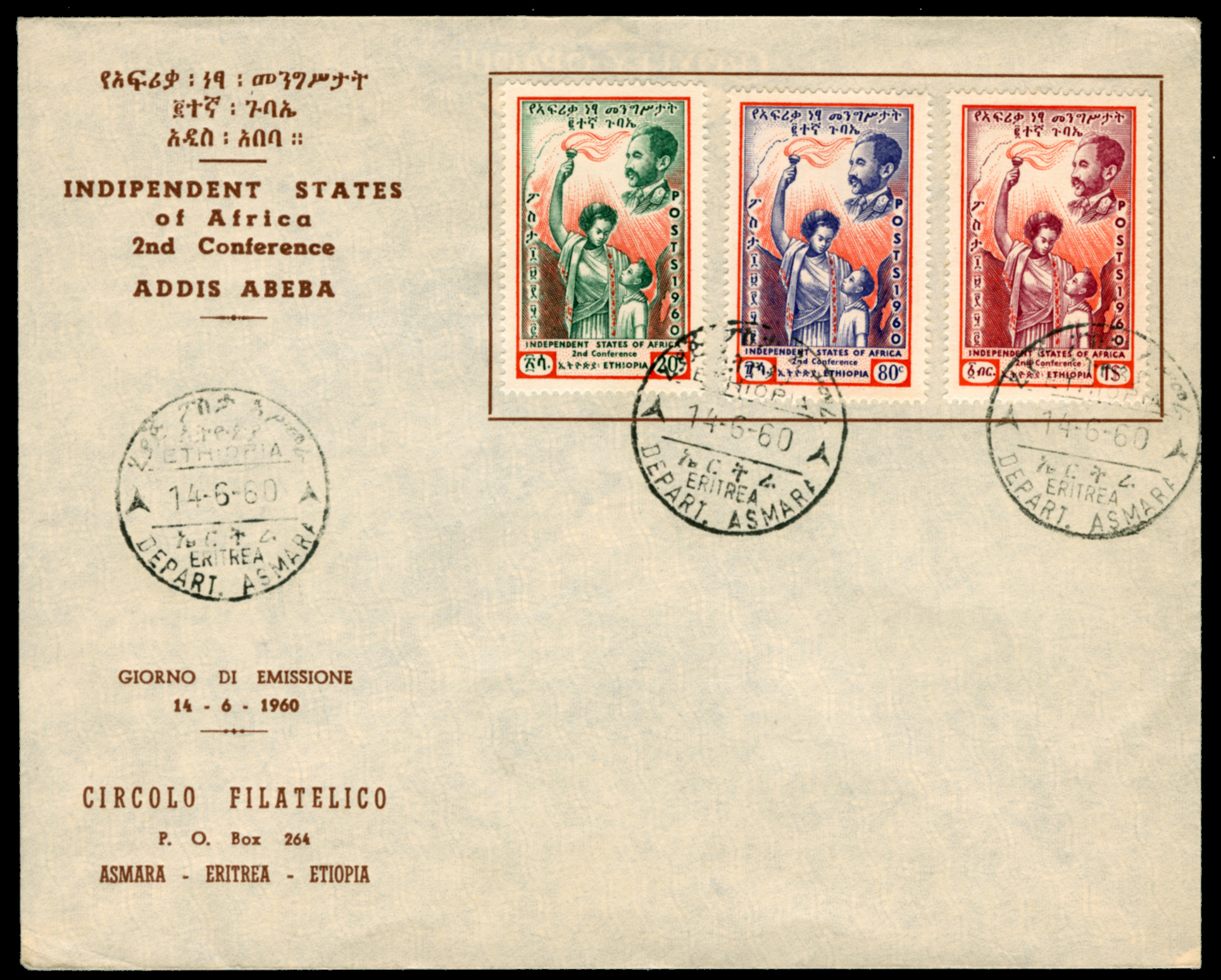
1960. First Day Cover. ASMARA ERITREA '14 6 60'.
Possibly posted to Circolo Filatelico PO BOX 164. ASMARA. ERITREA, ETHIOPIA.
Stamps cancelled with datestamp that has ETHIOPIA above ERITREA (above 'DEPART ASMARA').
This set of stamps has the head of Emperor Haile Selassie of Ethiopia and a woman with a child. She appears to be an Ethiopian mother who is holding high the flame and light of freedom. This is how Selassie imagined Ethiopia's relationship with the rest of Africa. The stamp issue celebrates the 2nd Conference of Independent African States. Ethiopia and Liberia were the only two African countries not under European colonial control at the end of WW2.
The stamps have been cancelled with a bilingual Amharic / English datestamp that has ETHIOPIA above ERITREA at base which is above 'DEPART ASMARA'. This issue is from the time of the UN-approved federation of Eritrea and Ethiopia. The UN hoped this would reconcile Ethiopian claims of sovereignty over Eritrea and Eritrean aspirations for independence. This set precedes the anti-imperialist, anti-colonial, pro-African independence Emperor Haile Selassie of Ethiopia dissolving this UN federation in 1961, effectively annexing Eritrea entirely in order to gain unfettered access to the sea. It suggests that for Selassie the right of nations to independece was subordinate to his grand (and no doubt benevolent) imperial ambition. The Eritreans and the Somalis would not share his vision. The Four Horsemen of the Apolcalypse would vist Hell on his Kingdom and he and millions of innocents would not survive.