Joint Aircrew Training Scheme (South Africa)
Quote from Steve on October 7, 2026, 7:57 amEmpire Air Training Scheme (EATS) or Joint Aircrew Training Scheme (JATS).
After Dunkirk Britain stood alone in Europe against Nazi Germany and the Luftwaffe. It was bombed from north to south and east to west. In 1940 after the Battle of Britain it had to face up to the harsh realisation that it would have to train new aircrew in its contested wartime skies. As a result, it was decided to transfer RAF training to the friendlier skies of its distant Empire, its Dominions and colonies, like Canada, South Africa, Rhodesia, Australia and New Zealand.
1941 . Label. Over-Seas League. Empire Day. 24 May 1941. (Traditionally held every year on the birthday of Queen Victoria).
On this day the British battlecruiser HMS Hood was sunk during the search for the Bismark. (Battle of the Denmark Strait).Known in Canada, Australia and New Zealand as the "British Commonwealth Air Training Plan" (BCATP) and in South Africa and Rhodesia as the "Joint Air Training Scheme" (JATS), it was the single largest aviation training program in history. It was responsible for training nearly half the pilots, navigators, bomb aimers, air gunners, wireless operators and flight engineers who served with British Imperial Air Forces. Canada's contribution was by far the largest. It trained some 131,500 aircrew while South Africa and Rhodesia added a further 33,347. My father was one of the latter number. It was how he met my mother.
1942. Block 4 Bantam stamps SA War Effort.
Cancelled BLOEMFONTEIN LOC / LOK (Location) '18 DEC 42'.South Africa had seven Elementary Flying Training Schools (EFTS). All were based in the Transvaal. They were Baragwanath (1 Air School), Randfontein (2 AS), Wonderboom (3 AS), Benoni (4 AS), Witbank (5 AS), Potchefstroom (6 AS) and Kroonstad (7 AS). The main type of trainer used in these Elementary Flying Schools was the redoubtable and reliable Tiger Moth biplane. All these Air Schools were established on 11th November 1940, (Kroonstad being the exception on 22nd December 1940). The earliest to open was Wonderboom (3 AS, Pretoria) on 16th Feb 1941, the last was Baragwanath in April 1944.
1942. Aerial photo. The caption on the reverse reads "Hangklip, the highest peak in the (Queenstown) district.
(View taken from one of our kites. Queenstown can be seen just to the left of the peak in the background.
Queenstown. April 1942.". (Ex 2 Volume Photo Album of Roy Baker's War.)Once the pilot trainees had achieved the required level of elementary competence they were transferred to other Air Schools around South Africa for more advanced training in the art of flting, navigating, bomb aiming, gunnery, observation and photographic reconnaisance. Some notable WW2 Air Schools in South Africa were:
No. 21 Air School (Kimberley, Northern Cape)].
No. 24 Air School: ([Dunnottar / Nigel, Gauteng.) Pilot and service training.
No. 41 Air School: (Collondale, East London, Eastern Cape.) Navigators and observers.
No. 42 Air School: (Southdene, Port Elizabeth, Eastern Cape.) Navigation and bombing.
No. 43 Air School: (Port Alfred, Eastern Cape.)
No. 45 Air School: ([Oudtshoorn, Western Cape.) Air observers, navigation, bombing, and gunnery).
No. 48 Air School: (Woodbrook, East London, Eastern Cape.)Three Air Schools also provided the WAAFs (Women's Auxillary Air Force) with Basic and Technical training.
1941. Photo. Roy Baker, RAF dentist, stands before an Avro Anson.
"Self and Steed. Port Elizabeth, November 1941."
(Ex 2 Volume Photo Album of Roy Baker's War.)The men werre trained initially in biplane aircraft like the Hawker Hind and Hart before moving up to monoplanes like the North American Harvard, probably the most successul Allied trainer aircraft of the WW2.South Africa received 633 Harvards (T-6). A wide variety of other aircraft were also used, specifically the twin-engined Avro Anson and Airspeed Oxfords which were used to train bomber pilots and navigators. If the traineesgraduated they moved up to operational training on Lockeed Ventura bombers or Lockheed 18 Lodestar passenger aircraft. Potential fighter pilots converted to Curtiss Kittyhawks and Hawker Hurricanes. The following types of aircraft are known used in South Africa for training:
Airspeed AS.10 Oxford I & II
Avro 621 Tutor
Avro 652a Anson
Curtiss H-75A-4 Mohawk IV
Curtiss P.40E/N Kittyhawk I, III & IV
DH 82a Tiger Moth
DH.89a Dominie (Rapide by another name)
Fairey Battle
Hawker Hart (and variants Hawker Hartbees and Fury)
Hawker Hurricane IIb & IIc
Lockheed L.37 Ventura I and II
Martin 167F Maryland
Miles M.19 Master II
North American Harvard I, IIa and III
Northrop 8-A5 Nomad I
Westland WapitiOnly the Curtiss P.40 Kittyhawk, Hawker Hurricane and Martin Maryland continued to be used in combat situations, all the others being either obsolete or dedicated trainers or like the Lockheed Ventura yet to be released. The Hawker Hartbees was a South African assembled version of the Hawker Hart biplane of the 1920s. Some 27 Westland Wapitis were built under licence in South Africa. Both the Hart and Wapiti were British two-seat general-purpose military single-engined biplanes of 1920s vintage. Like many of the aircraft used to train aircrew, they were out-of-date but nevertheless made good preliminary aircrew training platforms. However, the mainstay of the Joint Air Training Scheme flying schools was the dependable North American Harvard, known to the Yanks as the T-6. There are conflicting views as to when they first arrived in South Africa. By July 1944, 633 Harvard Mk IIA and III aircraft had been shipped out to SA with 555 surviving in October 1945 (379 MkIIAs and 176 Mk IIIs).
1942. Photo. 'Station Sick Quarters & Dental Staffs, 47 Air Scool, Queenstown. April 1942.'
(Ex 2 Volume Photo Album of Roy Baker's War.) Roy Baker, third right, standing.
Empire Air Training Scheme (EATS) or Joint Aircrew Training Scheme (JATS).
After Dunkirk Britain stood alone in Europe against Nazi Germany and the Luftwaffe. It was bombed from north to south and east to west. In 1940 after the Battle of Britain it had to face up to the harsh realisation that it would have to train new aircrew in its contested wartime skies. As a result, it was decided to transfer RAF training to the friendlier skies of its distant Empire, its Dominions and colonies, like Canada, South Africa, Rhodesia, Australia and New Zealand.
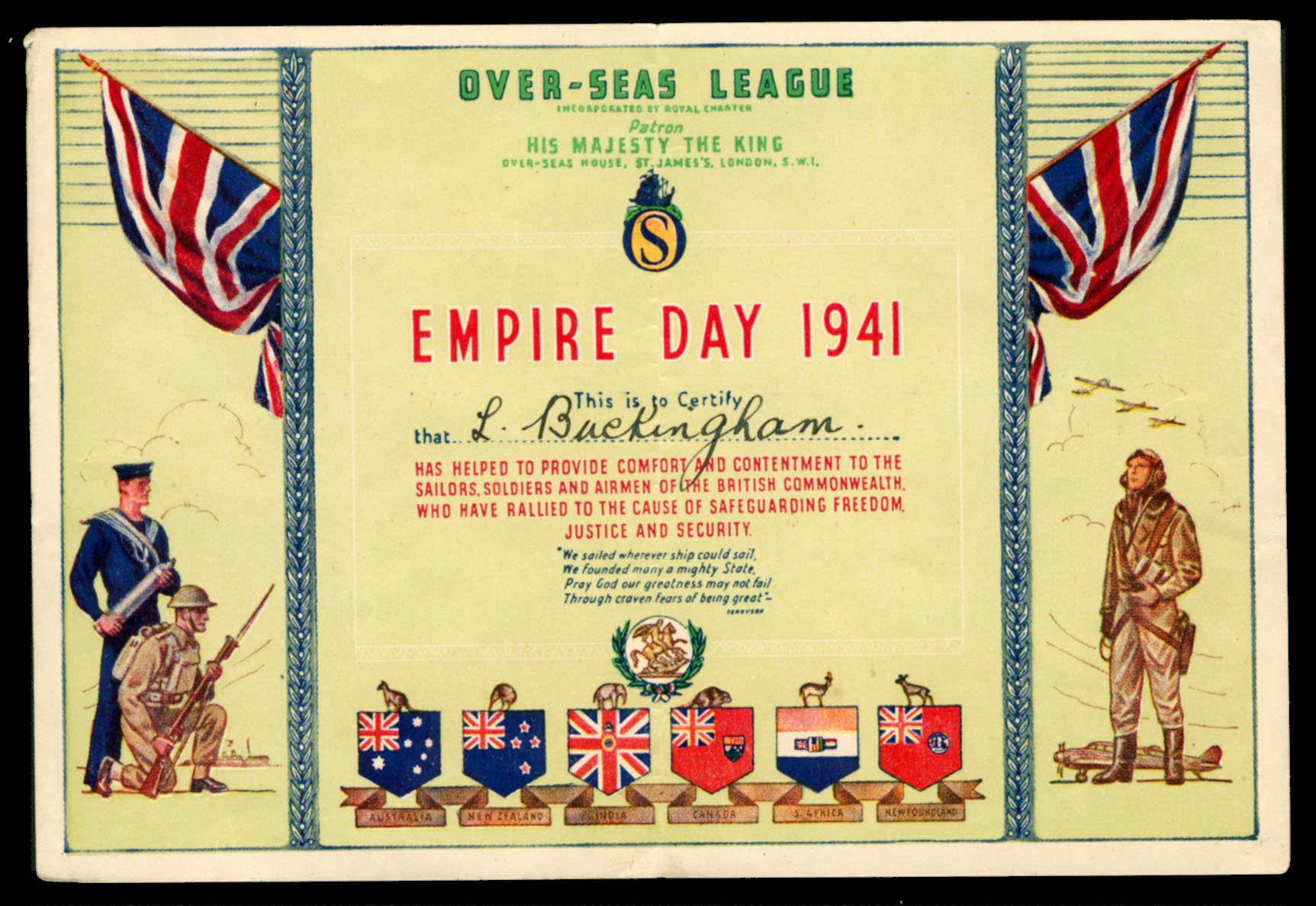
1941 . Label. Over-Seas League. Empire Day. 24 May 1941. (Traditionally held every year on the birthday of Queen Victoria).
On this day the British battlecruiser HMS Hood was sunk during the search for the Bismark. (Battle of the Denmark Strait).
Known in Canada, Australia and New Zealand as the "British Commonwealth Air Training Plan" (BCATP) and in South Africa and Rhodesia as the "Joint Air Training Scheme" (JATS), it was the single largest aviation training program in history. It was responsible for training nearly half the pilots, navigators, bomb aimers, air gunners, wireless operators and flight engineers who served with British Imperial Air Forces. Canada's contribution was by far the largest. It trained some 131,500 aircrew while South Africa and Rhodesia added a further 33,347. My father was one of the latter number. It was how he met my mother.
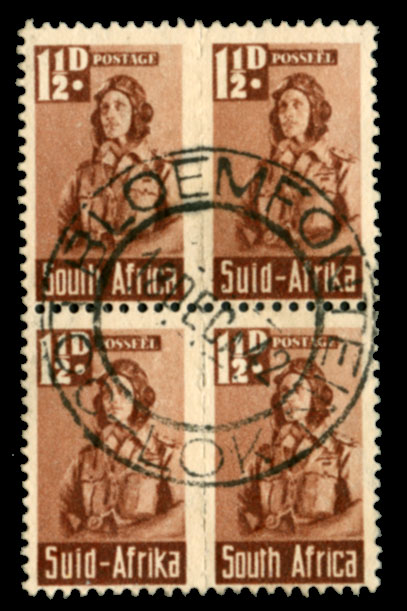
1942. Block 4 Bantam stamps SA War Effort.
Cancelled BLOEMFONTEIN LOC / LOK (Location) '18 DEC 42'.
South Africa had seven Elementary Flying Training Schools (EFTS). All were based in the Transvaal. They were Baragwanath (1 Air School), Randfontein (2 AS), Wonderboom (3 AS), Benoni (4 AS), Witbank (5 AS), Potchefstroom (6 AS) and Kroonstad (7 AS). The main type of trainer used in these Elementary Flying Schools was the redoubtable and reliable Tiger Moth biplane. All these Air Schools were established on 11th November 1940, (Kroonstad being the exception on 22nd December 1940). The earliest to open was Wonderboom (3 AS, Pretoria) on 16th Feb 1941, the last was Baragwanath in April 1944.
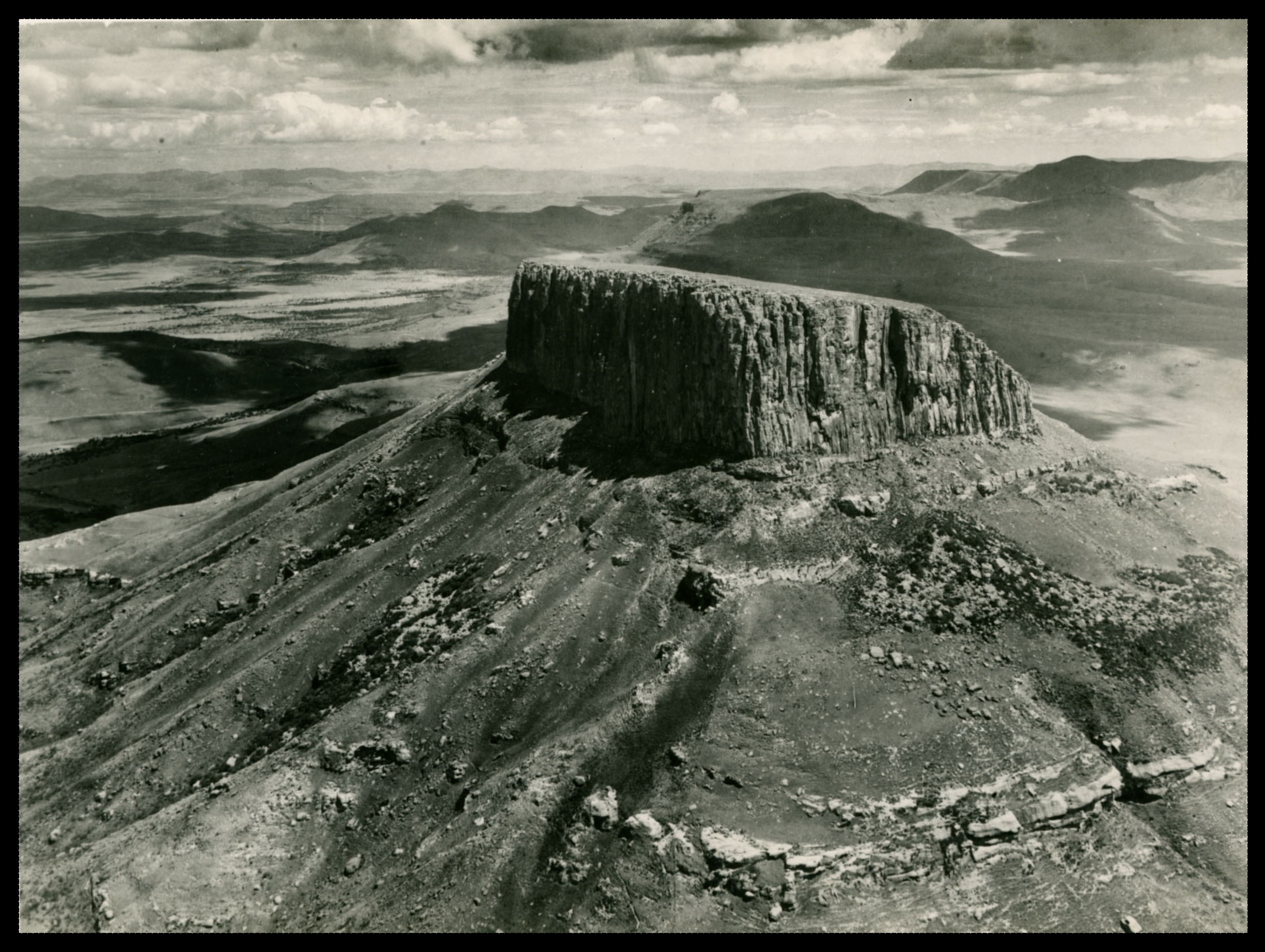
1942. Aerial photo. The caption on the reverse reads "Hangklip, the highest peak in the (Queenstown) district.
(View taken from one of our kites. Queenstown can be seen just to the left of the peak in the background.
Queenstown. April 1942.". (Ex 2 Volume Photo Album of Roy Baker's War.)
Once the pilot trainees had achieved the required level of elementary competence they were transferred to other Air Schools around South Africa for more advanced training in the art of flting, navigating, bomb aiming, gunnery, observation and photographic reconnaisance. Some notable WW2 Air Schools in South Africa were:
No. 21 Air School (Kimberley, Northern Cape)].
No. 24 Air School: ([Dunnottar / Nigel, Gauteng.) Pilot and service training.
No. 41 Air School: (Collondale, East London, Eastern Cape.) Navigators and observers.
No. 42 Air School: (Southdene, Port Elizabeth, Eastern Cape.) Navigation and bombing.
No. 43 Air School: (Port Alfred, Eastern Cape.)
No. 45 Air School: ([Oudtshoorn, Western Cape.) Air observers, navigation, bombing, and gunnery).
No. 48 Air School: (Woodbrook, East London, Eastern Cape.)
Three Air Schools also provided the WAAFs (Women's Auxillary Air Force) with Basic and Technical training.
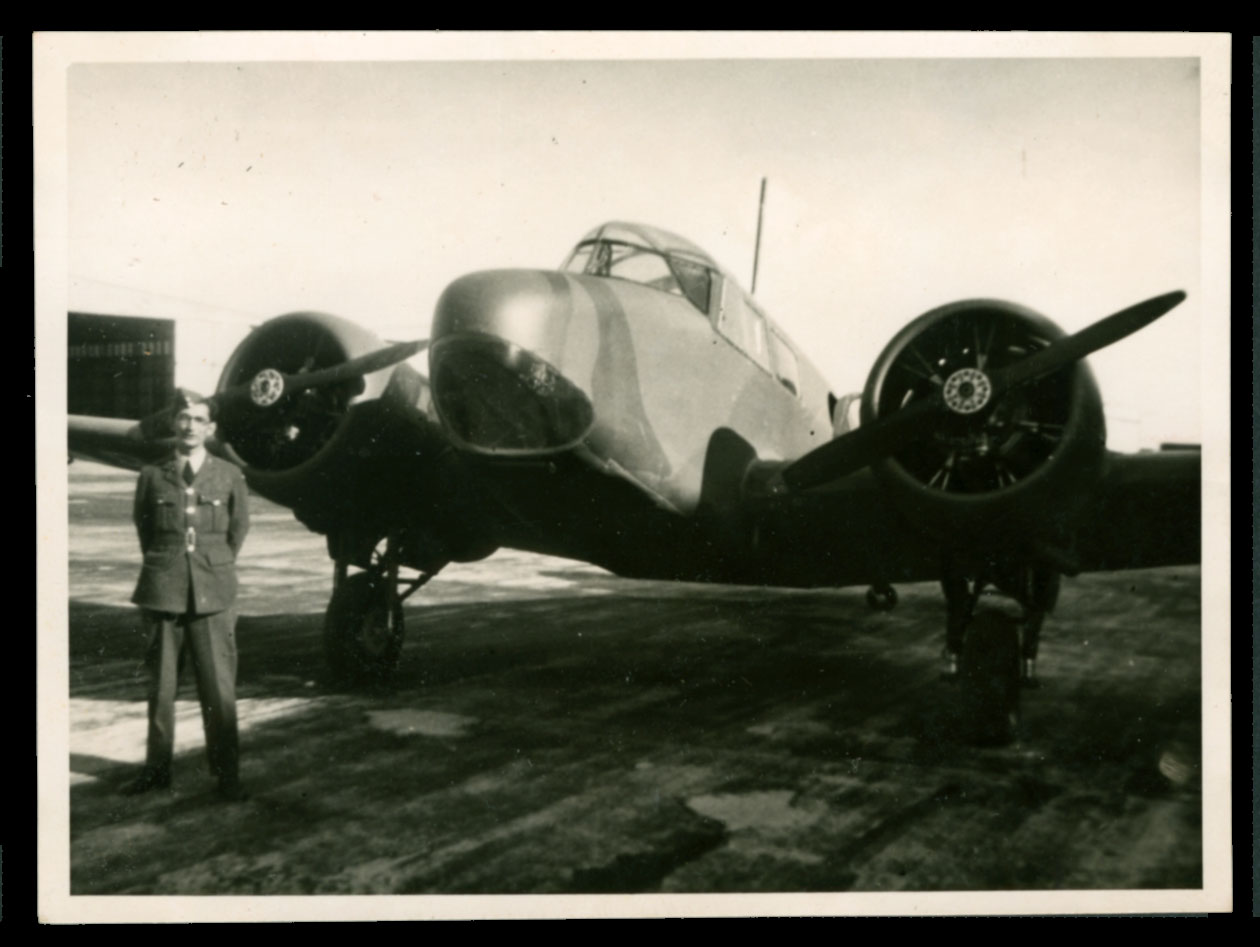
1941. Photo. Roy Baker, RAF dentist, stands before an Avro Anson.
"Self and Steed. Port Elizabeth, November 1941."
(Ex 2 Volume Photo Album of Roy Baker's War.)
The men werre trained initially in biplane aircraft like the Hawker Hind and Hart before moving up to monoplanes like the North American Harvard, probably the most successul Allied trainer aircraft of the WW2.South Africa received 633 Harvards (T-6). A wide variety of other aircraft were also used, specifically the twin-engined Avro Anson and Airspeed Oxfords which were used to train bomber pilots and navigators. If the traineesgraduated they moved up to operational training on Lockeed Ventura bombers or Lockheed 18 Lodestar passenger aircraft. Potential fighter pilots converted to Curtiss Kittyhawks and Hawker Hurricanes. The following types of aircraft are known used in South Africa for training:
Airspeed AS.10 Oxford I & II
Avro 621 Tutor
Avro 652a Anson
Curtiss H-75A-4 Mohawk IV
Curtiss P.40E/N Kittyhawk I, III & IV
DH 82a Tiger Moth
DH.89a Dominie (Rapide by another name)
Fairey Battle
Hawker Hart (and variants Hawker Hartbees and Fury)
Hawker Hurricane IIb & IIc
Lockheed L.37 Ventura I and II
Martin 167F Maryland
Miles M.19 Master II
North American Harvard I, IIa and III
Northrop 8-A5 Nomad I
Westland Wapiti
Only the Curtiss P.40 Kittyhawk, Hawker Hurricane and Martin Maryland continued to be used in combat situations, all the others being either obsolete or dedicated trainers or like the Lockheed Ventura yet to be released. The Hawker Hartbees was a South African assembled version of the Hawker Hart biplane of the 1920s. Some 27 Westland Wapitis were built under licence in South Africa. Both the Hart and Wapiti were British two-seat general-purpose military single-engined biplanes of 1920s vintage. Like many of the aircraft used to train aircrew, they were out-of-date but nevertheless made good preliminary aircrew training platforms. However, the mainstay of the Joint Air Training Scheme flying schools was the dependable North American Harvard, known to the Yanks as the T-6. There are conflicting views as to when they first arrived in South Africa. By July 1944, 633 Harvard Mk IIA and III aircraft had been shipped out to SA with 555 surviving in October 1945 (379 MkIIAs and 176 Mk IIIs).
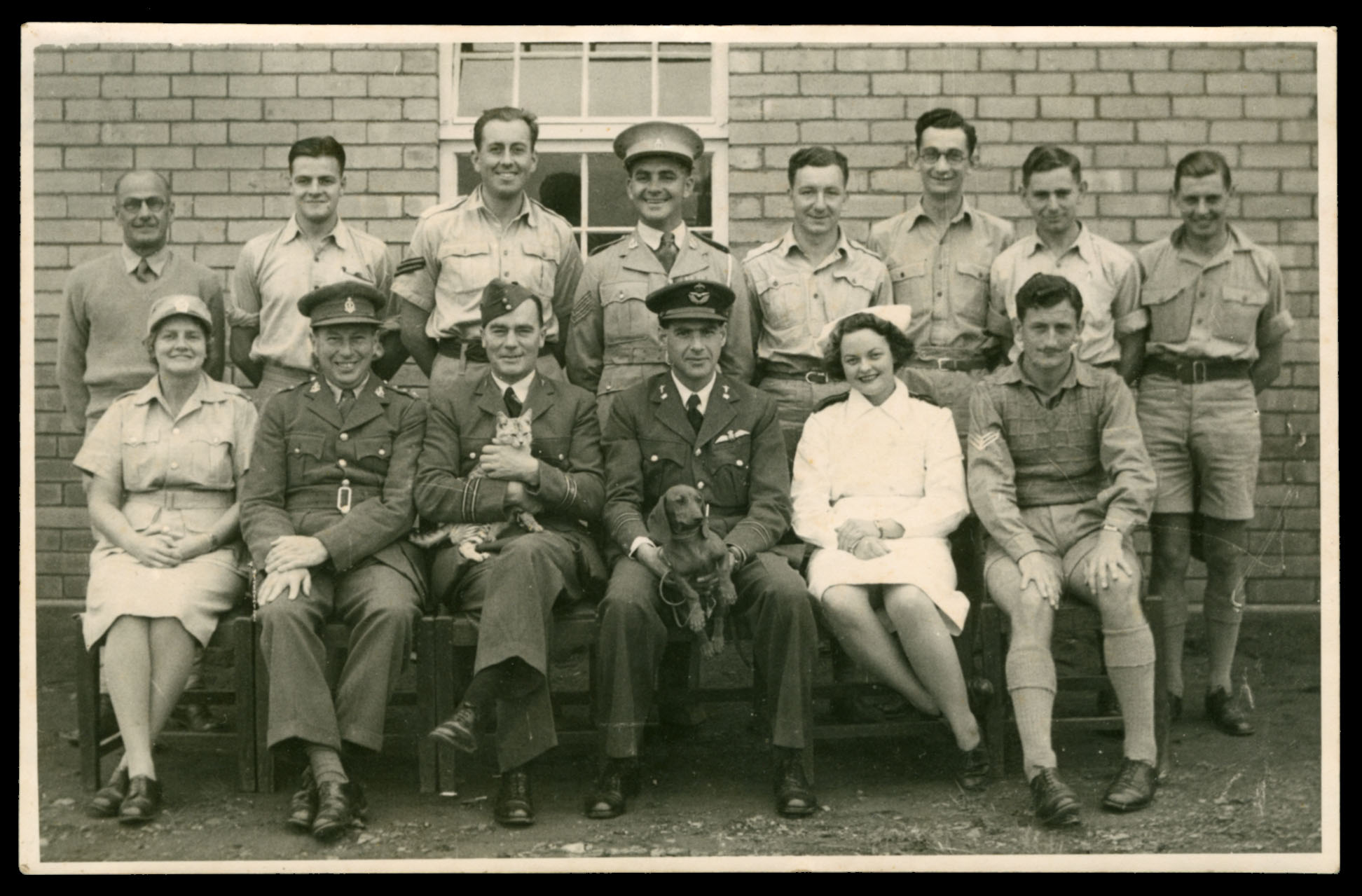
1942. Photo. 'Station Sick Quarters & Dental Staffs, 47 Air Scool, Queenstown. April 1942.'
(Ex 2 Volume Photo Album of Roy Baker's War.) Roy Baker, third right, standing.
Quote from Jamie Smith on October 7, 2026, 8:13 amSteve, Nice account, but I think you may have missed RAF Vereeniging off your writeup, (or I may have missed it. I lived in Vereeniging for 40 years and saw an old hanger placed in the middle of Vereeniging as a shopping center. Also when I was a volunteer Chaplin in Stockport. I had a patient who had been stationed there. He told me that they used to take joyrides in a Harard up to the Victoria Falls. I add an AI account of the station.
Vereeniging’s main role during WW2 was training pilots for the Allied war effort. What is sometimes called “RAF Vereeniging” was No. 22 Air School, a South African Air Force establishment that trained both SAAF and RAF personnel through the Joint Air Training Scheme. raf.mod.uk
Its wartime story was broadly:
- Established in 1940–41: No. 22 Air School was formally formed on 11 November 1940; a local history dates the opening of the school at Leeukuil to January 1941. The site developed into a base with accommodation, classrooms and aircraft hangars. rafweb.org
- Flying training: Pupils progressed from elementary training elsewhere to service flying training at Vereeniging. Pilot Jack Spencer recalled flying Hawker Hinds, Harts and Audaxes there, receiving his wings in July 1942. Harvard trainers arrived in January 1943, becoming a major part of the school’s fleet. saafww2pilots.yolasite.com
- Fatal training accidents: There were deaths among pupils and instructors. One example was Flight Lieutenant Peter Walker, who died on 31 July 1941; family accounts reproduced in an RAF research forum describe a crash that killed him and a pupil. He is buried in Vereeniging Old Town Cemetery, although that account leaves the precise aircraft and circumstances unresolved. rafcommands.com
- Closure after the war: A local history records training ending on 30 November 1945. The unit was formally disbanded on 27 February 1946. I have a few cachets that I have been workiing on and will add when I polish them up.
Steve, Nice account, but I think you may have missed RAF Vereeniging off your writeup, (or I may have missed it. I lived in Vereeniging for 40 years and saw an old hanger placed in the middle of Vereeniging as a shopping center. Also when I was a volunteer Chaplin in Stockport. I had a patient who had been stationed there. He told me that they used to take joyrides in a Harard up to the Victoria Falls. I add an AI account of the station.
Vereeniging’s main role during WW2 was training pilots for the Allied war effort. What is sometimes called “RAF Vereeniging” was No. 22 Air School, a South African Air Force establishment that trained both SAAF and RAF personnel through the Joint Air Training Scheme. raf.mod.uk
Its wartime story was broadly:
- Established in 1940–41: No. 22 Air School was formally formed on 11 November 1940; a local history dates the opening of the school at Leeukuil to January 1941. The site developed into a base with accommodation, classrooms and aircraft hangars. rafweb.org
- Flying training: Pupils progressed from elementary training elsewhere to service flying training at Vereeniging. Pilot Jack Spencer recalled flying Hawker Hinds, Harts and Audaxes there, receiving his wings in July 1942. Harvard trainers arrived in January 1943, becoming a major part of the school’s fleet. saafww2pilots.yolasite.com
- Fatal training accidents: There were deaths among pupils and instructors. One example was Flight Lieutenant Peter Walker, who died on 31 July 1941; family accounts reproduced in an RAF research forum describe a crash that killed him and a pupil. He is buried in Vereeniging Old Town Cemetery, although that account leaves the precise aircraft and circumstances unresolved. rafcommands.com
- Closure after the war: A local history records training ending on 30 November 1945. The unit was formally disbanded on 27 February 1946. I have a few cachets that I have been workiing on and will add when I polish them up.
Quote from Jamie Smith on October 7, 2026, 8:25 amI met Bob Kershaw (on the 1 1/2d stamp) when we had the Nationals in East London, He was our speaker at the dinner. As a point of interest I also met another South African pilot when I gave a talk in St. Helens. I heard Zulu being spoken and when I turned round it was another South African pilot and Nomvula going at it, it turned out it was his first languange that he learnt from his ayah. He told me that he flew shells up from Matubatuba to North Africa. They were shipped down from Johannesburg, presumably because of load/altitude/take-off problems. They were for Montgomery's 80 mile line bombardment at the opening of the el Alamein offensive. Something else you don't finnd in history books.
I met Bob Kershaw (on the 1 1/2d stamp) when we had the Nationals in East London, He was our speaker at the dinner. As a point of interest I also met another South African pilot when I gave a talk in St. Helens. I heard Zulu being spoken and when I turned round it was another South African pilot and Nomvula going at it, it turned out it was his first languange that he learnt from his ayah. He told me that he flew shells up from Matubatuba to North Africa. They were shipped down from Johannesburg, presumably because of load/altitude/take-off problems. They were for Montgomery's 80 mile line bombardment at the opening of the el Alamein offensive. Something else you don't finnd in history books.
Quote from Steve on October 7, 2026, 10:25 amMany thanks for your comments and additions. This is exactly what I hoped this Forum would be all about. Someone makes a post, another fills in the gaps and or makes corrections and adds anecdotes. Excellent. Keep it up.
You are right. My 'Some notable WW2 Air Schools in South Africa' did not include No. 22 Air School Vereeniging. Thanks for filling this in. Another notable omission was Youngsfield in Cape Town (where my Dad was based when he met my Mom). Youngsfield, near Wynberg, was used as an air training facility during WW2, housing No. 65 Air School (Air Armament and Gunnery Training) and No. 66 Air School of the South African Air Force / RAF. No doubt, there are many more Air Schools that I have omitted. Readers please add!
Here are a few snapshot photos taken when Roy Baker and a few of his Brylcreemed pals undertook a road trip in May - Jume 1942. They departed Queenstown, travelled through the rural Transkei at a time when there was no main road north to south, went through Pondoland, vistited Zululand and Durban and then came home to 47 Air School Queenstown. These snapshots serve as a metaphor for my post. They got lost along the way and had to ask a passing gentleman on a horse for directions! A bit like me. No offence intended.
TOP: 'The start for Durban. Queenstown. May 42'.
CENTRE: 'Asking the way'.
BELOW: 'Safely back in Queenstown. June 42. L to R. Self, Jock, Ken and Sid.'

TOP:' The start for Durban. Queenstown. May 42'.
CENTRE: 'Asking the way'.
BELOW: 'Safely back in Queenstown. June 42. (L to R. Self, Jock, Ken and Sid'.)
Many thanks for your comments and additions. This is exactly what I hoped this Forum would be all about. Someone makes a post, another fills in the gaps and or makes corrections and adds anecdotes. Excellent. Keep it up.
You are right. My 'Some notable WW2 Air Schools in South Africa' did not include No. 22 Air School Vereeniging. Thanks for filling this in. Another notable omission was Youngsfield in Cape Town (where my Dad was based when he met my Mom). Youngsfield, near Wynberg, was used as an air training facility during WW2, housing No. 65 Air School (Air Armament and Gunnery Training) and No. 66 Air School of the South African Air Force / RAF. No doubt, there are many more Air Schools that I have omitted. Readers please add!
Here are a few snapshot photos taken when Roy Baker and a few of his Brylcreemed pals undertook a road trip in May - Jume 1942. They departed Queenstown, travelled through the rural Transkei at a time when there was no main road north to south, went through Pondoland, vistited Zululand and Durban and then came home to 47 Air School Queenstown. These snapshots serve as a metaphor for my post. They got lost along the way and had to ask a passing gentleman on a horse for directions! A bit like me. No offence intended.
TOP: 'The start for Durban. Queenstown. May 42'.
CENTRE: 'Asking the way'.
BELOW: 'Safely back in Queenstown. June 42. L to R. Self, Jock, Ken and Sid.'
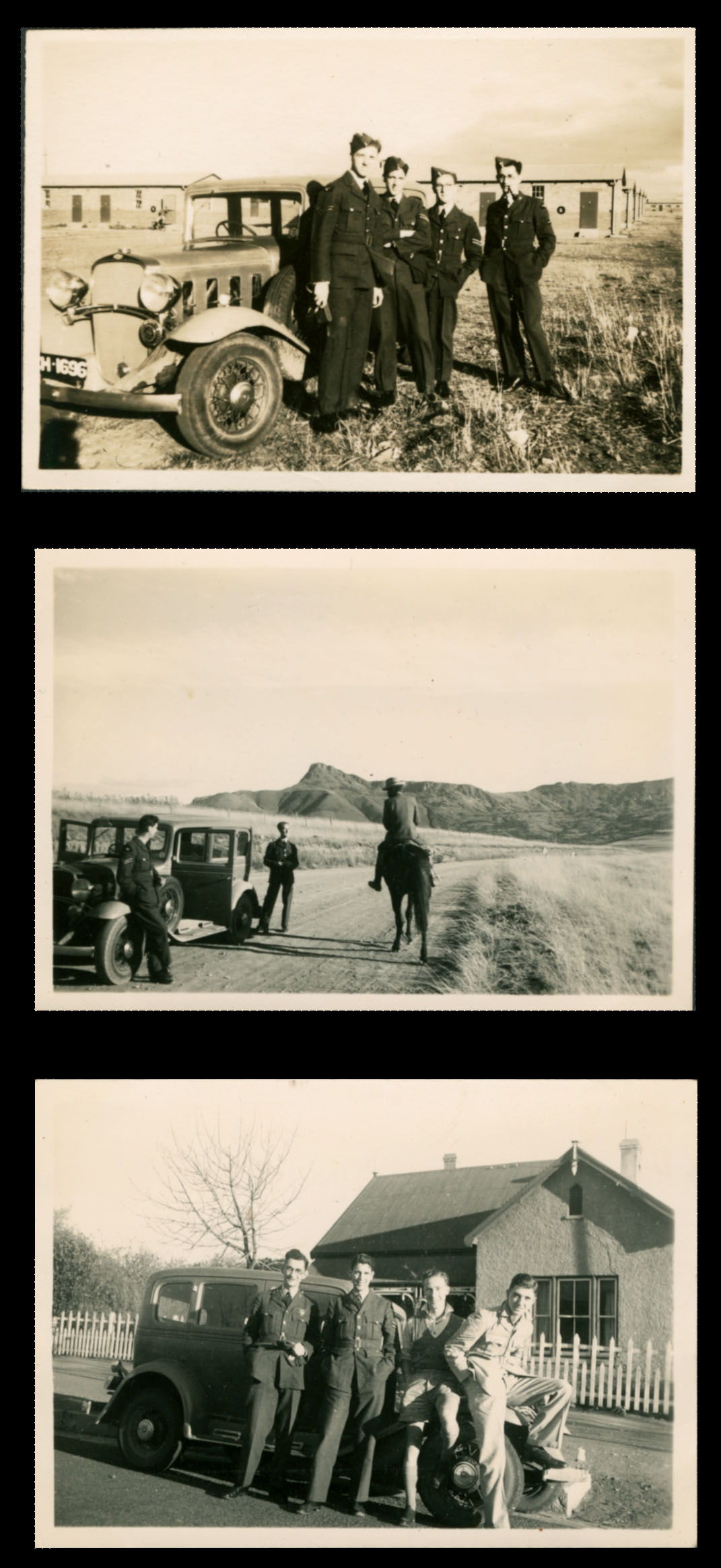
TOP:' The start for Durban. Queenstown. May 42'.
CENTRE: 'Asking the way'.
BELOW: 'Safely back in Queenstown. June 42. (L to R. Self, Jock, Ken and Sid'.)
Quote from Steve on October 7, 2026, 10:43 amIf you visit the 'Hotels of southern Africa' post and scroll down the first page you will find a reference to the Heaxagon Hotel, Queenstown, and another aerial photo of Roy Baker's, plus a cover from the Queenstown Air Traing School with its cachet.
To see it, click on the link here (then scroll down): https://southafricanphilatelyclub.com/forum/topic/southern-african-hotels
If you visit the 'Hotels of southern Africa' post and scroll down the first page you will find a reference to the Heaxagon Hotel, Queenstown, and another aerial photo of Roy Baker's, plus a cover from the Queenstown Air Traing School with its cachet.
To see it, click on the link here (then scroll down): https://southafricanphilatelyclub.com/forum/topic/southern-african-hotels
Quote from Jamie Smith on October 7, 2026, 10:51 amRemind me, not why we were called the Brylcream boys but why we used it by the gallon.
Remind me, not why we were called the Brylcream boys but why we used it by the gallon.
Quote from Steve on October 7, 2026, 11:36 amCollectively, by Squadron or Wing, it was used by the gallon. Individually, I believe "a little dab will do you!" I guess the reason men used it was because it made them look so debonair that the girls ran their fingers through their hair. Oops, stickly mistake!
Collectively, by Squadron or Wing, it was used by the gallon. Individually, I believe "a little dab will do you!" I guess the reason men used it was because it made them look so debonair that the girls ran their fingers through their hair. Oops, stickly mistake!