Hotels of southern Africa
Quote from Steve on October 12, 2026, 11:01 amThe Rotunda Hotel, Camps Bay.
The Union Castle Year Book and Guide to Southern Africa lists two hotels in Camps Bay in 1956, the Camps Bay and Rotunda hotels. It says "the Bay is named after von Camptz who farmed this area in 1779". It is quite surprising that this popular area today remained so uninhabited for so long, some 120+ years, after the Dutch arrived just over the Nek in 1652 . However, just look at the dense thicket of 'bos' (Afr. bush) behind the Rotunda in the postcard below. Perhaps the impenetrable bush is one reason why development was delayed for so long? When Simon van der Stel mapped the Simon's Bay area in 1687 he had real difficulty getting through the coastal bush.
The building is said to be an early example of steel-frame construction in South Africa. This probably supported the round roof with central cupola. In its time the Rotunda has been used as a dance hall, a roller-skating rink and a music venue. In the late 60s or early 70s I heard either Coloured Rain or Freedom's Children perform there. My pal Brian Davison, ("Briany Boo" to Cheryl Adams, my Blue School crush), was the lead singer. We were tearaway teenagers together in Pinelands. Brian was from Strubens Road, Mowbray and hung out with us. He once, famously, bought a 'half-man can' of Witblits to a party, the real deal with the chicken poeping in the barrel. I recall Brian belting out Led Zeppelin's "Whole Lotta Love" in his distinctive way, using his voice as an instrument. He was amazing!
1913. Postcard. MOWBRAY 'MR 12 13' to SPALDING, LINCS.
Entitled, 'Pavilion, Camps Bay', we only ever knew the place as the 'Rotnda'.I believe that this is a rare postcard as I have not yet seen another. The empty land is a property developer's dream. I vaguely recall that in the 60s and 70s the foreground may have been a car park and the green of a bowling club ("old man's marbles").
'The Rotunda' was built in 1904, was modified in 1910 and saved from property development and structurally repaired in the late 1980s. It is not known if the hotel was built at the same time. The Rotunda is built in a Florentine style while the adjoining hotel building is more your typical colonial era design. At some point the two structures were known collectively as 'The Rotunda Hotel'. Today the Rotunda is a part of the adjoining Bay Hotel, (the old Rotunda Hotel), and is used to host weddings and other swanky functions. It is still there but is no loger the cool alternative haunt of Cape Town's subterraneans! Today, Camp's Bay is hugely up-market. The Bay Hotel leads the charge! Psychedelia is out!! Those were the daze. Any gaps in my memory of the Rotunda in the 60s is due to the fact thar I was actually there, celebrated the moment and lived through it with a patchy tale to tell!
Circa 1905. Postcard. 'Camps Bay near Cape Town'. The Rotunda Hotel is seen centre left.
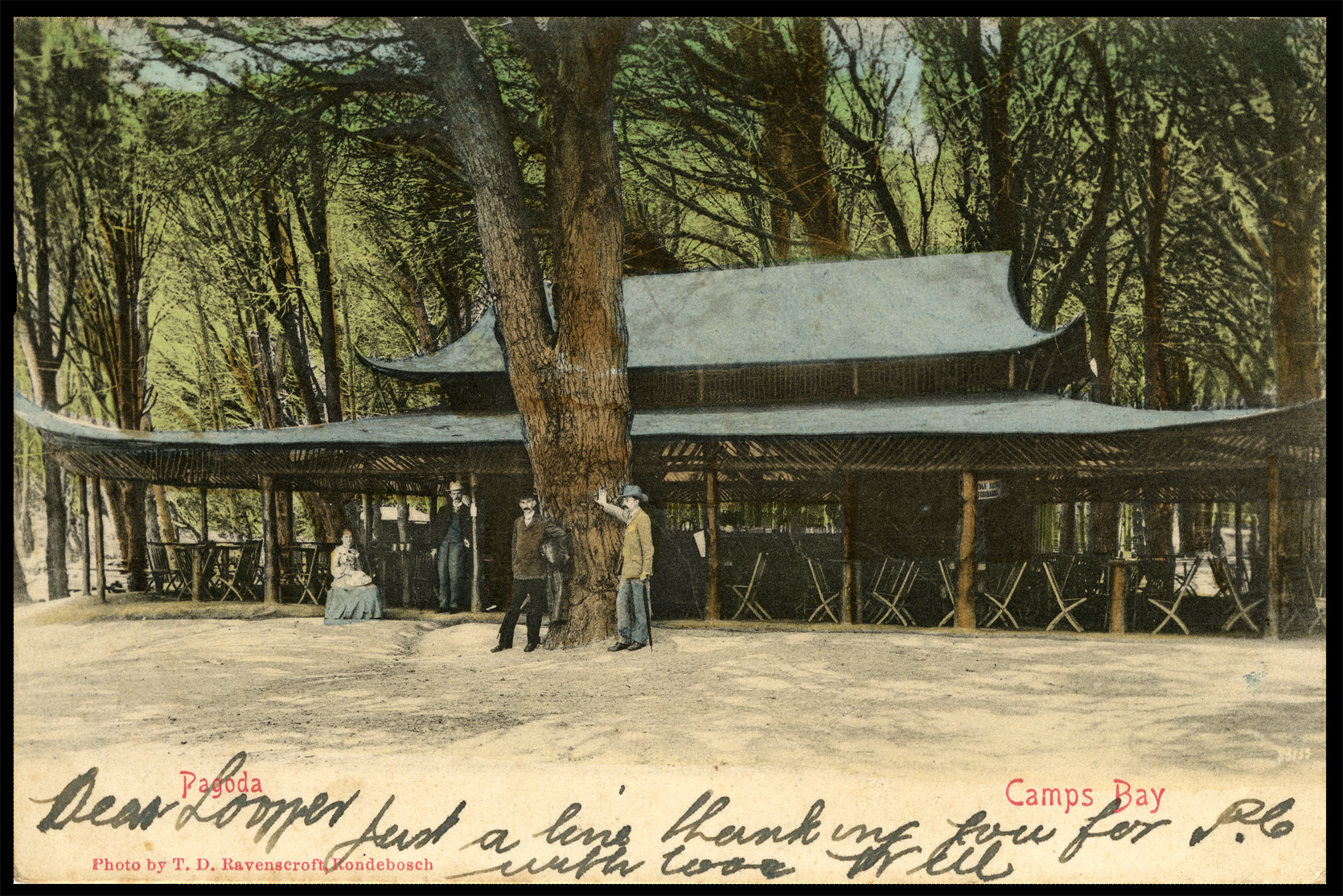
The near foreground around the hotel now looks more managed and kempt, almost terraced!The tall chimney that is visible in both the above postcards of Camps Bay belonged to the power station that generated electricity to run the local tram service connecting Cape Town and Camps Bay. You can see a tram in the foreground. There are postcards of the trams running over Kloof Nek, probably not a ride for the faint-hearted. Finally, while we are still at Camps Bay, what do you make of the very curious Camps Bay's Pagoda. I doubt it had much to do with the hotel. It could not have stood much of a chance in a north-wester gale!

The Rotunda Hotel, Camps Bay.
The Union Castle Year Book and Guide to Southern Africa lists two hotels in Camps Bay in 1956, the Camps Bay and Rotunda hotels. It says "the Bay is named after von Camptz who farmed this area in 1779". It is quite surprising that this popular area today remained so uninhabited for so long, some 120+ years, after the Dutch arrived just over the Nek in 1652 . However, just look at the dense thicket of 'bos' (Afr. bush) behind the Rotunda in the postcard below. Perhaps the impenetrable bush is one reason why development was delayed for so long? When Simon van der Stel mapped the Simon's Bay area in 1687 he had real difficulty getting through the coastal bush.
The building is said to be an early example of steel-frame construction in South Africa. This probably supported the round roof with central cupola. In its time the Rotunda has been used as a dance hall, a roller-skating rink and a music venue. In the late 60s or early 70s I heard either Coloured Rain or Freedom's Children perform there. My pal Brian Davison, ("Briany Boo" to Cheryl Adams, my Blue School crush), was the lead singer. We were tearaway teenagers together in Pinelands. Brian was from Strubens Road, Mowbray and hung out with us. He once, famously, bought a 'half-man can' of Witblits to a party, the real deal with the chicken poeping in the barrel. I recall Brian belting out Led Zeppelin's "Whole Lotta Love" in his distinctive way, using his voice as an instrument. He was amazing!
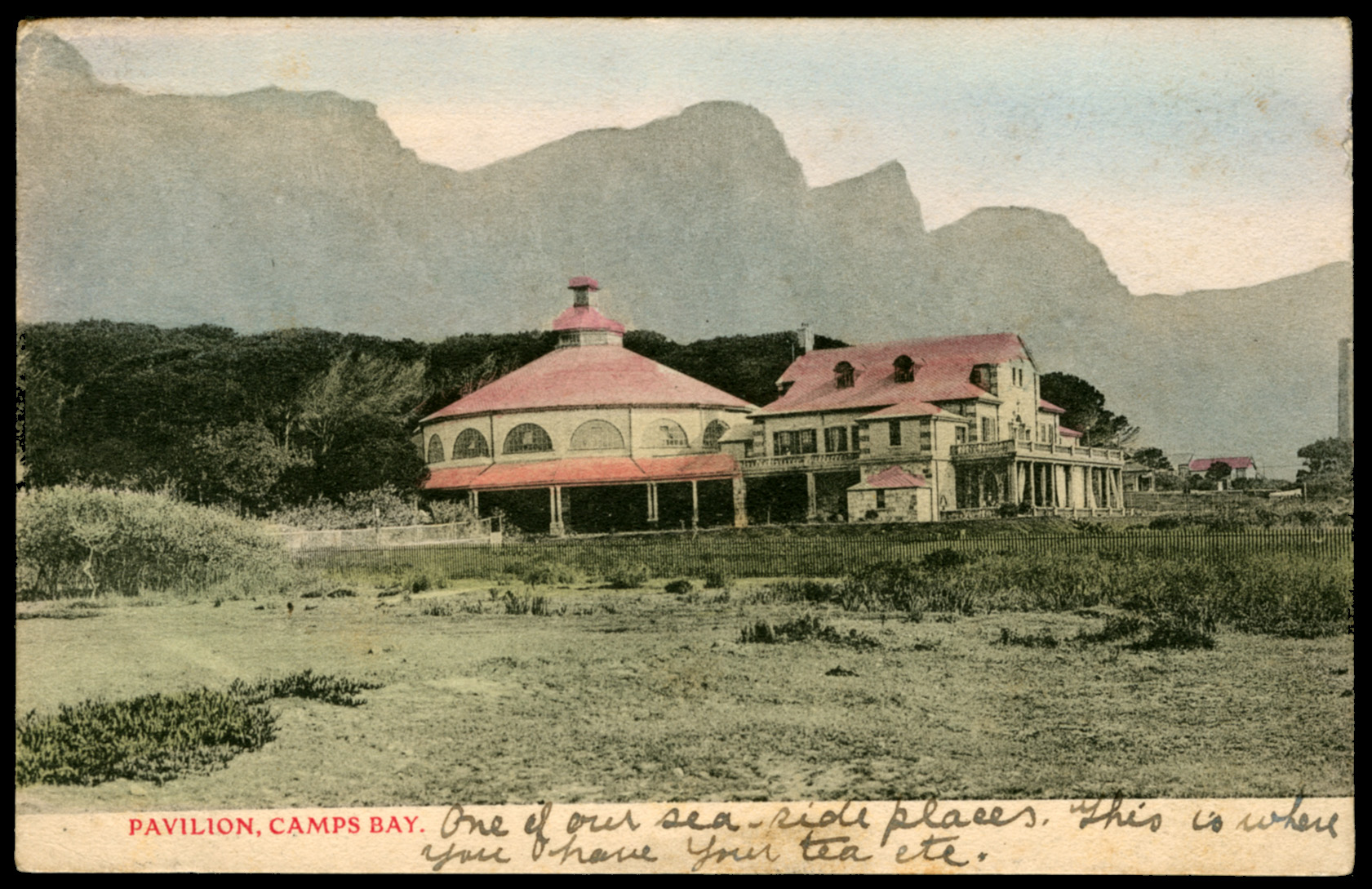
1913. Postcard. MOWBRAY 'MR 12 13' to SPALDING, LINCS.
Entitled, 'Pavilion, Camps Bay', we only ever knew the place as the 'Rotnda'.
I believe that this is a rare postcard as I have not yet seen another. The empty land is a property developer's dream. I vaguely recall that in the 60s and 70s the foreground may have been a car park and the green of a bowling club ("old man's marbles").
'The Rotunda' was built in 1904, was modified in 1910 and saved from property development and structurally repaired in the late 1980s. It is not known if the hotel was built at the same time. The Rotunda is built in a Florentine style while the adjoining hotel building is more your typical colonial era design. At some point the two structures were known collectively as 'The Rotunda Hotel'. Today the Rotunda is a part of the adjoining Bay Hotel, (the old Rotunda Hotel), and is used to host weddings and other swanky functions. It is still there but is no loger the cool alternative haunt of Cape Town's subterraneans! Today, Camp's Bay is hugely up-market. The Bay Hotel leads the charge! Psychedelia is out!! Those were the daze. Any gaps in my memory of the Rotunda in the 60s is due to the fact thar I was actually there, celebrated the moment and lived through it with a patchy tale to tell!
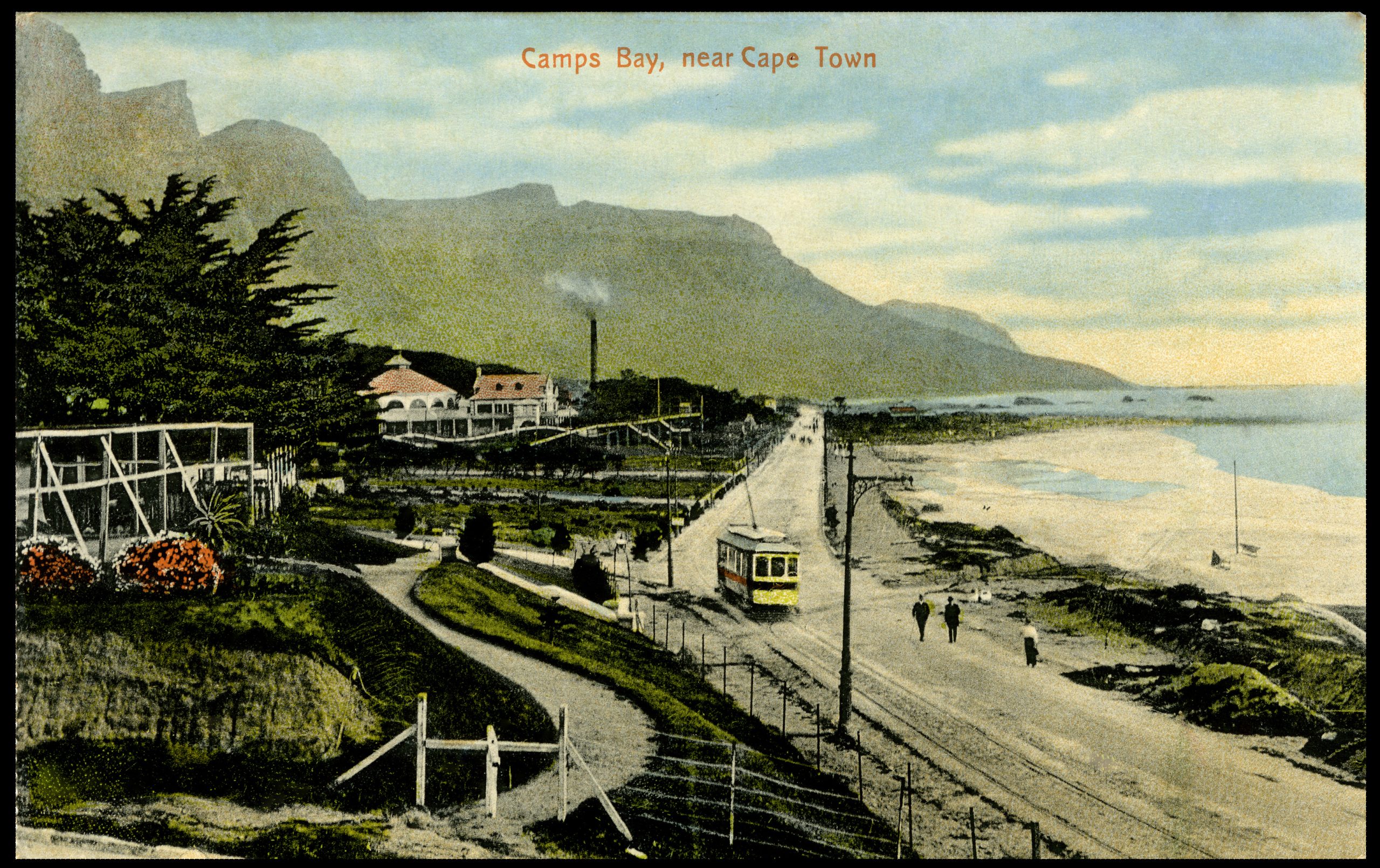
Circa 1905. Postcard. 'Camps Bay near Cape Town'. The Rotunda Hotel is seen centre left.
The near foreground around the hotel now looks more managed and kempt, almost terraced!
The tall chimney that is visible in both the above postcards of Camps Bay belonged to the power station that generated electricity to run the local tram service connecting Cape Town and Camps Bay. You can see a tram in the foreground. There are postcards of the trams running over Kloof Nek, probably not a ride for the faint-hearted. Finally, while we are still at Camps Bay, what do you make of the very curious Camps Bay's Pagoda. I doubt it had much to do with the hotel. It could not have stood much of a chance in a north-wester gale!
Quote from Steve on October 16, 2026, 2:26 pmClifton on Sea / Clifton Hotel
Clifton, Cape, is one of the few post offices in South Africa where no postmark has been recorded either by Putzel or Visser. Putzel lists a post office there (HO Cape Town) between 1912 - 1922 and a Telegraph Office from 1912 - 1927.
Circa 1906. Postcard. SEA POINT ''x x 14' to BRISTOL, GB.
(Clifton-on-Sea, CP. Valentine and Sons, Cape Town.)
This is presumablt the original hotel. The Tramline is on the upper road
Note the growth of beach shacks and cottages, etc.Clifton is probably Cape Town's most iconic beach. Any post on the Clifton Hotel, originally called Clifton-on-Sea Hotel, will very rapidly descend into reminisences about time spent on the beach. The fact is that not much can be found about the actual construction of the hotel by Samuel Blumenthall Mills in the 1890s. At that time all building materials would have been bought in by horse and cart, possibly by a steam tractor of some sort, from the railhead at Sea Point or a builder's merchant in Cape Town.
Like Bondi Beach in Australia where Ozzies unashamedly go to 'perve' on the other sex, Clifton's basic popularity stems from the same compulsion. Few go there to swim as the Atlantic is so cold it will propel a man's testicles upward into his body cavity for warmth. In the mid 1980s avant garde fashionista Cheryl Arthur edited 'Vula', a ground-breaking anti-apartheid magazine, (Xhosa. 'to open' or 'turn on'). It ran an amusing and risque article written by a South African woman - shock, horror - suggesting that some boys on Clifton beach put bananas in their speedos. Perhaps. It was that sort of place. Like the kelp and ozone on the beach where all was born, Clifton's combination of sun, sea, salty air, sand and sex induced a primal natural energy that left hedonistas atingle with vitality.
Circa 1902. Postcard. SALT RIVER 'JY 18 06' to LEYTON, GB..
(102. Clifton. T D Ravenscrofy, Rondebosh.)
Note that there are fewer bungalows to be seen. The hotel is in the cntre of the image.According to Putzel, the area was known in the 1700s as 'Schoenmakers Gat'. It was named after a shoemaker who lived in a cave where he repaired shoes. Some suggest he was a deserter from the VOC (Vereenigde Oostindische Compagnie or Dutch East India Company). This is unlikely as the VOC was a grim, authoritarian organisation liable to exercise the death penalty for desertion and other minor offences. Just 8km from central Kaapstad Clifton was never distant enough from VOC officialdom just over the Nek. Many runaway slaves and others took refuge at Cape Hangklip - and sometimes even that was not far enough!
Circa 1920. Postcard. Unused. (Clifton, near Cape Town. No. 5. Perry and Co. Cape Town.)
The cottages are mushrooming but there is no development above the road.
The Clifton Hotel is still the largest and most impressive building.In 1794, the Portuguese slave ship, São José Paquete Africa, carrying some 400 to 500 enslaved souls from Mozambique to Brazil, ran aground nearby. About 200 transportees died. The survivors were sold in Cape Town. Today there is a misconception that the biggest trader in slaves was the USA's southern Confederates. By far the biggest slaving nation was Portugal who shipped some 6m slaves to its Braziliam colony, the last country in the Western world to abolish slavery in 1888. Next time you are sunning yourself on Clifton Beach, try to imagine the washed up bodies of dead Madagascan slaves lying beside you.
Circa 1904. Postcard. WEST KENSINGTON, LONDON 'SP 11 06' to BIRKENHEAD. GB.
(Cape Town. Victoria Road and Clifton Hotel, Sea Point. Raphael Tuck and Son. Oilette. Wide World Series.)The reverse on the card states.: "The view depicts both the upper and lower road, lcading from Cape Town to Camps Bay. The upper is the route used by the Tramway Company, the journey to Camps Bay and thence to town again via the Kloof Nek, forming one of the prettiest tramway rides in the world. Nestled among the rocks, almost on the fore-shore itself, is the Clifton Hotel, from the balcony of which one breathes the pure ozone, whilst gazing on the vast expanse of water separating South Africa from home"
Clifton is s series of four beaches, five if you include Moses Beach, presumably named after the trickle of water that ran onto the beach and which allowed bullrushes to grow there. It was always my favourite beach, small and private and importantly shaded by boulders from the heat of the sun. The beaches were named in order of the proximity to Sea Point. The closest is First Beach, followed by Second and Third. The last and farthest out is Fourth Beach. Different people had their favourite beaches, usually one determined by proximity to the car park. Access to First Beach was difficult and worse on a hot day. Sea Point's jollers used to hang around the steps onto Second Beach and were known to us as as the 'Hole-in-the-Wall' gang.
Circa 1904. Postcard. CAPE TOWN '11 06 07' to TORONTO, CANADA. (G. B. & Co.)
This view is looking back to Sea Point. This is a relatively early view given the absence of shacks..
Moses Beach is just beyond the rocks painted red. The beach below the hotel is First Beach.
The tide is coming in.As can be seen in some postcards, the Clifton on Sea Hotel would appear to be the main building to be erected there. The area only became known as Clifton after the hotel was built, probably in the mid-to-late 1890s. The hotel was run by Bessie Clifton, The postcards suggest that the hotel preceded the tramway which was built along the road in 1902. At this time there was a tranway across the Nek from Cape Town to Camp's Bay, the next main beaach along the coastline. The postcards also reveal the growth of shacks, bungalows, cottages and beachouses. This was encouraged due to a shortage of housing after WW1.
Circa 1920. Moses Beach at Sunset, H Anderson.
Although this is untitled, I would recognise it anywhere!Historic pristine, primordial Clifton has disappeared today, cast beneath concrete high rises perched on cliffs, now the eyries of the super rich. The last time I was there Moses Beach had apparently disappeared under the weight of rubble from property development, trashed for 'Progress'. One of my most treasured possessions is this Anderson watercolour above of Moses Beach, painted in a bar from memory for a drink! I remember the rock in the foreground like it was yesterday. The tide is out.
Clifton on Sea / Clifton Hotel
Clifton, Cape, is one of the few post offices in South Africa where no postmark has been recorded either by Putzel or Visser. Putzel lists a post office there (HO Cape Town) between 1912 - 1922 and a Telegraph Office from 1912 - 1927.
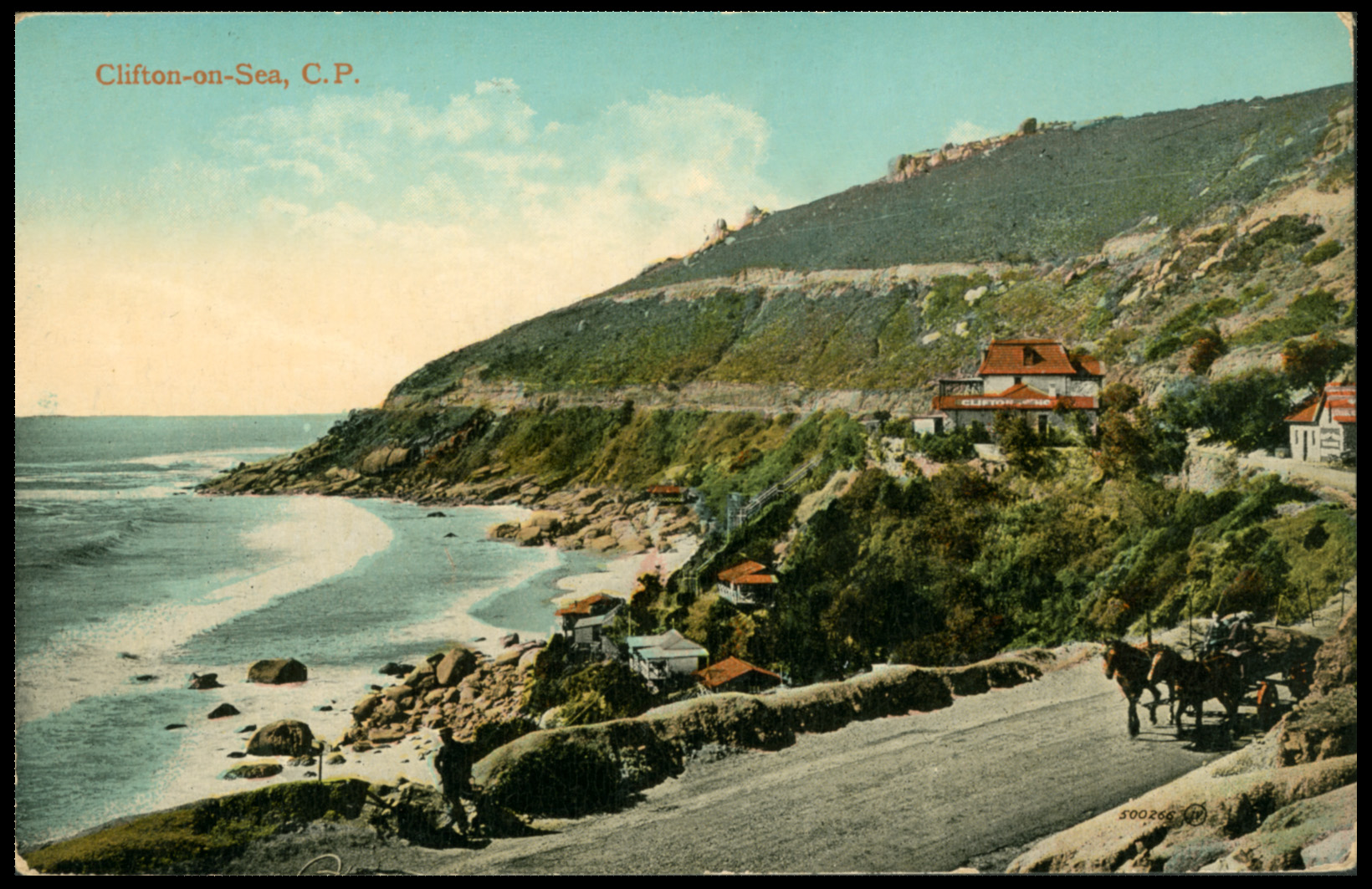
Circa 1906. Postcard. SEA POINT ''x x 14' to BRISTOL, GB.
(Clifton-on-Sea, CP. Valentine and Sons, Cape Town.)
This is presumablt the original hotel. The Tramline is on the upper road
Note the growth of beach shacks and cottages, etc.
Clifton is probably Cape Town's most iconic beach. Any post on the Clifton Hotel, originally called Clifton-on-Sea Hotel, will very rapidly descend into reminisences about time spent on the beach. The fact is that not much can be found about the actual construction of the hotel by Samuel Blumenthall Mills in the 1890s. At that time all building materials would have been bought in by horse and cart, possibly by a steam tractor of some sort, from the railhead at Sea Point or a builder's merchant in Cape Town.
Like Bondi Beach in Australia where Ozzies unashamedly go to 'perve' on the other sex, Clifton's basic popularity stems from the same compulsion. Few go there to swim as the Atlantic is so cold it will propel a man's testicles upward into his body cavity for warmth. In the mid 1980s avant garde fashionista Cheryl Arthur edited 'Vula', a ground-breaking anti-apartheid magazine, (Xhosa. 'to open' or 'turn on'). It ran an amusing and risque article written by a South African woman - shock, horror - suggesting that some boys on Clifton beach put bananas in their speedos. Perhaps. It was that sort of place. Like the kelp and ozone on the beach where all was born, Clifton's combination of sun, sea, salty air, sand and sex induced a primal natural energy that left hedonistas atingle with vitality.
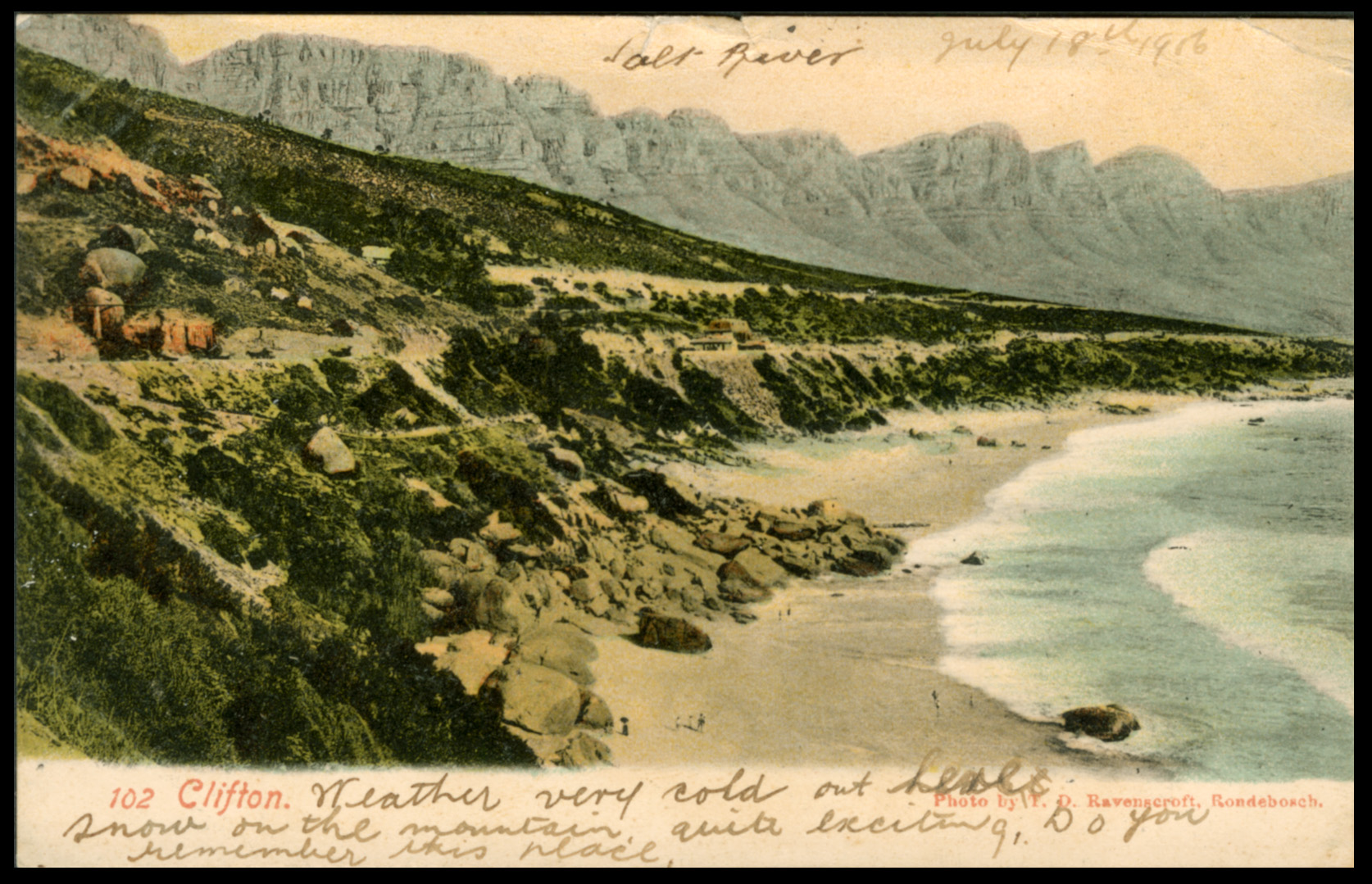
Circa 1902. Postcard. SALT RIVER 'JY 18 06' to LEYTON, GB..
(102. Clifton. T D Ravenscrofy, Rondebosh.)
Note that there are fewer bungalows to be seen. The hotel is in the cntre of the image.
According to Putzel, the area was known in the 1700s as 'Schoenmakers Gat'. It was named after a shoemaker who lived in a cave where he repaired shoes. Some suggest he was a deserter from the VOC (Vereenigde Oostindische Compagnie or Dutch East India Company). This is unlikely as the VOC was a grim, authoritarian organisation liable to exercise the death penalty for desertion and other minor offences. Just 8km from central Kaapstad Clifton was never distant enough from VOC officialdom just over the Nek. Many runaway slaves and others took refuge at Cape Hangklip - and sometimes even that was not far enough!
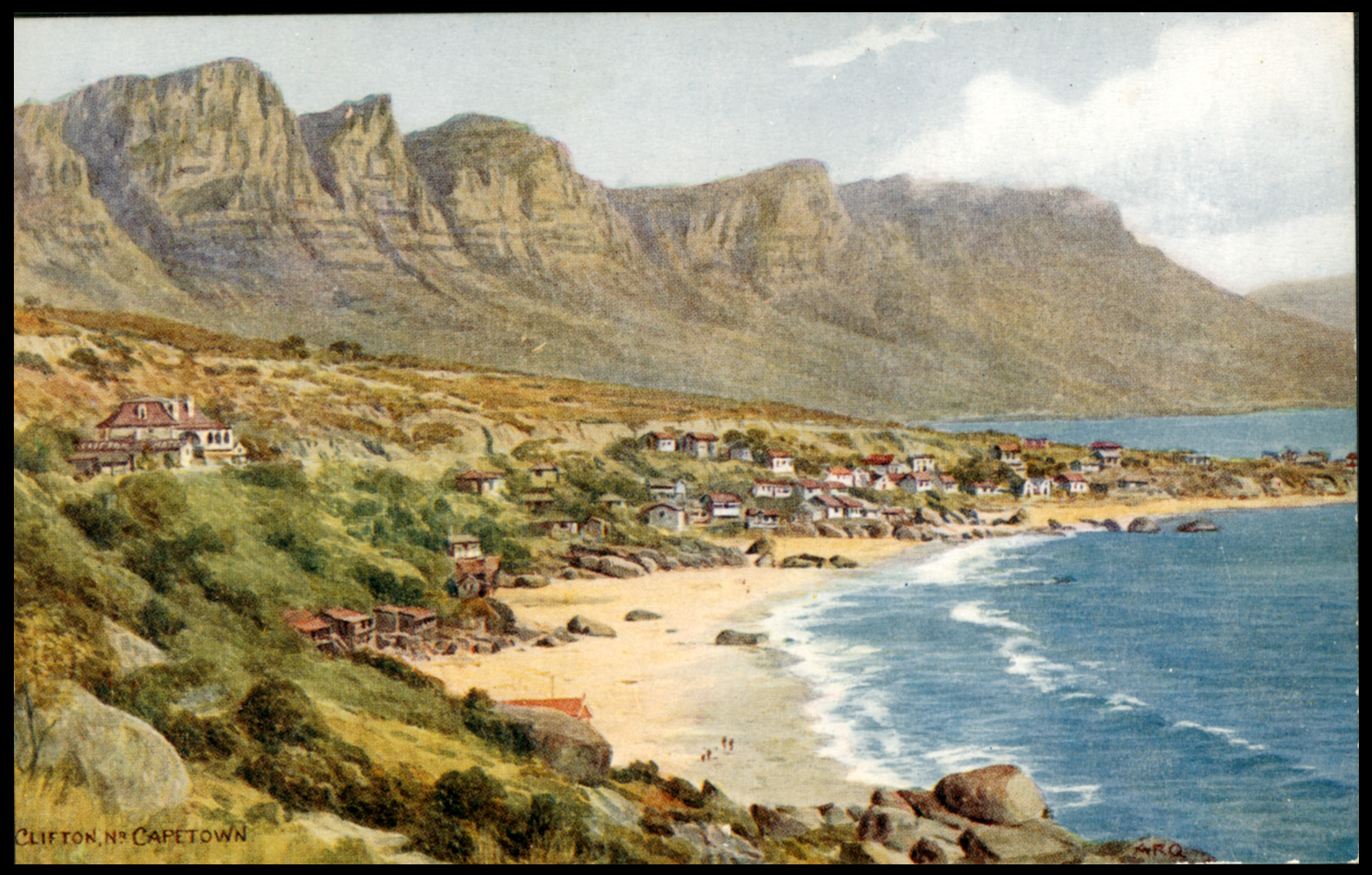
Circa 1920. Postcard. Unused. (Clifton, near Cape Town. No. 5. Perry and Co. Cape Town.)
The cottages are mushrooming but there is no development above the road.
The Clifton Hotel is still the largest and most impressive building.
In 1794, the Portuguese slave ship, São José Paquete Africa, carrying some 400 to 500 enslaved souls from Mozambique to Brazil, ran aground nearby. About 200 transportees died. The survivors were sold in Cape Town. Today there is a misconception that the biggest trader in slaves was the USA's southern Confederates. By far the biggest slaving nation was Portugal who shipped some 6m slaves to its Braziliam colony, the last country in the Western world to abolish slavery in 1888. Next time you are sunning yourself on Clifton Beach, try to imagine the washed up bodies of dead Madagascan slaves lying beside you.
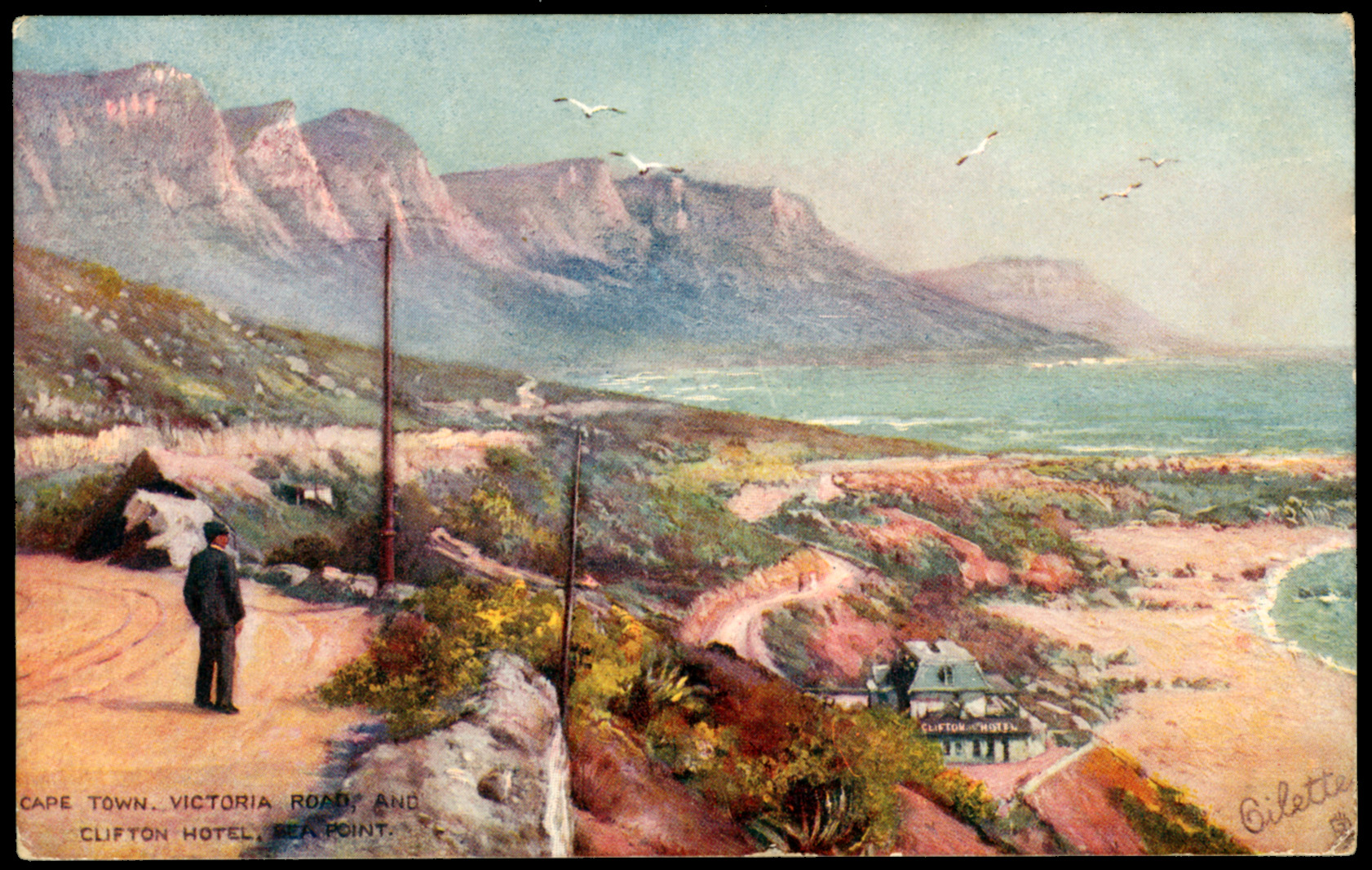
Circa 1904. Postcard. WEST KENSINGTON, LONDON 'SP 11 06' to BIRKENHEAD. GB.
(Cape Town. Victoria Road and Clifton Hotel, Sea Point. Raphael Tuck and Son. Oilette. Wide World Series.)
The reverse on the card states.: "The view depicts both the upper and lower road, lcading from Cape Town to Camps Bay. The upper is the route used by the Tramway Company, the journey to Camps Bay and thence to town again via the Kloof Nek, forming one of the prettiest tramway rides in the world. Nestled among the rocks, almost on the fore-shore itself, is the Clifton Hotel, from the balcony of which one breathes the pure ozone, whilst gazing on the vast expanse of water separating South Africa from home"
Clifton is s series of four beaches, five if you include Moses Beach, presumably named after the trickle of water that ran onto the beach and which allowed bullrushes to grow there. It was always my favourite beach, small and private and importantly shaded by boulders from the heat of the sun. The beaches were named in order of the proximity to Sea Point. The closest is First Beach, followed by Second and Third. The last and farthest out is Fourth Beach. Different people had their favourite beaches, usually one determined by proximity to the car park. Access to First Beach was difficult and worse on a hot day. Sea Point's jollers used to hang around the steps onto Second Beach and were known to us as as the 'Hole-in-the-Wall' gang.
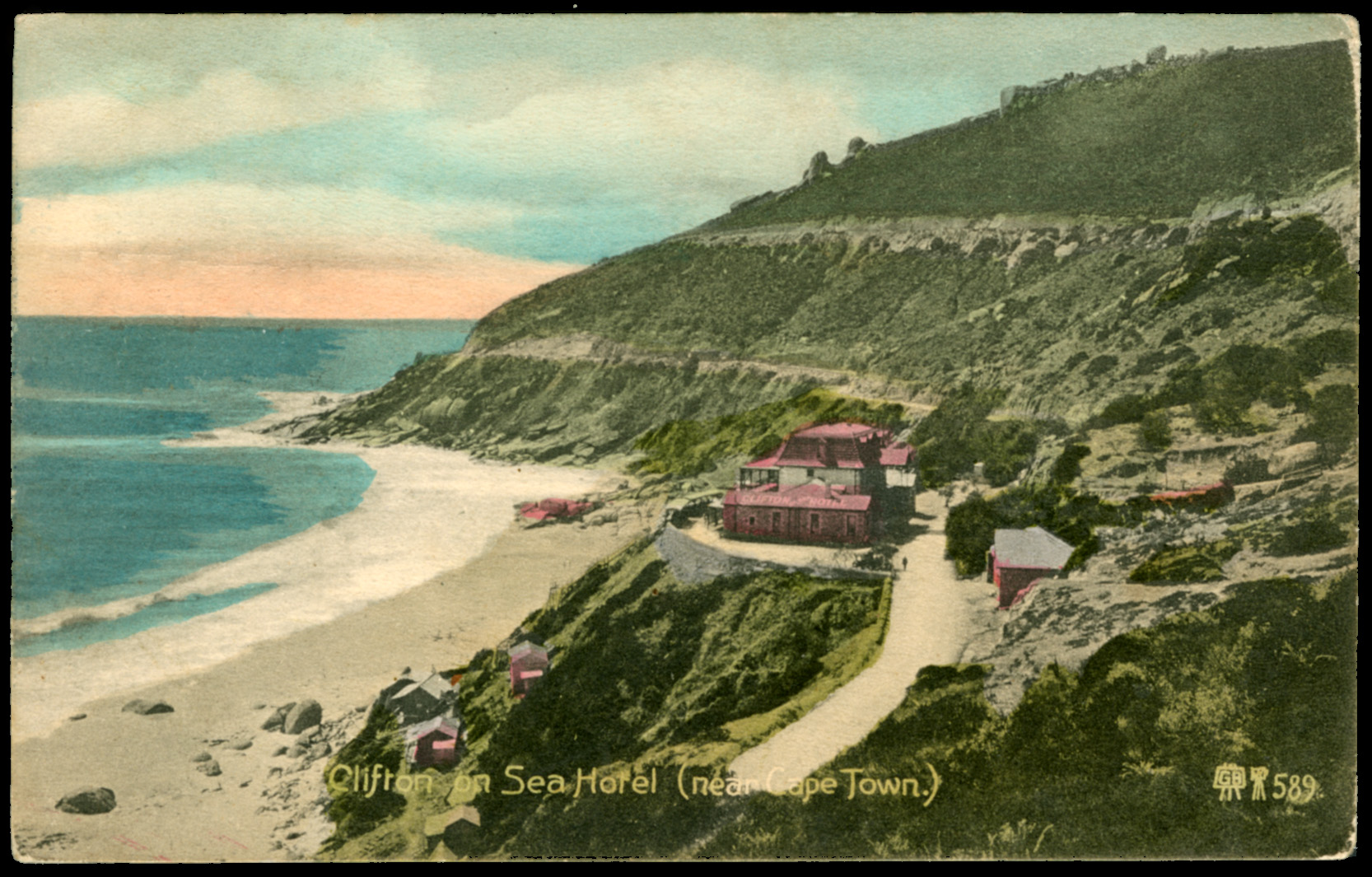
Circa 1904. Postcard. CAPE TOWN '11 06 07' to TORONTO, CANADA. (G. B. & Co.)
This view is looking back to Sea Point. This is a relatively early view given the absence of shacks..
Moses Beach is just beyond the rocks painted red. The beach below the hotel is First Beach.
The tide is coming in.
As can be seen in some postcards, the Clifton on Sea Hotel would appear to be the main building to be erected there. The area only became known as Clifton after the hotel was built, probably in the mid-to-late 1890s. The hotel was run by Bessie Clifton, The postcards suggest that the hotel preceded the tramway which was built along the road in 1902. At this time there was a tranway across the Nek from Cape Town to Camp's Bay, the next main beaach along the coastline. The postcards also reveal the growth of shacks, bungalows, cottages and beachouses. This was encouraged due to a shortage of housing after WW1.
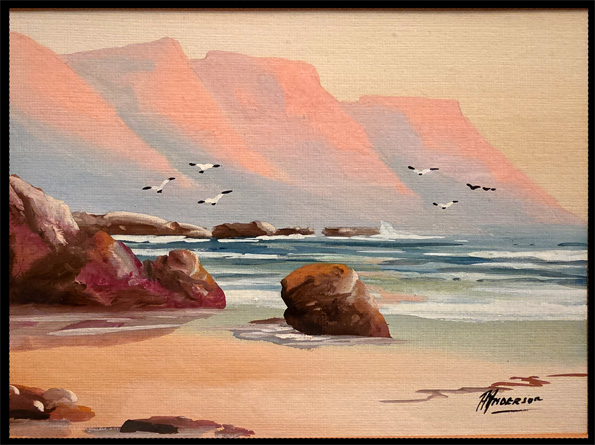
Circa 1920. Moses Beach at Sunset, H Anderson.
Although this is untitled, I would recognise it anywhere!
Historic pristine, primordial Clifton has disappeared today, cast beneath concrete high rises perched on cliffs, now the eyries of the super rich. The last time I was there Moses Beach had apparently disappeared under the weight of rubble from property development, trashed for 'Progress'. One of my most treasured possessions is this Anderson watercolour above of Moses Beach, painted in a bar from memory for a drink! I remember the rock in the foreground like it was yesterday. The tide is out.
Quote from Steve on October 18, 2026, 6:47 pmBeacon Island / Isle Hotel, Plettenberg Bay
There are several postcards from 'Plett' showing the Beascon Isle or Island Hotel. I will add more as I find them.
Set on a spit of land surrounded on three sides by the Indian Ocean it has always been a dramatically modern hotel, even before Sol Kerzner developed the latest incarnation. The Beacon Island Resort in Plettenberg Bay on the Garden Route has evolved from an early 18th-century navigational marker into a 19th-century whaling station before opening as a hotel in the early-mid 20th-century.
In 1771 a navigational aid and marker made of indigenous stinkwood, inscribed with the position's latitude and longitude, was placed on the island to help passing ships more accurately identify their position. This was replaced by a stone beacon in 1881 by a Captain Sewell. These two navigational markers gave Beacon Island its name. The original stone beacon has been repaired and altered several times over almost two centuries. What remains of the eponymous beacon can still be seen in the hotel grounds.
John Sinclair started commercial whaling in Plettenberg Bay in 1834. It passed through several hands until purchased by the wealthy Thesen family in 1908. The Thesens had made a small fortune building wooden ships in Knysna. They bought in seven Norwegian whaling steamers with crew and a house built in Norway for the operations manager, Captain Jacob Odland. When WW1 restricted the export of whale oil to Britain the industry suffered and became unprofitable at a time when the whale pods were decreasing. All whaling operations ceased in 1916 and the manager's Norwegian house became a boarding house for the next 20 years.
Circa 1950. Postcard. Unused. 'Beascon Island Hotel, Plettenberg Bay. CP'.
Presunably this is an item of Hotel Promotional Stationery.
Can anyone identify the car with the 'dicky seat' at rear?The house became knowen as Hopwood’s boarding house, a forerunner of the Angler’s Inn. It proved the attraction of Plettenberg Bay to holidaymakers and anglers. In 1938, the Department of Lands sold the island for £1,500 under the condition that all old structures be demolished and a new hotel built within five years. Hugh Owen Grant built the first Beacon Island Hotel on the site in 1940. This is the building shown in the postcard above. In 1972 the structure was demolished to make way for a more modern design. South Africa's famous 'Sun City' hotelier, Sol Kerzner, developed the site into a luxury resort. His six-story building opened in December 1972.
Beacon Island / Isle Hotel, Plettenberg Bay
There are several postcards from 'Plett' showing the Beascon Isle or Island Hotel. I will add more as I find them.
Set on a spit of land surrounded on three sides by the Indian Ocean it has always been a dramatically modern hotel, even before Sol Kerzner developed the latest incarnation. The Beacon Island Resort in Plettenberg Bay on the Garden Route has evolved from an early 18th-century navigational marker into a 19th-century whaling station before opening as a hotel in the early-mid 20th-century.
In 1771 a navigational aid and marker made of indigenous stinkwood, inscribed with the position's latitude and longitude, was placed on the island to help passing ships more accurately identify their position. This was replaced by a stone beacon in 1881 by a Captain Sewell. These two navigational markers gave Beacon Island its name. The original stone beacon has been repaired and altered several times over almost two centuries. What remains of the eponymous beacon can still be seen in the hotel grounds.
John Sinclair started commercial whaling in Plettenberg Bay in 1834. It passed through several hands until purchased by the wealthy Thesen family in 1908. The Thesens had made a small fortune building wooden ships in Knysna. They bought in seven Norwegian whaling steamers with crew and a house built in Norway for the operations manager, Captain Jacob Odland. When WW1 restricted the export of whale oil to Britain the industry suffered and became unprofitable at a time when the whale pods were decreasing. All whaling operations ceased in 1916 and the manager's Norwegian house became a boarding house for the next 20 years.
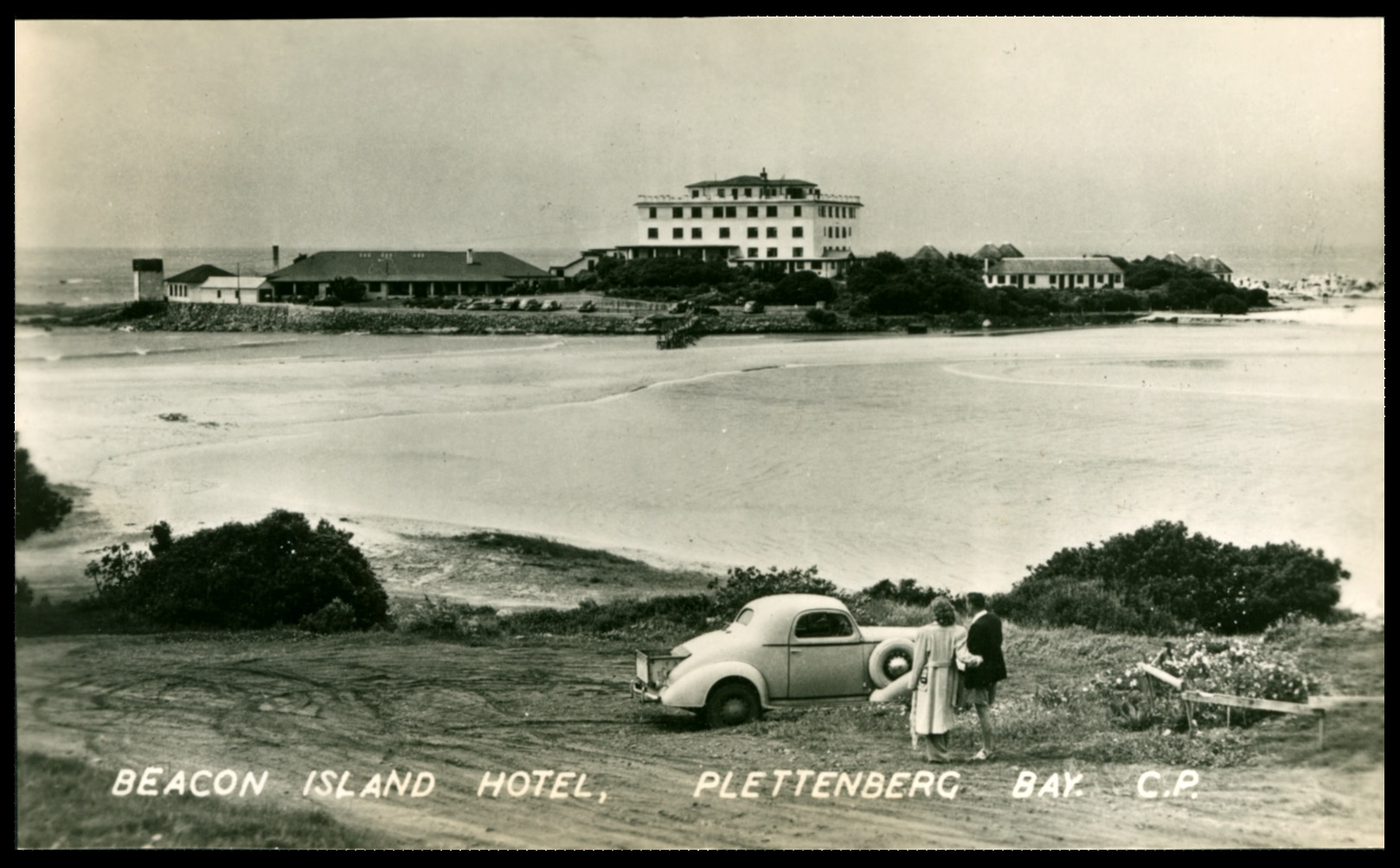
Circa 1950. Postcard. Unused. 'Beascon Island Hotel, Plettenberg Bay. CP'.
Presunably this is an item of Hotel Promotional Stationery.
Can anyone identify the car with the 'dicky seat' at rear?
The house became knowen as Hopwood’s boarding house, a forerunner of the Angler’s Inn. It proved the attraction of Plettenberg Bay to holidaymakers and anglers. In 1938, the Department of Lands sold the island for £1,500 under the condition that all old structures be demolished and a new hotel built within five years. Hugh Owen Grant built the first Beacon Island Hotel on the site in 1940. This is the building shown in the postcard above. In 1972 the structure was demolished to make way for a more modern design. South Africa's famous 'Sun City' hotelier, Sol Kerzner, developed the site into a luxury resort. His six-story building opened in December 1972.