Hotels of southern Africa
Quote from Steve on June 7, 2026, 6:59 amThe Marine Hotel, Cape Town
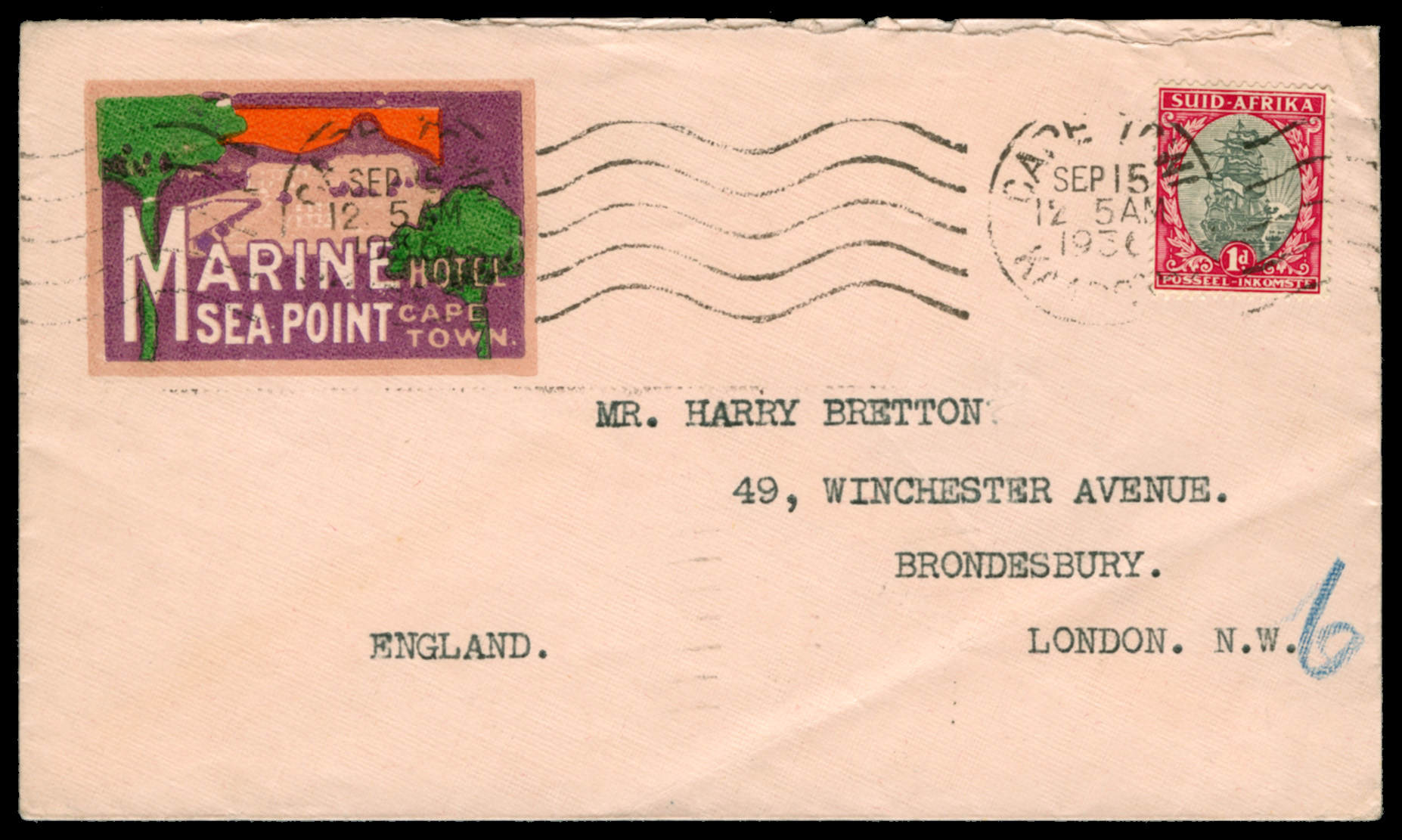
Below is another cover bought from Simon Peetoom (Africa Stamps) at the two day SACS Kenilworth meeting a week ago today. This one is slightly earlier, from September 1936. Clearly, what is most significant about this cover is the Cinderella label that is tied to it by a machine cancellation of 'SEP 15 CAPE TOWN / KAAPSTAD'. Sent Surface mail, it was received in LONDON '5 OCT 1936'
1936. Cover. CAPE TOWN 'SEP 15 1936' to LONDON '5 OCT 1936'.
The postage rate of 1d is correct for a Surface mail letter weighing less than half an ounce.
Marine Hotel label tied to the cover by CAPE TOWN / KAAPSTAD machine cancellation.The importance of stamps and labels being 'tied' to the cover by the cancellation is that it offers proof that this is genuine period use of a Cinderella, as the label above most unequivocally is. This label has not been added later by collectors or dealers wanting to embellish the cover with greater interest. (This would be a dull cover if not for the label.) Usually this sort of enhancement is done by dealers who want to 'improve' the cover in order to charge more for it. I know of one dealer who does this, most usually by adding Christmas labels to covers posted in December. He calls this act of fakery 'historic embellishment' and feels little or no guilt for doing so. Let the buyer beware, he believes.
The Marine Hotel in Sea Point, Cape Town, was, according to the indispensable 1956 'Union Castle Year Book and Guide to Southern Africa'. "a grand, Edwardian-era establishment that dominated the Beach Road promenade during the late 19th and early 20th centuries". Alongside the neighboring Queens Hotel, it was a social hub on Cape Town's northern Cape beachfront. Tea gardens, bars, restaurants, ice=cream parlours and a bustling dancehall scene gave Sea Point all in terms of sea, sun and late night entertainment.
Located on the lively Beach Road Promenade, the Marine Hotel operated as a glamorous resort-style accommodation popular with holidaymakers and locals. It sat alongside other notable social spots like the Adelphi, Arthur's Seat, Bordeaux, Clarensville, Elizabeth, Esplanade, King's, Marseille, Millroy, Mimosas, Ocean View, Queens and Seacliffe Hotels. In the 1930s and 40s a shift to high-rise apartments (flats in SA!) saw developers to convert and replace the grand and gracious Victorian / Edwardian homes and hotels of Beach Road with modern buildings that attempted to emulate Rio de Janeiro. The Marine Hotel was torn down in the 1960s. Today, the site and its surrounding area comprise many run-down high-density residential apartment blocks that await future redevlopment.
The Marine Hotel, Cape Town
Below is another cover bought from Simon Peetoom (Africa Stamps) at the two day SACS Kenilworth meeting a week ago today. This one is slightly earlier, from September 1936. Clearly, what is most significant about this cover is the Cinderella label that is tied to it by a machine cancellation of 'SEP 15 CAPE TOWN / KAAPSTAD'. Sent Surface mail, it was received in LONDON '5 OCT 1936'
1936. Cover. CAPE TOWN 'SEP 15 1936' to LONDON '5 OCT 1936'.
The postage rate of 1d is correct for a Surface mail letter weighing less than half an ounce.
Marine Hotel label tied to the cover by CAPE TOWN / KAAPSTAD machine cancellation.
The importance of stamps and labels being 'tied' to the cover by the cancellation is that it offers proof that this is genuine period use of a Cinderella, as the label above most unequivocally is. This label has not been added later by collectors or dealers wanting to embellish the cover with greater interest. (This would be a dull cover if not for the label.) Usually this sort of enhancement is done by dealers who want to 'improve' the cover in order to charge more for it. I know of one dealer who does this, most usually by adding Christmas labels to covers posted in December. He calls this act of fakery 'historic embellishment' and feels little or no guilt for doing so. Let the buyer beware, he believes.
The Marine Hotel in Sea Point, Cape Town, was, according to the indispensable 1956 'Union Castle Year Book and Guide to Southern Africa'. "a grand, Edwardian-era establishment that dominated the Beach Road promenade during the late 19th and early 20th centuries". Alongside the neighboring Queens Hotel, it was a social hub on Cape Town's northern Cape beachfront. Tea gardens, bars, restaurants, ice=cream parlours and a bustling dancehall scene gave Sea Point all in terms of sea, sun and late night entertainment.
Located on the lively Beach Road Promenade, the Marine Hotel operated as a glamorous resort-style accommodation popular with holidaymakers and locals. It sat alongside other notable social spots like the Adelphi, Arthur's Seat, Bordeaux, Clarensville, Elizabeth, Esplanade, King's, Marseille, Millroy, Mimosas, Ocean View, Queens and Seacliffe Hotels. In the 1930s and 40s a shift to high-rise apartments (flats in SA!) saw developers to convert and replace the grand and gracious Victorian / Edwardian homes and hotels of Beach Road with modern buildings that attempted to emulate Rio de Janeiro. The Marine Hotel was torn down in the 1960s. Today, the site and its surrounding area comprise many run-down high-density residential apartment blocks that await future redevlopment.
Quote from Steve on June 9, 2026, 5:36 pmNew Park Hotel, Bethlehem, OFS.
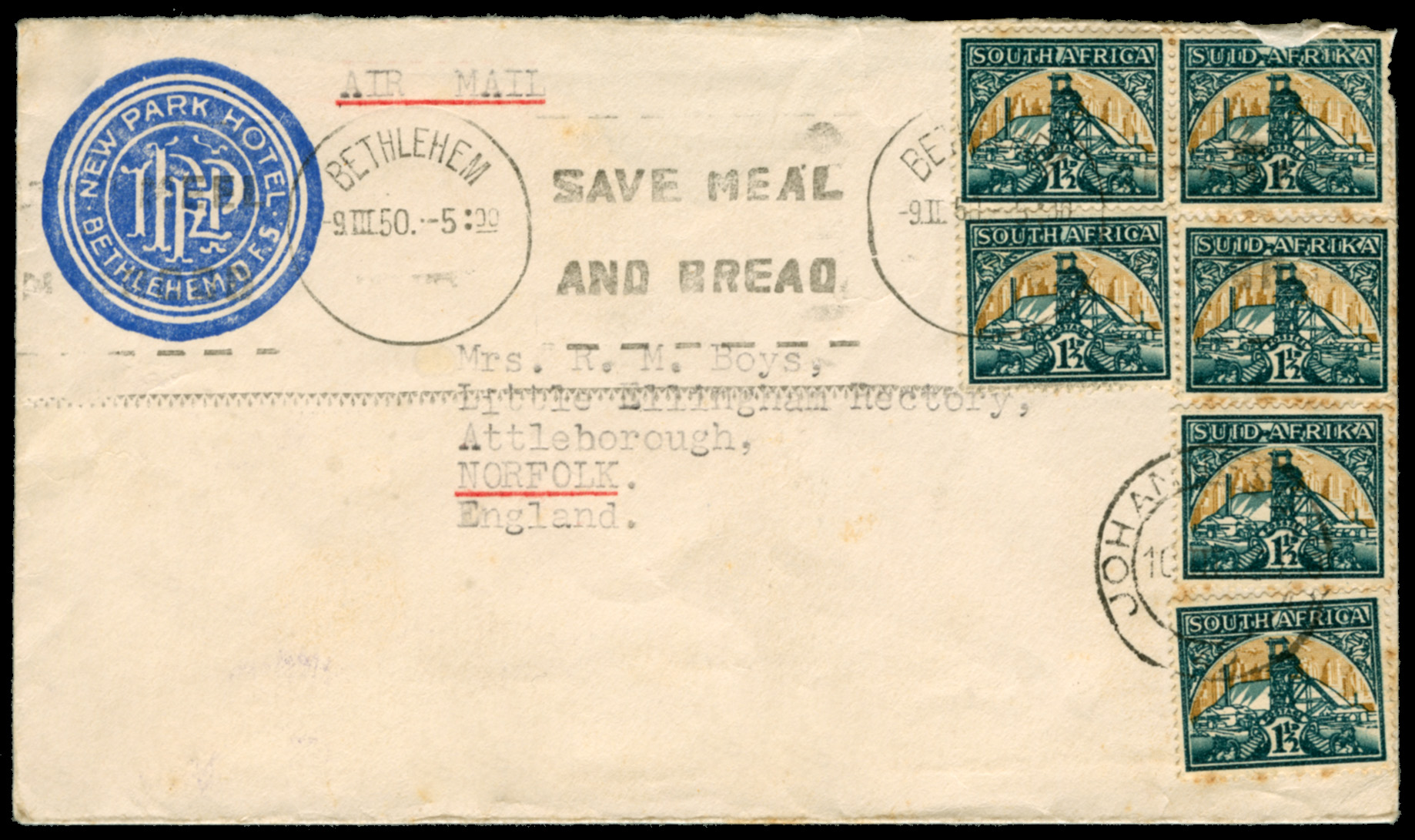
Unlike the preceding Marine Hotel, Sea Point, cover, the one below does not show a label / Cinderella. It is a printed envelope.
1950. Advertising Cover. Airmail. BETHELEM '9 III 50' to ATTLEBOROUGH, GB. (Undated).
Six 1941 Union reduced-size 1½d definitives (not Bantams) make up an Airmail rate of 9d.
Cancelled with a BETHLEHEM bilingual slogan machine canceller 'SAVE MEAL AND BREAD'.
Transited via JOHANNESBURG '10 MAR 50'.There is not much easily found information on this hotel other than a comment that "it dates back to the 1920s". This was a time when the rural areas of the OFS were getting back on their feet again after the devastation of the South African War (1899 - 1902).
New Park Hotel, Bethlehem, OFS.
Unlike the preceding Marine Hotel, Sea Point, cover, the one below does not show a label / Cinderella. It is a printed envelope.
1950. Advertising Cover. Airmail. BETHELEM '9 III 50' to ATTLEBOROUGH, GB. (Undated).
Six 1941 Union reduced-size 1½d definitives (not Bantams) make up an Airmail rate of 9d.
Cancelled with a BETHLEHEM bilingual slogan machine canceller 'SAVE MEAL AND BREAD'.
Transited via JOHANNESBURG '10 MAR 50'.
There is not much easily found information on this hotel other than a comment that "it dates back to the 1920s". This was a time when the rural areas of the OFS were getting back on their feet again after the devastation of the South African War (1899 - 1902).
Quote from Steve on June 16, 2026, 9:44 amFairy Knowe Hotel, Wilderness.
'Fairy knowe' is a Scottish term which refers to small hills where fairies are thought to live. A fairy knowe in Scotland is typically a small hillock, often wooded with mature deciduous trees. There is usually some archaeological feature like a stone, a slab, a well or a tree, associated with them. The fairy knowes are thought to be entrances into a mystical realm, a private domain which the fairies fiercely protect. The fairies are most “active” during dawn and twilight. In some countries, like Ireland, fairies are feared for bringing bad luck.
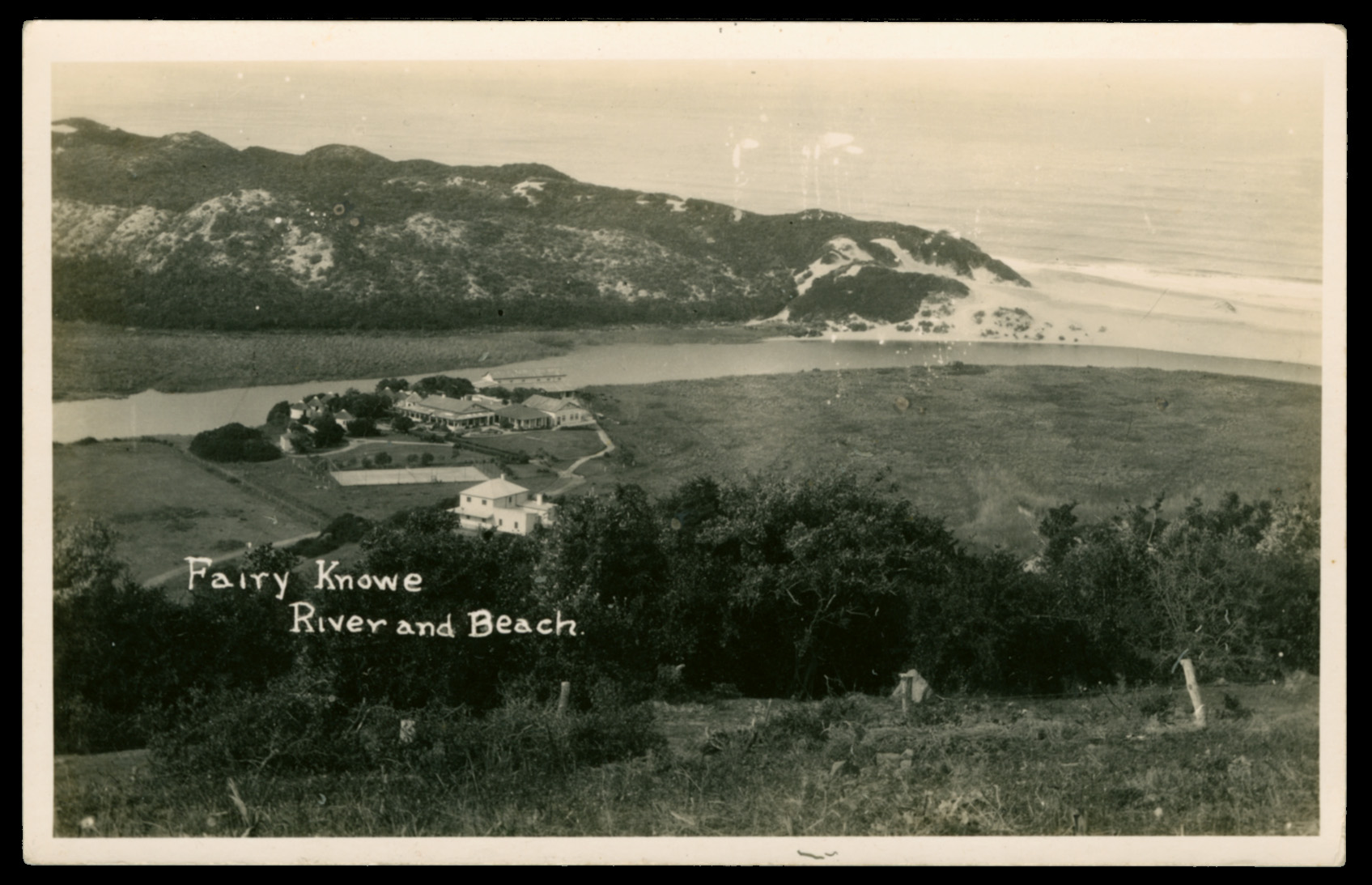
Circa 1940. Real Photo Postcard. Unused. Fairy Knowe River and Beach. (R Jennings, Chemist, Hibernia Street, George.)
The building is presumably the Fairy Knowe Hotel with rondawels, a tennis court and a verandah roof painted 'BAR'.The Fairy Knowe Hotel is situated on the banks of the Touws River estuary in the Wilderness National Park Lake District. This Park is a protected area on the Garden Route in the Western Cape between George (where the postcard above was sold) and Knysna (where the letter below was posted). The area features a network of rivers, estuaries, and five major lakes fringed by indigenous forests, once all a part of the single great magical Knysna forest. Today locals who believe in fairies claim elephants still live in the forest's remoter depths.
The Fairy Knowe Hotel has been affectionately referred to as ‘the grand dame’ of Wilderness. It has been welcoming guests since 1924. It was renovated in 2021 and accordeing to its PR people is looking gracious and glorious once again! A 20-minute drive from George the hotel provides a well=placed base from which to explore the Garden Route's beaches, forests, lakes and golf courses and hiking trails. The hotel is a birders paradise with over 280 species to be found here, including the Knysna Loerie which is a regular visitor.
1941. Airmail Cover. Fairey Knowe Hotel Stationery. KNYSNA '25 VII 41' to ELMINA, GOLD COAST 'undated'.
The 'RAC Appointed Hotel' logo suggests the pre-war era of touring South Africa by motor car.
Posted wartime airmail to Gold Coast (Ghana) at 1/- 3d.
Fairy Knowe Hotel, Wilderness.
'Fairy knowe' is a Scottish term which refers to small hills where fairies are thought to live. A fairy knowe in Scotland is typically a small hillock, often wooded with mature deciduous trees. There is usually some archaeological feature like a stone, a slab, a well or a tree, associated with them. The fairy knowes are thought to be entrances into a mystical realm, a private domain which the fairies fiercely protect. The fairies are most “active” during dawn and twilight. In some countries, like Ireland, fairies are feared for bringing bad luck.
Circa 1940. Real Photo Postcard. Unused. Fairy Knowe River and Beach. (R Jennings, Chemist, Hibernia Street, George.)
The building is presumably the Fairy Knowe Hotel with rondawels, a tennis court and a verandah roof painted 'BAR'.
The Fairy Knowe Hotel is situated on the banks of the Touws River estuary in the Wilderness National Park Lake District. This Park is a protected area on the Garden Route in the Western Cape between George (where the postcard above was sold) and Knysna (where the letter below was posted). The area features a network of rivers, estuaries, and five major lakes fringed by indigenous forests, once all a part of the single great magical Knysna forest. Today locals who believe in fairies claim elephants still live in the forest's remoter depths.
The Fairy Knowe Hotel has been affectionately referred to as ‘the grand dame’ of Wilderness. It has been welcoming guests since 1924. It was renovated in 2021 and accordeing to its PR people is looking gracious and glorious once again! A 20-minute drive from George the hotel provides a well=placed base from which to explore the Garden Route's beaches, forests, lakes and golf courses and hiking trails. The hotel is a birders paradise with over 280 species to be found here, including the Knysna Loerie which is a regular visitor.
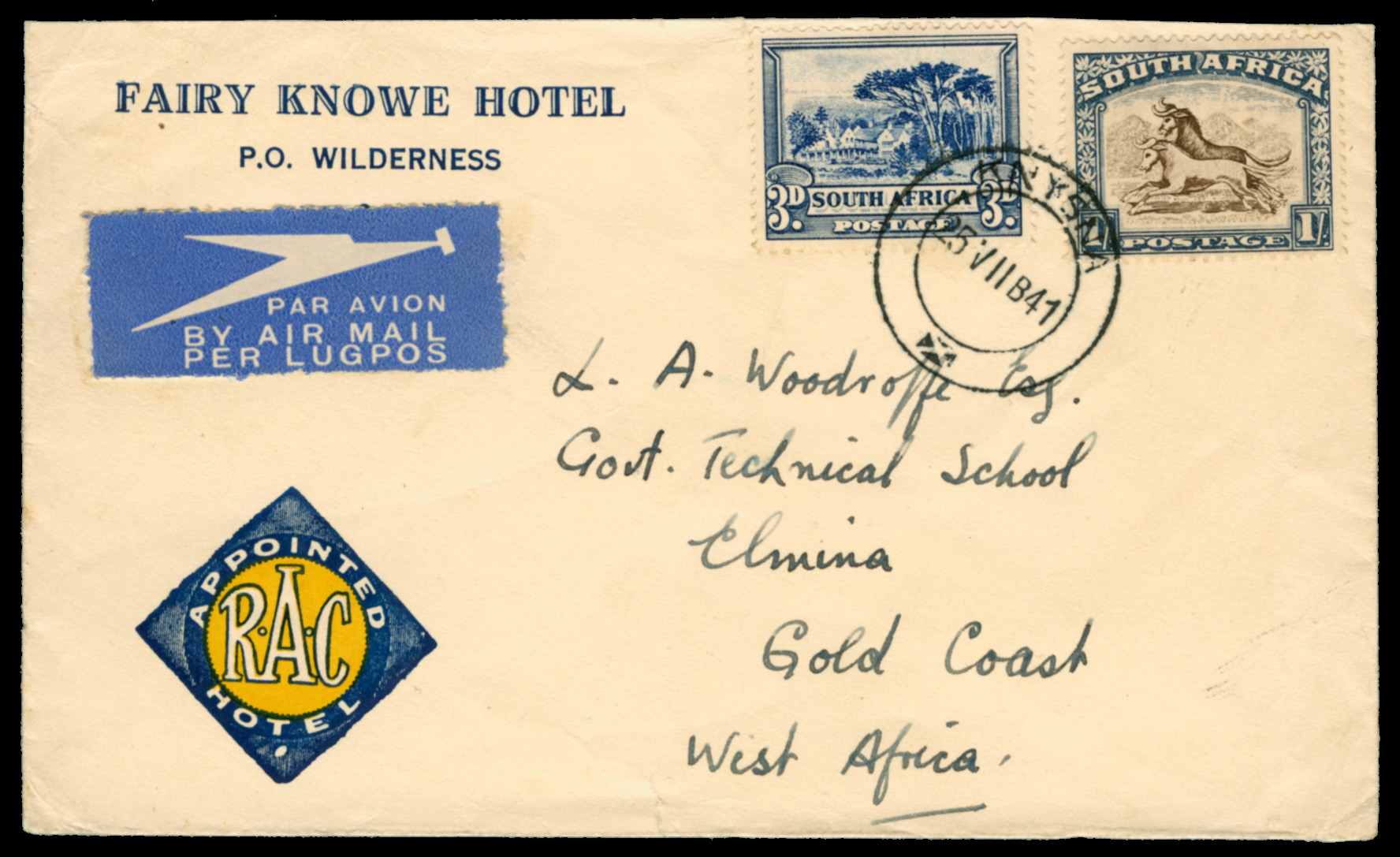
1941. Airmail Cover. Fairey Knowe Hotel Stationery. KNYSNA '25 VII 41' to ELMINA, GOLD COAST 'undated'.
The 'RAC Appointed Hotel' logo suggests the pre-war era of touring South Africa by motor car.
Posted wartime airmail to Gold Coast (Ghana) at 1/- 3d.
Quote from Steve on June 17, 2026, 9:57 amMarine Hotel, Humewood, Port Elizabeth
Port Elizabeth was founded in the Eastern Cape by the British in 1820, 170 years after the Dutch started a replishment station at 'de Kaap', later Cape Town in the Western Cape. PE (Port Elizabeth) lies 400 miles (650 km) north-east of Cape Town and is well-placed as a port with a much shorter route into the South African interior. It developed slowly at first but by 1860 it was the Easten Cape's largest city and the Cape Colony’s most important port.
PE was a major point of entry for immigrants, the military and missionaries. The discovery of diamonds in Kimberley in 1866 spurred the construction of railways from PE to deliver imported machinery and manufactured goods to exploit this wealth. As South Africa industrialised, so PE became an Eastern Cape industrial powerhouse, a centre for unionised labour and anti-segregationist policies. However, as its nickname of the 'Windy City' suggests, it was never South Africa's most popular Indian Ocean beach and holiday resort.
1956. Advertisement. Union Castle Line Yearbook and Guide to Southern Africa.
Port Elizabeth Publicity Association, City Hall, PO Box 357, Port Elizabeth.The British Settlers came ashore in Algoa Bay where the town of PE developed aroond Fort Frederick, a defence intended to deter the French rather than the region's displaced Xhosa tribesmen. Today PE has been officially renamed Gqeberha, a Xhosa word that refers to the Dutch-named Baakens River that flows through the city. Algoa Bay retains its old Portuguese name and should not be confused with the Nelson Mandela Bay Metropolitan Municipality which broadly encompasses both the city and its bay area.
But back in the 1950s.... the PE Publicity Association is attempting to get people to visit 'the Friendly City'.
1959. Airmail Letter. PORT ELIZABETH 101 '1 X 59' to PARIS, FRANCE '5 OCT 59'.
Posted airmail to France at a 1/- 6d postage rate.The 1956 Union Castle Line Yearbook and Guide to Southern Africa lists the Marine Hotel at Summerstrand "beyond Humewood". Is this, perhaps, a case of the Marine Hotel wanting to appear closer to the centre of town?
Marine Hotel, Humewood, Port Elizabeth
Port Elizabeth was founded in the Eastern Cape by the British in 1820, 170 years after the Dutch started a replishment station at 'de Kaap', later Cape Town in the Western Cape. PE (Port Elizabeth) lies 400 miles (650 km) north-east of Cape Town and is well-placed as a port with a much shorter route into the South African interior. It developed slowly at first but by 1860 it was the Easten Cape's largest city and the Cape Colony’s most important port.
PE was a major point of entry for immigrants, the military and missionaries. The discovery of diamonds in Kimberley in 1866 spurred the construction of railways from PE to deliver imported machinery and manufactured goods to exploit this wealth. As South Africa industrialised, so PE became an Eastern Cape industrial powerhouse, a centre for unionised labour and anti-segregationist policies. However, as its nickname of the 'Windy City' suggests, it was never South Africa's most popular Indian Ocean beach and holiday resort.
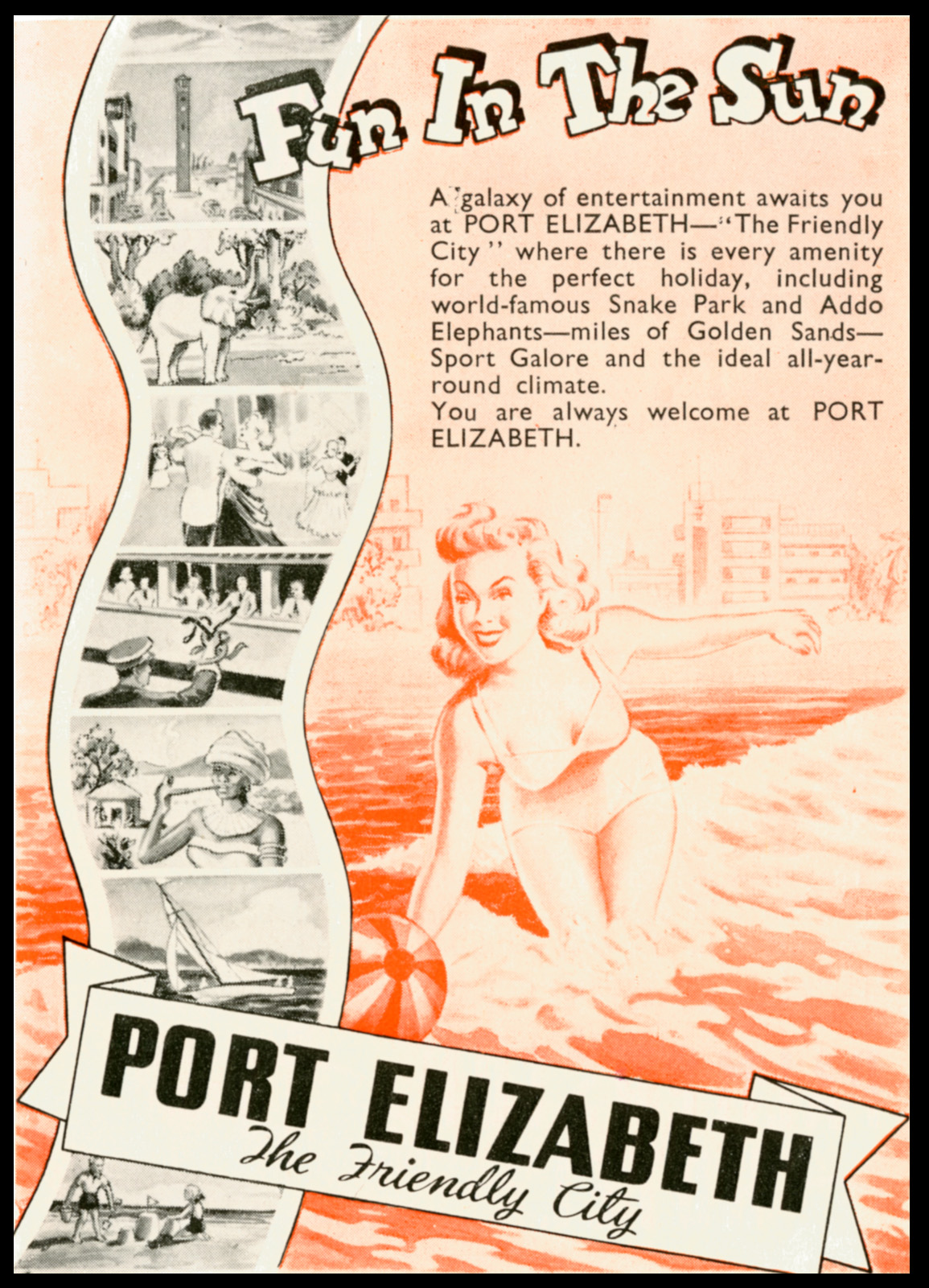
1956. Advertisement. Union Castle Line Yearbook and Guide to Southern Africa.
Port Elizabeth Publicity Association, City Hall, PO Box 357, Port Elizabeth.
The British Settlers came ashore in Algoa Bay where the town of PE developed aroond Fort Frederick, a defence intended to deter the French rather than the region's displaced Xhosa tribesmen. Today PE has been officially renamed Gqeberha, a Xhosa word that refers to the Dutch-named Baakens River that flows through the city. Algoa Bay retains its old Portuguese name and should not be confused with the Nelson Mandela Bay Metropolitan Municipality which broadly encompasses both the city and its bay area.
But back in the 1950s.... the PE Publicity Association is attempting to get people to visit 'the Friendly City'.
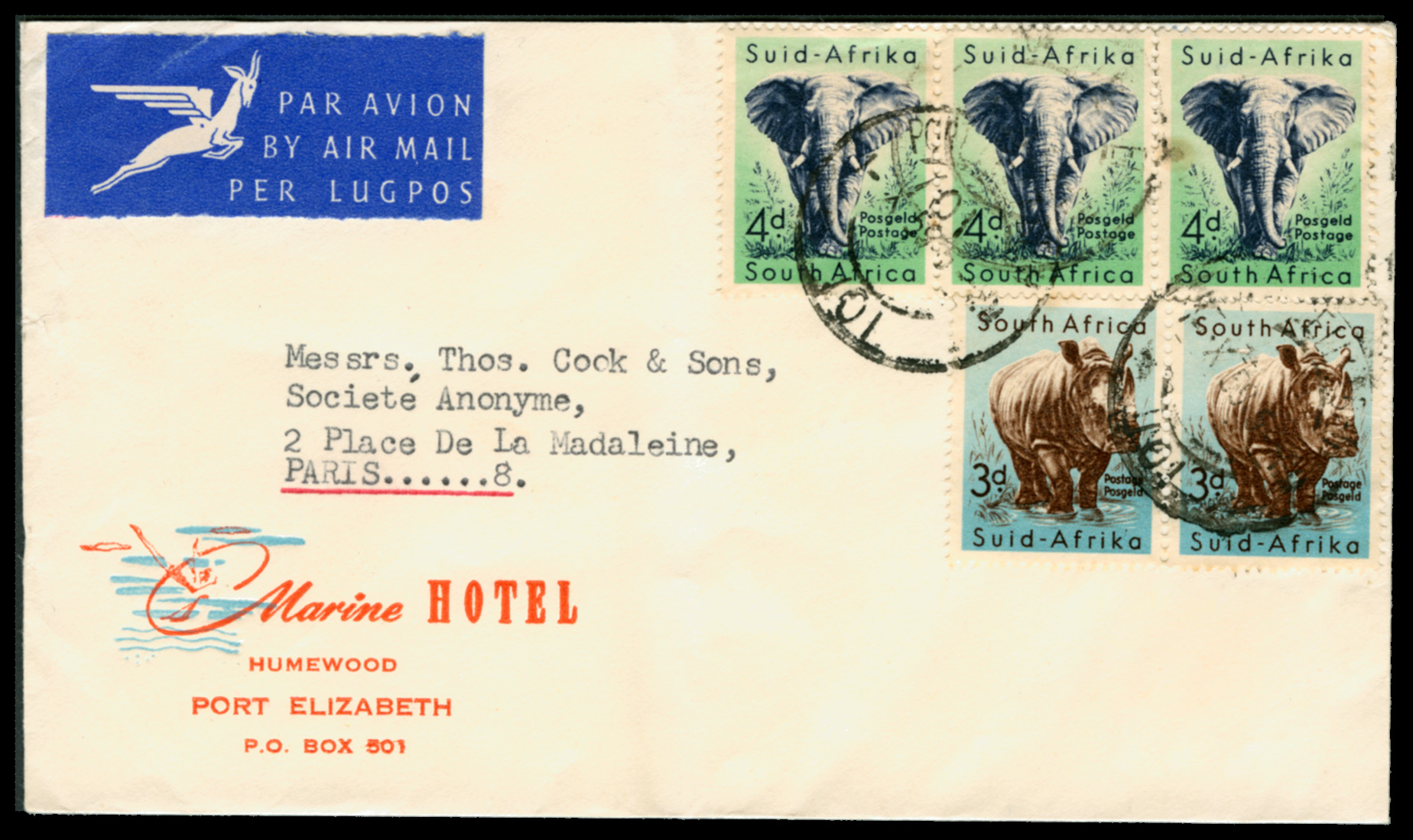
1959. Airmail Letter. PORT ELIZABETH 101 '1 X 59' to PARIS, FRANCE '5 OCT 59'.
Posted airmail to France at a 1/- 6d postage rate.
The 1956 Union Castle Line Yearbook and Guide to Southern Africa lists the Marine Hotel at Summerstrand "beyond Humewood". Is this, perhaps, a case of the Marine Hotel wanting to appear closer to the centre of town?
Quote from Steve on June 20, 2026, 11:19 amGrand National Hotel, Johannesburg.
1923. Letter. JOHANNESBURG 2 '7AUG 23' to LLANDUDNO. WALES.
Posted at the 2d Surface Mail rate.This historic Johannesburg hotel was built relatively early in the City of Gold's life between 1888 - 1889. It is apparemtlunamed after the the racecourse at Aintree near Liverpool, England. Ther name possibly explains one of the more madcap events in the life of the hotel when "a well-known gentleman .... rode his skittish pony up the stairs for a wager. The pony would not look at the stairs so the rider set spurs into it and it charged the bar. Two ladies fainted and a scene of indescribable excitement ensued, the fair customers of the bar being terror-stricken at the spectacle.” (Rand Rush.) No, doubt, the gentelman won his wager and a good laugh was had by him and his pals.
The curious armorial shield of the Grand National on the reverse of the letter above.
Classically English with helmet, shield and crenallated castle, it includes a ZAR eagle (?) with outstretched wings.The Grand National stood at 50 - 54 Rissik Street on the corner with Kerk Street, although some sources say this was the northwest corner of Pritchard and Rissk Streets in 1888 - 1891. Designed by J. S. Donaldson, the hotel was situated in Johannesburg's shopping district. As a result, this three-storey building featured stores on the ground floor. Most notably, Turner’s Drug Store prominently occupied the corner shop for many years. The hotel rooms were upstairs and in the attic. After the Kerk Street extension was made there were 100 rooms, three drawing rooms, a ladies’ sitting room, hot and cold running water and electricity. There were stables with grooms.
The hotel was popular with Johannesburg’s millionaires like Barney Barnato, Herman Eckstein, Abe Bailey and George Albu. Mark Twain stayed there in 1896, the same year Carl Hertz showed the first cinema film in Johannesburg at the Grand National. By the 1930s, the stand on which the Grand National stood in the city centre had become a valuable plot. The hotel was demolished and a new Grand National Building designed by Cook & Cowen was constructed between 1935 - 1938. This featured shops at street level and flats (apartments) above. At this time people still lived in the centre of Johannesburg before the exodus to the northern and southern suburbs. Non-European people were forbidden from living there or generally being around after dark without a pass.
xxx
Grand National Hotel, Johannesburg.
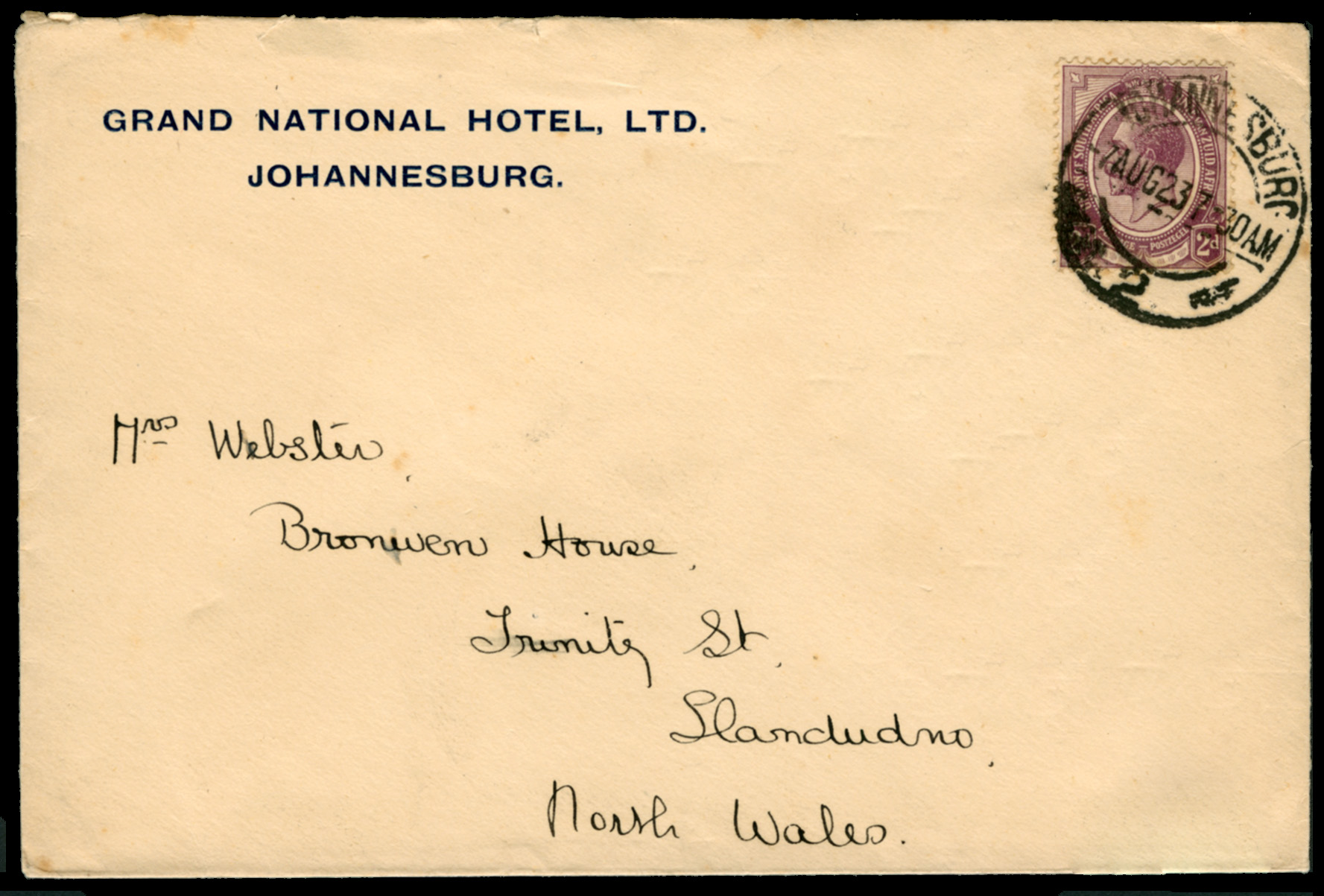
1923. Letter. JOHANNESBURG 2 '7AUG 23' to LLANDUDNO. WALES.
Posted at the 2d Surface Mail rate.
This historic Johannesburg hotel was built relatively early in the City of Gold's life between 1888 - 1889. It is apparemtlunamed after the the racecourse at Aintree near Liverpool, England. Ther name possibly explains one of the more madcap events in the life of the hotel when "a well-known gentleman .... rode his skittish pony up the stairs for a wager. The pony would not look at the stairs so the rider set spurs into it and it charged the bar. Two ladies fainted and a scene of indescribable excitement ensued, the fair customers of the bar being terror-stricken at the spectacle.” (Rand Rush.) No, doubt, the gentelman won his wager and a good laugh was had by him and his pals.
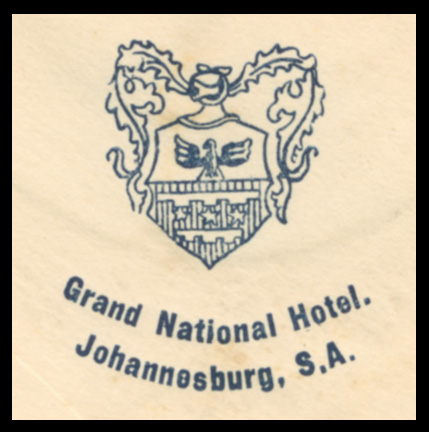
The curious armorial shield of the Grand National on the reverse of the letter above.
Classically English with helmet, shield and crenallated castle, it includes a ZAR eagle (?) with outstretched wings.
The Grand National stood at 50 - 54 Rissik Street on the corner with Kerk Street, although some sources say this was the northwest corner of Pritchard and Rissk Streets in 1888 - 1891. Designed by J. S. Donaldson, the hotel was situated in Johannesburg's shopping district. As a result, this three-storey building featured stores on the ground floor. Most notably, Turner’s Drug Store prominently occupied the corner shop for many years. The hotel rooms were upstairs and in the attic. After the Kerk Street extension was made there were 100 rooms, three drawing rooms, a ladies’ sitting room, hot and cold running water and electricity. There were stables with grooms.
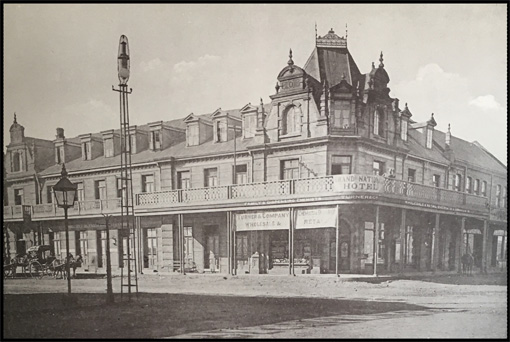
The hotel was popular with Johannesburg’s millionaires like Barney Barnato, Herman Eckstein, Abe Bailey and George Albu. Mark Twain stayed there in 1896, the same year Carl Hertz showed the first cinema film in Johannesburg at the Grand National. By the 1930s, the stand on which the Grand National stood in the city centre had become a valuable plot. The hotel was demolished and a new Grand National Building designed by Cook & Cowen was constructed between 1935 - 1938. This featured shops at street level and flats (apartments) above. At this time people still lived in the centre of Johannesburg before the exodus to the northern and southern suburbs. Non-European people were forbidden from living there or generally being around after dark without a pass.
xxx
Quote from Steve on June 22, 2026, 8:58 amQueen's Hotel, Oudtshoorn
In examining the postcard below, I wondered how a town with such a Dutch name in such a remote area was 'anglicised'. This postcard casts a light on the transformation of the Cape into an 'English' colony, something it never truly was. The Cape Dutch Boers represented the majority of the European population across the colony. Only pockets of English speakers maintained the illusion of imperial loyalty.
Oudtshoorn was established as a Dutch communityy in the 1750s. Decades after the British occupied the Cape in 1806 Oudtshoorn was officially founded as a town in 1848, a part of the George magisterial district. By the time that the first resident magistrate, Colonel A.B. Armstrong, arrived in 1855, the settlement had spread over a mile and a half. Oudtshoorn was proclaimed as its own, separate magisterial district in 1858. In that year, the first British settlers appeared. The proprietor of the Queen's Hotel, the Irishman Jonny Bawden, was one such 'Engelsman'.
1907. Postcard. Oudtshoorn 'SP 14 07' to GB. (J. Bawden, Proprietor).
1d stamp not applied. Taxed at twice the rate. See next.
1907. Postcard. Oudtshoorn 'SP 14 07' to GB. No stamp applied.
Stamped with octagonal 10c (centime) postage due handstamp, presumably in the Cape.
Stamped with 2- ISL presumably in London. (2d to pay - twice the shortfall.)I found the following online on the Oudtshoorn Info site. Thanks. It is very useful.
The hotel with its distinctive colonial atmosphere is situated in the heart of Oudtshoorn’s tourist area – Baron van Reede Street.
- Built in 1880, the Queen’s Hotel is the third oldest hotel in South Africa. (This seems implausible!)
- The original building was made of stone and had a thatched roof. (The PC shows what appears to be a corrugated iron roof.)
- The first owner was a Mr Ford who was followed shortly after by a Mr Stokkam roundabout 1885.
- The third owner was a famous Oudtshoorn personality, Mr Johnny Bawden. He was born in Ireland in 1856 and arrived in Oudtshoorn in 1881. As Major John Bawden he participated in the Bechuanaland Expedition.* He was in charge of the “Oudtshoorn Home guard” during the Anglo Boer War and was awarded the Queen’s Medal.
- He managed the hotel until 1913 when he passed away. He was followed by his son-in-law, Mr F Cilliers.
- He managed the hotel until 1938 and sold the hotel to a Mr Schmidt. See 1946 cover below.
1946. Printed Cover. OUDTSHOORN '17 VII 46' to EAST LONDON.
* The Bechuanaland Expedition or Warren Expedition, (Major-General Sir Charles Warren) of late 1884/1885, was a British military expedition to into Bechuanaland (today Botswana) to assert British sovereignty in the face of encroachments from Germnany and the ZAR (Transvaal) and to suppress the Boer 'freebooter' states of Stellalands and Goshen, all of which Warren accomplished.
Queen's Hotel, Oudtshoorn
In examining the postcard below, I wondered how a town with such a Dutch name in such a remote area was 'anglicised'. This postcard casts a light on the transformation of the Cape into an 'English' colony, something it never truly was. The Cape Dutch Boers represented the majority of the European population across the colony. Only pockets of English speakers maintained the illusion of imperial loyalty.
Oudtshoorn was established as a Dutch communityy in the 1750s. Decades after the British occupied the Cape in 1806 Oudtshoorn was officially founded as a town in 1848, a part of the George magisterial district. By the time that the first resident magistrate, Colonel A.B. Armstrong, arrived in 1855, the settlement had spread over a mile and a half. Oudtshoorn was proclaimed as its own, separate magisterial district in 1858. In that year, the first British settlers appeared. The proprietor of the Queen's Hotel, the Irishman Jonny Bawden, was one such 'Engelsman'.
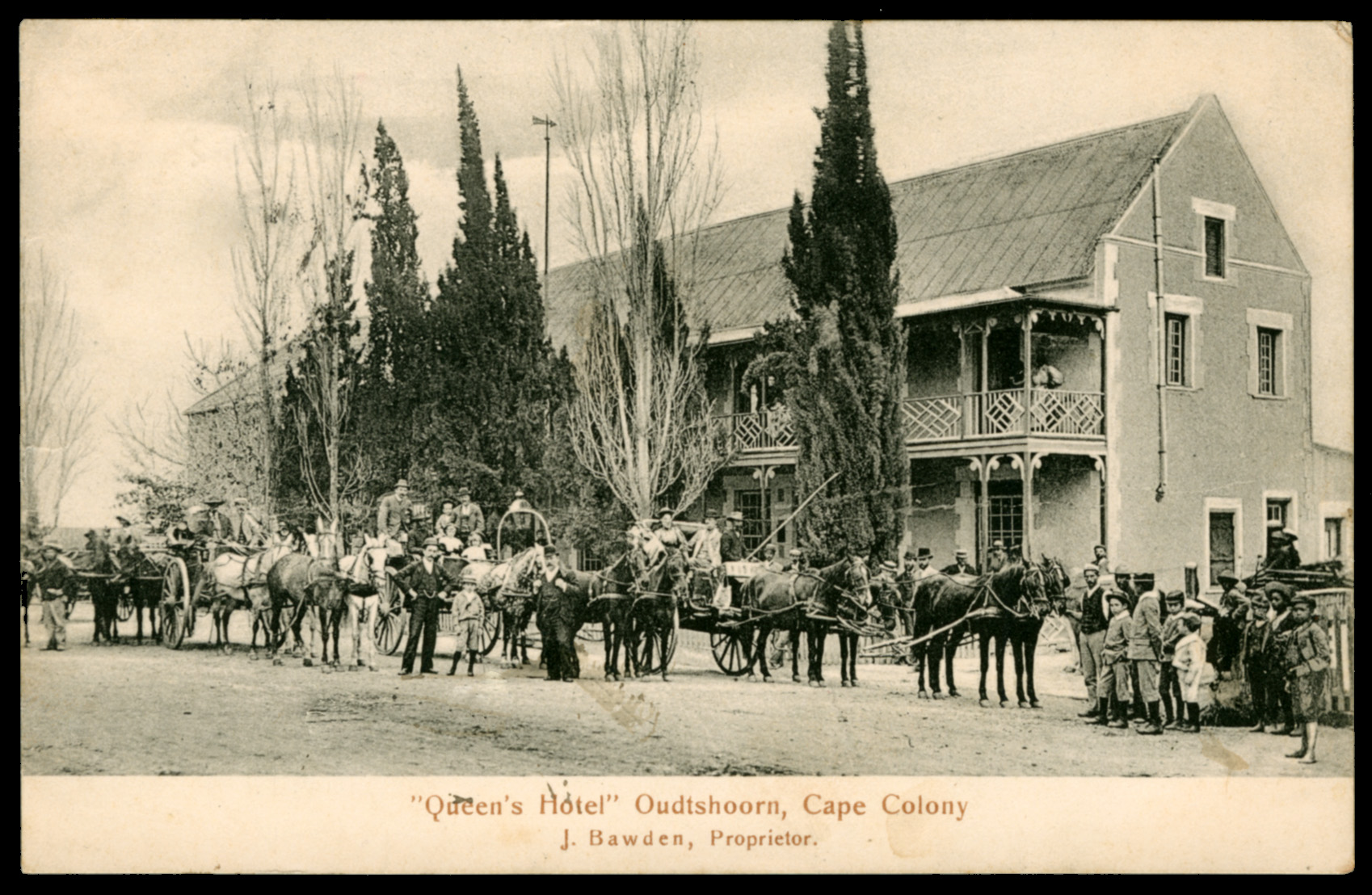
1907. Postcard. Oudtshoorn 'SP 14 07' to GB. (J. Bawden, Proprietor).
1d stamp not applied. Taxed at twice the rate. See next.
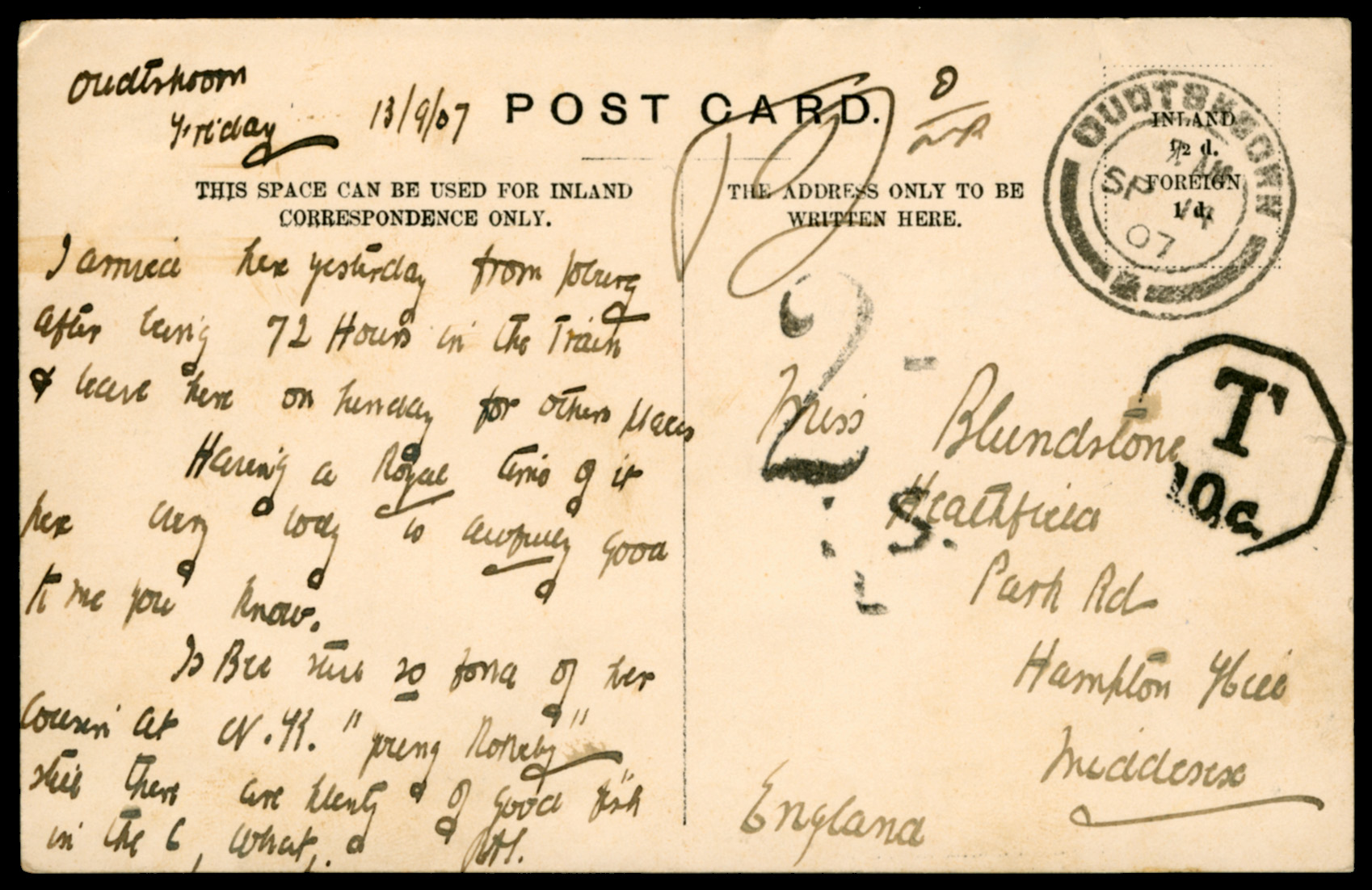
1907. Postcard. Oudtshoorn 'SP 14 07' to GB. No stamp applied.
Stamped with octagonal 10c (centime) postage due handstamp, presumably in the Cape.
Stamped with 2- ISL presumably in London. (2d to pay - twice the shortfall.)
I found the following online on the Oudtshoorn Info site. Thanks. It is very useful.
The hotel with its distinctive colonial atmosphere is situated in the heart of Oudtshoorn’s tourist area – Baron van Reede Street.
- Built in 1880, the Queen’s Hotel is the third oldest hotel in South Africa. (This seems implausible!)
- The original building was made of stone and had a thatched roof. (The PC shows what appears to be a corrugated iron roof.)
- The first owner was a Mr Ford who was followed shortly after by a Mr Stokkam roundabout 1885.
- The third owner was a famous Oudtshoorn personality, Mr Johnny Bawden. He was born in Ireland in 1856 and arrived in Oudtshoorn in 1881. As Major John Bawden he participated in the Bechuanaland Expedition.* He was in charge of the “Oudtshoorn Home guard” during the Anglo Boer War and was awarded the Queen’s Medal.
- He managed the hotel until 1913 when he passed away. He was followed by his son-in-law, Mr F Cilliers.
- He managed the hotel until 1938 and sold the hotel to a Mr Schmidt. See 1946 cover below.
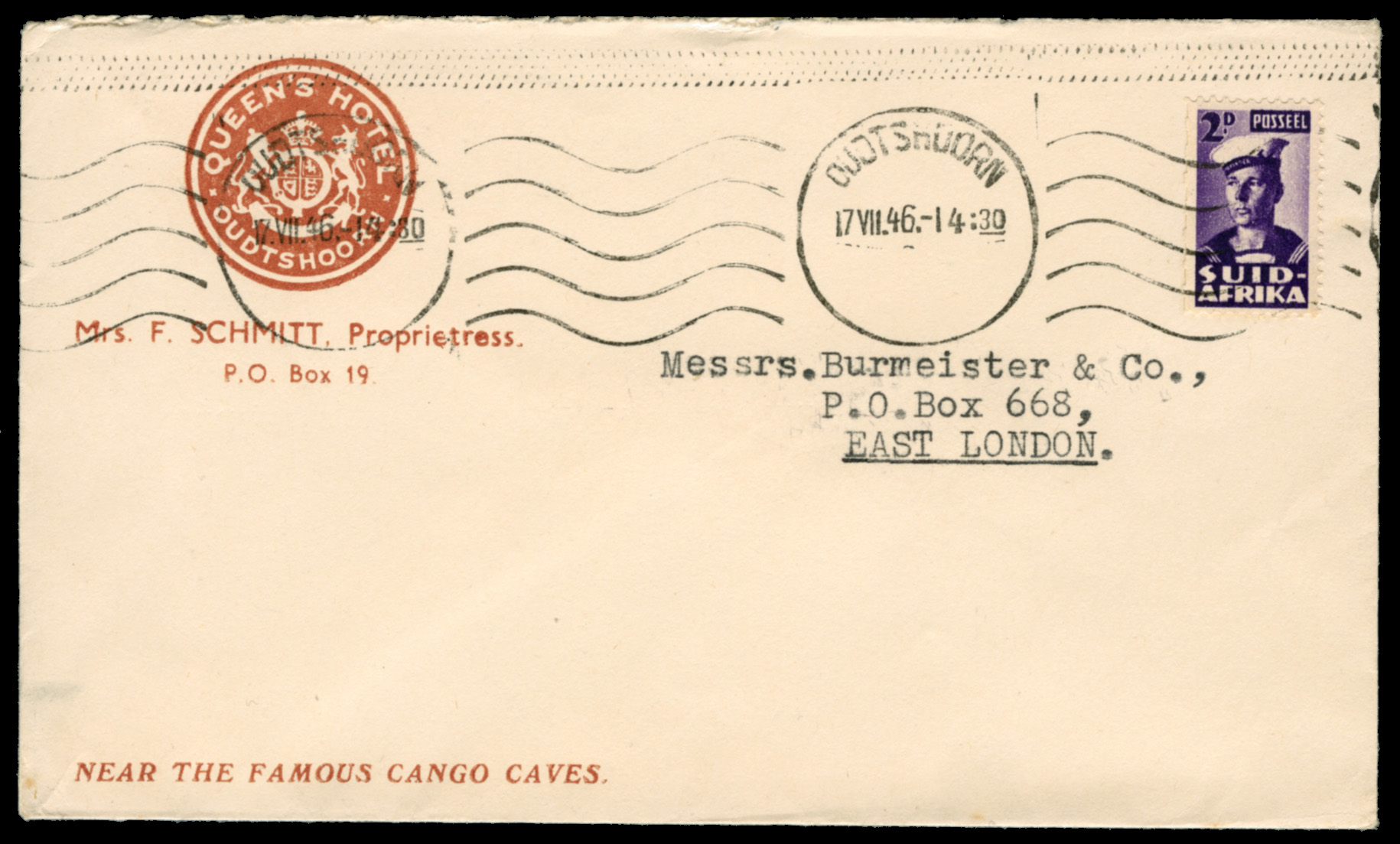
1946. Printed Cover. OUDTSHOORN '17 VII 46' to EAST LONDON.
* The Bechuanaland Expedition or Warren Expedition, (Major-General Sir Charles Warren) of late 1884/1885, was a British military expedition to into Bechuanaland (today Botswana) to assert British sovereignty in the face of encroachments from Germnany and the ZAR (Transvaal) and to suppress the Boer 'freebooter' states of Stellalands and Goshen, all of which Warren accomplished.
Quote from Steve on June 25, 2026, 10:07 amNational Hotel, Harrismith, ORC.
I have found out very little on this hotel. I would be grateful to receive any informnation you might have.
1908. Postcard. HARRISMITH ORC '18 JUL 08' via GERMISTON '19 JUL 08' to LONDON, GB.
The proprietor is O. F. Heuser.Like many hotels of this era it supplemented or even depended on its income from travelling commercial salesmen. This was a job dominated by largely hard-drinking men. My Uncle Calvin was a travelling sales representative. His job took him far from home where bars were his only solace and source of conversation. If anyone knows of a woman doing this job in 1908, I would like to know, please. That's not to say women could not do this job, just that back then 'ladies' did not generally travel alone and were certainly not allowed in Men's Bar. Most bars had signs that clearly stated 'No Women Allowed'. A woman could lose her good reputation simply by entering a rough and rude men's bar. Some hotels had a small 'Ladies Bar' on the side where men and women could drink together provided they maintained a degree of polite decorum. Back then the police were as much guardian's of public morals as upholders of the law. While hotels could turn a blind eye to discreet, silver-tongued seduction loud, lewd and overt prostitution would see their hotels closed down!
These comments are general and are not specifically directed at the National Hotel, Harrismith, about which we know next to nothing.
1908. Postcard. HARRISMITH ORC '18 JUL 08' via GERMISTON '19 JUL 08' to LONDON, GB.
Posted to GB at the 1d postcard rate.
National Hotel, Harrismith, ORC.
I have found out very little on this hotel. I would be grateful to receive any informnation you might have.
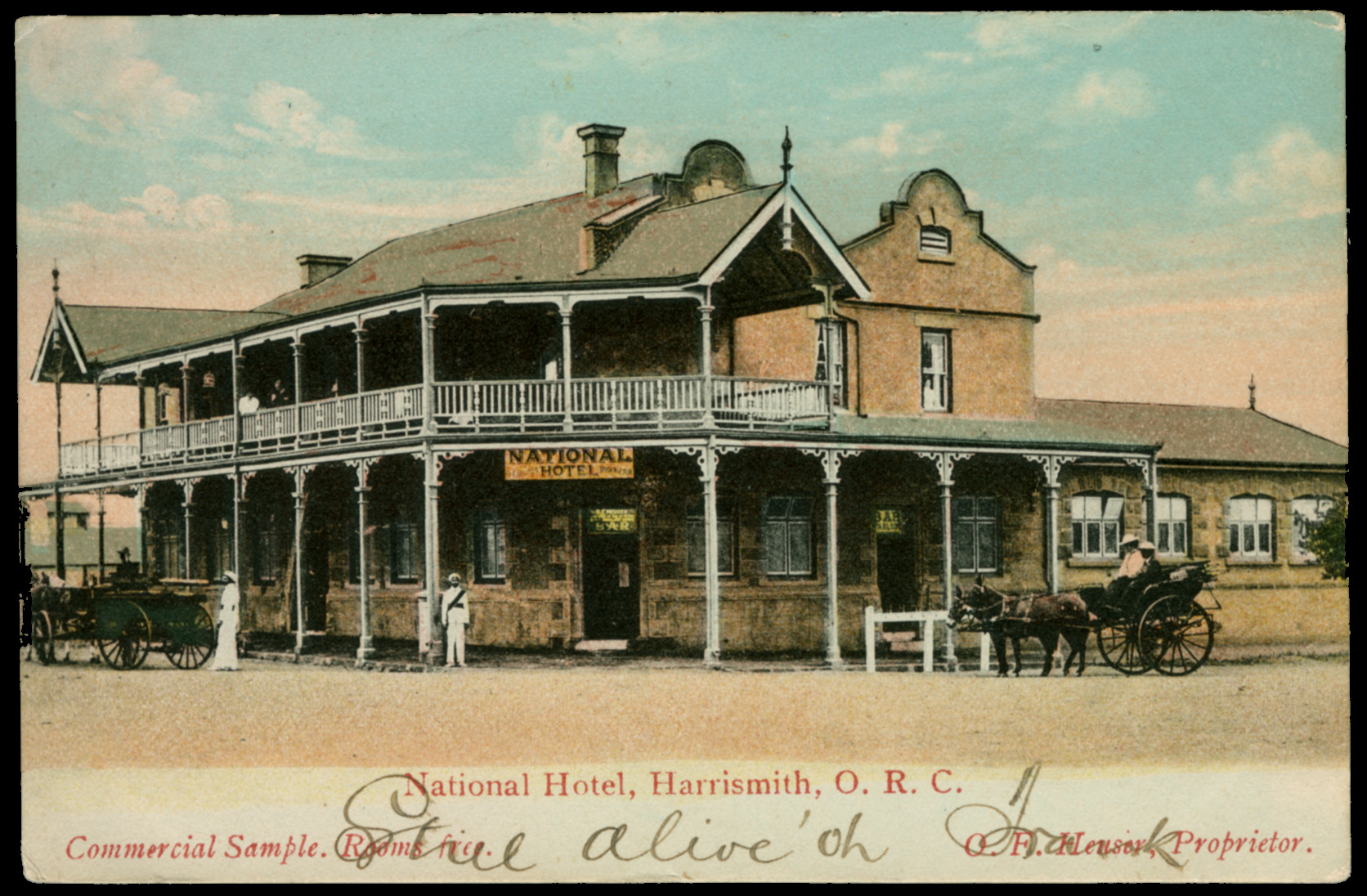
1908. Postcard. HARRISMITH ORC '18 JUL 08' via GERMISTON '19 JUL 08' to LONDON, GB.
The proprietor is O. F. Heuser.
Like many hotels of this era it supplemented or even depended on its income from travelling commercial salesmen. This was a job dominated by largely hard-drinking men. My Uncle Calvin was a travelling sales representative. His job took him far from home where bars were his only solace and source of conversation. If anyone knows of a woman doing this job in 1908, I would like to know, please. That's not to say women could not do this job, just that back then 'ladies' did not generally travel alone and were certainly not allowed in Men's Bar. Most bars had signs that clearly stated 'No Women Allowed'. A woman could lose her good reputation simply by entering a rough and rude men's bar. Some hotels had a small 'Ladies Bar' on the side where men and women could drink together provided they maintained a degree of polite decorum. Back then the police were as much guardian's of public morals as upholders of the law. While hotels could turn a blind eye to discreet, silver-tongued seduction loud, lewd and overt prostitution would see their hotels closed down!
These comments are general and are not specifically directed at the National Hotel, Harrismith, about which we know next to nothing.
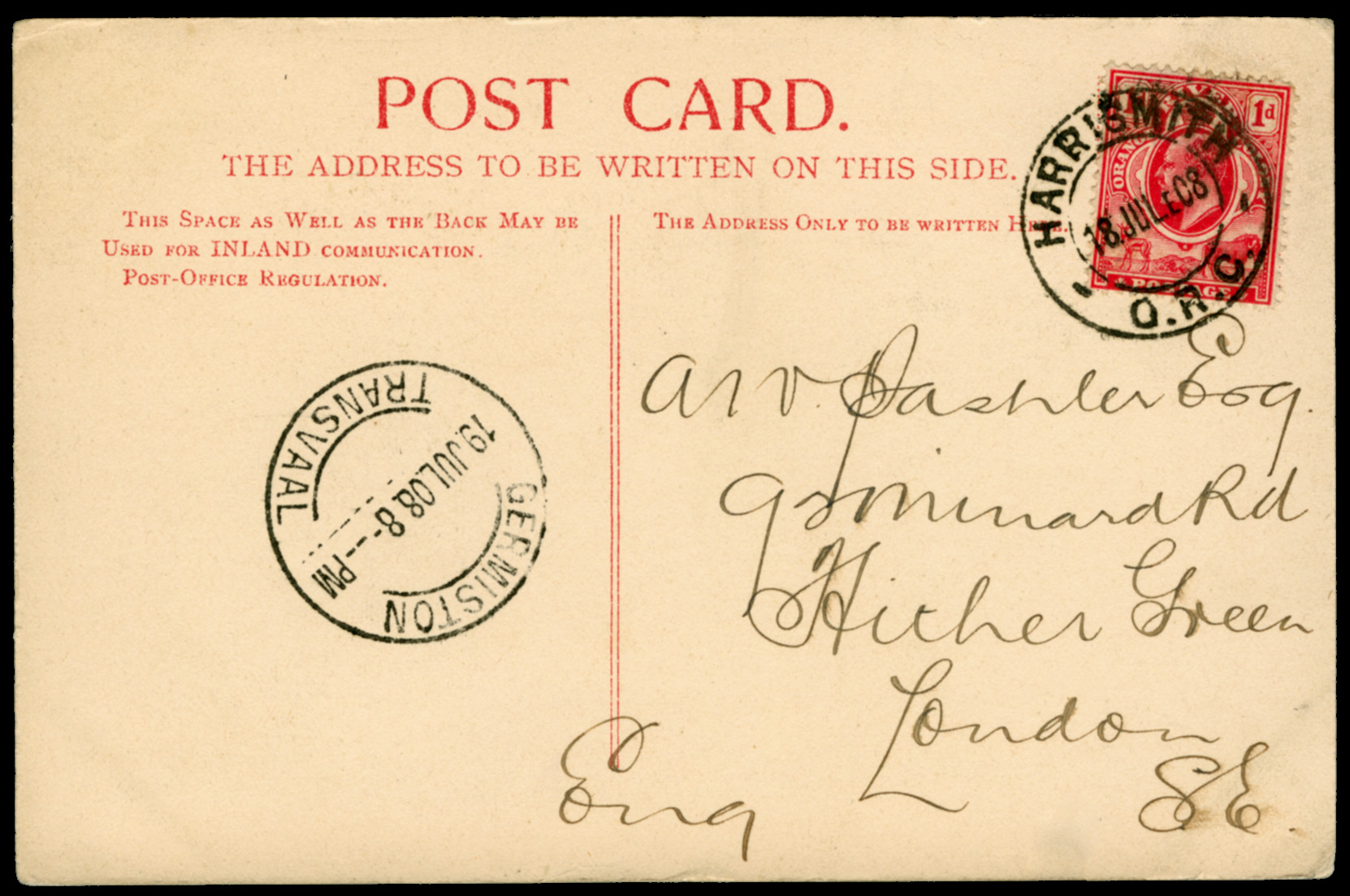
1908. Postcard. HARRISMITH ORC '18 JUL 08' via GERMISTON '19 JUL 08' to LONDON, GB.
Posted to GB at the 1d postcard rate.
Quote from Steve on June 28, 2026, 10:15 amVictoria Hotel, Bloemfontein
Another example what appears to be a hotel expressing its Imperial loyalties in the belief that it was good for business. The truth, however, is somewhat darket. See below.
1913. Postcard. BLOEMFONTEIN 4 S AFRICA '24 FEB 13' to TWICKENHAM, LONDON.
( J. D. & Co., Bloemfonten)Most postcards are printed on thickish card but some, like this one from J. D. & Co. of Bloemfonten have had the image front printed on a thinnish card and the reverse printed on paper. These were then presumably pasted together before or more likely after printing. Some times, as in the case of this postcard and others I have occasionally seen, the front and the back separate, again presumably because the postcard got wet or damp. The separation of the two sheets has given me the benefit of being able to scan both the front and back at the same time. I believe this is a first for me in scanning over a 1000+ postcards. I have noticed this phenomena before, usually in instances where people have made bad attempts to glue the two sides together again. I have also seen what appear to be fronts and backs from different postcard that have been stuck together. This is always unsatisfying, especially when one side is a good example.
1913. Postcard. BLOEMFONTEIN 4 S AFRICA '24 FEB 13' to TWICKENHAM, LONDON.
Interprovincial use. 1d Transvaal used in OFS cancelled with BLOEMFONTEIN 4 S AFRICA '24 FEB 13'Built in the late 19th century, the original name of the Victoria Hotel in Bloemfontein was the 'Railway Hotel'. As its name suggests it attempted to find customers among railway passengers following the boom in railway traffic from the coast to the interior. The preceding Queen's Hotel, Oudsthoorn postcard has a comment from a man who had spent a long 72 hours on the train to Oudtshoorn. No doubt, he needed a break from railway travel. Pretty much any hotel along the length of the line would do.
After the British Army occupied the city in March 1900, the Railway Hotel was renamed the 'Victoria Hotel' at the command of Field Marshal Lord Roberts. At this time the British were attempting to anglicise Bloemfontein by removing the irritating aspects of Boer life and culture. (It is worth noting that a]. this had never worked with the Boers before and b.] the Boer OFS State had never behaved so intolerably badly to the British despite much provocation.) The imperialist's stated aim was to make Bloemfontein 'British'. One of their comedians joked of making Bloemfontein a 'Steynless City', a poor pun referring to the OFS President M. Steyn who would remain in the veld for the duration of the war in an attempt to win his people's freedom while desperately trying to maintain his health. He lost both and died not long after the war's end, his Scottish wife at his side. She had done a better job of anglicising him! The British Army used the Victoria Hotel as a billet for their troops, most probably officers only. It did not survive Union and the site was redeveloped.
Victoria Hotel, Bloemfontein
Another example what appears to be a hotel expressing its Imperial loyalties in the belief that it was good for business. The truth, however, is somewhat darket. See below.
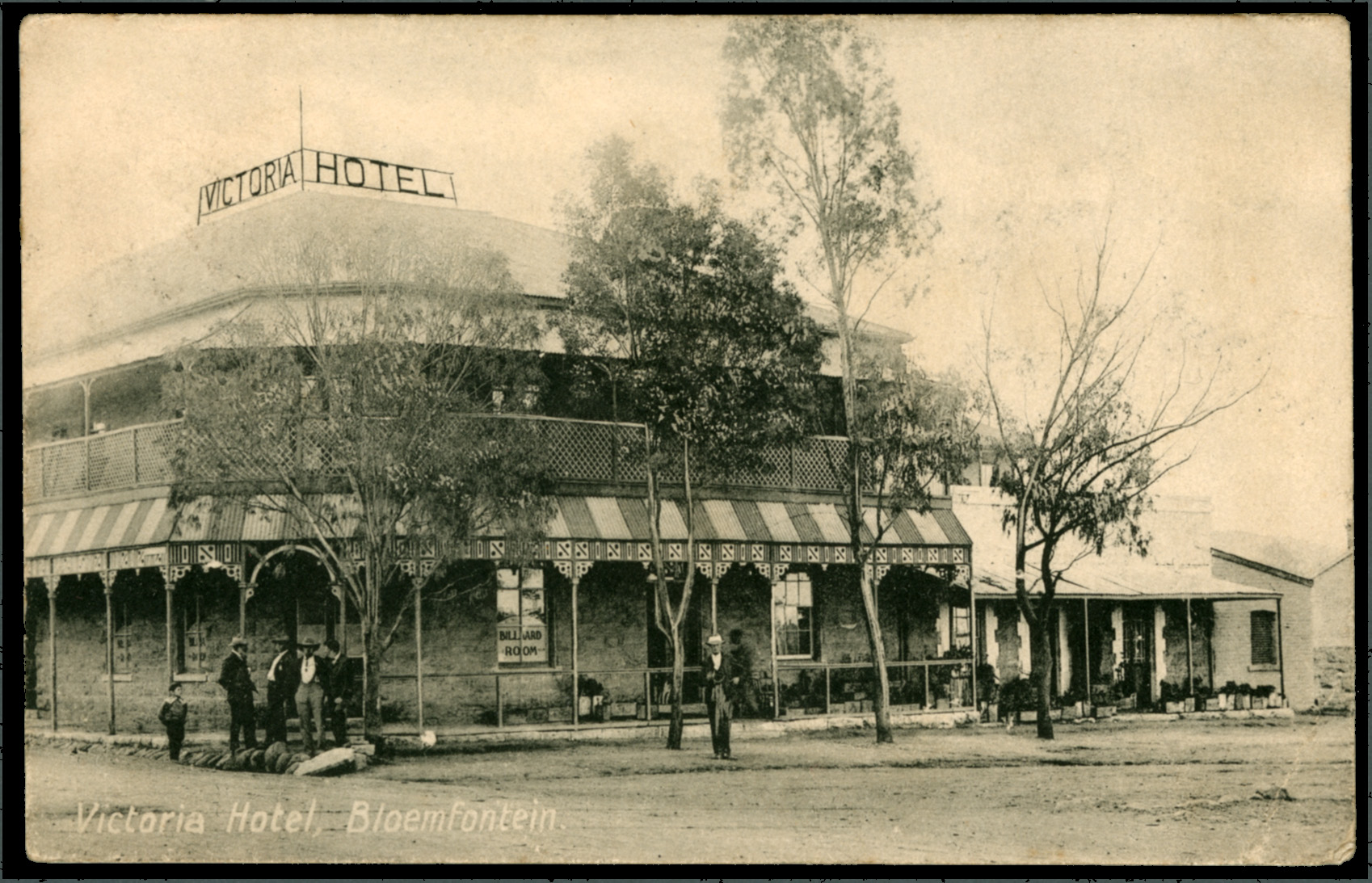
1913. Postcard. BLOEMFONTEIN 4 S AFRICA '24 FEB 13' to TWICKENHAM, LONDON.
( J. D. & Co., Bloemfonten)
Most postcards are printed on thickish card but some, like this one from J. D. & Co. of Bloemfonten have had the image front printed on a thinnish card and the reverse printed on paper. These were then presumably pasted together before or more likely after printing. Some times, as in the case of this postcard and others I have occasionally seen, the front and the back separate, again presumably because the postcard got wet or damp. The separation of the two sheets has given me the benefit of being able to scan both the front and back at the same time. I believe this is a first for me in scanning over a 1000+ postcards. I have noticed this phenomena before, usually in instances where people have made bad attempts to glue the two sides together again. I have also seen what appear to be fronts and backs from different postcard that have been stuck together. This is always unsatisfying, especially when one side is a good example.
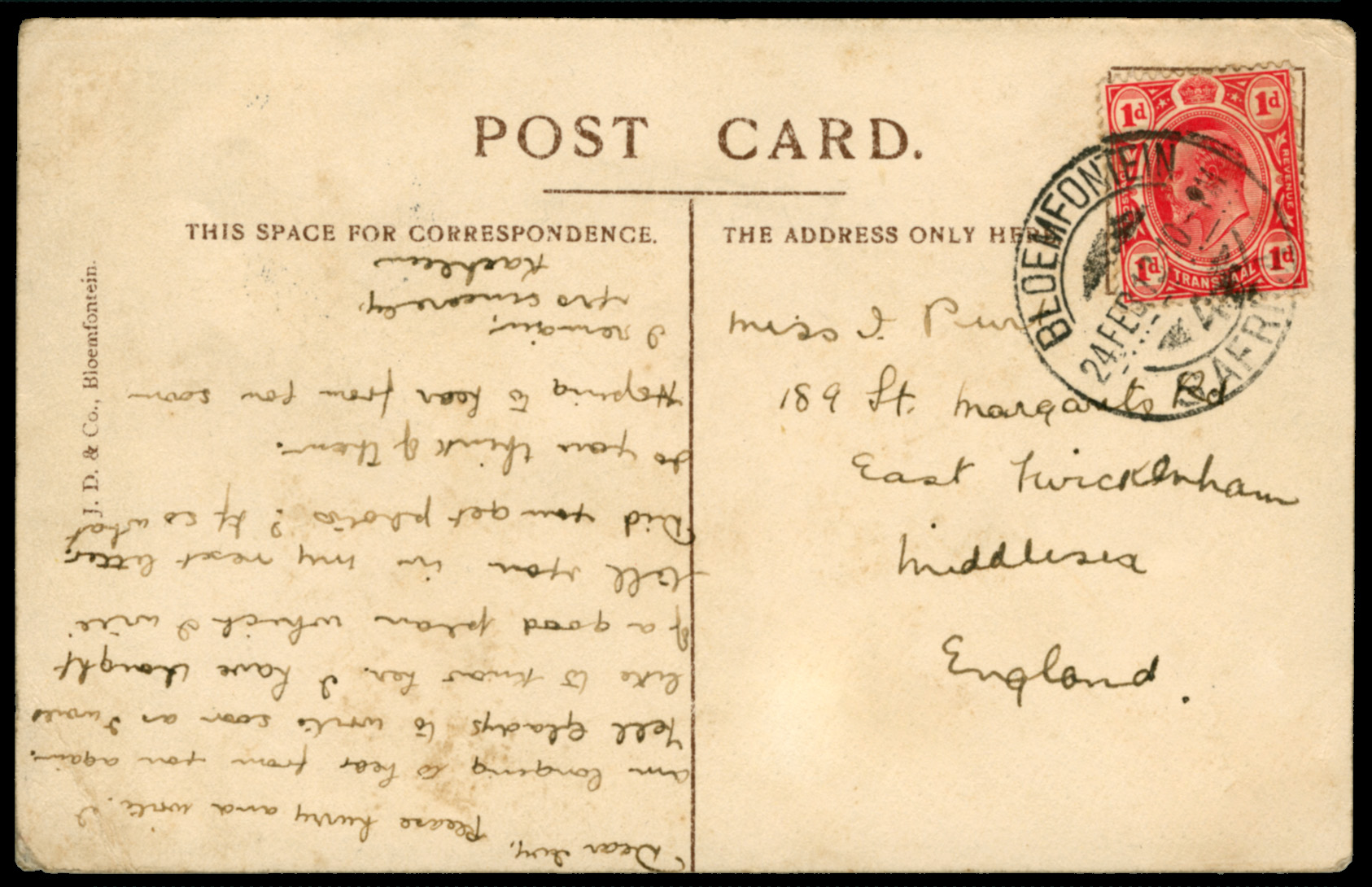
1913. Postcard. BLOEMFONTEIN 4 S AFRICA '24 FEB 13' to TWICKENHAM, LONDON.
Interprovincial use. 1d Transvaal used in OFS cancelled with BLOEMFONTEIN 4 S AFRICA '24 FEB 13'
Built in the late 19th century, the original name of the Victoria Hotel in Bloemfontein was the 'Railway Hotel'. As its name suggests it attempted to find customers among railway passengers following the boom in railway traffic from the coast to the interior. The preceding Queen's Hotel, Oudsthoorn postcard has a comment from a man who had spent a long 72 hours on the train to Oudtshoorn. No doubt, he needed a break from railway travel. Pretty much any hotel along the length of the line would do.
After the British Army occupied the city in March 1900, the Railway Hotel was renamed the 'Victoria Hotel' at the command of Field Marshal Lord Roberts. At this time the British were attempting to anglicise Bloemfontein by removing the irritating aspects of Boer life and culture. (It is worth noting that a]. this had never worked with the Boers before and b.] the Boer OFS State had never behaved so intolerably badly to the British despite much provocation.) The imperialist's stated aim was to make Bloemfontein 'British'. One of their comedians joked of making Bloemfontein a 'Steynless City', a poor pun referring to the OFS President M. Steyn who would remain in the veld for the duration of the war in an attempt to win his people's freedom while desperately trying to maintain his health. He lost both and died not long after the war's end, his Scottish wife at his side. She had done a better job of anglicising him! The British Army used the Victoria Hotel as a billet for their troops, most probably officers only. It did not survive Union and the site was redeveloped.
Quote from Steve on June 29, 2026, 10:44 amHotel Selborne, Kroonstad
Not a lot is known about this hotel. I have seen two different postcards of it. The one below appears to be the oldest (no motor car) snd the scarcest, it being the only example seen. Judging by several early cars parked outside in the later postcards the hotel underwent considerable renovation roundabout Union and or WW1. The ground floor remained largely unaltered while the the attic floor above the balcony became a raised plastered extension with tall chimneys. This gave it an ugly cobbled together appearance.
Lord Selborne was the British Commissioner for South Africa from May 1905 to May 31, 1910 (Union). His predecessor, Alfred Milner, 1st Viscount Milner, was arguably the man most single-handedly responsible for the South African War (1899 - 1902). Selborne's successor would be Viscount Gladstone. He would be the first Governor-General of the Union of South Africa. The Hotel Selborne was most likely named in his honour some time during his tenure as British Commissioner for South Africa (May 1905 to May 31, 1910).
In 1907, Selborne wrote the highly influential 'Selborne Memorandum' which outlined the need to unite the British colonies and old Boer states. This was not new. It was a long held political aim of the British Colonial Office. Selborne's Memorandum was a foundational text that spurred and directly led to the formation of the Union of South Africa in 1910. He had no particular loyalty to South Africa and after the Union was established in 1910, he returned to GB where he remained active in British politics until his death in 1942.
Circa 1905. Postcard. Unused. 'Hotel Selborn, Kroonstad'. (W. D. & S., Ltd. C.T. & L.)
Founded in 1855, Kroonstad served briefly as the capital of the Orange Free State (March 13–May 11, 1900) after the fall of Bloemfontein during the South African War. A busy agricultural and commercial town lying roughly halfway between Johannesburg and Bloemfontein, the British residents of Kroonstad gave strong minority support to British imperialism and the British Army. H. Guest was a leading Eastern Cape imperialist before he cane to the OFS where was active as a publisher, editor and printer of British Loyalist postcards. My limited research suggests he was the first 'South African' to use the divisive term 'Anglo-Boer War' in 1901.
Circa 1907. Postcard. Unused. 'Lord Selbourne's (sic) arrival in Standerton, 1907'.
(Albert Greenblatt, Standerton.)
Selborne's job as British Commissioner was to control the Boers, bring them to the table and negotiate the Union of SA.
Hotel Selborne, Kroonstad
Not a lot is known about this hotel. I have seen two different postcards of it. The one below appears to be the oldest (no motor car) snd the scarcest, it being the only example seen. Judging by several early cars parked outside in the later postcards the hotel underwent considerable renovation roundabout Union and or WW1. The ground floor remained largely unaltered while the the attic floor above the balcony became a raised plastered extension with tall chimneys. This gave it an ugly cobbled together appearance.
Lord Selborne was the British Commissioner for South Africa from May 1905 to May 31, 1910 (Union). His predecessor, Alfred Milner, 1st Viscount Milner, was arguably the man most single-handedly responsible for the South African War (1899 - 1902). Selborne's successor would be Viscount Gladstone. He would be the first Governor-General of the Union of South Africa. The Hotel Selborne was most likely named in his honour some time during his tenure as British Commissioner for South Africa (May 1905 to May 31, 1910).
In 1907, Selborne wrote the highly influential 'Selborne Memorandum' which outlined the need to unite the British colonies and old Boer states. This was not new. It was a long held political aim of the British Colonial Office. Selborne's Memorandum was a foundational text that spurred and directly led to the formation of the Union of South Africa in 1910. He had no particular loyalty to South Africa and after the Union was established in 1910, he returned to GB where he remained active in British politics until his death in 1942.
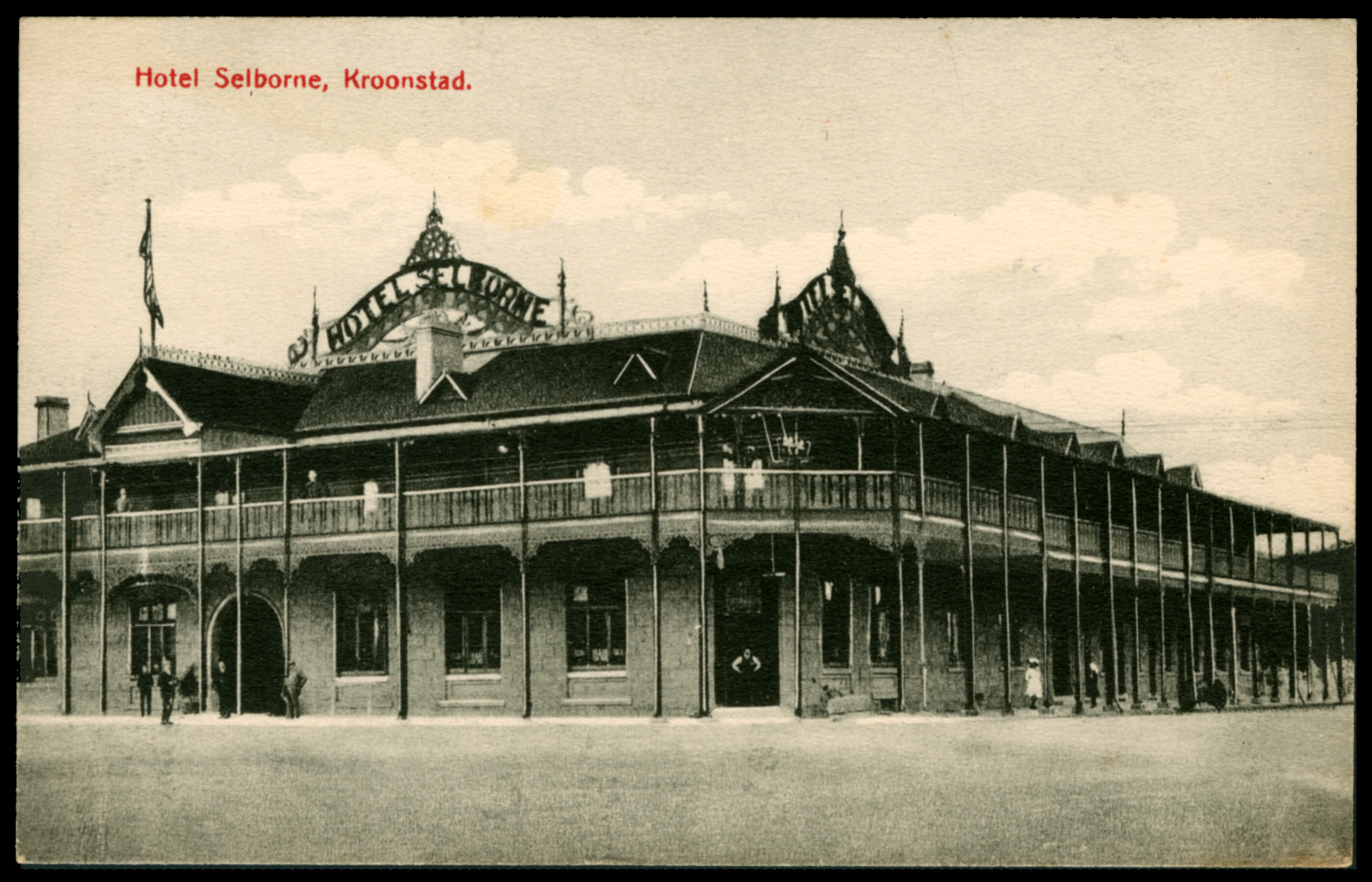
Circa 1905. Postcard. Unused. 'Hotel Selborn, Kroonstad'. (W. D. & S., Ltd. C.T. & L.)
Founded in 1855, Kroonstad served briefly as the capital of the Orange Free State (March 13–May 11, 1900) after the fall of Bloemfontein during the South African War. A busy agricultural and commercial town lying roughly halfway between Johannesburg and Bloemfontein, the British residents of Kroonstad gave strong minority support to British imperialism and the British Army. H. Guest was a leading Eastern Cape imperialist before he cane to the OFS where was active as a publisher, editor and printer of British Loyalist postcards. My limited research suggests he was the first 'South African' to use the divisive term 'Anglo-Boer War' in 1901.
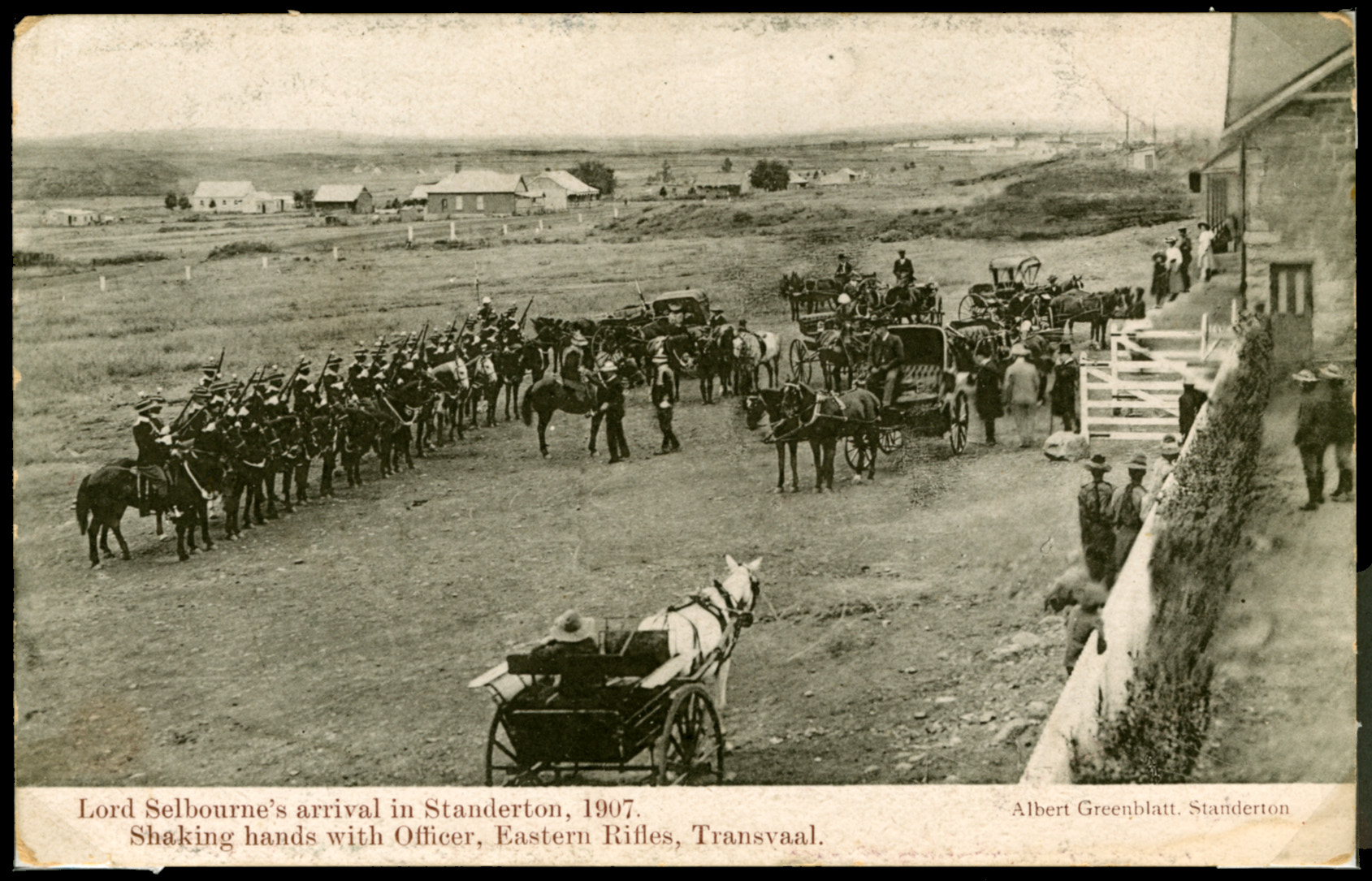
Circa 1907. Postcard. Unused. 'Lord Selbourne's (sic) arrival in Standerton, 1907'.
(Albert Greenblatt, Standerton.)
Selborne's job as British Commissioner was to control the Boers, bring them to the table and negotiate the Union of SA.
Quote from Steve on June 30, 2026, 3:04 pmSentral Hotel, Kroonstad
Staying in Kroonstad (overnight) .... we find the Sentral Hotel in the far distance across the Market Square.
The low building on the left was a Boer / Dutch commercial establishment targetiing the farming community. This was a 'boernwinkel' or farmer's shop. It shows that commerce was not the exclusive preserve of the British, nor was Kroonstad an entirely English-speaking town. As this postcard was posted in 1904, it suggests that the shop of J. A. Louw,possibly preceded the start of the South African war. The building alongside with the prominent SAR sign has all the apperanace of a hotel. Or is it the railway station?
1904. Postcard. KROONSTAD O.R.C '19 DEC 04' to CARDIFF, GB.
Lets take a closer look at the Sentral Hotel. (Afr. 'Sentraal' is 'Central'.) This magnified view below is of the Sentral Hotel. It was scanned at 600 dpi. (The postcard scan above is a 300 dpi scan.) It looks like a fairly standard brick, mortar building with corrugated iron roof and 'broekie lace' wrought iron work on the balconies. Apparently. ships captain's coming to SA made a few extra quid on the side by having their ship's ballast comprise manufactured wrought ironwork which they would sell in the ports of the colonies they visited. What suggest that the building is more 'South Afrian' than English in its design is its 'Dutch' gable.
Here is the reverse of the postcard. It has a fairly useful KROONSTAD postmark.
1904. Postcard. KROONSTAD O.R.C '19 DEC 04' to CARDIFF, GB.
Posted at the standard rate to GB with an ORC 1d adhesive.
Sentral Hotel, Kroonstad
Staying in Kroonstad (overnight) .... we find the Sentral Hotel in the far distance across the Market Square.
The low building on the left was a Boer / Dutch commercial establishment targetiing the farming community. This was a 'boernwinkel' or farmer's shop. It shows that commerce was not the exclusive preserve of the British, nor was Kroonstad an entirely English-speaking town. As this postcard was posted in 1904, it suggests that the shop of J. A. Louw,possibly preceded the start of the South African war. The building alongside with the prominent SAR sign has all the apperanace of a hotel. Or is it the railway station?
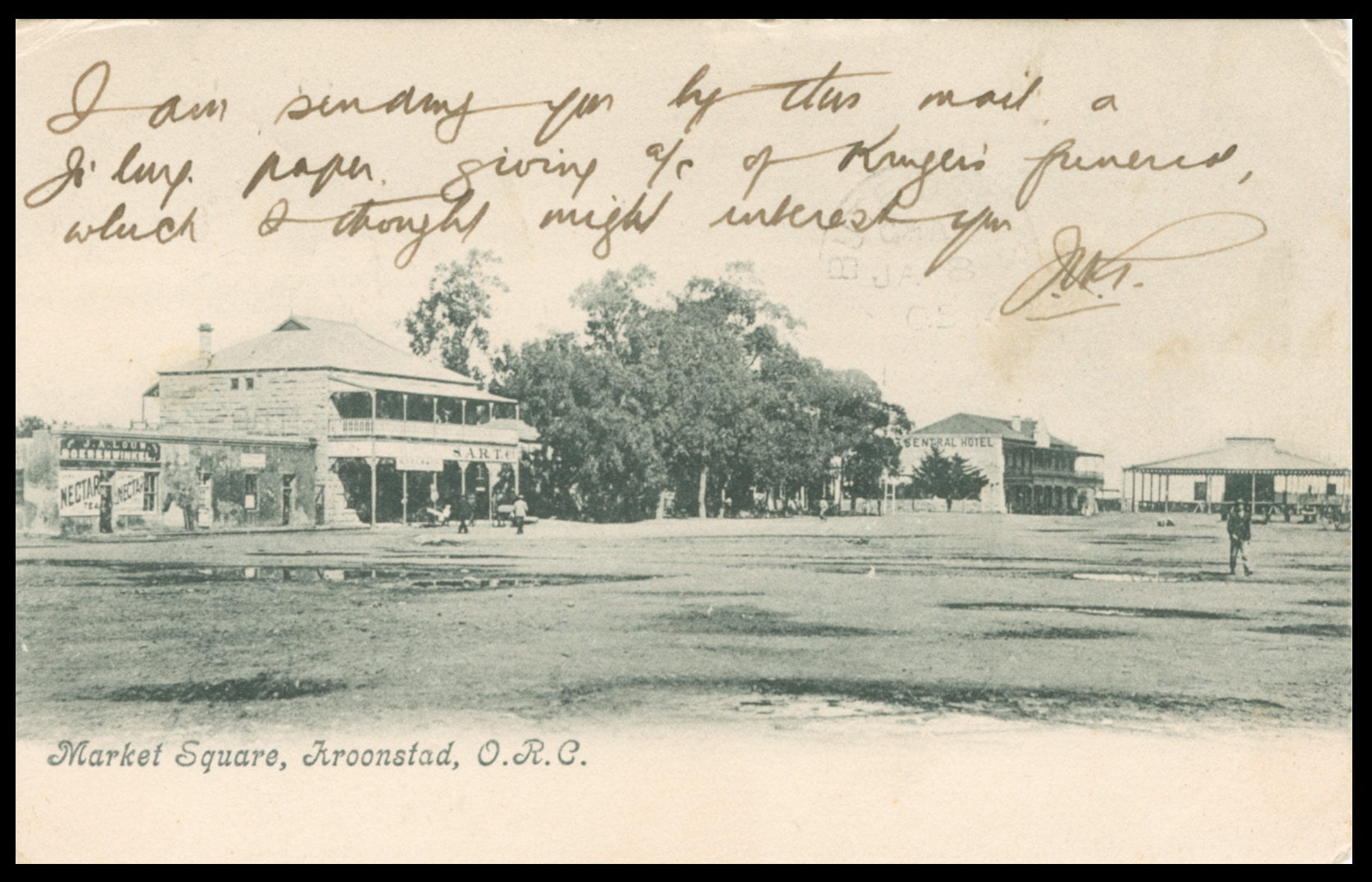
1904. Postcard. KROONSTAD O.R.C '19 DEC 04' to CARDIFF, GB.
Lets take a closer look at the Sentral Hotel. (Afr. 'Sentraal' is 'Central'.) This magnified view below is of the Sentral Hotel. It was scanned at 600 dpi. (The postcard scan above is a 300 dpi scan.) It looks like a fairly standard brick, mortar building with corrugated iron roof and 'broekie lace' wrought iron work on the balconies. Apparently. ships captain's coming to SA made a few extra quid on the side by having their ship's ballast comprise manufactured wrought ironwork which they would sell in the ports of the colonies they visited. What suggest that the building is more 'South Afrian' than English in its design is its 'Dutch' gable.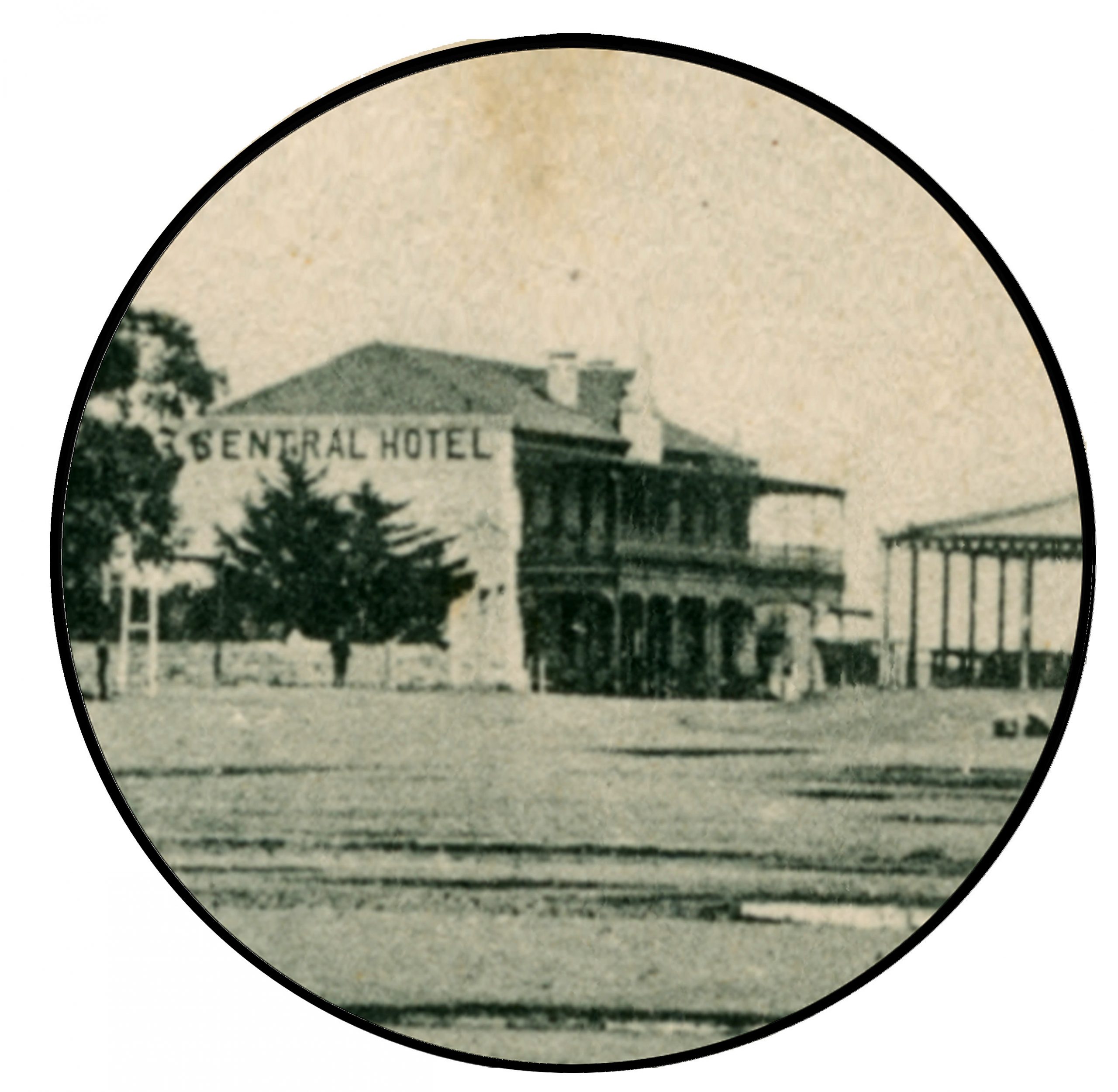
Here is the reverse of the postcard. It has a fairly useful KROONSTAD postmark.
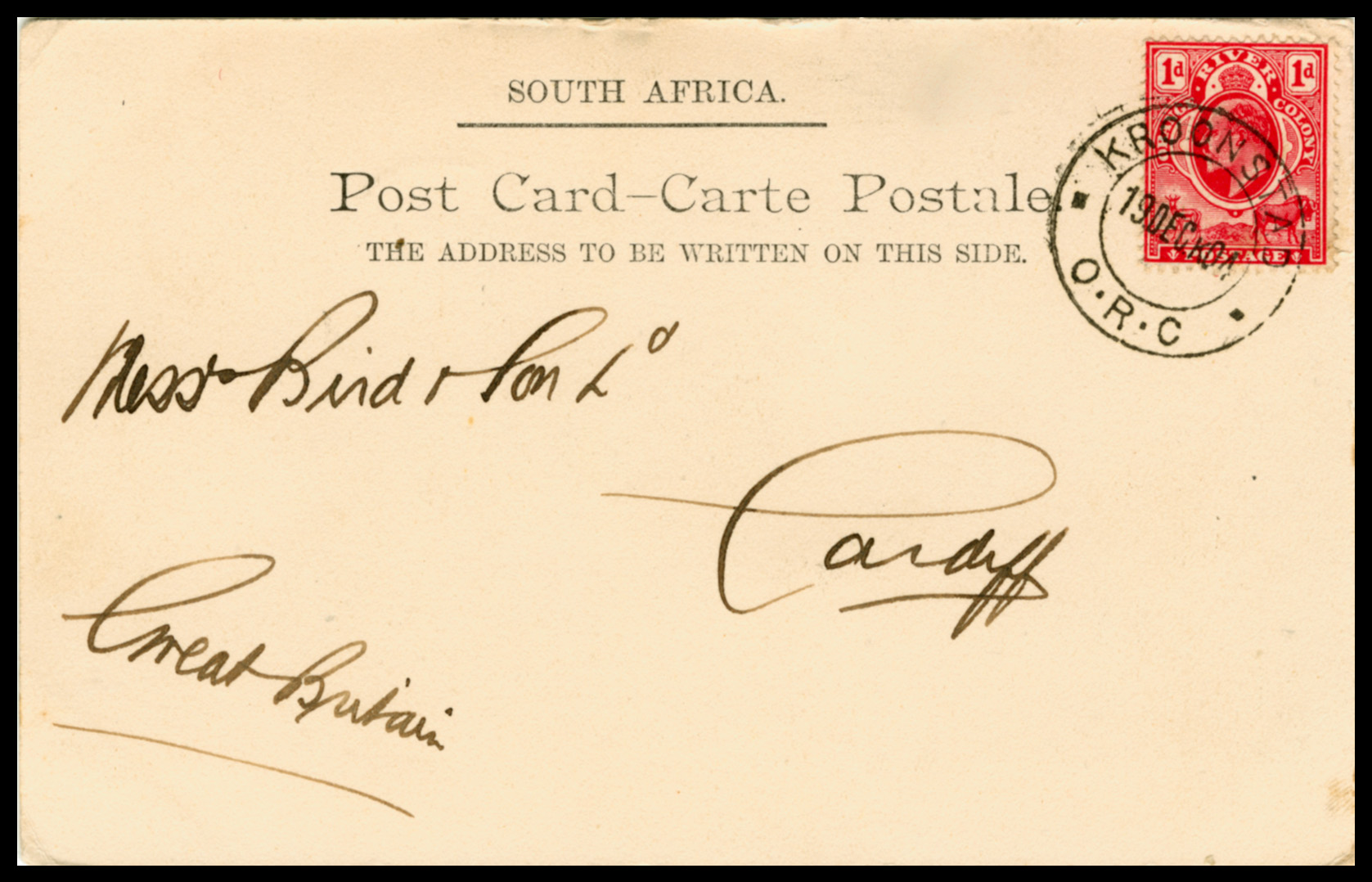
1904. Postcard. KROONSTAD O.R.C '19 DEC 04' to CARDIFF, GB.
Posted at the standard rate to GB with an ORC 1d adhesive.