Hotels of southern Africa
Quote from Steve on July 24, 2026, 10:16 amRailway Hotel, Middelburg (Cape).
I believe that this hotel is still standing today, (2026), although obviously somewhat altered in appearance.
There is another postcard of this hotel from Hallis and Co., (PE). It described the Railway Hotel being on Church Street, Middelburg, Cape, circa 1910. You can see in the gable of the PC above that the hotel was built in 1904 as Seligman's Building.
Further details coming soon....
Railway Hotel, Middelburg (Cape).
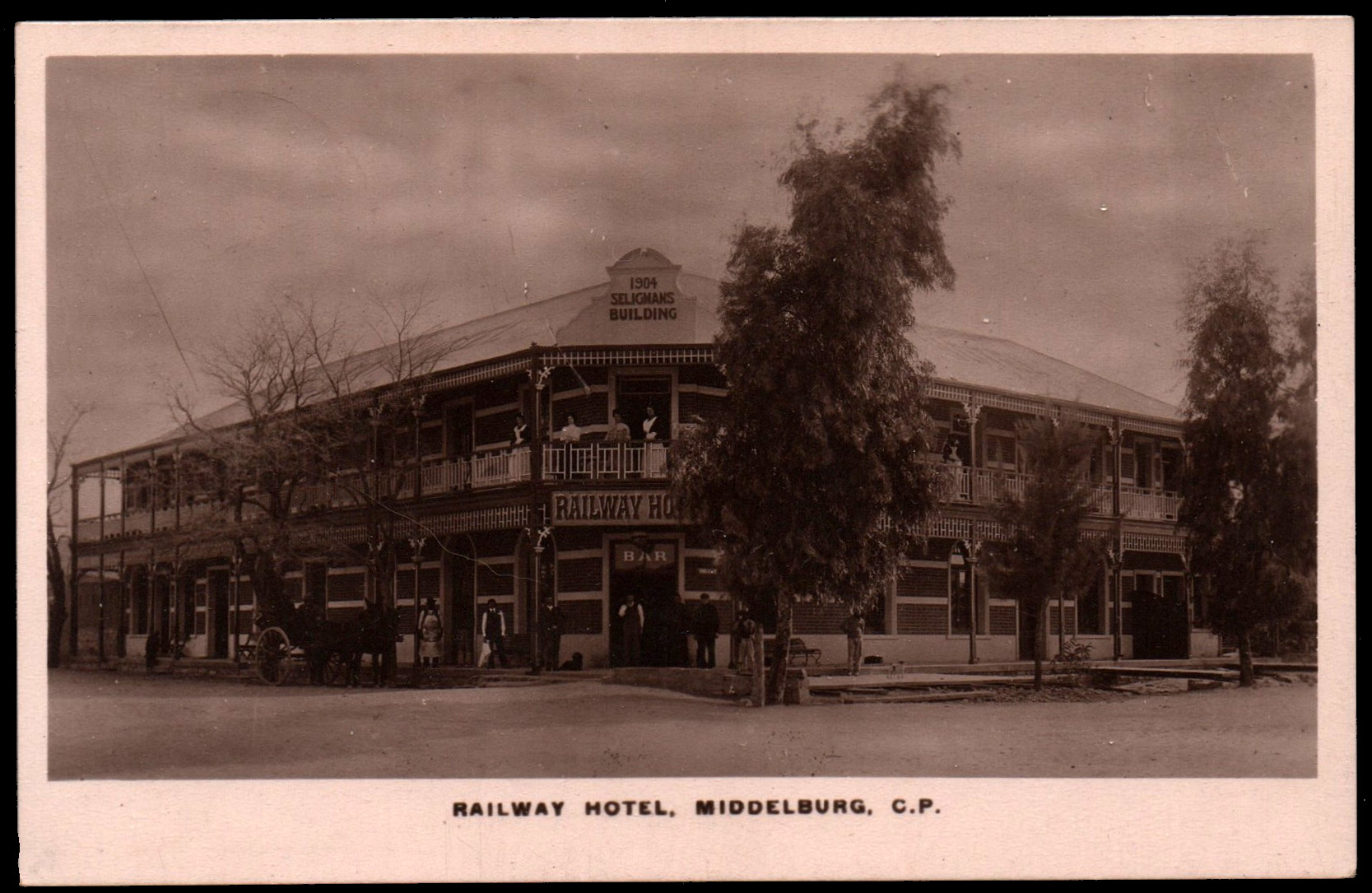
I believe that this hotel is still standing today, (2026), although obviously somewhat altered in appearance.
There is another postcard of this hotel from Hallis and Co., (PE). It described the Railway Hotel being on Church Street, Middelburg, Cape, circa 1910. You can see in the gable of the PC above that the hotel was built in 1904 as Seligman's Building.
Further details coming soon....
Quote from Steve on August 31, 2026, 11:31 amLeisure Isle Hotel, Knysna
Leisure Isle Hotel (and Golf Links) was located on Leisure Isle in Knysna, Cape Province, presumably on the waterfront of Bollard Bay Beach facing the Knysna Heads, the island's prime location. In 1948, when this cover was posted in Pretoria, Leisure Isle was approved as a local area under the control of the Divisional Council which was guided by the Leisure Isle Advisory Board.
I have found little information on the Leisure Isle Hotel. I have found two references, the first which says "that by 1963 "Leisure Isle had a golf course with a nearby hotel which was used as a clubhouse" and the second later one that says "there is no longer an active golf course on Leisure Isle in Knysna, South Africa, though a small course was historically started there in 1935". These, presumably refer to the same "Leisure Isle Hotel and GOLF LINKS' which is promoted on the cover from 1948 below. The Unanswered Question is "when did the Hotel open?"
1948. Registered First Day Cover. Silver Wedding issue. PRETORIA 97 '26 IV 48' to HOVE, GB.
Leisure Isle Hotel and Golf Links Promotional Stationery.Leisure Isle was previously known as Steenbok Island. Herds of small Steebok and flocks of wild birds were among its earliest inhabitants. It was essentially just a grassy sandbank set in the Knysna tidal estuary which surrounded it on all four sides. It was accessible only at low tide. When mankind arrived the uninhabited island became a place to graze cattle. A traveller, Mr George Cearn, arrived with his wife in Knysna in 1925 and was so impressed with the location and its potential that he decided to develop Steenbok Island which at that time belonged to the Duthie Family of Woodbourne Farm.
'Duthie' is an anglicised Scottish surname. 'Woodbourne' is derived from two Old English words: wudu, meaning "wood" or "forest," and burna (or bourne), meaning "a spring, brook, or stream". It suggests a wooded area with a stream, probably a good general description of 'Knysna', which apparently is a Khoikhoi word meaning "place of trees or ferns". The surname 'Cearn' is an uncommon variant or Anglicized form linked to Irish Gaelic roots. Broadly, the Duthie's farm name, 'Woodbourne', describes a British settler putting down Anglo-Saxon roots in land that once belonged to the Khoi but now soon to be exploited by an Irishman.
Cearn bought the Island from the Duthie’s and had a wall built around the island as well as a causeway for permanent access to and from the mainland. Rock was locally quarried for this purpose and transported from the mainland via a coco-pan railway line. For three years over 55 labourers worked to complete the job. In 1967 the Knysna Municipality took over Leisure Isle. Today it has over 450 homes, of which more than 50% are occupied by residents, the rest being holiday homes or boutique hotels. Little is known of the original hotel. Today most 'hotels' refer to themselves as 'Lodges'. Perhaps this reinforces the traveller's African experience.
Leisure Isle Hotel, Knysna
Leisure Isle Hotel (and Golf Links) was located on Leisure Isle in Knysna, Cape Province, presumably on the waterfront of Bollard Bay Beach facing the Knysna Heads, the island's prime location. In 1948, when this cover was posted in Pretoria, Leisure Isle was approved as a local area under the control of the Divisional Council which was guided by the Leisure Isle Advisory Board.
I have found little information on the Leisure Isle Hotel. I have found two references, the first which says "that by 1963 "Leisure Isle had a golf course with a nearby hotel which was used as a clubhouse" and the second later one that says "there is no longer an active golf course on Leisure Isle in Knysna, South Africa, though a small course was historically started there in 1935". These, presumably refer to the same "Leisure Isle Hotel and GOLF LINKS' which is promoted on the cover from 1948 below. The Unanswered Question is "when did the Hotel open?"
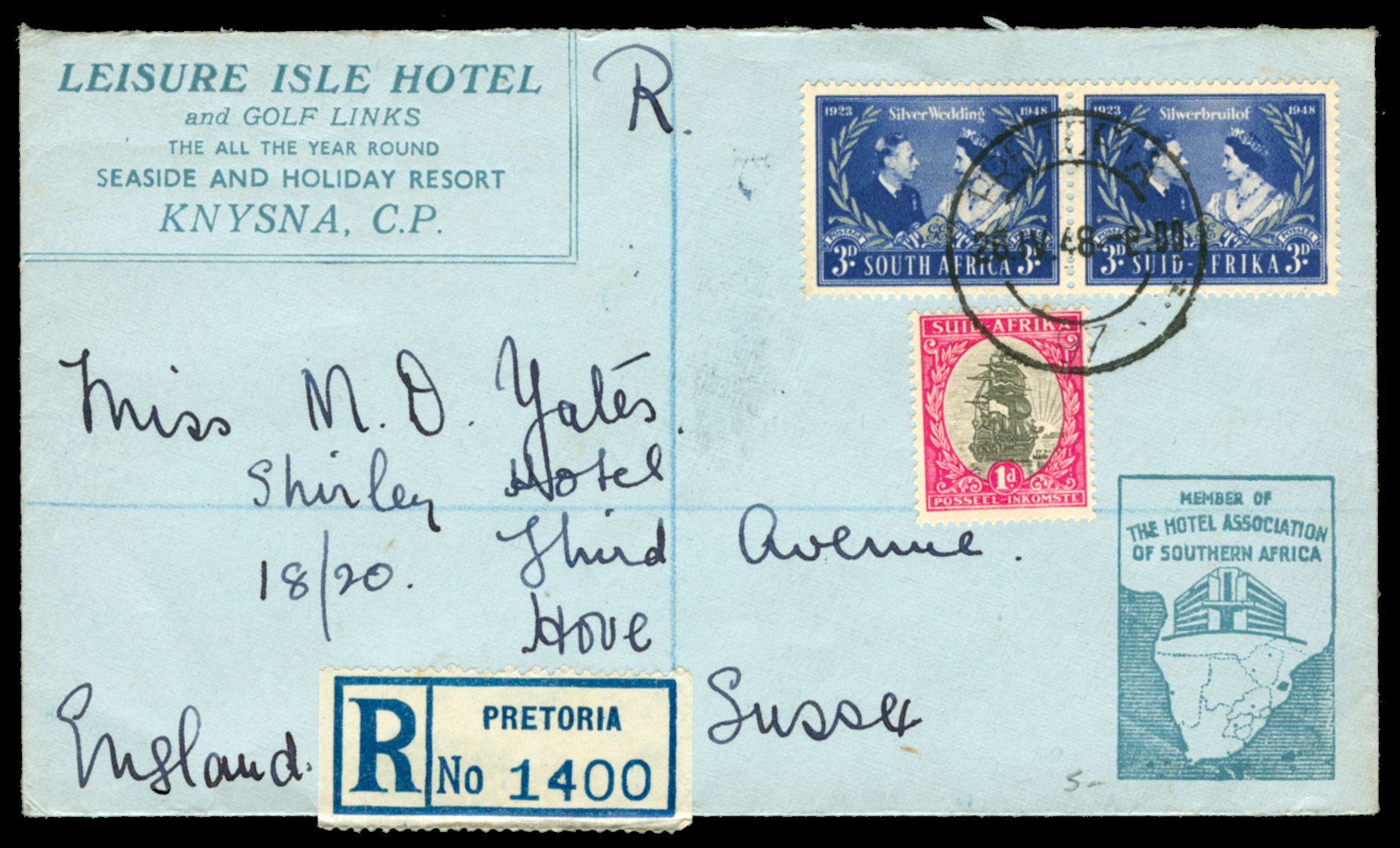
1948. Registered First Day Cover. Silver Wedding issue. PRETORIA 97 '26 IV 48' to HOVE, GB.
Leisure Isle Hotel and Golf Links Promotional Stationery.
Leisure Isle was previously known as Steenbok Island. Herds of small Steebok and flocks of wild birds were among its earliest inhabitants. It was essentially just a grassy sandbank set in the Knysna tidal estuary which surrounded it on all four sides. It was accessible only at low tide. When mankind arrived the uninhabited island became a place to graze cattle. A traveller, Mr George Cearn, arrived with his wife in Knysna in 1925 and was so impressed with the location and its potential that he decided to develop Steenbok Island which at that time belonged to the Duthie Family of Woodbourne Farm.
'Duthie' is an anglicised Scottish surname. 'Woodbourne' is derived from two Old English words: wudu, meaning "wood" or "forest," and burna (or bourne), meaning "a spring, brook, or stream". It suggests a wooded area with a stream, probably a good general description of 'Knysna', which apparently is a Khoikhoi word meaning "place of trees or ferns". The surname 'Cearn' is an uncommon variant or Anglicized form linked to Irish Gaelic roots. Broadly, the Duthie's farm name, 'Woodbourne', describes a British settler putting down Anglo-Saxon roots in land that once belonged to the Khoi but now soon to be exploited by an Irishman.
Cearn bought the Island from the Duthie’s and had a wall built around the island as well as a causeway for permanent access to and from the mainland. Rock was locally quarried for this purpose and transported from the mainland via a coco-pan railway line. For three years over 55 labourers worked to complete the job. In 1967 the Knysna Municipality took over Leisure Isle. Today it has over 450 homes, of which more than 50% are occupied by residents, the rest being holiday homes or boutique hotels. Little is known of the original hotel. Today most 'hotels' refer to themselves as 'Lodges'. Perhaps this reinforces the traveller's African experience.
Quote from Jamie Smith on August 31, 2026, 12:06 pmSteve, I remember the golf course being on the top of the cliff (late 1960's). You went through the heads with the big cave up high on your left then climbed up the cliff. The ground was owned by Broderick Engineering in Vereeniging. Did they move it? or were there two?
Steve, I remember the golf course being on the top of the cliff (late 1960's). You went through the heads with the big cave up high on your left then climbed up the cliff. The ground was owned by Broderick Engineering in Vereeniging. Did they move it? or were there two?
Quote from Steve on August 31, 2026, 12:45 pmThanks for the comment about the Golf Course and entering Knysna through the Heads, not something many people do. I think you are referring to another golf course, probably the main one in Knysna which has at least two golf courses and a driving range. If you come through the Heads Leisure Isle is more-or-less directly ahead of you as you enter the lagoon. The two golf courses are to your right (NE) on high ground. Leisure Isle is a low flat island in the lagoon. It has no cliffs (and no golf course) but its surrounding headlands do.
My guess, and it is just that, is that Cearn's Leisure Isle was completed round about 1930 and the Leisure Isle Hotel built some time after the causeway was finished. It made it easier to bring building materials across from the mainland, probably the reason for its construction. Initially there was a lot of empty land on Leisure Isle big enough for a small golf course. However the demand for houses eventually saw the golf course standing in the way of profit and progress. By the 1960s, a boom time in SA, the golf course gave way to residential and holiday property development. The hotel continued for some time thereafter but no longer had the draw of being the golf course's 'clubhouse'. Not having lived there. I have no memories of it or Leisure Isle. Viewing it from afar across the lagoon I see it simply as an example of rampant property development. It is an eyesore in what was once a very beautiful part of SA.
Thanks for the comment about the Golf Course and entering Knysna through the Heads, not something many people do. I think you are referring to another golf course, probably the main one in Knysna which has at least two golf courses and a driving range. If you come through the Heads Leisure Isle is more-or-less directly ahead of you as you enter the lagoon. The two golf courses are to your right (NE) on high ground. Leisure Isle is a low flat island in the lagoon. It has no cliffs (and no golf course) but its surrounding headlands do.
My guess, and it is just that, is that Cearn's Leisure Isle was completed round about 1930 and the Leisure Isle Hotel built some time after the causeway was finished. It made it easier to bring building materials across from the mainland, probably the reason for its construction. Initially there was a lot of empty land on Leisure Isle big enough for a small golf course. However the demand for houses eventually saw the golf course standing in the way of profit and progress. By the 1960s, a boom time in SA, the golf course gave way to residential and holiday property development. The hotel continued for some time thereafter but no longer had the draw of being the golf course's 'clubhouse'. Not having lived there. I have no memories of it or Leisure Isle. Viewing it from afar across the lagoon I see it simply as an example of rampant property development. It is an eyesore in what was once a very beautiful part of SA.
Quote from Steve on September 1, 2026, 11:02 amLuthjes Langham Hotel, Johannesburg
It is said that the first Langham Hotel was known as the ‘Old Langham’. This may not be correct and that it was only known as the 'Old' after the 'New' one was built. Whatever.... It was started in early Johannesburg, South Africa, in 1896 by William Luthje and his wife Virginia. It is said that William Luthje had previously worked at the famous Langham Hotel in London. Luthje's Old Langham Hotel was in Kerk Street. His later more well-known Luthje’s Langham Hotel was a few blocks away on the corner of Kerk and Von Weilligh Streets (where the Sanlam Centre building now stands). Both historic building have since been demolished. It was well-known during the golden eras of the early 1900s when it was popular with wealthy men and gold-mining good time girls!.
1911. Postcard. JOHANNESBURG 'MAY 22 1911' to GRAHAMSTOWN ' MY 24 11'.
Green halfpenny KE7 stamp cancelled with the 8-bar TRANSVAAL Machine cancellerMark Lewis has written a fascinating account of these hotels on Facebook. He writes "Evidence indicates ‘Old Langham’ was between Polly and Mooi Streets. (And was still known as the ‘Old Langham Hotel’ in the late 1930s). This area was predominantly residential after the Second Boer War, with old houses and the occasional boarding establishment.
The ‘Old Langham’ was started by William Luthje and his wife Virginia in 1896. William had previously worked at the Langham in London, hence the name. Old Langham was a meeting place for mining magnates where the story goes, that Mrs. Luthje darned their socks while they visited! Lord & Lady Methuen were once guests.
In 1905 it moved to a new W. H. Stucke-designed building near the corner of Von Weilligh and Kerk Streets (112/4 Kerk Str), replacing four old semi-detached cottages. The smooth facade plane was interrupted by recessed balconies and the building was covered by a hipped roof that featured three Neo-Cape Dutch gables and tall chimneys.
One of the first guests at the new Luthje’s Langham Hotel was Lily Langtry, who sang from the balcony to a crowd below. In 1906 she performed successfully in South Africa. .... She was friends with Oscar Wilde and infamously had a romantic affair with His Royal Highness, Edward, Prince of Wales, later King Edward VII. It was frequented by many actors and singers in the early days. Leonard Rayne and Freda Godfrey stayed there when they visited the city. Lord and Lady Buxton were regular diners.
The Langham was expensive, discreet, smaller and less flashy than the Carlton which opened not long afterwards. … The Langham was a noted rendezvous for new-rich mining magnates and the upper strata of the town’s good-time girls.
In 1936, the hotel had a modern six-storey section added on the corner of Von Welligh and it’s this version that old Johannesburgers remember. Photographic evidence shows that part of the original gabled building remained after the extension.
It acquired some respectability later when India’s first Agent General lived there as well as successive Chinese Consuls. During WW2, Prince Paul and Princess Olga of Yugoslavia and the Shah of Persia stayed there. In 1947, Hollywood heart-throb Tyrone Power “attracted a siege of squealing fans.”The hotel was sold in 1929 for GBP £52, 250 to Simon Goldberg who ran it until 1946, then sold it to financiers Mr Joseph Milne and Mr Norbert Erleigh. Another source claims that in 1936, it was bought by Amalgamated African Hotels, and they built the new modern wing. This version seems likely. It’s also backed up by another version that claims Luthje died in 1921 and his wife ran the hotel for another 15 years before selling it to AAH who built the new wing.
The Amalgamated African Hotels (later Langham-Edward Group) is noted as being the first hotel chain in Johannesburg. The hotel went through various management changes thereafter as well as stiff competition from the new Tollman Towers across the road. In 1967, it was still part of the Langham-Edward Group which also owned the Dawson Hotel, as well as the Edward Hotel in Durban, and Deal’s Hotel in East London.
It was described as a three-star establishment to the end, but ultimately, it was too old-fashioned to keep up with the pace and progress of the city. In 1971 it was put under judicial management and later torn down along with several other buildings (including two other hotels: The Imperial and the Paul Kruger) to make way for the massive Sanlam Centre development.
One of the last to leave the Langham when it finally closed was the daughter of the original owners, Miss Ella Luthje, who was born there and served for most of its 67-year existence. In 1962 it was listed as having 150 rooms with 145 of them with their own bathrooms. In the absence of the Carlton Hotel, it was one of the city’s most expensive and exclusive at the time."
Luthjes Langham Hotel, Johannesburg
It is said that the first Langham Hotel was known as the ‘Old Langham’. This may not be correct and that it was only known as the 'Old' after the 'New' one was built. Whatever.... It was started in early Johannesburg, South Africa, in 1896 by William Luthje and his wife Virginia. It is said that William Luthje had previously worked at the famous Langham Hotel in London. Luthje's Old Langham Hotel was in Kerk Street. His later more well-known Luthje’s Langham Hotel was a few blocks away on the corner of Kerk and Von Weilligh Streets (where the Sanlam Centre building now stands). Both historic building have since been demolished. It was well-known during the golden eras of the early 1900s when it was popular with wealthy men and gold-mining good time girls!.
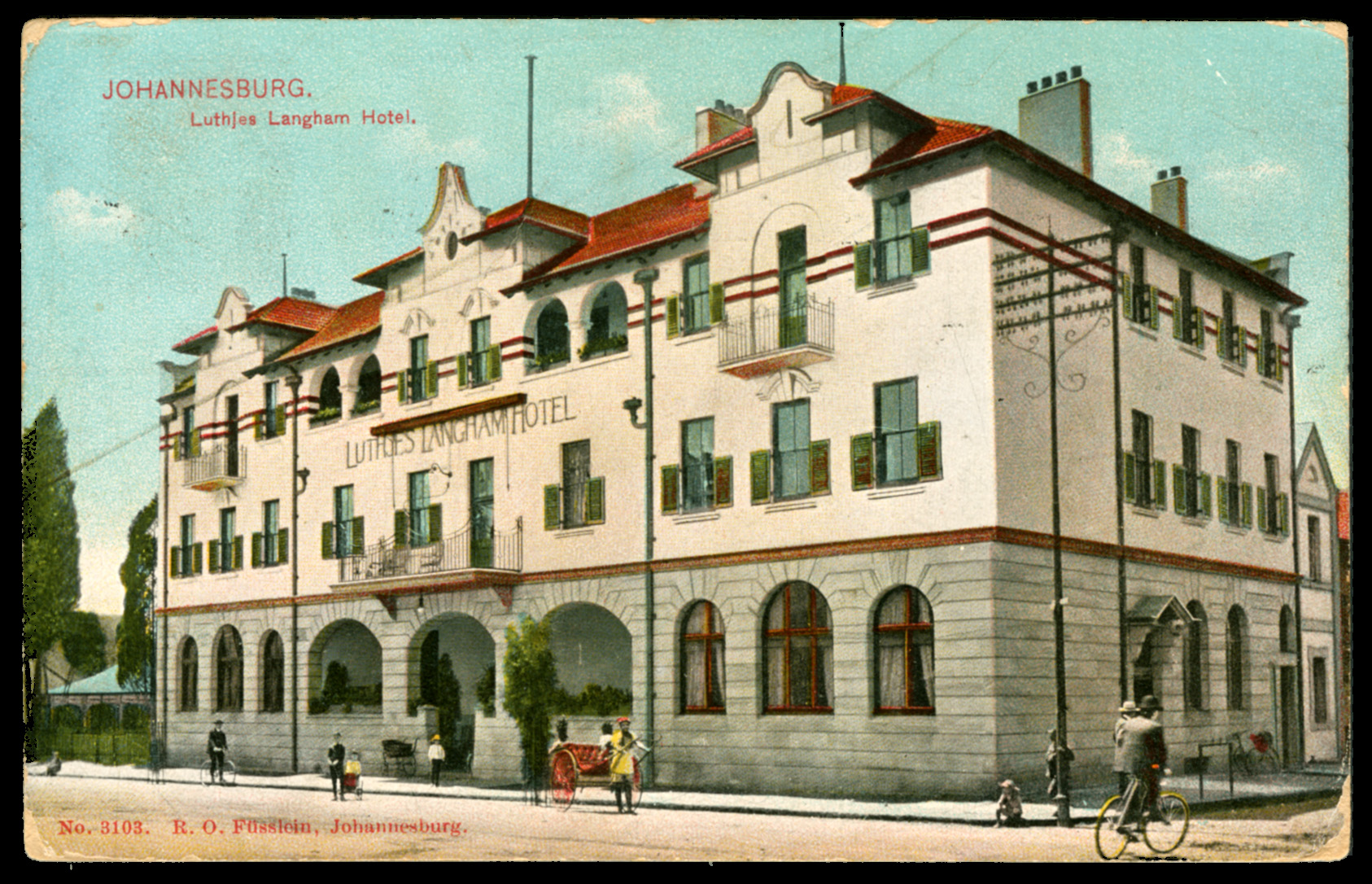
1911. Postcard. JOHANNESBURG 'MAY 22 1911' to GRAHAMSTOWN ' MY 24 11'.
Green halfpenny KE7 stamp cancelled with the 8-bar TRANSVAAL Machine canceller
Mark Lewis has written a fascinating account of these hotels on Facebook. He writes "Evidence indicates ‘Old Langham’ was between Polly and Mooi Streets. (And was still known as the ‘Old Langham Hotel’ in the late 1930s). This area was predominantly residential after the Second Boer War, with old houses and the occasional boarding establishment.
The ‘Old Langham’ was started by William Luthje and his wife Virginia in 1896. William had previously worked at the Langham in London, hence the name. Old Langham was a meeting place for mining magnates where the story goes, that Mrs. Luthje darned their socks while they visited! Lord & Lady Methuen were once guests.
In 1905 it moved to a new W. H. Stucke-designed building near the corner of Von Weilligh and Kerk Streets (112/4 Kerk Str), replacing four old semi-detached cottages. The smooth facade plane was interrupted by recessed balconies and the building was covered by a hipped roof that featured three Neo-Cape Dutch gables and tall chimneys.
One of the first guests at the new Luthje’s Langham Hotel was Lily Langtry, who sang from the balcony to a crowd below. In 1906 she performed successfully in South Africa. .... She was friends with Oscar Wilde and infamously had a romantic affair with His Royal Highness, Edward, Prince of Wales, later King Edward VII. It was frequented by many actors and singers in the early days. Leonard Rayne and Freda Godfrey stayed there when they visited the city. Lord and Lady Buxton were regular diners.
The Langham was expensive, discreet, smaller and less flashy than the Carlton which opened not long afterwards. … The Langham was a noted rendezvous for new-rich mining magnates and the upper strata of the town’s good-time girls.
In 1936, the hotel had a modern six-storey section added on the corner of Von Welligh and it’s this version that old Johannesburgers remember. Photographic evidence shows that part of the original gabled building remained after the extension.
It acquired some respectability later when India’s first Agent General lived there as well as successive Chinese Consuls. During WW2, Prince Paul and Princess Olga of Yugoslavia and the Shah of Persia stayed there. In 1947, Hollywood heart-throb Tyrone Power “attracted a siege of squealing fans.”
The hotel was sold in 1929 for GBP £52, 250 to Simon Goldberg who ran it until 1946, then sold it to financiers Mr Joseph Milne and Mr Norbert Erleigh. Another source claims that in 1936, it was bought by Amalgamated African Hotels, and they built the new modern wing. This version seems likely. It’s also backed up by another version that claims Luthje died in 1921 and his wife ran the hotel for another 15 years before selling it to AAH who built the new wing.
The Amalgamated African Hotels (later Langham-Edward Group) is noted as being the first hotel chain in Johannesburg. The hotel went through various management changes thereafter as well as stiff competition from the new Tollman Towers across the road. In 1967, it was still part of the Langham-Edward Group which also owned the Dawson Hotel, as well as the Edward Hotel in Durban, and Deal’s Hotel in East London.
It was described as a three-star establishment to the end, but ultimately, it was too old-fashioned to keep up with the pace and progress of the city. In 1971 it was put under judicial management and later torn down along with several other buildings (including two other hotels: The Imperial and the Paul Kruger) to make way for the massive Sanlam Centre development.
One of the last to leave the Langham when it finally closed was the daughter of the original owners, Miss Ella Luthje, who was born there and served for most of its 67-year existence. In 1962 it was listed as having 150 rooms with 145 of them with their own bathrooms. In the absence of the Carlton Hotel, it was one of the city’s most expensive and exclusive at the time."
Quote from Steve on September 27, 2026, 9:06 amThe Haven. Elliotdale, Eastern Cape
The Haven Hotel is set in a wonderful location that mixes sub-tropical beach and lagoon with mangrove trees, a river mouth and a nature reserve complete with coastal forest walks. Once a simple huddle of basic holiday huts today's hotel has maintained its rural charm with unpretentious simplicity. Its rooms may be a bit out-dated to some visitors but most find it friendly with superb food, the perfect place for a relaxing holiday in a 'paradise' that lets one leave the modern world behind. A haven indeed!
1952. Cover. THE HAVEN '23 4 52' to EAST LONDON.
Putzel's Encyclopedia describes a PA (Postal Agency) opening presumably in the original hotel in 1928. This later became a PTA (Post and Telegraph Agency) in 1931. Interstingly, the cover above has its address as "The Haven, Elliotdale District, Cape Province'. In 1976 the Apartheid Government transferred this section of the Eastern Cape to the Transkei Homeland. Putzel recorded two postmarks used here.
Trennerys
Another Eastern Cape beachfront hotel set in similar surroundings which also transferred to the Transkei in 1976 was Trennery's which opened as a TtO (Telegraph and Telephone Office) in 1930. Putzel lists Trennery's as a Post Office from 1939 - 1942 but according to him, no postmark had yet been seen. Thankfully, we have Alex Visser who has recorded a partial skeleton relief type canceller with no time code letter and Month before day. Alex suggests that based on the stamp design it is probably from 1939, and is thus the first date stamp after the Trennery's PO opened. You can see it on the PFSA Resources under 'T'.
The Haven. Elliotdale, Eastern Cape
The Haven Hotel is set in a wonderful location that mixes sub-tropical beach and lagoon with mangrove trees, a river mouth and a nature reserve complete with coastal forest walks. Once a simple huddle of basic holiday huts today's hotel has maintained its rural charm with unpretentious simplicity. Its rooms may be a bit out-dated to some visitors but most find it friendly with superb food, the perfect place for a relaxing holiday in a 'paradise' that lets one leave the modern world behind. A haven indeed!
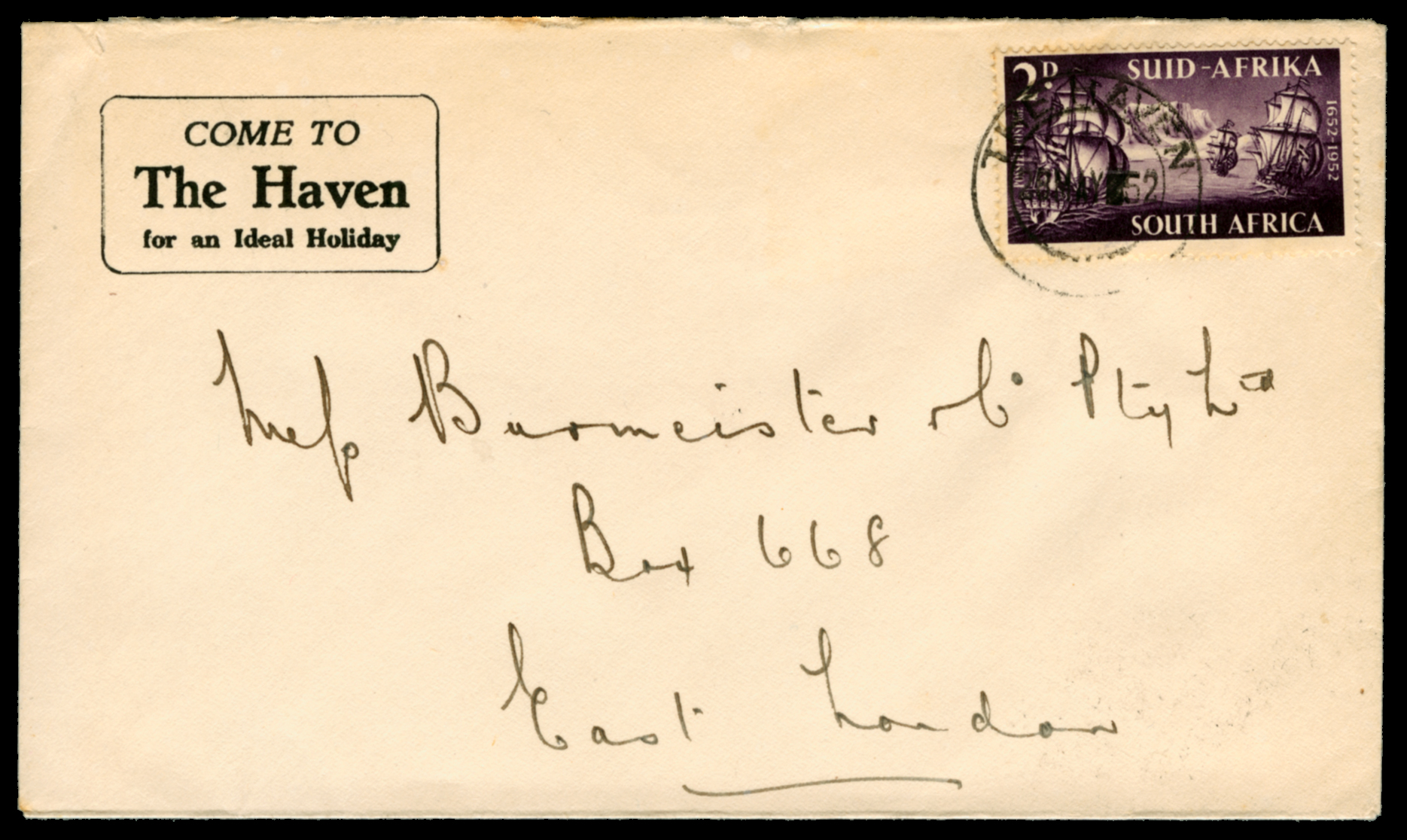
1952. Cover. THE HAVEN '23 4 52' to EAST LONDON.
Putzel's Encyclopedia describes a PA (Postal Agency) opening presumably in the original hotel in 1928. This later became a PTA (Post and Telegraph Agency) in 1931. Interstingly, the cover above has its address as "The Haven, Elliotdale District, Cape Province'. In 1976 the Apartheid Government transferred this section of the Eastern Cape to the Transkei Homeland. Putzel recorded two postmarks used here.
Trennerys
Another Eastern Cape beachfront hotel set in similar surroundings which also transferred to the Transkei in 1976 was Trennery's which opened as a TtO (Telegraph and Telephone Office) in 1930. Putzel lists Trennery's as a Post Office from 1939 - 1942 but according to him, no postmark had yet been seen. Thankfully, we have Alex Visser who has recorded a partial skeleton relief type canceller with no time code letter and Month before day. Alex suggests that based on the stamp design it is probably from 1939, and is thus the first date stamp after the Trennery's PO opened. You can see it on the PFSA Resources under 'T'.
Quote from Steve on October 2, 2026, 6:52 pmSeahurst Hotel, Kalk Bay, Cape Province
I am not familiar with this hotel although I distinctly remember its brooding background preence. I am more familar with the Brass Bell tavern opposite it, across or underneath the railway line to Simonstown on the sea side. I remember sitting in the Brass Bell enjoying a beer and spicey calamari while watching a whale rise and langurously fall in False Bay's slow translucent swell.
Circa 1939. Postcard. Seahusrt Hotel, Kalk Bay, CP. (Unused PC).
The Seahurst Hotel is or was a well-known building that faced the sea. This postcard was taken from a photo album compiled by a WW2 dentist who served in the RAF in South Africa from about July 1941. He flew around the country to serve the dental needs of young men in the Commonwealth Air Training Plan. I imagine, being a dentist and an officer, that he was possibly temporarily billeted here. If not he was bought here for tea by womene like my Mom and her mother, both members of SAWAS (South African Women's Auxillary Service), who spent much of their spare time entertaining the troops. It is how my Mom met my Dad, one of the Brylcreem Boys in Blue!
The Seahurst Hotel was a historic landmark on the coast between Kalk Bay and St. James. It later became the Robin Gordon Hotel. During WWII, it was converted into a convalescent home for military personnel. My dentist visited the convalescent home in about June 1941 just after arriving in SA. Situated along Main Road between Kalk Bay and St. James the building featured classic architecture before the later extension that can be seen in the postcard above was added to ruin it. (This is the inelegant white frontal extension that destroys the building's classic lines and part of its view of False Bay.) The area on which the original Seahurst / Robin Gordon Hotel stood has now been redveloped. It is strange howt I can remember this building as clearly as I do. It was a 'larney' St James classic.
Seahurst Hotel, Kalk Bay, Cape Province
I am not familiar with this hotel although I distinctly remember its brooding background preence. I am more familar with the Brass Bell tavern opposite it, across or underneath the railway line to Simonstown on the sea side. I remember sitting in the Brass Bell enjoying a beer and spicey calamari while watching a whale rise and langurously fall in False Bay's slow translucent swell.
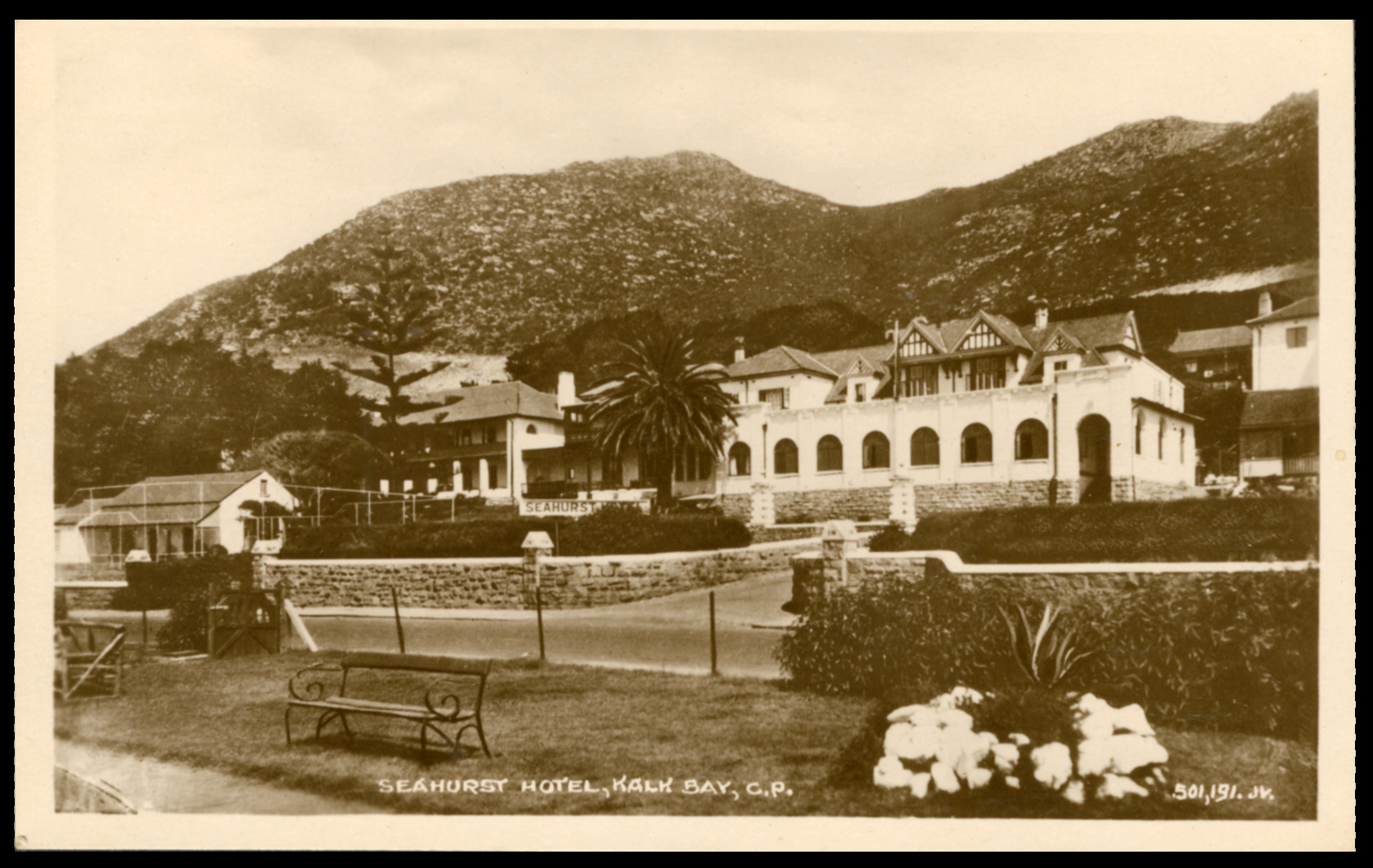
Circa 1939. Postcard. Seahusrt Hotel, Kalk Bay, CP. (Unused PC).
The Seahurst Hotel is or was a well-known building that faced the sea. This postcard was taken from a photo album compiled by a WW2 dentist who served in the RAF in South Africa from about July 1941. He flew around the country to serve the dental needs of young men in the Commonwealth Air Training Plan. I imagine, being a dentist and an officer, that he was possibly temporarily billeted here. If not he was bought here for tea by womene like my Mom and her mother, both members of SAWAS (South African Women's Auxillary Service), who spent much of their spare time entertaining the troops. It is how my Mom met my Dad, one of the Brylcreem Boys in Blue!
The Seahurst Hotel was a historic landmark on the coast between Kalk Bay and St. James. It later became the Robin Gordon Hotel. During WWII, it was converted into a convalescent home for military personnel. My dentist visited the convalescent home in about June 1941 just after arriving in SA. Situated along Main Road between Kalk Bay and St. James the building featured classic architecture before the later extension that can be seen in the postcard above was added to ruin it. (This is the inelegant white frontal extension that destroys the building's classic lines and part of its view of False Bay.) The area on which the original Seahurst / Robin Gordon Hotel stood has now been redveloped. It is strange howt I can remember this building as clearly as I do. It was a 'larney' St James classic.
Quote from Steve on October 3, 2026, 6:28 pmGrosvenor Hotel, Umtata
The snapshot below is also from the wartime photo album of Roy Baker, RAF dentist. Based in Queenstown he and some of his pals drove to Durban through the Transkeri, Pondoland and Zululand in 1942. They had many adventures on the way. It was quite a feat as there was no good road running north to south at that time. For years this 'homeland' was the most neglected and remote part of South Africa.
1942. Snapshot. The Grtosvenor Hotel , Umtata, in Augsur 1942.
"Our lodgings for the night!"
Note the name on the roof, an aid to aerial navigation.The Grosvenor Hotel is named after the East Indiaman, Grosvenor, Captain John Coxon, that ran aground on the south-eastern coast of Africa in the early hours of the 4th August 1782. The majority of its passengers and seamen came ashore. Native people descended on the wreck in a desperate effort to get metal, most the ship's iron spikes. In the absence of help from the natives, the survivors decided to march down the coast to the Dutch colony at the Cape of Good Hope. The survivors soon broke in three main parties. The first to leave comprised the ablest, most assertive healhy men and a boy. The second group had stayed with the Captain's group which comprised the women and children, the old, the sick and the dying, also the loyal. When it became obvious that if they remained they would neither survive nor be able to bring help, the second party, all men, departed. The Captain's party was nto seen agan. The majority of survivors died singly and alone, abandoned along the coast. Just 12 survived the long ordeal. The local native people provided little help, many showing outright hostility. The timing of the wreck was unfortunate. It was only a few years after the first Trekboers had encountered the Xhosa tribe and conflict over land had developed. Most Xhosa had never seen a European person before. The Grosvenor survivors paid the price. It is ironic that the Grosvenor's starving and abused survivors should be commemorated in the name of a guesthouse.
Grosvenor Hotel, Umtata
The snapshot below is also from the wartime photo album of Roy Baker, RAF dentist. Based in Queenstown he and some of his pals drove to Durban through the Transkeri, Pondoland and Zululand in 1942. They had many adventures on the way. It was quite a feat as there was no good road running north to south at that time. For years this 'homeland' was the most neglected and remote part of South Africa.
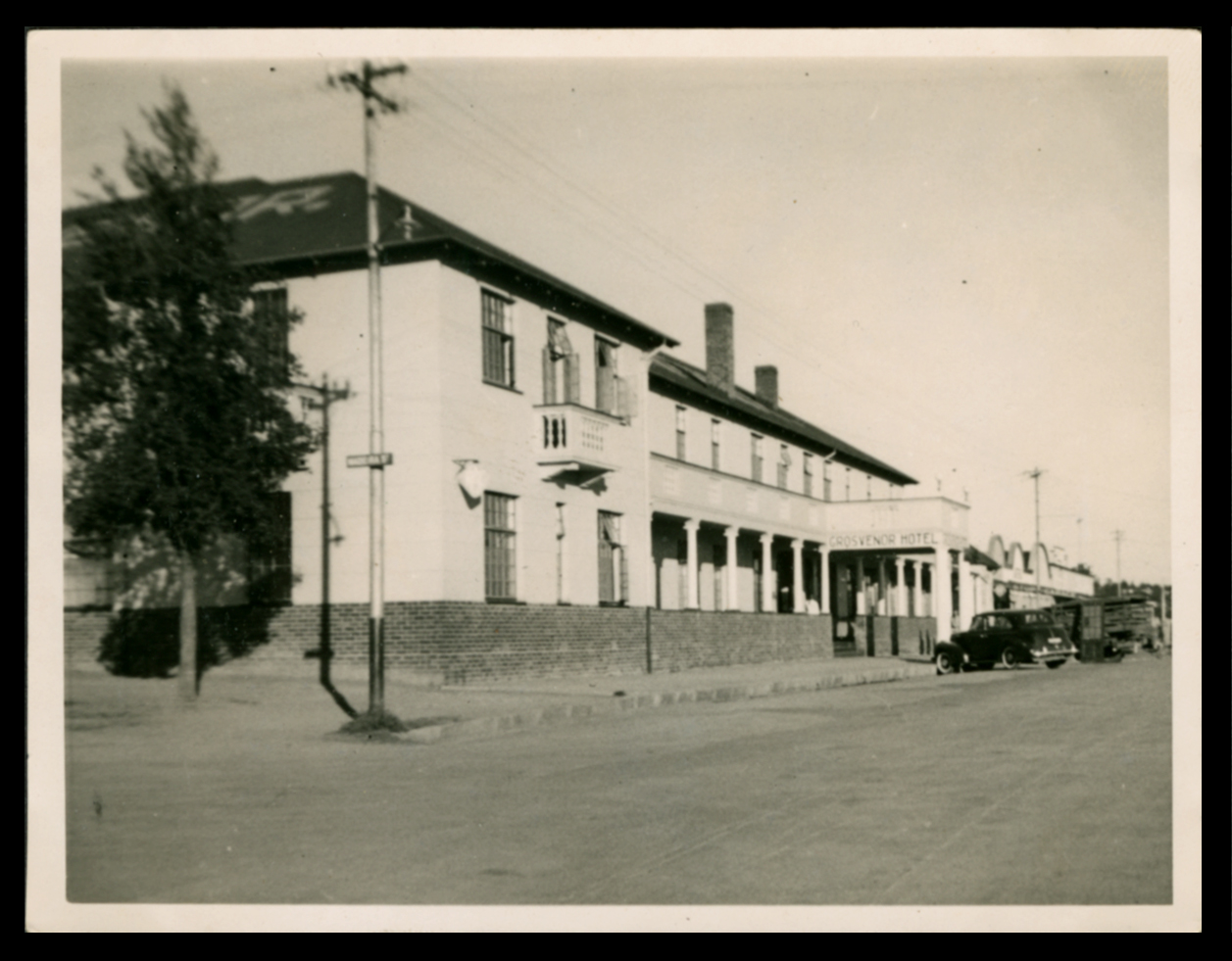
1942. Snapshot. The Grtosvenor Hotel , Umtata, in Augsur 1942.
"Our lodgings for the night!"
Note the name on the roof, an aid to aerial navigation.
The Grosvenor Hotel is named after the East Indiaman, Grosvenor, Captain John Coxon, that ran aground on the south-eastern coast of Africa in the early hours of the 4th August 1782. The majority of its passengers and seamen came ashore. Native people descended on the wreck in a desperate effort to get metal, most the ship's iron spikes. In the absence of help from the natives, the survivors decided to march down the coast to the Dutch colony at the Cape of Good Hope. The survivors soon broke in three main parties. The first to leave comprised the ablest, most assertive healhy men and a boy. The second group had stayed with the Captain's group which comprised the women and children, the old, the sick and the dying, also the loyal. When it became obvious that if they remained they would neither survive nor be able to bring help, the second party, all men, departed. The Captain's party was nto seen agan. The majority of survivors died singly and alone, abandoned along the coast. Just 12 survived the long ordeal. The local native people provided little help, many showing outright hostility. The timing of the wreck was unfortunate. It was only a few years after the first Trekboers had encountered the Xhosa tribe and conflict over land had developed. Most Xhosa had never seen a European person before. The Grosvenor survivors paid the price. It is ironic that the Grosvenor's starving and abused survivors should be commemorated in the name of a guesthouse.